
How Do Bursting Strength and Edge Crush Test (ECT) Ratings Compare?
Short answer: Mullen Bursting Strength (psi) measures puncture and containment resistance when internal contents shift. Edge Crush Test (ECT) measures vertical column compression strength for pallet stacking. ECT is the modern standard for palletized freight, while Mullen burst ratings excel for rough parcel sorting.
On this page
- What is the Mullen Bursting Strength Test and how is it conducted
- What is the Edge Crush Test (ECT) and why did it become the modern standard
- How do Mullen burst ratings and ECT ratings correspond across board grades
- What information is certified on a Box Maker's Certificate (BMC) stamp
- How does McKee's formula use ECT to calculate box compression strength
- What environmental safety factors degrade corrugated strength during transit
- How does ECT fiber optimization support sustainable lightweighting
- Which rating standard should your brand specify on purchase orders
- Common mistakes
- FAQs
Request a custom quoteFree dieline & 3D mockup
Understanding the technical distinction between Mullen Bursting Strength and Edge Crush Test (ECT) ratings is essential for engineering compliant, damage-free custom corrugated boxes. Historically governed by carrier freight Rule 41 and Item 222, packaging specifications once relied exclusively on the Mullen Burst Test (ASTM D3786 / TAPPI T 810), which measures the hydraulic pressure in pounds per square inch (psi) required to rupture a corrugated liner. A 200# Mullen box guarantees superior side-wall puncture resistance and containment when rough parcel carrier sorting drops boxes onto edges. Conversely, modern supply chains emphasize warehouse pallet stacking and top-load compression, which is precisely evaluated by the Edge Crush Test (ASTM D2808 / TAPPI T 811). A 32 ECT board withstands 32 pounds per linear inch of vertical edge pressure, offering equivalent stacking strength to 200# burst board while utilizing ten percent less cellulose fiber to reduce shipping weight.
What is the Mullen Bursting Strength Test and how is it conducted?
The Mullen Burst Test (standardized under TAPPI T 810 and ASTM D3786) measures the hydraulic pressure required to burst through a clamped specimen of corrugated board. An automated hydraulic tester inflates an elastic rubber diaphragm against the board face until the cellulose fibers rupture. The resulting measurement is recorded in pounds per square inch (psi), commonly referred to as '# test' (for example, 200# test). Mullen testing evaluates the tensile strength and puncture resistance of the linerboards, indicating how well a container contains loose or shifting internal merchandise. This test remains vital for heavy, unpalletized parcels that endure rough drops and multi-carrier postal transfers where packages are sorted aggressively.
What is the Edge Crush Test (ECT) and why did it become the modern standard?
As global distribution shifted from hand-loaded railcars to mechanized warehouse palletization, vertical stacking compressive strength became the dominant engineering requirement. The Edge Crush Test (standardized under TAPPI T 811 and ASTM D2808) directly measures this property by compressing a small specimen of corrugated board on edge between two parallel rigid platens until the fluting arches buckle. Measured in pounds per linear inch of fluted edge, ECT accurately predicts how many pounds of top load a box can bear when stacked in warehouse storage racks. This predictive precision allows engineers to optimize board weight accurately to avoid over-packaging while maintaining zero transit damage.
How do Mullen burst ratings and ECT ratings correspond across board grades?
Carrier freight classification Item 222 recognizes exact equivalencies between traditional Mullen burst ratings and modern ECT values. For single-wall corrugated board, a 200# Mullen burst rating corresponds to a 32 ECT rating, both certified for a maximum gross weight of 40 pounds. A 275# burst rating corresponds to 44 ECT, approved for up to 65 pounds. In double-wall corrugated constructions, 350# burst corresponds to 48 ECT (up to 80 pounds), and 400# burst corresponds to 51 ECT (up to 100 pounds). Understanding these tiers prevents under-specifying packaging during high-volume production quoting.
Know your size? Compare pricing across up to 3 quantities.
Request a Quote →What information is certified on a Box Maker's Certificate (BMC) stamp?
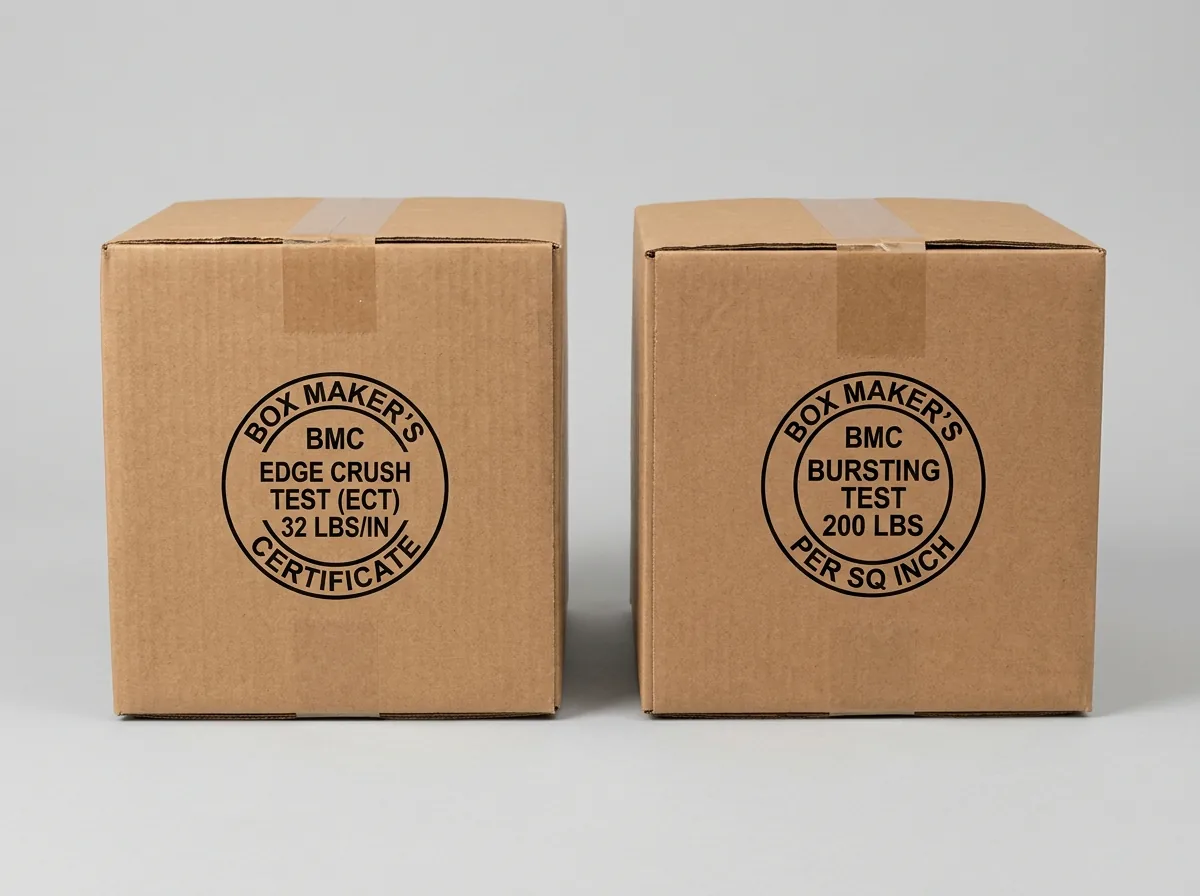
A Box Maker's Certificate (BMC) is an official circular or rectangular emblem printed on an exterior bottom flap of a corrugated box. The BMC certifies that the container complies with the structural requirements of carrier freight classifications Rule 41 and Item 222. It explicitly states whether the box is certified under Bursting Test (psi) or Edge Crush Test (ECT), the board construction (single-wall or double-wall), the maximum outside dimensions (Length + Width + Depth in inches), and the gross weight limit. Printing a certified BMC stamp guarantees transit insurability against carrier damage claims.
How does McKee's formula use ECT to calculate box compression strength?
Packaging engineers calculate the theoretical Box Compression Strength (BCT) of a container using McKee's classic formula: BCT = 5.876 x ECT x sqrt(T x P), where ECT is edge crush test strength, T is board thickness, and P is box perimeter (2L + 2W). This mathematical relationship reveals that top-to-bottom compression depends directly on both ECT rating and flute thickness. A taller C-flute board provides significantly higher BCT than thinner B-flute board with identical ECT, because greater thickness resists panel sidewall bowing under sustained top loads.
What environmental safety factors degrade corrugated strength during transit?
Laboratory ECT ratings reflect pristine testing conditions at 50% relative humidity and 73°F (ASTM D685 standard). In real-world supply chains, environmental factors drastically degrade board compressive strength. High relative humidity of 80% reduces box compression by up to 50% as cellulose fibers absorb moisture. In addition, long-term warehouse storage duration (over 90 days), pallet overhang, and vibrational transit shocks further degrade strength. Engineers apply safety factors of 3:1 to 5:1 when specifying ECT ratings to account for dynamic freight conditions.
How does ECT fiber optimization support sustainable lightweighting?
The transition from Mullen burst specifications to ECT ratings revolutionized environmental sustainability in the packaging industry. Meeting Mullen burst requirements historically forced paper mills to use heavy virgin kraft softwood fibers with high tear strength. ECT focuses solely on the compressive stiffness of the fluting medium and linerboard composite, allowing mills to incorporate recycled post-consumer waste fibers and optimized basis weights. As a result, 32 ECT board achieves identical stacking strength while reducing raw cellulose consumption by up to ten percent, supporting sustainable enterprise packaging mandates.
Which rating standard should your brand specify on purchase orders?
When ordering custom corrugated shipping cartons, modern brands should specify Edge Crush Test (ECT) ratings unless products possess unique transit hazards. If you ship rigid consumer goods, master wholesale cases, or palletized e-commerce parcels, 32 ECT and 44 ECT ratings provide the most cost-effective, environmentally optimized protection. However, if your merchandise consists of loose heavy metal fasteners, irregular sharp hardware, or bulk liquid containers that exert heavy puncture force against sidewalls, specifying traditional 200# or 275# Mullen burst board ensures maximum puncture containment. Procurement managers ordering custom corrugated cartons consult converting engineers to align board specs with carrier compliance and freight safety requirements.
What common corrugated packaging mistakes should you avoid?
Developing corrugated shipping containers requires balancing structural compression strength with material fiber efficiency. Packaging specialists identify four frequent errors
- Confusing Mullen burst ratings (psi) with Edge Crush Test (lbs/in), leading to mismatched board specifications on supplier purchase orders.
- Failing to apply environmental safety factors for high-humidity warehouse storage, resulting in collapsed bottom pallet cartons.
- Allowing cartons to overhang pallet edges by even one inch, which destroys up to 32% of total box compression strength.
- Omitting the official Box Maker's Certificate (BMC) stamp on master shipping cartons, risking carrier freight claim rejections.
Packaging for this


Ready to order corrugated boxes? Compare up to 3 quantities with a free 3D mockup.
Request a Quote →Questions about corrugated boxes
What is the main difference between Mullen Burst and Edge Crush Test?
Mullen Burst Test (psi) measures the puncture and containment strength of corrugated liners against outward forces. Edge Crush Test (ECT) measures vertical column compression strength for safe warehouse pallet stacking during commercial freight transport.
Is 32 ECT the same strength as 200# burst test board?
Yes. Carrier freight regulations (Rule 41 and Item 222) recognize 32 ECT single-wall board as the modern stacking equivalent of 200# Mullen burst board, both rated for a maximum gross weight of 40 pounds across parcel networks.
Why do freight carriers require a Box Maker's Certificate (BMC)?
The BMC is an official circular stamp certifying that the container meets carrier freight regulations for burst or ECT strength, maximum outside dimensions, and gross weight limits, ensuring transit insurability against damage claims.
When should I upgrade from 32 ECT to 44 ECT board?
Upgrade to 44 ECT (or 275# burst) when total package weight exceeds 40 pounds (up to 65 pounds), or when boxes will be stacked more than four tiers high in humid warehouse environments for extended storage periods.
How does humidity affect corrugated box stacking strength?
Paperboard absorbs ambient moisture. At 80% relative humidity, corrugated cartons lose up to 50% of their compressive stacking strength, requiring higher ECT ratings and generous environmental safety factors during summer transit.
Can custom printed boxes carry a certified BMC stamp?
Yes. Every custom corrugated shipping carton we manufacture includes an official, certified Box Maker's Certificate stamp printed cleanly on the bottom flap in compliance with carrier freight regulations and NMFC standards.
Still have a question? Ask a packaging specialist.
Request a Quote →Request your corrugated boxes quote
Tell us your size and quantities, and one dedicated account manager prepares pricing for each tier.
- Free design & AI-to-print studio + 3D mockup
- No die or plate charges · 4–5 day rush available
- Free shipping to all 50 states
- 10% off your first order
Corrugated board specifications, Edge Crush Test (ECT) ratings, and Mullen burst parameters were verified against TAPPI T 811 and FEFCO International Fibreboard standards. Reviewed by senior packaging engineers.
Sources
- FEFCO International Fibreboard Case Code standards for corrugated box styles and flap configurations
- TAPPI T 811 Edge Crush Test and TAPPI T 810 Mullen Burst Test standards for corrugated containerboard
- Idealliance G7 Master Color specifications for flexographic and digital printing on corrugated linerboard
What changed
- November 11, 2026: Published technical engineering guide analyzing bursting strength vs edge crush test corrugated for custom corrugated boxes, including 5 custom SVG diagrams.
More guides
New packaging guides by email
Sizes, materials and design tips. Unsubscribe anytime.