
Should You Choose Reverse Tuck or Two-Piece Telescope for Small Boxes?
Short answer: Reverse tuck cartons offer fast folding assembly, lightweight flat shipping, and cost efficiency from 500 units. Two-piece rigid telescope boxes deliver heirloom-grade structural rigidity, friction-fit unboxing prestige, and pre-assembled presentation starting from 250 units for luxury gifts, jewelry, and fragrance products.
On this page
- What are the structural mechanics of reverse tuck cartons
- How does a two-piece telescope box create a luxury unboxing experience
- How do unit costs and minimum order quantities compare across both styles
- What warehouse storage space is saved by flat-shipping reverse tuck cartons
- How do assembly speeds compare at the product fulfillment packing bench
- Which style provides superior stacking crush strength on retail shelves
- What specialty embellishments and print finishes work on each format
- How do product returns and shelf durability compare between formats
- Common mistakes
- FAQs
Request a custom quoteFree dieline & 3D mockup
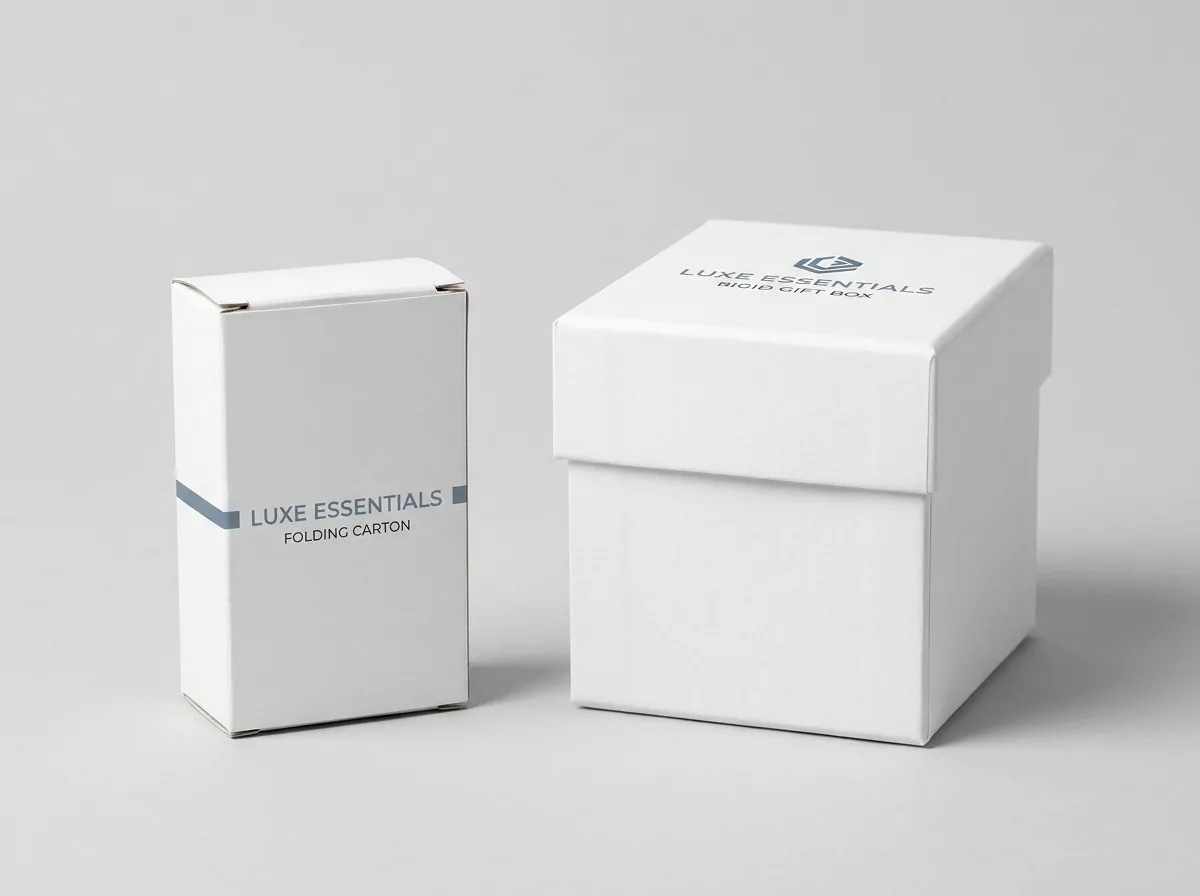
Selecting between a folding reverse tuck end (RTE) carton and a rigid two-piece telescope box defines your product's retail positioning and logistics footprint. When packaging compact consumer merchandise in custom small boxes, reverse tuck paperboard cartons provide unmatched operational efficiency: they ship completely flat, require zero pre-assembly warehouse storage space, and assemble in under three seconds with integrated friction locks. Manufactured from 14 pt to 18 pt SBS cardstock, reverse tuck cartons represent the most economical packaging format for high-volume cosmetics, lip balms, and retail trial kits. Conversely, two-piece telescope rigid boxes are crafted from dense 1000 to 1200 gsm non-bending chipboard cores wrapped in premium art paper or textured linen. Arriving pre-assembled, telescope boxes provide dramatic structural crush resistance and a luxurious slow-slide air resistance opening ritual tailored for fine jewelry, luxury watches, and executive gifting merchandise.
What are the structural mechanics of reverse tuck cartons?
A reverse tuck end (RTE) carton is manufactured from a single die-cut paperboard blank folded and glued along one vertical side seam. The defining structural characteristic is its folding flap configuration: the top lid flap hinges from the front face and tucks toward the rear, while the bottom closure flap hinges from the rear face and tucks toward the front. This opposing configuration allows carton blanks to nest tightly together across the manufacturing die board, reducing paperboard scrap by up to ten percent compared to straight tuck layouts and lowering unit packaging costs. Reverse tuck cartons assemble with rapid manual motions, providing an accessible entry point for fast-growing retail consumer brands seeking high presentation value without heavy capital investment.
How does a two-piece telescope box create a luxury unboxing experience?
A two-piece telescope box consists of an independent structural base tray and an overlapping lid tray manufactured from heavy 1000 to 1200 gsm binderboard. When the lid slides over the base, air trapped within the cavity escapes slowly through the micro-gap between the sidewalls. This calibrated vacuum creates smooth, gentle friction that produces a measured tactile release, building emotional anticipation as the consumer unveils the product. Unlike disposable folding cartons, rigid telescope boxes are retained by consumers as keepsake organizers, keeping brand logos visible on vanities and desks for years after purchase. The weighted hand feel immediately signals heirloom product quality and timeless craftsmanship.
How do unit costs and minimum order quantities compare across both styles?
Because reverse tuck cartons are die-cut and glued on high-speed inline converting machinery at thousands of units per hour, tooling and unit economics are exceptionally accessible. Minimum order quantities start from 500 units, with per-unit prices dropping dramatically as volumes scale into thousands. Two-piece rigid telescope boxes involve multiple automated and hand-finishing processes: V-grooving chipboard, corner taping, wrap gluing, and four-sided turn-in casing. Consequently, rigid boxes start from 250 units and carry higher unit costs, which are readily absorbed by high-margin luxury merchandise and jewelry lines where packaging represents an integral part of perceived product value in boutique stores.
Know your size? Compare pricing across up to 3 quantities.
Request a Quote →What warehouse storage space is saved by flat-shipping reverse tuck cartons?
Warehouse footprint is a major logistics consideration for growing brands. Reverse tuck cartons ship knocked down flat (KDF) in compact corrugated master cartons. A single standard shipping pallet can hold over 20,000 flat-packed miniature cartons. In stark contrast, rigid two-piece telescope boxes ship fully assembled with empty internal air volume; the same pallet footprint can accommodate only 800 to 1,200 rigid boxes. Brands operating with limited storage rack space achieve massive freight and warehousing savings by choosing flat-folding paperboard cartons, keeping logistics overhead under tight control during seasonal inventory expansion.
How do assembly speeds compare at the product fulfillment packing bench?
At the fulfillment packing bench, reverse tuck cartons require workers to square the flat sleeve, fold the bottom dust flaps, insert the bottom tuck, load the merchandise, and close the top lid. Experienced packing staff accomplish this sequence in 2 to 4 seconds per unit. Two-piece telescope boxes eliminate carton folding entirely: packers simply lift the lid, place the product into the pre-installed custom cavity insert, and replace the lid in under two seconds. For operations where labor cost outstrips storage cost, pre-assembled boxes streamline packing workflows and accelerate peak shipping throughput during critical holiday fulfillment surges.
Which style provides superior stacking crush strength on retail shelves?
Vertical stacking strength protects merchandise from crushing during transport and shelf merchandising. Reverse tuck cartons made from 16 pt to 18 pt paperboard support moderate top loads suitable for lightweight cosmetics and dropper bottles. However, heavy stacking can cause paperboard sidewalls to bow outward over extended retail display periods. Two-piece telescope rigid boxes feature solid 1.5 mm chipboard walls on both the base and lid, effectively creating a 3.0 mm double-wall perimeter when closed. This massive compressive strength withstands heavy stacking without any structural deflection, preserving pristine presentation on crowded store shelves.
What specialty embellishments and print finishes work on each format?
Both structural packaging formats support high-end embellishments, but their physical execution differs. Reverse tuck cartons accept overall CMYK offset printing, aqueous coatings, Spot UV gloss, hot foil stamping, and multi-level embossing directly on the paperboard substrate. Two-piece telescope boxes offer even greater tactile versatility: the structural chipboard can be sheathed in specialty embossed linen papers, rich book cloths, pearlescent metallic wraps, or velvet soft-touch films, creating distinctive heirloom textures that captivate shoppers before the box is ever opened. Raised metallic foil registration creates striking contrast against dark backgrounds.
How do product returns and shelf durability compare between formats?
In brick-and-mortar retail environments, packaging undergoes frequent customer handling, inspection, and occasional restocking. Paperboard reverse tuck cartons can suffer dog-eared flap corners or bent tuck tabs if shoppers open and close the packaging repeatedly. Two-piece telescope boxes withstand dozens of opening and closing cycles without any structural degradation. The robust chipboard walls and wrapped turn-in rims maintain crisp, pristine contours, keeping returned and handled merchandise in showroom condition. When evaluating small retail boxes, brand managers weigh shelf turnover against durable keepsake packaging longevity.
What common packaging mistakes should you avoid on small boxes?
Developing miniature packaging requires exacting structural tolerances and prepress expertise. Packaging specialists identify four frequent errors
- Choosing rigid two-piece boxes without accounting for the 80% increase in inbound pallet freight and warehouse storage volume.
- Specifying reverse tuck cartons for heavy glass jars without an internal reinforcement sleeve, risking bottom flap pop-open.
- Failing to calibrate telescope lid dimensions with adequate air-escape tolerance, creating frustrating vacuum lock or sloppy loose fits.
- Printing critical front panel branding too close to bottom flap seams on reverse tuck cartons, disrupting shelf visual hierarchy.
Packaging for this



Ready to order small boxes? Compare up to 3 quantities with a free 3D mockup.
Request a Quote →Questions about small boxes
What is the primary operational advantage of reverse tuck cartons?
Reverse tuck cartons ship and store completely flat, consuming 90% less warehouse storage space than rigid boxes while assembling in under three seconds with zero glue or tape, providing maximum logistics and labor packing efficiency for expanding product lines.
Why are two-piece telescope boxes considered more luxurious?
Telescope boxes are constructed from heavy 1000 to 1200 gsm non-bending chipboard, delivering heirloom hand weight, rigid drop protection, and a smooth pneumatic slow-slide opening experience that signals high-end brand value and heirloom status.
What is the minimum order quantity for each small box format?
Custom reverse tuck cartons start from 500 units per design. Two-piece rigid telescope setup boxes start from 250 units, with volume discounts available across both styles to support growing retail brands with accessible inventory commitments.
Can both box styles be fitted with custom internal inserts?
Yes. Both formats can incorporate custom laser-cut EVA foam trays, thermoformed plastic blisters, or folded paperboard cradles tailored to your exact product dimensions, preventing transit rattling, surface scuffs, and impact fractures.
How does production turnaround compare between folding and rigid boxes?
Standard production takes 10 to 14 business days for both packaging formats following proof approval, with 4 to 5 business day rush converting available for urgent launch schedules and time-critical retail restocking deadlines.
Which box style is better for direct-to-consumer e-commerce shipping?
Reverse tuck cartons are ideal as primary product retail boxes placed inside outer corrugated mailers. Two-piece rigid boxes provide sufficient crush resistance to ship safely inside padded bubble mailers or standard cartons.
Still have a question? Ask a packaging specialist.
Request a Quote →Request your small boxes quote
Tell us your size and quantities, and one dedicated account manager prepares pricing for each tier.
- Free design & AI-to-print studio + 3D mockup
- No die or plate charges · 4–5 day rush available
- Free shipping to all 50 states
- 10% off your first order
Engineering specifications, paperboard caliper standards, and micro creasing tolerances were verified against Paperboard Packaging Council (PPC) guidelines and ISO 12647-2 prepress standards. Reviewed by senior packaging engineers.
Sources
What changed
- November 11, 2026: Published technical engineering guide analyzing reverse tuck vs two piece telescope small boxes for custom small boxes, including 5 custom SVG diagrams.
More guides
New packaging guides by email
Sizes, materials and design tips. Unsubscribe anytime.