
How Do You Accurately Measure Inside Dimensions for Cardboard Boxes?
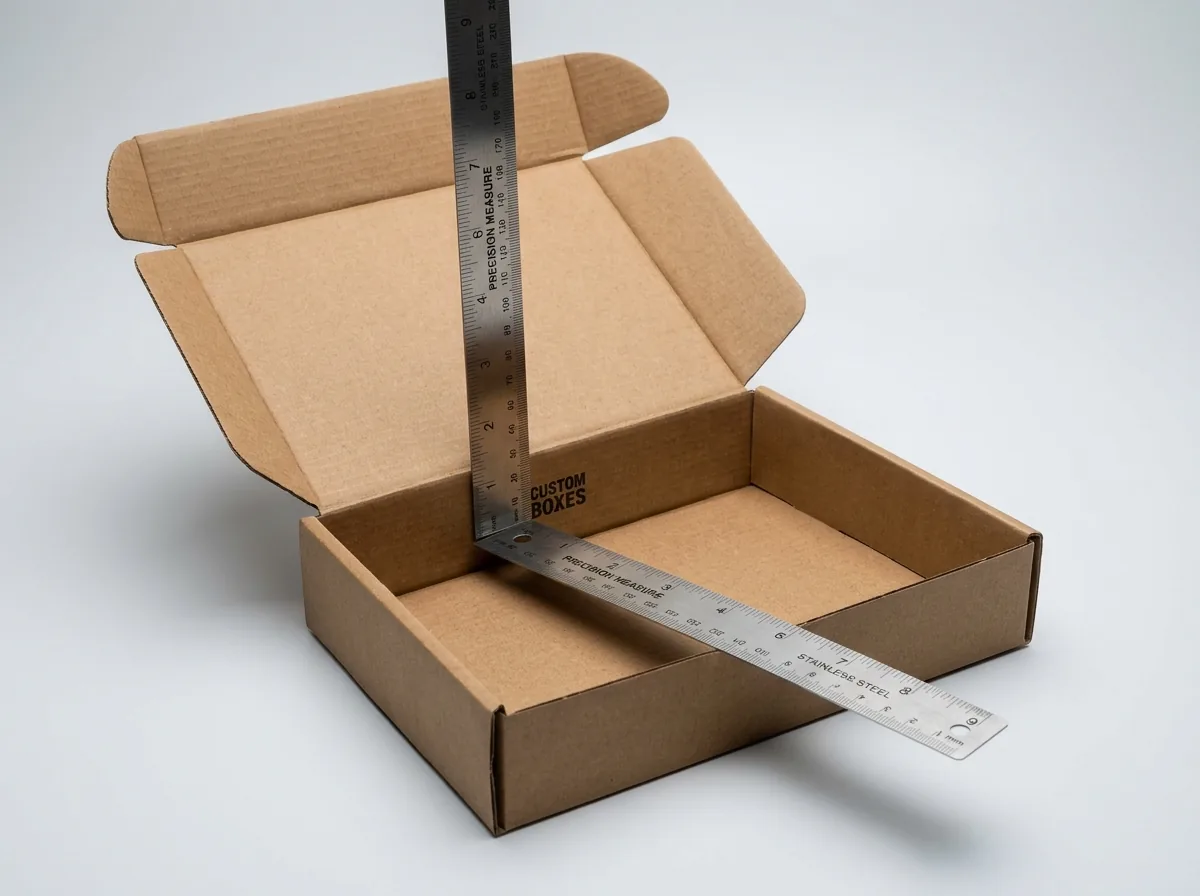
Short answer: Accurately measuring inside dimensions requires measuring Length (longest opening side), Width (shorter opening side), and Depth (vertical height from base to opening). Always quote inside dimensions (ID) and add 1/16 to 1/8 inch clearance so paperboard or corrugated wall thickness does not cramp products.
On this page
- What is the standard sequence for measuring cardboard box dimensions
- Why must you always specify Inside Dimensions (ID) rather than Outside
- How do you measure irregular, curved, or non-rectangular products
- What clearance allowances should you add for easy product loading
- How do custom protective inserts impact internal box dimensions
- How does accurate sizing eliminate costly void fill and bubble wrap
- How does dimensional accuracy reduce parcel carrier shipping costs
- How can you verify dieline fit using complimentary 2D CAD templates
- Common mistakes
- FAQs
Request a custom quoteFree dieline & 3D mockup
Measuring your product accurately before ordering custom cardboard boxes is the single most critical step in packaging engineering. The packaging industry adheres to an absolute measurement standard: dimensions are always stated in the sequence of Length x Width x Depth (L x W x D) based strictly on Inside Dimensions (ID). Length represents the longest dimension of the container opening; Width represents the shorter dimension of the opening; and Depth (or Height) represents the vertical distance perpendicular from the base to the top opening. Sizing a box based on outside dimensions (OD) is a frequent mistake that leads to cramped, damaged products, because corrugated board thickness (up to 3/16 inch per wall) reduces internal volume. By measuring product extremities with a digital caliper and adding 1/16 to 1/8 inch of functional insertion clearance, procurement teams guarantee a tailored, rattle-free fit with zero wasted void fill.
What is the standard sequence for measuring cardboard box dimensions?
Across all paperboard converters and corrugated manufacturing plants globally, box dimensions are stated in an immutable sequence: Length by Width by Depth (L x W x D). Length is always the larger of the two dimensions defining the box opening. Width is the smaller dimension of the opening. Depth (frequently called Height) is the vertical dimension perpendicular to the opening, measuring from the bottom scoreline to the top opening scoreline. Reversing Width and Depth alters flap proportions and can result in incorrect dieline assembly and packaging failure at the fulfillment bench. Prepress engineering teams verify internal volume clearances to guarantee smooth customer receiving.
Why must you always specify Inside Dimensions (ID) rather than Outside?
Cardboard and corrugated packaging converters manufacture tooling based on internal usable volume, known as Inside Dimensions (ID). Because packaging materials possess physical thickness, ranging from 0.016 inches for paperboard up to 0.1875 inches (3/16 in) for C-flute corrugated board, the exterior dimensions of a folded box are always larger than its interior space. If a buyer quotes a box using external measurements, the internal cavity will be constricted by twice the board thickness on every axis, preventing merchandise from fitting inside properly, causing jammed products and torn carton corners. Prepress engineering teams verify internal volume clearances to guarantee smooth customer receiving.
How do you measure irregular, curved, or non-rectangular products?
Consumer products rarely form perfect geometric cubes; bottles have tapered shoulders, pumps extend above caps, and electrical cords bulge from adapters. To measure irregular merchandise, place the item flat on a tabletop against a carpenter's square or two rigid vertical blocks. Measure between the outermost extreme points across all three axes. For cylindrical dropper bottles or cosmetic tubes, the diameter equals both the Length and Width of the product, while the overall height from base to top of cap represents Depth, ensuring full clearance for dispensing pumps and spray nozzles. Prepress engineering teams verify internal volume clearances to guarantee smooth customer receiving.
Know your size? Compare pricing across up to 3 quantities.
Request a Quote →What clearance allowances should you add for easy product loading?
A custom box should never measure exactly identical to your product's nominal dimensions. If clearances are zero, friction and air resistance will make manual loading difficult, slowing down fulfillment bench packing and risking torn carton corners. Packaging specialists recommend adding functional clearance allowances: for lightweight paperboard retail cartons, add 1/16 inch (0.0625 in) to each dimension; for corrugated mailers and shipping boxes holding heavier merchandise, add 1/8 inch (0.125 in) of breathing room, allowing fulfillment staff to pack items rapidly without carton edge abrasion. Prepress engineering teams verify internal volume clearances to guarantee smooth customer receiving.
How do custom protective inserts impact internal box dimensions?
When packaging fragile merchandise inside custom laser-cut EVA foam trays, thermoformed blisters, or folded paperboard cradles, internal box dimensions must accommodate both the product and its protective insert border. High-density foam inserts require a minimum perimeter wall margin of 0.5 to 0.75 inches around the product cavity to absorb drop shocks without tearing. Consequently, internal box dimensions must equal product dimensions plus twice the insert margin thickness across all axes to prevent perimeter walls from tearing during heavy shipping vibration. Prepress engineering teams verify internal volume clearances to guarantee smooth customer receiving.
How does accurate sizing eliminate costly void fill and bubble wrap?
One of the most immediate financial returns of ordering custom-sized cardboard boxes is the total elimination of secondary void fill materials. Standard stock boxes force packing workers to stuff plastic bubble wrap, crumpled kraft paper, or foam peanuts into oversized voids, increasing labor time and packaging material costs. A custom-sized box engineered to exact product dimensions supports items snugly, drastically speeding up fulfillment packing times while projecting an eco-conscious, professional unboxing aesthetic that builds long-term customer loyalty and repeat orders. Prepress engineering teams verify internal volume clearances to guarantee smooth customer receiving.
How does dimensional accuracy reduce parcel carrier shipping costs?
Major parcel couriers (FedEx, UPS, USPS) bill freight charges based on dimensional weight whenever package volume exceeds scale weight. A box measuring just one inch larger in each dimension can push a shipment into a higher dimensional billing tier, increasing freight costs on every order. By measuring carefully and specifying snug custom cardboard boxes, e-commerce brands optimize package cubic volume, cutting annual parcel carrier logistics expenses by fifteen percent or more across high-volume shipping operations across multi-channel retail distribution networks. Prepress engineering teams verify internal volume clearances to guarantee smooth customer receiving.
How can you verify dieline fit using complimentary 2D CAD templates?
Before committing to high-volume manufacturing, brand managers should verify dimensional accuracy using physical prototypes. CubitPack provides complimentary 2D vector CAD dielines and interactive 3D digital proofs for every custom size. You can print the 2D CAD dieline at 100% scale on heavy cardstock, cut out the template with a craft knife, and test-fit your physical merchandise inside. Ordering custom cardboard packaging with verified digital dielines guarantees 100% fitting accuracy prior to full production runs, eliminating expensive sizing errors and tooling adjustments. Prepress engineering teams verify internal volume clearances to guarantee smooth customer receiving.
What common cardboard packaging mistakes should you avoid?
Developing custom cardboard packaging requires balancing structural substrate selection with precise dimensioning. Packaging specialists identify four frequent errors
- Quoting outside dimensions instead of inside dimensions, resulting in an interior cavity too small to fit the merchandise.
- Reversing Width and Depth on order forms, altering flap proportions and causing carton closing panels to assemble incorrectly.
- Failing to account for product protrusions such as bottle pumps, handles, or cords when measuring product dimensions.
- Omitting functional clearance allowances, causing products to jam tightly into cartons and slowing down fulfillment packing lines.
Packaging for this



Ready to order cardboard boxes? Compare up to 3 quantities with a free 3D mockup.
Request a Quote →Questions about cardboard boxes
What is the standard order for stating box dimensions?
Box dimensions are always stated in the order of Length x Width x Depth (L x W x D). Length is the longest side of the box opening, Width is the shorter side of the opening, and Depth is the vertical height from bottom to top.
Why should I measure inside dimensions rather than outside?
Inside dimensions represent the usable space where your product sits. Because paperboard and corrugated board have physical thickness, outside dimensions are larger. Specifying inside dimensions guarantees your item fits perfectly.
How much clearance should I add to my product measurements?
We recommend adding 1/16 inch (0.0625 in) to each dimension for lightweight paperboard folding cartons, and 1/8 inch (0.125 in) for corrugated shipping boxes and mailers to allow smooth, rapid product loading.
How do I measure cylindrical bottles or jars for custom boxes?
For round bottles or jars, the diameter of the container represents both the Length and the Width of the box. The vertical height from the bottom of the base to the highest point of the cap or pump represents the Depth.
Can CubitPack help verify my box dimensions before ordering?
Yes. Every custom quote includes a complimentary 2D vector CAD dieline template and interactive 3D digital proof. You can print the dieline or order a physical sample to verify exact product fit before production.
What happens if I order the wrong box dimensions?
Because our boxes are custom manufactured to your specifications, reviewing our free digital 3D proof and checking inside dimensions against physical product samples prevents sizing errors before press setup.
Still have a question? Ask a packaging specialist.
Request a Quote →Request your cardboard boxes quote
Tell us your size and quantities, and one dedicated account manager prepares pricing for each tier.
- Free design & AI-to-print studio + 3D mockup
- No die or plate charges · 4–5 day rush available
- Free shipping to all 50 states
- 10% off your first order
Cardboard packaging specifications, paperboard calipers, and fluted fiberboard parameters were verified against Paperboard Packaging Council (PPC) and FEFCO International Fibreboard standards. Reviewed by senior packaging engineers.
Sources
- Paperboard Packaging Council (PPC) folding carton caliper standards and prepress die-cutting tolerances
- FEFCO International Fibreboard Case Code standards for corrugated box styles and flap configurations
- Idealliance G7 Master Color specifications for offset lithographic and flexographic printing on paperboard
What changed
- November 11, 2026: Published technical engineering guide analyzing how to measure inside dimensions for cardboard boxes for custom cardboard boxes, including 5 custom SVG diagrams.
More guides
New packaging guides by email
Sizes, materials and design tips. Unsubscribe anytime.