
Perforated protein bar display boxes vs tuck-end multipack cartons: which should you choose?
Short answer: Choose 12-count perforated PDQ display boxes for gyms, supplement stores, coffee shops, and convenience stores where shoppers buy single bars at the counter, and choose sealed 4- or 6-count multipack cartons for supermarket aisles. Both custom protein bar boxes start at 1,000 units.
On this page
- How do 12-count perforated PDQ caddies, grocery multipacks, and DTC mailers compare
- How does a 12-count perforated PDQ protein bar caddy convert from shipper to display
- When should you use a sealed 4-pack or 6-pack tuck or seal-end grocery carton
- Where do vertical gravity dispenser boxes and flat DTC variety mailers fit in
- How do you manage single-bar vs 4-pack vs 12-pack barcodes across formats
- Common mistakes
- FAQs
Request a custom quoteFree dieline & 3D mockup
Protein bar packaging splits into two primary retail structures based on how the bar is rung up at checkout. In gyms, health clubs, vitamin retailers, cafés, and convenience stores, customers buy one bar at a time for immediate fuel - which requires a 12-count perforated PDQ counter display caddy whose top hood zips off in two seconds and folds backward into a pop-up billboard header. In conventional supermarkets and mass retailers, shoppers buy a sealed 4-count, 5-count, or 6-count multipack carton scanned as a single unit for the week's lunches. Growing nutrition brands typically order both structures on shared brand artwork, plus a flat 8-bar E-flute mailer for direct-to-consumer starter kits and monthly subscription refills. At CubitPack, every style is custom printed from 1,000 boxes with free design help, a 3D mockup, and no die charges.
How do 12-count perforated PDQ caddies, grocery multipacks, and DTC mailers compare?
Each retail channel has strict operational rules for how nutrition bars are stocked and scanned. Sending a closed, non-perforated carton to a convenience store distributor or sending an open single-bar tray to a supermarket grocery aisle will get your product rejected at the buyer's desk. When planning your printed protein bar boxes, match the structural format to the point of sale. Compare the four core protein bar box structures across sales channel, opening mechanism, and barcode setup in the table below.
| Feature | 12-count perforated PDQ caddy | 4- or 6-pack grocery carton | 10-bar gravity dispenser | 8-bar flat DTC mailer |
|---|---|---|---|---|
| Primary sales channel | Gyms, c-stores, vitamin shops, cafés & Amazon 12-packs | Supermarket nutrition & breakfast aisles | Office breakrooms, club stores & home pantries | DTC website trial bundles & subscriptions |
| How it sells at checkout | Individual bars (or full 12-box online) | Sealed multi-bar unit (1 outer UPC) | Sealed multi-bar tower (1 outer UPC) | Online starter kit (no retail barcode needed) |
| Opening mechanism | Zipper perforation tears off top hood; lid folds into header | Side or top perforated tear strip or tuck flap | Bottom perforated chute drops one bar at a time | Front-tucking hinged lid opens flat |
| Typical board stock | 20 pt–24 pt white/kraft card or E-flute | 18 pt–20 pt white or kraft paperboard | 20 pt–22 pt heavy folding paperboard | 32 ECT E-flute corrugated |
| Bottom closure | Pre-glued auto-lock bottom or slit-lock tuck | Glued seal end or straight tuck end | Auto-lock or glued seal end | Roll-end tuck-front double wall |
How does a 12-count perforated PDQ protein bar caddy convert from shipper to display?
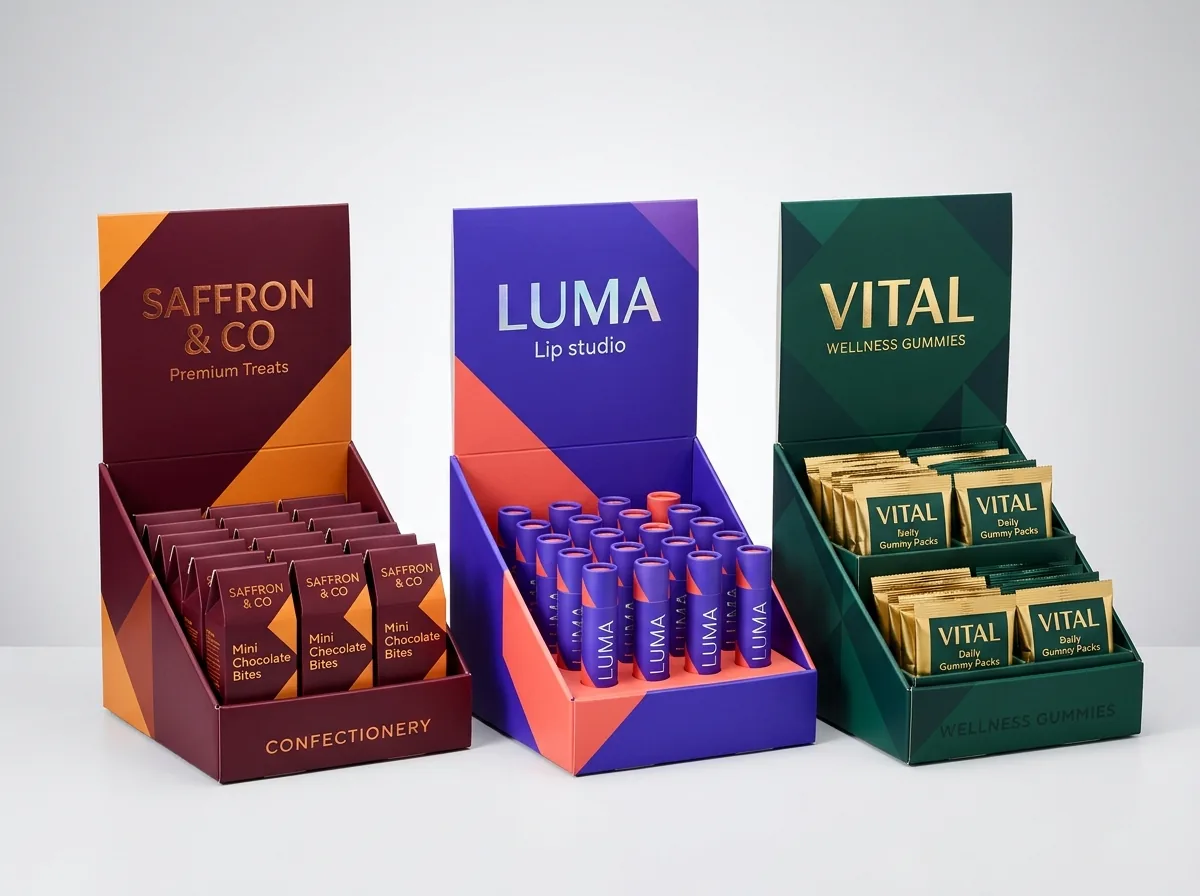
A shelf-ready custom counter display box (often called a PDQ caddy) has to survive two completely different jobs. While inside the master shipping case or travelling to an Amazon customer, it must stay 100% sealed so bars never spill out. The moment a gym receptionist or convenience-store clerk places it on the counter, it must open cleanly by hand without a box cutter. We engineer this dual function using calibrated cut-to-tie zipper perforations along the front lip and slanted side walls, paired with a horizontal fold score across the middle of the top lid. The clerk hooks a finger under the front thumb notch, zips off the perforated upper hood in two seconds, folds the top lid panel backward along its center crease, and tucks the tab behind the back row of bars to lock a double-thick vertical header card in place.
- Dual-channel ready: ships sealed as an e-commerce 12-pack and opens into a single-bar counter display in stores.
- Calibrated perforation ties: strong enough to resist popping open in transit, yet tears cleanly without ripping the front lip.
- Zero-waste header fold: the top lid folds into the vertical header card rather than throwing the entire top in the trash.
- Auto-lock bottom option: pre-glued crash-lock base lets co-packers pop the 12-count caddy open in one second.
When should you use a sealed 4-pack or 6-pack tuck or seal-end grocery carton?
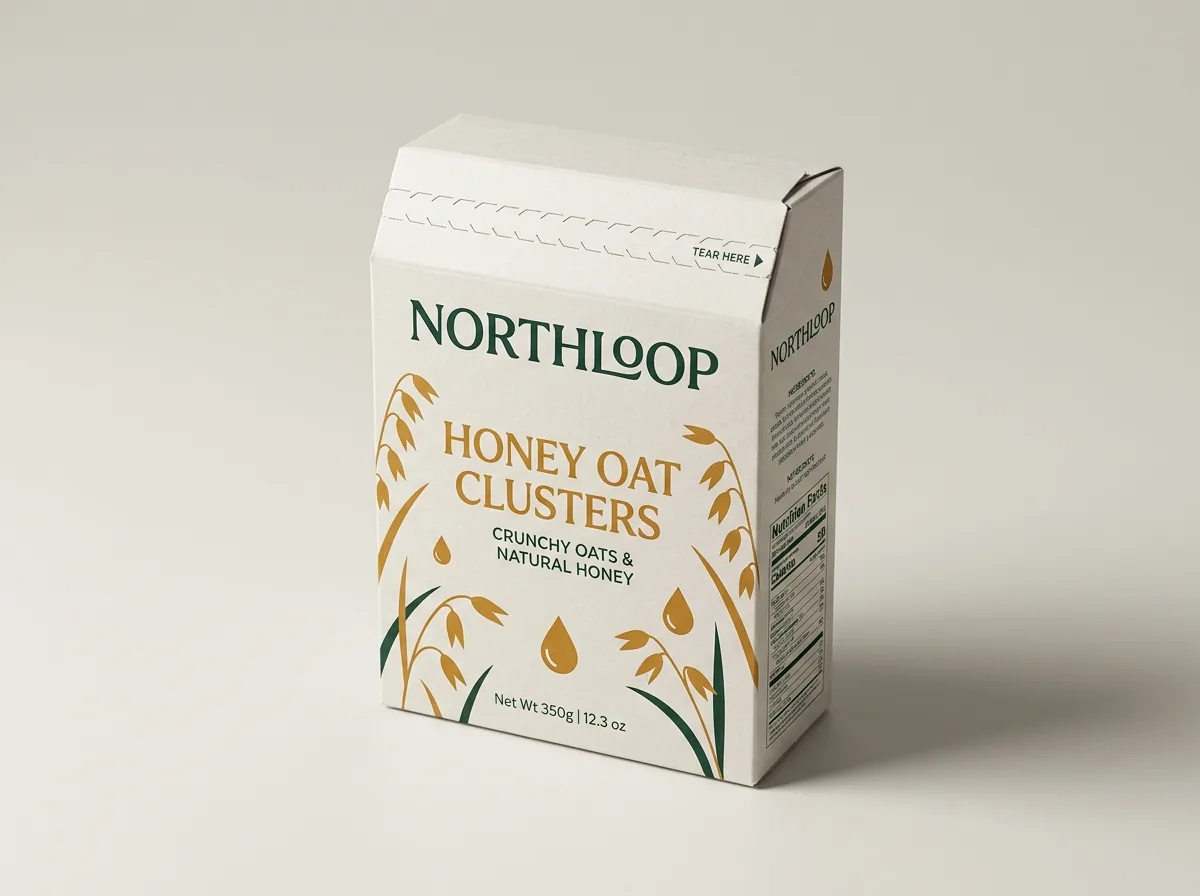
In grocery chains, shoppers buy protein bars for the whole week at a lower price point than a 12-count box allows. A 4-count or 6-count custom seal end box or custom straight tuck end box gives you a compact vertical footprint (5.75 × 2.0 × 3.75 inches for 4 bars) that stands upright next to national brands in the nutrition bar set. For automated co-packing lines running 60+ cartons per minute, glued seal-end flaps with a side-panel zipper tear strip provide tamper-evident retail security and fast machine closing. For smaller batch runs packed by hand, a straight tuck end carton with slit locks gives you crease-free front and back panels without needing hot-melt glue equipment on your line. Most grocery buyers also prefer vertical cartons over wide horizontal boxes because three 3.75-inch wide cartons fit cleanly into a standard 12-inch shelf facing, letting you place Chocolate Peanut Butter, Cookies & Cream, and Salted Caramel side by side.
- Glued seal-end carton: best for high-speed horizontal cartoners and supermarket tamper resistance.
- Straight tuck end with slit locks: best for hand-packed or semi-automated runs of 1,000 to 10,000 cartons.
- Reclosable top or side tear strip: lets shoppers open the 4-pack at home without ripping the front panel.
- 18 pt to 20 pt paperboard: holds a crisp vertical stance on crowded wire or metal supermarket shelves.
Know your size? Compare pricing across up to 3 quantities.
Request a Quote →Where do vertical gravity dispenser boxes and flat DTC variety mailers fit in?
Two specialized box styles unlock high-repeat sales for protein bar brands: vertical custom dispenser boxes and flat single-layer E-flute custom mailer boxes. A gravity dispenser carton stands tall and narrow (typically holding 10 or 12 horizontally stacked bars) and features a perforated pull-out tray at the very bottom. Customers keep the tower on their kitchen counter or office desk and pull one bar from the bottom slot each day while gravity drops the next bar down. For online customer acquisition, a flat 11.5 × 6.25 × 1.25 inch E-flute corrugated mailer holds 8 different bar flavors side by side in a single layer. Because the mailer is only 1.25 inches thick, it ships at light parcel rates, slides straight into standard residential mailboxes, and presents every flavor face-up like a chocolate assortment when the lid opens. An angled interior crash ramp at the base of the gravity dispenser prevents the bottom bar from catching on the rear wall.
How do you manage single-bar vs 4-pack vs 12-pack barcodes across formats?
One critical detail when running both 12-count PDQ displays and 4-pack grocery cartons is GS1 UPC barcode isolation. Every individual flow-wrapped protein bar carries a single-unit UPC barcode so gyms and convenience stores can scan one bar at the register. When those same wrapped bars are packed inside a 4-pack grocery carton (or when a 12-count PDQ caddy is sold as a sealed 12-pack at a club store or Amazon warehouse), checkout and fulfillment lasers must scan the outer box's multipack UPC - never the single-bar UPC. To prevent accidental mis-scans, never place a die-cut window on a multipack carton over the back side of the bar wrapper where the single-unit barcode sits. On 12-count PDQ caddies that sell both ways, place the 12-pack case UPC on the flat bottom panel of the tray (where it stays hidden while sitting on a c-store counter, but scans easily when shipped sealed). Always print outer carton barcodes in 100% black ink on a crisp white box so retail flatbed and handheld scanners read them on the first pass. Every CubitPack order includes a free digital proof and 3D mockup to verify barcode and perforation placement before payment.
What are the most common mistakes when choosing a protein bar box style?
Sending the wrong carton style to a retail channel or misplacing barcodes causes costly distributor chargebacks. Avoid these five mistakes
- Sending a sealed, non-perforated 12-pack carton to convenience stores or gyms where clerks need an open countertop display tray.
- Forgetting two-sided printing on a fold-and-tuck PDQ lid, leaving the pop-up header blank white once folded upright.
- Cutting a front window on a 4-pack grocery carton that exposes the individual single-bar UPC barcode to checkout laser scanners.
- Using a light friction-fit tuck bottom on a heavy 12-count or 18-count bar caddy instead of a pre-glued auto-lock base.
- Scoring PDQ perforations too weak so the top hood bursts open inside master shipping cases during parcel transit.
Find your size
Suggested inside size: 5.0 × 1.75 × 0.875 in
A starting point. Your account manager confirms the size with you before the proof.
Quote this size →Packaging for this
Ready to order protein bar boxes? Compare up to 3 quantities with a free 3D mockup.
Request a Quote →Questions about protein bar boxes
Can one 12-count protein bar PDQ box work for both Amazon 12-packs and gym counters?
Yes. Because a perforated PDQ display box ships completely sealed like a standard carton and only converts into an open tray when the retailer pulls the tear strip, the exact same 12-count box works for online 12-pack orders and wholesale gym counter displays.
Should I choose an auto-lock bottom or a tuck bottom for a 12-count protein bar caddy?
Choose a pre-glued auto-lock bottom (crash-lock base) for 12-count caddies holding twelve 60 g bars (over 1.6 lb total weight). It pops flat in one second on the packing line and never bows or opens when lifted.
Why does a fold-up PDQ header require two-sided printing?
On a standard fold-and-tuck PDQ display box, the top lid hinges backward along a center crease and folds in half so the interior surface of the lid faces forward as the pop-up header card. Two-sided printing puts your macro graphics right on that header.
What board thickness is best for a 12-count perforated protein bar display box?
Most 12-count protein bar PDQ caddies use 20 pt to 24 pt heavy folding paperboard (white SBS or natural kraft) or thin E-flute corrugated board so the side walls and pop-up header stay rigid in high-traffic gym and c-store environments.
Can I order 12-count PDQ caddies and 4-pack grocery boxes in the same run?
Yes. Each distinct box size has its own 1,000-unit minimum (or ask your account manager about trial splits), and our prepress team matches your Pantone colors and finishes across your 12-count caddies, 4-packs, and DTC variety mailers.
Do you charge extra die fees for perforated tear hoods and pop-up headers?
No. CubitPack charges zero die or plate fees on any custom protein bar box, including complex perforated PDQ tear hoods, custom-shaped headers, and gravity dispenser slots.
Still have a question? Ask a packaging specialist.
Request a Quote →Request your protein bar boxes quote
Tell us your size and quantities, and one dedicated account manager prepares pricing for each tier.
- Free design & AI-to-print studio + 3D mockup
- No die or plate charges · 4–5 day rush available
- Free shipping to all 50 states
- 10% off your first order
This comparison evaluates shelf-ready PDQ counter caddies, grocery seal-end multipacks, gravity dispensers, and flat E-flute mailers across c-store, gym, supermarket, and e-commerce fulfillment standards. A CubitPack packaging specialist reviewed all specifications. Spot an error? Let us know and we will fix it.
Sources
What changed
- October 22, 2026: First published.
- October 22, 2026: Updated specifications, terminology, and verified source links.
More guides
New packaging guides by email
Sizes, materials and design tips. Unsubscribe anytime.