
How do I design custom fruit boxes for cold-chain storage and gifting?
Short answer: Keep die-cut airflow vents at least 5/8 inch away from vertical corner creases, add matte lamination or wet-strength kraft for 34°F cold-storage condensation, request food-safe grease barriers for chocolate-dipped fruit, and print ripening guides inside the lid. Start your layout on our custom fruit boxes page.
On this page
- Where should airflow and ethylene vents go on a fruit box dieline
- Which finishes and liners protect fruit boxes from condensation, juice and cocoa butter
- How can an orchard use one master gift mailer across summer peaches, fall apples and winter pears
- Why should you print ripening tests and storage tips inside the box lid
- What FDA, USDA and grocery barcode details belong on retail fruit cartons
- Common mistakes
- FAQs
Request a custom quoteFree dieline & 3D mockup
Designing a high-performing custom fruit box requires balancing postharvest respiration, cold-chain moisture protection, and farm-to-table unboxing appeal. Because fresh berries, peaches, pears, and apples continue breathing after harvest and sweat when moved from 34°F coolers into ambient air, structural dielines need 5% to 8% side ventilation open area placed along the center neutral axis of the sidewalls - never within 5/8 inch of load-bearing vertical corners. Exterior matte or gloss lamination sheds surface condensation, while optional food-safe interior barriers on request prevent cocoa butter on dipped strawberries or sugar syrup on Medjool dates from wicking into the paperboard. To control costs across summer stone fruit, autumn apples, and winter pears, print one master orchard mailer with a dedicated top-lid label zone or slide-in harvest card, and use inside-lid printing for varietal ripening charts.
Where should airflow and ethylene vents go on a fruit box dieline?
Fresh produce is living tissue that respires heat, water vapor, and ripening ethylene gas long after it leaves the tree or vine. When growers order custom printed fruit boxes, placing die-cut ventilation holes in the wrong spot is the number-one cause of collapsed pallet corners in humid walk-in coolers. In a rectangular paperboard punnet or corrugated orchard mailer, roughly 65% to 75% of the vertical stacking load is carried by the four vertical corner columns (within 5/8 inch to 3/4 inch of each corner crease). If your artwork places decorative cutouts or wide airflow slots right across a corner score line, cold-room humidity enters the exposed fiber edge right where bending stress is highest. Instead, concentrate die-cut ventilation slots along the middle third of the front, back, and side walls, and align side vents with the channels between your internal custom cardboard inserts so forced-air chillers can push cold air straight through the box.
- Corner safety margin: Keep every die-cut vent, window patch, and handle slot at least 5/8 inch (16 mm) away from vertical fold scores.
- Forced-air alignment: Position oblong side slots at mid-fruit height so cooling air flows across the equatorial waist of pears, peaches, and berries.
- Custom botanical vent shapes: Because CubitPack charges zero die fees, you can shape side vents like orchard leaves, citrus slices, or berries at no extra cost.
- Pinch-free smooth radii: Round the ends of oblong vent slots (minimum 1/8 inch radius) so fragile berry skins never catch on a sharp paperboard corner.
Which finishes and liners protect fruit boxes from condensation, juice and cocoa butter?
A fruit box faces two very different liquid challenges depending on what sits inside: exterior condensation from cold-chain temperature swings, and interior oil or juice migration from the fruit itself. Matching the right finish and board treatment to your crop keeps graphics sharp from the packing shed to the customer's kitchen counter. When chilled 1-pint berry punnets or 6-cell orchard pear mailers leave a 34°F cooler and ride in a warm delivery van, atmospheric moisture condenses into water droplets on the outside of the box. Adding matte lamination or gloss lamination on the exterior seals the printed ink under a protective film so water beads never rub color off onto shoppers' hands. Inside the box, unwashed field apples and pears sitting in dry paper wraps need breathable unvarnished board, whereas sticky Medjool dates, glazed figs, and chocolate-covered strawberries need food-safe grease- or moisture-resistant liners on request so cocoa butter and fruit sugars never leave dark halo stains on the outer lid.
| Fruit application | Recommended outer finish | Interior liner / board setup |
|---|---|---|
| Chilled 1-pint / 1-quart berry punnets | Matte lamination or wet-strength kraft | Breathable unbleached kraft + side airflow vents |
| 6- & 12-cell orchard pear / apple mailers | Matte lamination or scuff-resistant varnish | E/B-flute corrugated + full-height cell dividers |
| Chocolate-covered strawberries (6 or 12 ct) | Soft-touch or matte lamination + clear window | Food-safe grease-resistant liner + cavity insert |
| Stuffed Medjool dates & glazed figs | Matte or soft-touch + gold foil stamping | Food-safe grease barrier tray + partitioned pockets |
| Freeze-dried fruit crisps (bag-in-box) | Gloss or matte lamination + spot UV fruit icons | Dry 18 pt SBS carton over sealed foil barrier pouch |
How can an orchard use one master gift mailer across summer peaches, fall apples and winter pears?
Seasonal harvest windows are short: an orchard might ship Georgia peaches in July, Honeycrisp apples in October, Comice pears in November, and navel oranges in January. Printing four separate 1,000-box corrugated mailer runs creates leftover seasonal inventory and misses out on volume price breaks. Instead, design one master custom mailer boxes dieline built around a standardized 3.5 × 3.5 inch 6-cell or 12-cell grid, and print your permanent orchard crest, heritage story, and botanical border across the exterior panels. Leave a clean 3 × 4 inch framed badge zone on the front flap or top lid where your packing shed applies a crop-specific roll label from our custom food labels line for each harvest. Consolidating three 1,000-box seasonal crops into one 3,000-box master mailer order lowers your per-box cost while giving every fruit variety a tailored retail presentation.
Know your size? Compare pricing across up to 3 quantities.
Request a Quote →Why should you print ripening tests and storage tips inside the box lid?
Unlike a bag of pretzels or roasted nuts, fresh gift fruit requires customer care the moment the box opens. Many recipients do not know that European pears (like Comice, Bosc, and Anjou) ripen from the inside out at room temperature and must be checked by pressing gently at the narrow stem neck rather than the wide body, or that fresh cherries and berries should go straight into the refrigerator unwashed until serving. Printing a step-by-step illustrated ripening and storage guide using inside printing on the inner lid of your fruit mailer solves two problems at once: it eliminates the cost and packing labor of a loose paper care leaflet that can get damp in transit, and it turns the underside of the lid into a full-color farm-to-table billboard the moment the customer lifts the flap.
What FDA, USDA and grocery barcode details belong on retail fruit cartons?
Whether you sell 1-pint blueberry punnets through regional supermarkets or dried mango cartons at specialty grocers, your dieline needs clean zones for mandatory retail and food labeling. Under FDA 21 CFR 101 and USDA Country of Origin Labeling (COOL) rules for fresh and dried produce, reserve space on the front principal display panel for product identity and net weight (or dry pint/quart volume) in both US customary and metric units (for example, 'Net Wt 16 oz (1 lb) 454 g'). On the back or bottom panel, place your orchard or packer name and street address, Country of Origin statement ('Grown in USA' or specific origin), Nutrition Facts panel (for processed, dried, or dipped fruit), and a high-contrast dark-ink-on-white UPC barcode with at least 1/8 inch of quiet zone around the bars. Leave an unvarnished knock-out rectangle for inkjet or rubber-stamped harvest lot codes and pack dates. Ready to size your punnet or cell grid? Check our fruit box size chart for berries, orchard trays and dates, and compare board grades in paperboard berry punnets vs corrugated fruit shipping boxes.
What are the five fruit box design mistakes that ruin shelf appeal?
Avoid these five structural and artwork errors before approving your digital proof
- Placing die-cut ventilation holes or wide window cutouts within 5/8 inch of vertical corner fold lines, which weakens corner stacking strength in humid coolers.
- Forgetting to request a food-safe grease barrier on chocolate-covered strawberry and stuffed Medjool date trays, allowing cocoa butter and syrup to stain the outer board.
- Applying slick gloss or soft-touch lamination over the harvest date and lot-code stamp box so packing-shed ink smears.
- Printing separate small box runs for summer peaches, fall apples, and winter pears instead of using one master orchard mailer with variedad labels or insert cards.
- Putting fragile loose paper ripening instructions on top of damp chilled fruit instead of printing the ripening guide directly inside the box lid.
Find your size
Suggested inside size: 4.25 × 4.25 × 2.75 in
A starting point. Your account manager confirms the size with you before the proof.
Quote this size →Packaging for this
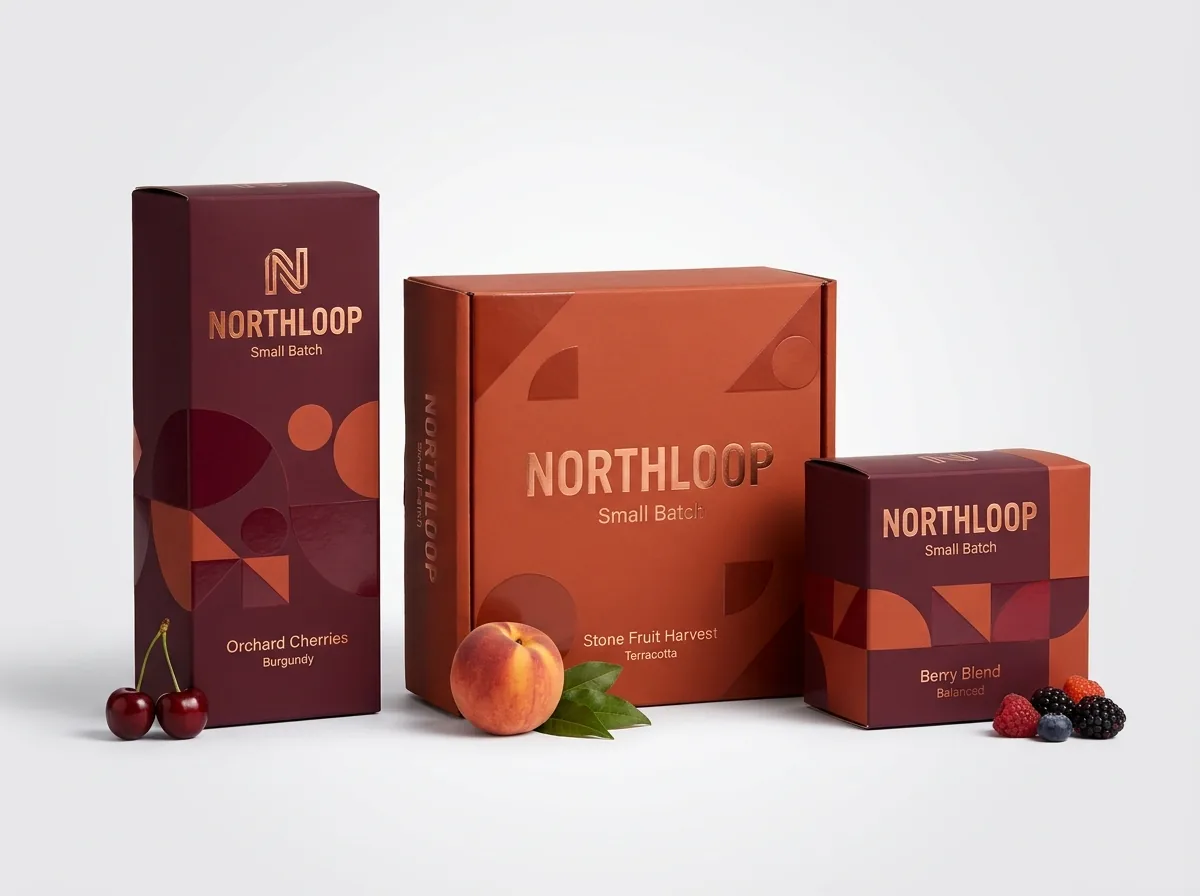

Ready to order fruit boxes? Compare up to 3 quantities with a free 3D mockup.
Request a Quote →Questions about fruit boxes
Where should ventilation holes be placed on a berry punnet or fruit mailer?
Place die-cut ventilation slots along the middle third of the front, back, and side panels, keeping every cutout at least 5/8 inch away from the vertical corner score lines. This lets forced-air chillers remove field heat and ethylene gas while preserving full corner stacking strength.
Do custom leaf- or berry-shaped ventilation cutouts cost extra?
No. Because CubitPack charges zero die or plate fees on every custom order, shaping your side airflow vents like orchard leaves, strawberries, or citrus segments costs the exact same as standard round or oblong holes.
How do I prevent chocolate-dipped strawberries or dates from staining the box?
Tell your account manager that your fruit has a chocolate coating, glaze, or natural syrup so we can produce the tray and multi-cavity insert in a certified partner facility with a food-safe grease- and moisture-resistant interior barrier on request.
How do I stamp harvest dates and lot numbers onto a laminated fruit box?
Inkjet and rubber-stamp inks dry slowly on slick matte, gloss, or soft-touch lamination. Show our prepress team where your packing line stamps the harvest date and lot code, and we will leave an unlaminated knock-out rectangle that absorbs ink instantly.
Can CubitPack set up the dieline and cell divider layout if I only have a logo?
Yes. Every order includes free structural dielines and free design help. Send us your logo, fruit dimensions, and pack count, and our designers will lay out the box, cell grid, vents, and inside-lid ripening chart on a digital proof and 3D mockup before you pay.
Can I print an AI-generated botanical illustration on my fruit boxes?
Yes. If you created an orchard landscape or botanical fruit pattern with an AI tool, send us the file. Our prepress team will upscale the resolution, convert colors to CMYK or Pantone, and fit the artwork cleanly across your box panels at no extra charge.
Still have a question? Ask a packaging specialist.
Request a Quote →Request your fruit boxes quote
Tell us your size and quantities, and one dedicated account manager prepares pricing for each tier.
- Free design & AI-to-print studio + 3D mockup
- No die or plate charges · 4–5 day rush available
- Free shipping to all 50 states
- 10% off your first order
This design guide combines corrugated corner-column compression principles, FDA 21 CFR 101 and USDA COOL produce labeling rules, and CubitPack prepress standards. Checked by a packaging specialist. Spot an error? Let us know and we will fix it.
Sources
What changed
- October 22, 2026: First published.
- October 22, 2026: Updated specifications, terminology, and verified source links.
More guides
New packaging guides by email
Sizes, materials and design tips. Unsubscribe anytime.