
How do I design custom protein bar boxes for gym counters and grocery aisles?
Short answer: Design custom protein bar boxes so your brand logo, flavor color band, and macro badges (such as '20g Protein · 1g Sugar') appear on both the permanent 1.375-inch front tray lip and the fold-up PDQ header, and include Protein % Daily Value in the FDA Nutrition Facts panel. Orders start at 1,000 boxes.
On this page
- How do I layout artwork on a perforated PDQ protein bar box so key branding stays on the counter
- How do I structure macro callouts, flavor colors, and finishes for sports vs whole-food bars
- Why does a 1:1 bar cross-section photo beat a clear window on flow-wrapped bar boxes
- What FDA labeling rules apply when you print a front-of-pack '20g Protein' claim
- What drives the price of custom protein bar boxes and how can I group flavors
- Common mistakes
- FAQs
Request a custom quoteFree dieline & 3D mockup
Designing high-converting protein bar packaging requires planning for two states at once: how the closed carton looks in a warehouse club or online photo, and how the open tray looks on a gym front desk or convenience-store counter after the perforated hood is torn away. The biggest mistake new bar brands make is centering their main logo and protein callout right across the perforated tear-away hood panel that store clerks rip off and discard. Instead, anchor your permanent branding on two zones that stay on the counter until the final bar sells: the lower 1.25 to 1.5 inch front tray lip and the interior fold-up header card. Pair bold flavor color-coding and a 1:1 bar cross-section photo with a compliant FDA Nutrition Facts panel that lists Protein % Daily Value. At CubitPack, our designers build your dieline and 3D proof for free.
How do I layout artwork on a perforated PDQ protein bar box so key branding stays on the counter?
On a 12-count perforated custom counter display box, a U-shaped zipper perforation runs across the front face (about 1.375 inches up from the bottom crease) and angles upward along both side walls to the top back hinge. When a gym or convenience-store employee opens the box, everything above that perforation line on the front and upper side walls is either torn off or folded backward to form the upright header card. If you design your custom printed protein bar boxes like a static cereal carton with your logo in the middle of the front panel, tearing off the hood cuts your logo in half. Always design the front panel as two independent zones: place a complete logo, flavor name, and macro summary ('20g PROTEIN · 2g SUGAR · GLUTEN-FREE') inside the permanent 1.375-inch lower front lip, and place a bold billboard graphic on the underside of the top lid that pops upright as the back header card.
- Permanent front lip (bottom 1.25–1.5 in): repeat brand wordmark, flavor name, and top 2 macros below the perforation line.
- Pop-up header card (inside top lid): print high-impact '20g PROTEIN' badge, brand logo, and bar cross-section on the interior pass.
- Slanted side walls: angle side typography parallel to the diagonal perforation slope so nothing gets clipped.
- Closed-state front hood: print exterior graphics on the tear-away hood so the closed 12-pack looks great for Amazon and club orders.
How do I structure macro callouts, flavor colors, and finishes for sports vs whole-food bars?
Protein bar shoppers buy by the numbers first and the flavor second. Whether a customer is standing at a CrossFit front desk after a workout or scanning the supermarket nutrition aisle, they want to read protein grams, sugar or net carb grams, and flavor profile in under two seconds from four feet away. Use the table below to match your bar formulation to the visual hierarchy, board stock, and finishing pass that drives impulse trial.
| Bar category & buyer | Front-panel macro hierarchy | Best board & finishing pass |
|---|---|---|
| Whey isolate & gym performance bars | 1. '20g–25g PROTEIN' · 2. '1g SUGAR' · 3. Flavor banner | White card + matte lamination + gloss spot UV on macros |
| Keto, low-carb & MCT functional bars | 1. '2g–3g NET CARBS' · 2. '15g PROTEIN' · 3. 'KETO' | White card + velvety soft-touch lamination + foil badge |
| Whole-food date, egg-white & nut bars | 1. Ingredient count ('5 Whole Ingredients') · 2. '12g Protein' | Unbleached natural brown kraft + opaque white ink |
| Plant-based pea / brown rice vegan bars | 1. '15g–18g PLANT PROTEIN' · 2. 'Certified Vegan & GF' | Kraft or recycled board + satin matte + embossed leaf |
| Collagen, adaptogen & boutique wellness bars | 1. '10g GRASS-FED COLLAGEN' · 2. '0g Added Sugar' | Pastel or warm cream on white card + gold foil stamp |
Why does a 1:1 bar cross-section photo beat a clear window on flow-wrapped bar boxes?
On bakery or granola boxes, a clear die-cut window shows the actual food inside. On protein bar boxes, however, individual bars are almost always sealed inside opaque metallized or plastic flow-wrap film to block oxygen and prevent texture hardening. Cutting a window on a 4-pack grocery carton only shows the shiny plastic wrapper inside - not the chocolate chunks, caramel layer, or peanut butter core. Instead of a window, print a sharp, actual-size angled cross-section photograph of your unwrapped bar broken or sliced in half on the front of your 4-pack carton and on the pop-up header of your 12-count PDQ caddy. Highlighting the chocolate drizzle, cookie crisps, and caramel pull with selective spot UV against a non-glare matte lamination background shows shoppers the exact texture they are about to bite into. Pair that cross-section photo with short texture callouts - such as 'Crispy Whey Nuggets' or 'Gooey Caramel Core' - so first-time buyers know the bar is soft and crunchy rather than chalky.
- 1:1 angled cross-section photo: shows internal layers, nuts, and drizzle hidden behind opaque flow-wrap film.
- Spot UV texture highlights: adds a mouthwatering sheen over chocolate coating and caramel layers.
- Color-matched flavor bands: assign a distinct Pantone or CMYK accent stripe to each flavor SKU for fast restocking.
Know your size? Compare pricing across up to 3 quantities.
Request a Quote →What FDA labeling rules apply when you print a front-of-pack '20g Protein' claim?
Sports nutrition brands should watch one specific FDA labeling rule closely before going to press: 21 CFR 101.9(c)(7). On standard food packages that do not make a protein claim, listing the '% Daily Value' (%DV) next to the Protein gram line in the Nutrition Facts table is optional. However, the moment you print any protein claim on the front panel, header card, or lip of your box - such as '20g Protein', 'High Protein', or 'Good Source of Protein' - FDA regulations require you to calculate and print the % Daily Value for Protein (adjusted for protein quality / PDCAAS) inside the Nutrition Facts panel. In addition, protein bar kitchens frequently process multiple major allergens on the same line. Ensure the side or bottom panel of your carton clearly states all applicable FDA FALCPA allergens - including milk (whey, casein), soy (soy protein isolate, soy lecithin), peanuts, specific tree nut species (almond, cashew, pecan, coconut), eggs, wheat, and sesame - alongside any sugar alcohol (erythritol, maltitol, allulose) disclosures.
What drives the price of custom protein bar boxes and how can I group flavors?
Four factors drive the unit price of custom protein bar boxes: the flat sheet size and board caliper (an 18 pt 4-pack carton uses less board than a 22 pt 12-count PDQ caddy), whether the box requires two-sided printing for a fold-up interior header, the total order quantity (unit cost drops substantially at 2,500, 5,000, and 10,000 boxes vs 1,000), and specialty finishes like soft-touch lamination or spot UV. Because protein bar brands typically launch with 3 to 6 flavors (such as Chocolate Peanut Butter, Cookies & Cream, Salted Caramel, and Lemon Crisp), the smartest cost-saving strategy is to keep the exact same bar weight and wrapper size across all flavors. That lets you use one shared 12-count PDQ dieline and one shared 4-pack grocery dieline across your entire catalog, allowing CubitPack to gang-run your flavors together with zero die or plate charges. Every order includes free design help, a digital proof, and a 3D mockup before payment.
What are the most common protein bar box design and prepress mistakes?
Torn-off logos, missing Protein %DV numbers, and upside-down fold-up headers are the top prepress traps on bar cartons. Check these five points before approving your proof
- Placing your only front brand logo and protein badge on the upper perforated PDQ hood that store clerks tear off and throw away.
- Orienting the interior header artwork upside down on the flat dieline so it stands on its head when folded backward at the counter.
- Printing '20g Protein' on the front of the box while leaving the % Daily Value column blank on the Protein line of the Nutrition Facts panel.
- Using low-contrast neon or metallic ink for the UPC barcode instead of 100% black ink on a clean white rectangle.
- Placing small text or macro badges right on top of the zipper perforation score where the die-cutting teeth clip the letters.
Find your size
Suggested inside size: 5.0 × 1.75 × 0.875 in
A starting point. Your account manager confirms the size with you before the proof.
Quote this size →Packaging for this
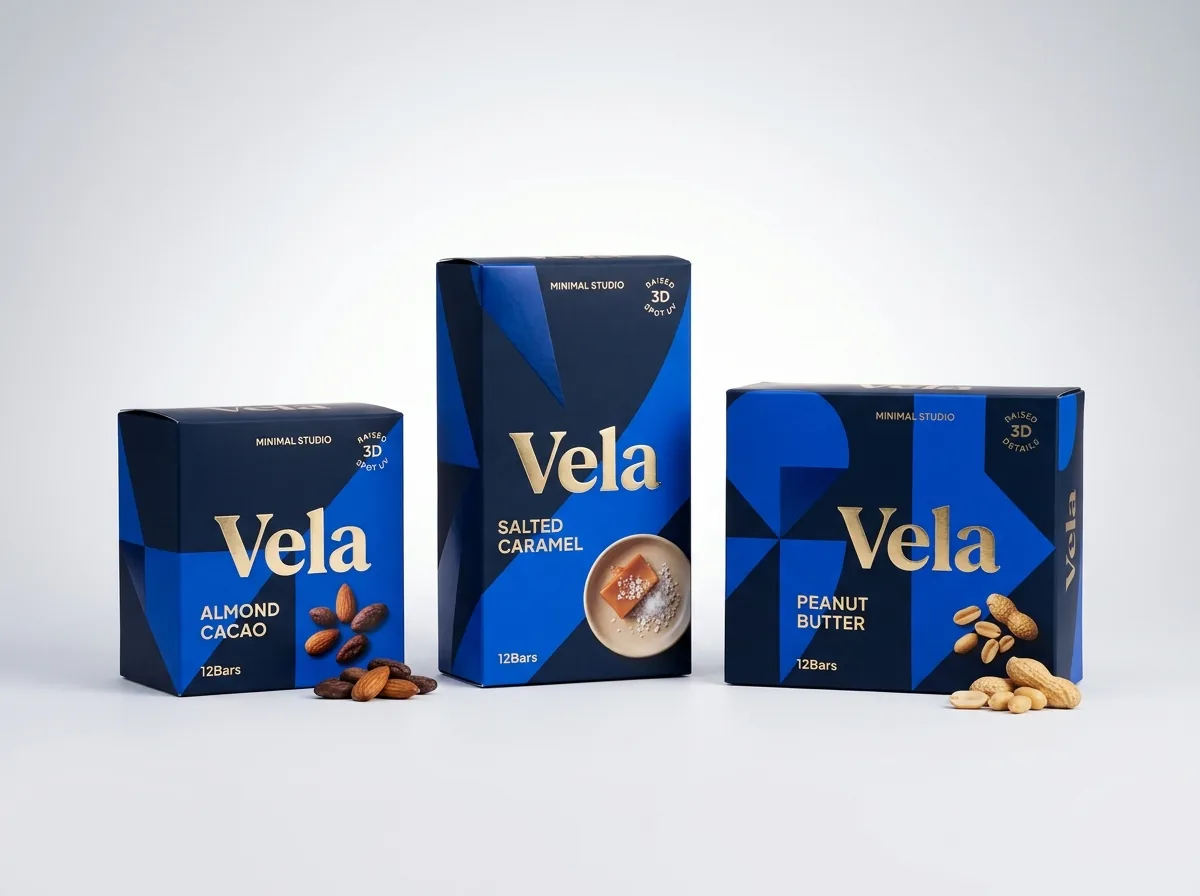
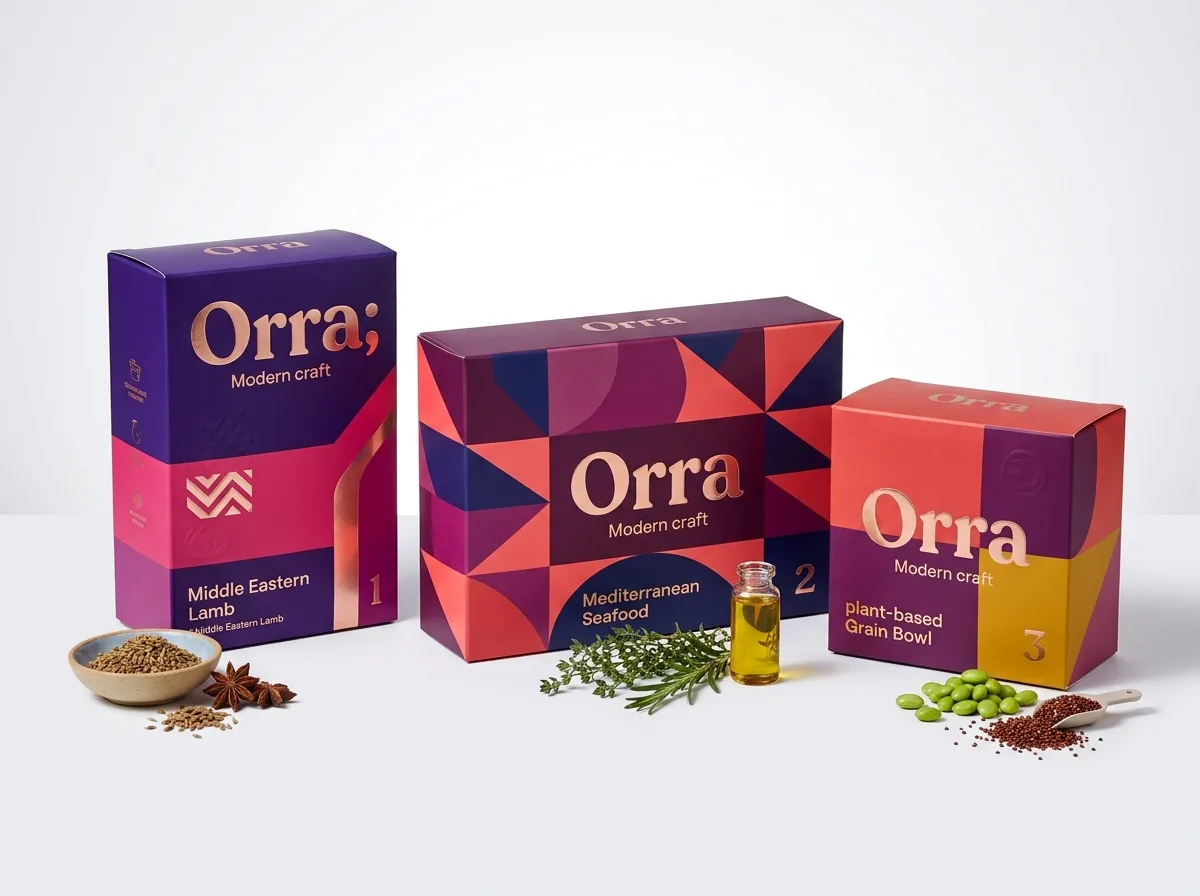
Ready to order protein bar boxes? Compare up to 3 quantities with a free 3D mockup.
Request a Quote →Questions about protein bar boxes
How do I make sure my pop-up PDQ header isn't upside down when folded?
Because the top lid folds backward 180 degrees along its horizontal crease to stand upright behind the bars, the artwork printed on the inside surface of the lid must be oriented accordingly on the flat dieline. Our prepress team checks this orientation and shows you a 3D folded mockup before printing.
Do I have to list % Daily Value for protein on my protein bar box?
Yes, if your box makes any protein claim on the front panel or header (such as '20g Protein' or 'High Protein'). Under FDA 21 CFR 101.9(c)(7), making a protein claim triggers the requirement to display the % Daily Value for protein in the Nutrition Facts table.
What bleed and safe margin do I need around perforations on a protein bar box?
Extend background colors 1/8 inch (0.125 in) past all outer cut lines for bleed, keep text 1/8 inch inside standard cut and fold lines, and keep logos and macro badges at least 3/16 inch (0.1875 in) away from zipper perforation lines.
Can I use spot UV on just the '20g PROTEIN' numbers and bar photo?
Yes. Pairing matte or soft-touch lamination across the whole carton with selective high-gloss spot UV over your protein gram badge and bar cross-section photo is the most popular finishing combo in sports nutrition.
Can CubitPack help set up my PDQ dieline and artwork across multiple bar flavors?
Yes. Free design help is included with every order. Send us your wrapped bar dimensions, logos, flavor colors, and nutrition panels, and our designers will build your PDQ and multipack dielines, digital proofs, and 3D mockups at no extra charge.
How can I lower the cost per box when launching 4 protein bar flavors?
Keep all four flavors on the exact same bar dimensions so they share one identical 12-count PDQ dieline. Combining all four flavors into one production run lets you reach higher-tier volume pricing with zero die or plate charges.
Still have a question? Ask a packaging specialist.
Request a Quote →Request your protein bar boxes quote
Tell us your size and quantities, and one dedicated account manager prepares pricing for each tier.
- Free design & AI-to-print studio + 3D mockup
- No die or plate charges · 4–5 day rush available
- Free shipping to all 50 states
- 10% off your first order
This design guide combines CubitPack PDQ prepress standards (3/16 inch perforation safe zones, two-sided fold-up header orientation, and 1/8 inch bleed) with FDA 21 CFR 101.9(c)(7) protein %DV and FALCPA allergen labeling rules. A packaging specialist reviewed every section. Spot an error? Let us know and we will fix it.
Sources
What changed
- October 22, 2026: First published.
- October 22, 2026: Updated specifications, terminology, and verified source links.
More guides
New packaging guides by email
Sizes, materials and design tips. Unsubscribe anytime.