
How do I turn a ChatGPT or Claude box mockup into real packaging?
Short answer: Turn a ChatGPT or Claude box mockup into real packaging by sending your AI image, draft copy, and inside product dimensions to CubitPack. Our designers unwrap 3D renders onto a flat vector dieline for custom product boxes, typeset sharp text and scannable barcodes, match CMYK or Pantone inks, and send a 3D mockup before payment.
On this page
- How does a studio rebuild compare to pasting a ChatGPT image into an online box builder
- How do packaging designers unwrap a ChatGPT 3D render onto a six-panel folding carton
- How can I pair ChatGPT visuals with Claude copy and SVG wireframes effectively
- How do I measure my bottle, jar, or pouch so the rebuilt carton fits properly
- How do we verify scannable barcodes, Pantone colors, and 3D fold alignment before printing
- Common mistakes
- FAQs
Request a custom quoteFree dieline & 3D mockup
Founders routinely pair ChatGPT and Claude to launch new consumer products: ChatGPT generates realistic 3D retail carton images, while Claude drafts front-panel hierarchy, ingredient copy, and rough SVG wireframes. Yet neither AI model produces a press-ready packaging file. ChatGPT exports a single flattened RGB raster picture with baked-in shadows, invented tuck seams, and unreadable small lettering, while Claude wireframes lack paperboard caliper allowances, glue-flap tapers, and calibrated print color profiles. Sending those raw files straight to a commercial printer triggers immediate prepress rejection. Through our AI-generated packaging rebuild service, CubitPack converts ChatGPT renders and Claude layouts into manufacturable folding cartons at no extra design charge. Share your exported mockup, copy doc, and bottle or jar measurements. Our packaging specialists engineer the exact six-panel dieline, redraw every graphic and font in crisp vectors, add a genuine GS1 barcode, and deliver a flat proof plus 3D spin before you pay.
How does a studio rebuild compare to pasting a ChatGPT image into an online box builder?
When a founder loves a 3D box picture generated in ChatGPT, the first instinct is often to drop that PNG into a browser-based 3D box customizer or hire a freelance illustrator who does not engineer structural packaging. Both shortcuts create expensive surprises once physical cartons come off the press. Browser templates stretch raster pixels across fold creases without fixing blurred AI text or fake perspective lighting, while general graphic designers frequently guess glue-flap widths and dust-flap clearances on printed retail product cartons. Compare the three routes side by side before ordering.
| Production step | Self-serve online box builder | General graphic freelancer | CubitPack free AI-to-print rebuild |
|---|---|---|---|
| 2D structural dieline | Fixed stock sizes only; no custom caliper offsets | Often traced by eye without press knife specs | Custom CAD dieline sized to your exact inside fit (free) |
| 3D perspective unwrapping | Pastes angled screenshot flat, printing fake shadows | Manual redraw billed by the hour or per revision | Full 6-panel vector reconstruction included at zero charge |
| Small text & legal panels | Prints blurred or misspelled ChatGPT pixels as-is | Requires finished dieline and print specs from you | Clean vector typesetting from your Claude or Google Doc copy |
| Barcodes & QR codes | Low-res raster bars often fail retail checkout scans | Varies; quiet-zone and contrast errors are common | Crisp vector GS1 UPC and QR placement clear of score lines |
| Color & metallic finishes | Auto-converts RGB to muddy CMYK; no real foil masks | May forget 100% K100 spot layers for foil or embossing | Calibrated CMYK, guaranteed Pantone, and real tooling plates |
| Proofing & accountability | Automated preview; printing mistakes fall on the buyer | Designer hands off a file; printer blames the file | One team owns dieline, proof, 3D spin, and physical printing |
How do packaging designers unwrap a ChatGPT 3D render onto a six-panel folding carton?
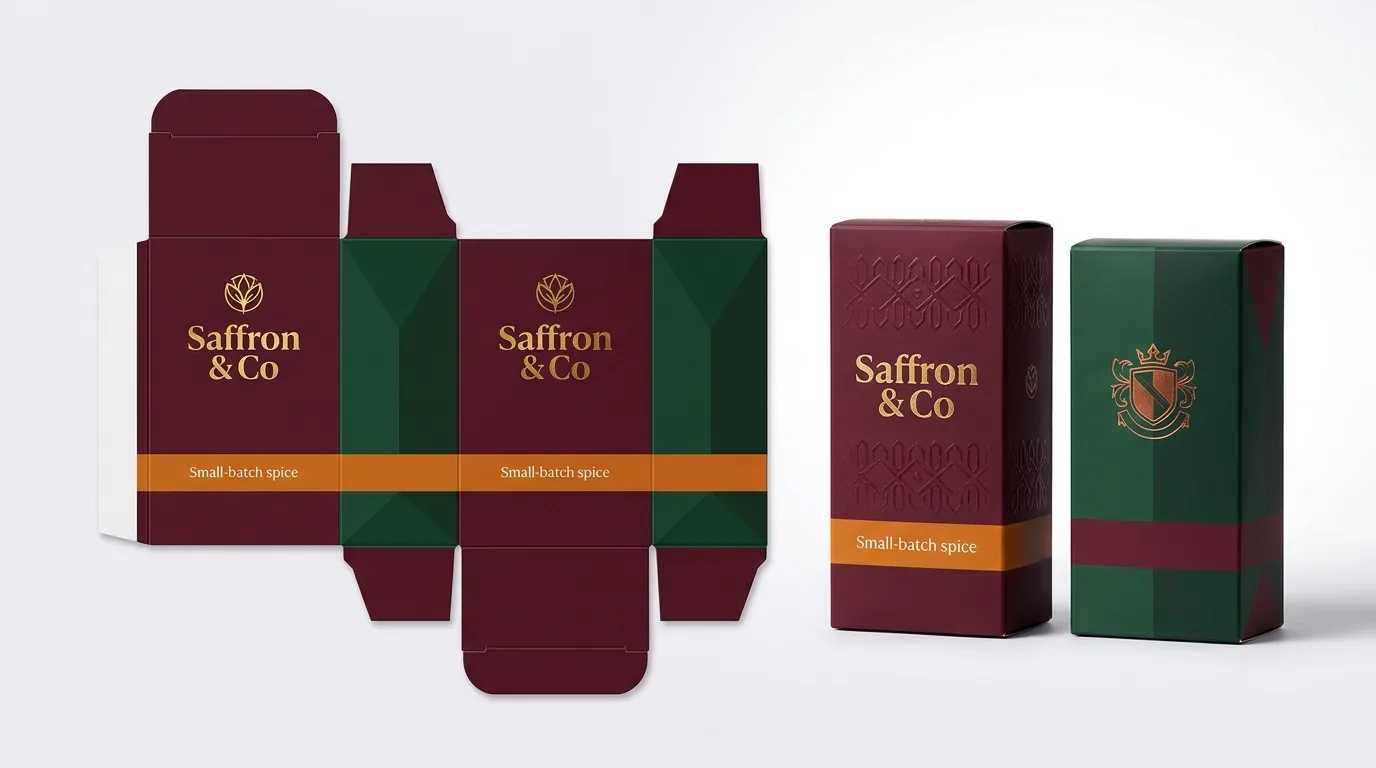
A typical ChatGPT image shows only the front face, one side panel, and the top lid of a retail box, leaving the back panel, opposite side wall, bottom closure, inner dust flaps, and side glue tab completely unseen. Turning that single camera view into a real carton starts with selecting the right folding carton closure for your product weight and shelf display, such as custom straight tuck end boxes for lightweight serums and cosmetics or auto-lock bottom cartons for heavier glass jars.
- Front display panel: Recreated faithfully from your ChatGPT hero view using clean vector logos, borders, illustrations, and product titles.
- Left and right side panels: Balanced symmetrically or split between brand storytelling on one side and usage directions or icons on the other.
- Back panel: Structured cleanly using your Claude copy outline for ingredients, nutrition or supplement facts, warnings, company address, and vector barcode.
- Top tuck lid and dust flaps: Engineered with friction-fit slit locks and flood-coated dust flaps so no unprinted white edge peeks through the corners.
- Bottom closure and glue tab: Matched to product weight (straight tuck, reverse tuck, snap-lock, or auto-lock bottom), keeping adhesive zones ink-free so factory glue bonds firmly.
How can I pair ChatGPT visuals with Claude copy and SVG wireframes effectively?
Many teams use ChatGPT for color, mood, illustration style, and foil placement, then switch to Claude to organize FDA or FTC label text, write concise back-panel copy, or output a rough flat SVG panel diagram. Combining both speeds up your studio proof dramatically because our designers never have to guess what the tiny illegible text on your ChatGPT image was supposed to say.
- Export your favorite ChatGPT image at full resolution: Download the original PNG or WebP directly from ChatGPT rather than taking a cropped phone screenshot.
- Keep a plain-text panel sheet from Claude: Group your exact wording under clear labels (Front Panel, Left Side, Back Panel, Top Flap) and double-check net weight units in both US ounces and metric grams.
- Treat Claude SVG layouts as proportion guides, not press dielines: Claude SVG code helps communicate text hierarchy, while our team supplies the true structural dieline with board caliper and bleed.
- Attach existing brand assets if you have them: Include vector logos, font names, or hex and Pantone codes; if you are starting from zero without a logo, our $250 brand identity package ($50 per box or item) builds your full mark and palette.
Know your size? Compare pricing across up to 3 quantities.
Request a Quote →How do I measure my bottle, jar, or pouch so the rebuilt carton fits properly?
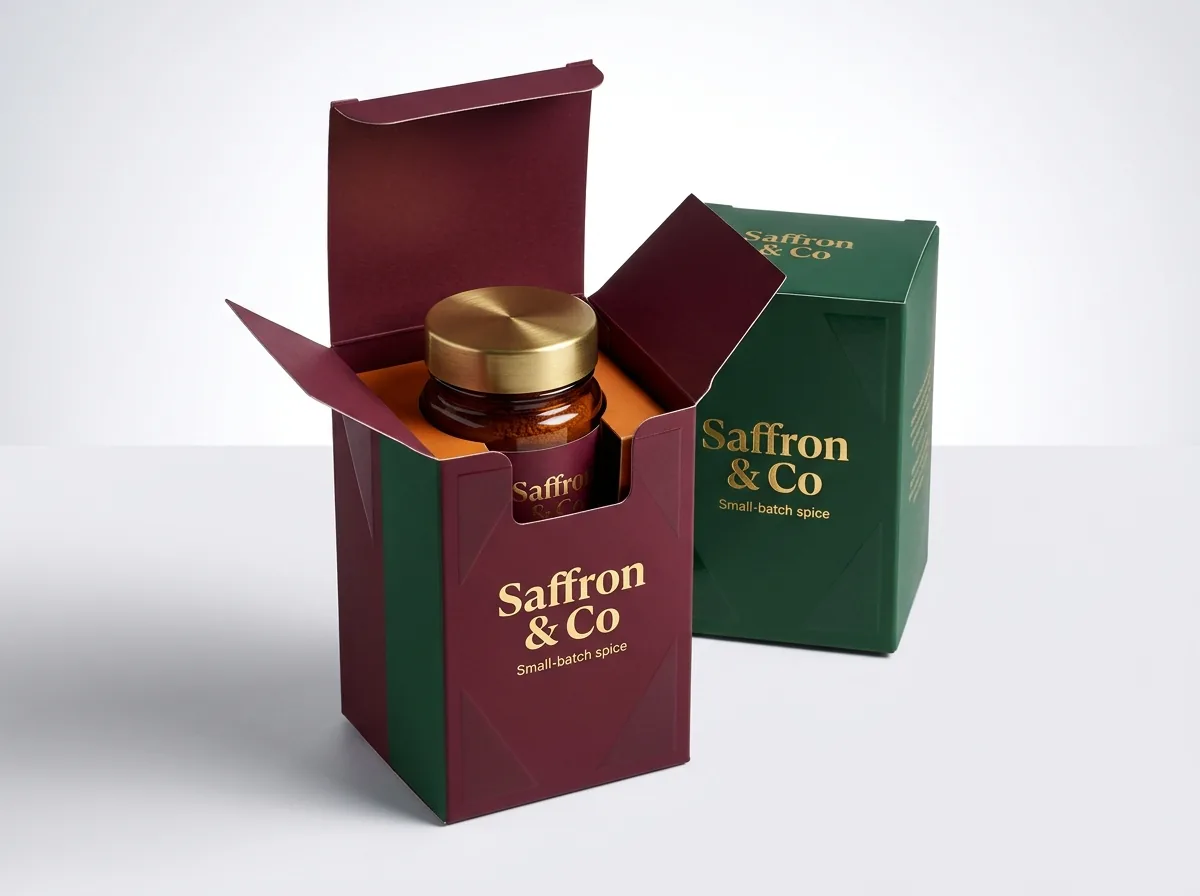
ChatGPT has no awareness of whether your dropper bottle is 30 ml or 120 ml, and it regularly renders tiny caps on wide boxes or impossible wall thicknesses. Before our studio lays a single graphic onto your folding carton dieline, we confirm the inside dimensions (Length by Width by Height, measured in inches from left-to-right opening, front-to-back depth, and top-to-bottom height) plus a small clearance allowance so your item slides in smoothly without rattling.
- Glass dropper bottles and skincare jars: Add 1/16 to 1/8 inch of interior clearance around the widest diameter and pair custom cosmetic boxes with a fitted paperboard neck insert if the bottle tapers.
- Wrapped snacks, tea sachets, and spice tins: Size custom food boxes with enough headspace for sealed inner pouches to settle without bulging the tuck lid.
- Board thickness selection: Standard 16pt to 18pt C1S paperboard suits light retail cartons, whereas 20pt to 24pt board or E-flute micro-corrugated board protects heavier glass containers.
- Minimums and turnaround: Custom folding cartons and product boxes start at 250 units and ship in 10 to 14 business days after proof sign-off, with 4 to 5 business day rush available.
How do we verify scannable barcodes, Pantone colors, and 3D fold alignment before printing?
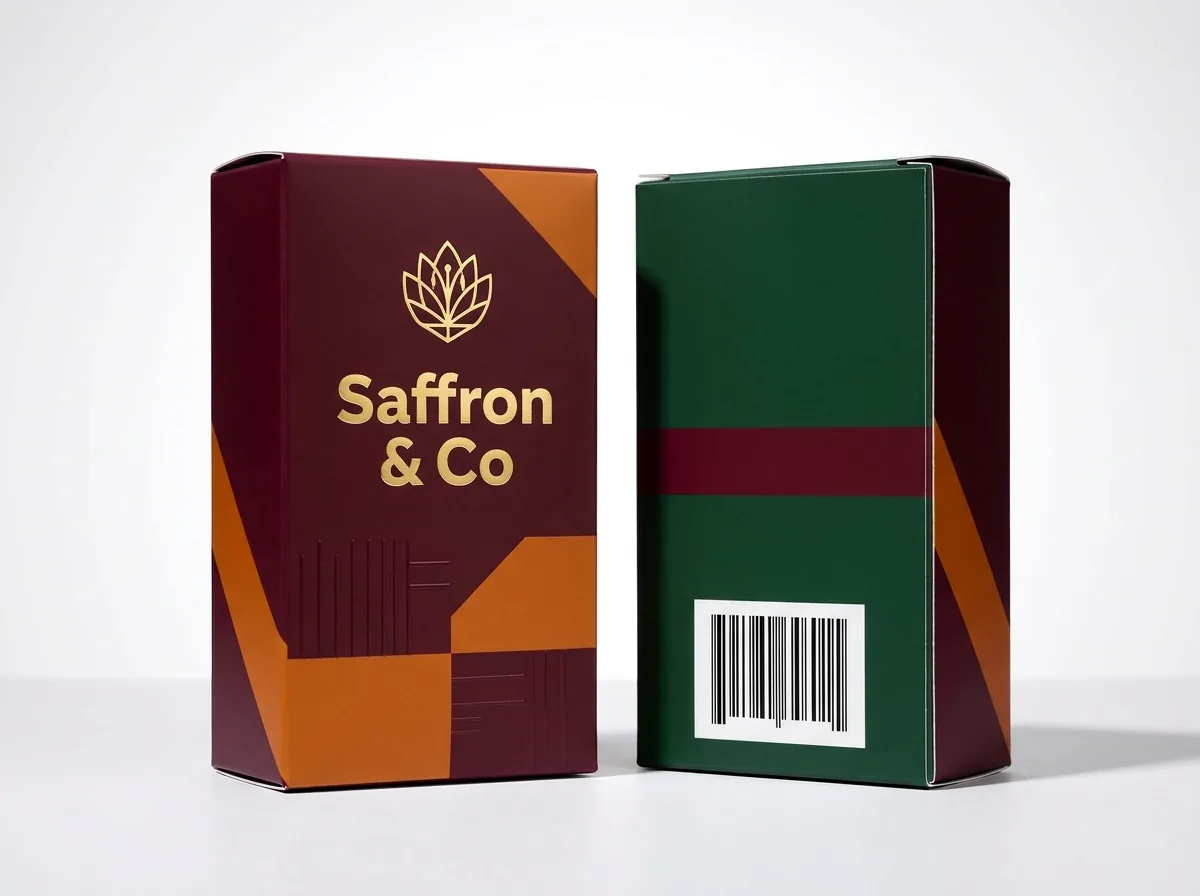
Every retail folding carton rebuilt from an AI mockup passes three prepress checks before you ever see an invoice. First, we strip away the artificial directional spotlight ChatGPT paints across the front face so your burgundy, emerald, or navy background prints evenly from edge to edge, either in calibrated four-color CMYK or guaranteed Pantone spot ink (if a Pantone color is clearly off, we reprint). Second, we generate a crisp black-on-white vector barcode from your real 12-digit GS1 UPC number and position it on the bottom or lower back panel at least 0.25 inches away from score lines so supermarket laser and camera scanners read it instantly. Third, we render your finished 2D dieline back into an interactive 3D mockup alongside your flat PDF proof. You rotate every face, confirm flap order and inside copy, and pay 100 percent only once you approve. Quote replies arrive in 5 to 7 minutes with zero die or plate charges and free shipping across all 50 US states.
What mistakes happen when turning a ChatGPT or Claude mockup into a folding carton?
Watch out for these five common pitfalls when moving from conversational AI concepts to physical retail cartons
- Using a Claude SVG wireframe directly as a cutting die. Code-generated SVG boxes omit paperboard thickness offsets, tuck-ear tapers, and glue-free zones, causing lids to pop open or tear.
- Sizing the carton to exact bottle dimensions with zero clearance. Without 1/16 to 1/8 inch of breathing room, rigid glass jars bow paperboard walls and jam manual packing lines.
- Forgetting the four unseen panels behind a ChatGPT front view. Plan your back-panel ingredient list, company address, and barcode early so front-panel typography stays uncluttered.
- Printing ink across the side glue flap. Press varnish or heavy ink on the glue tab blocks folding-gluer adhesive; our prepress team masks glue zones down to bare paperboard.
- Leaving dark low-contrast backgrounds behind retail barcodes. Red, metallic, or dark backgrounds confuse red-laser checkout scanners; always place black vector bars inside a clean white box.
Packaging for this
Ready to order product boxes? Compare up to 3 quantities with a free 3D mockup.
Request a Quote →Questions about product boxes
Can I send a ChatGPT box image and a Google Doc of text without an Illustrator file?
Yes. Most customers send their exported ChatGPT PNG or WebP render, a plain document with front and back panel wording, and their product measurements. Our packaging designers engineer the 2D dieline and rebuild the vector artwork free with your order.
Can CubitPack use an SVG layout generated by Claude?
Yes, a Claude SVG layout is a helpful visual wireframe for showing where headlines, icons, nutrition tables, and badges belong on each panel. Our studio transfers that hierarchy onto an accurate CAD folding carton dieline with proper bleed, crease offsets, and outlined print fonts.
What is the minimum order quantity for custom product boxes made from AI designs?
Custom product boxes and paperboard folding cartons start at 250 units, corrugated mailer boxes start at 250 units, rigid boxes start at 50 units, and custom labels start at 500 pieces. Standard production runs 10 to 14 business days after proof approval, with 4 to 5 day rush available.
Will you create a working UPC barcode for my retail box or use the one in my AI image?
Never use barcode bars drawn by an image generator, because AI invents random decorative stripes that cannot scan. Provide your registered 12-digit GS1 number (or website URL for a QR code) and we place a crisp, scan-ready vector barcode on your dieline.
What if my ChatGPT mockup shows gold foil, raised lettering, or a die-cut window?
Tell us which visual details on your render should become real physical upgrades. We create separate vector tooling paths for hot foil stamping, embossing, debossing, spot UV, or die-cut PVC-free and clear windows so your finished carton matches the concept.
How fast will I get a quote and see a 3D mockup of my rebuilt carton?
We reply to quote requests in 5 to 7 minutes, backed by 24/7 live support and a dedicated account manager. Before you pay anything, you receive both a flat production PDF proof and an interactive 3D mockup to review every panel and fold.
Still have a question? Ask a packaging specialist.
Request a Quote →Request your product boxes quote
Tell us your size and quantities, and one dedicated account manager prepares pricing for each tier.
- Free design & AI-to-print studio + 3D mockup
- No die or plate charges · 4–5 day rush available
- Free shipping to all 50 states
- 10% off your first order
We checked ChatGPT raster outputs and Claude SVG wireframe limitations against commercial folding carton CAD tolerances, C1S paperboard caliper rules, FTC net-quantity labeling placement, and GS1 barcode quiet-zone standards. A packaging specialist verified every measurement. Spot something wrong? Tell us and we fix it.
Sources
What changed
- November 5, 2026: First published with comparison of online box builders versus studio dieline rebuilds, 6-panel carton unwrapping guide, and Claude + ChatGPT prepress tips.
More guides
New packaging guides by email
Sizes, materials and design tips. Unsubscribe anytime.