
Hang-tab tuck box vs connector window box vs tray-and-sleeve cable boxes: which fits your cord?
Short answer: Choose a slit-lock hang-tab tuck carton for 3 ft to 6 ft USB-C cords, a connector window box to show braided weaves and plug ends, an auto-lock bottom carton for heavy 15 ft to 25 ft HDMI or XLR cables, and a drawer box for keyboard cords. All custom cable boxes start at 1,000 units.
On this page
- How do the six main cable box structures compare side by side
- Connector peephole window vs closed Spot UV front: which converts better
- How do slit-lock flaps and auto-lock bases tame springy or heavy cables
- Why do coiled keyboard, Thunderbolt and audiophile cables use drawer sleeves
- Which structure works best for multi-pack e-commerce bundles and IT kits
- Common mistakes
- FAQs
Request a custom quoteFree dieline & 3D mockup
Selecting the right structure for a cable carton comes down to three physical forces: the outward spring tension of a coiled cord, the hanging weight of copper wire on a retail pegboard hook, and the need for shoppers to verify connector ends without ripping open the box. A lightweight 3-foot silicone charging cord hangs cleanly in a straight tuck carton with slit-lock flaps, whereas a 20-foot braided HDMI 2.1 or XLR microphone lead will push a plain tuck base open unless it sits on a pre-glued auto-lock bottom. Meanwhile, high-margin Thunderbolt 4/5 cords, audiophile IEM leads and reverse-coiled mechanical keyboard cables benefit from a slide-out tray-and-sleeve drawer box or a two-piece rigid box that frames the connectors like precision hardware. At CubitPack, every style of printed cable boxes includes free structural dielines, free design help and zero die or plate charges.
How do the six main cable box structures compare side by side?
Before locking in your carton dieline, weigh your coiled cable (including any metal connector shells, ferrite chokes or braided sleeving) and decide whether your customers buy primarily from self-serve retail peg hooks or online product pages. A structure that hangs straight on a store pegboard also needs to resist crushing inside an automated fulfillment tote. Use the comparison table below to match your cable category, weight and price tier to the right box structure and internal winder card. Notice how all four folding carton styles ship flat in compact master cases, take up minimal warehouse pallet space, and fold rapidly on your assembly line without separate rigid setup costs.
| Cable box style | Best cable category & weight | Key structural & display advantage |
|---|---|---|
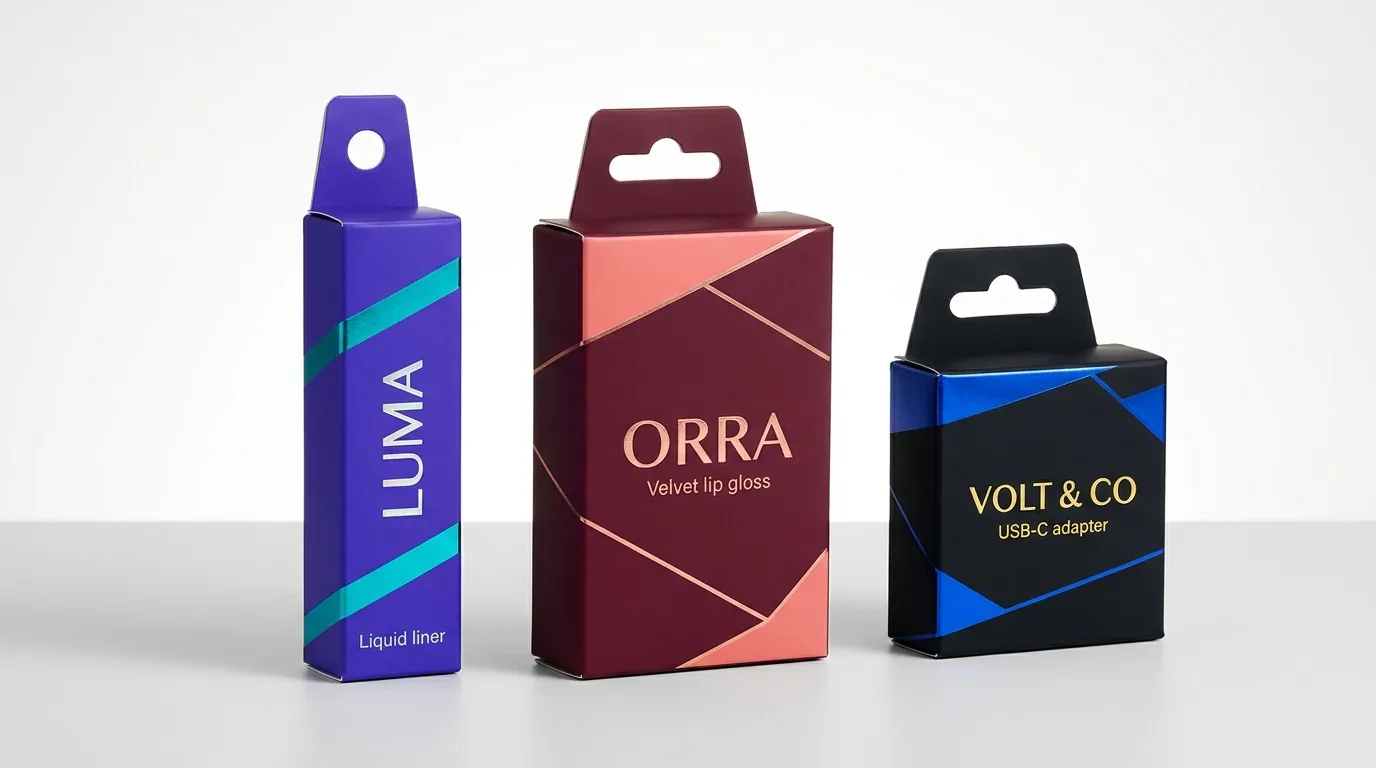
| Hang-tab straight tuck (with slit locks) | 3 ft-6 ft USB-C, Lightning & DAC dongles (under 5 oz) | Unbroken front face for 1:1 Spot UV plug render; lowest unit cost |
| Connector peephole window box | Braided nylon USB-C, HDMI 2.1 & optical leads (3-10 oz) | Shows real anodized plug shells & braided weave through a window |
| Auto-lock bottom hang-tab box | 15 ft-25 ft HDMI, Cat6A Ethernet & XLR mic cables (8-28 oz) | Pre-glued crash-lock base supports heavy copper reels without sagging |
| Tray and sleeve (drawer box) | Thunderbolt 4/5, coiled keyboard aviator & audiophile cords | Slide-out drawer reveals full unbent coil & metal couplings |
| E-flute corrugated mailer | Multi-pack patch bundles, 5-pack IT kits & server leads | Crush-resistant fluted walls ship direct in the mail without outer box |
| Two-piece rigid setup box | Custom sleeved PC PSU cable kits & flagship studio interconnects | Dense rigid board + die-cut EVA foam bed for keepsake storage |
Connector peephole window vs closed Spot UV front: which converts better?
In brick-and-mortar electronics stores, shoppers hesitate when buying a cable if they cannot confirm two details: the exact shape of both connector tips (for example, USB-C to USB-C vs USB-A to USB-C, or standard HDMI vs Mini-HDMI) and the build quality of the strain relief and braided jacket. You can solve that hesitation in two ways. The first option is a connector peephole window box: we die-cut a compact 2.00 × 1.50 inch window near the top of the front panel and pair it with an internal paperboard spool card that parks both actual metal connector heads side by side right behind the opening, while hiding the messy coiled wire below the solid lower panel. The second option is a closed straight-tuck front panel finished in glare-free matte lamination with a 1:1 actual-size gloss Spot UV photograph of both connectors and the braided weave. Closed Spot UV fronts cost slightly less per unit because they skip window patching, and they never suffer from scuffed window film in transit. They also give you 100% paperboard curb recyclability without needing a cellulose window patch, making them a strong fit for eco-focused retail chains and online tech brands.

How do slit-lock flaps and auto-lock bases tame springy or heavy cables?
A coiled cable is an active load inside a folding carton. When your assembly team winds a 6-foot braided USB-C cord or a 10-foot DisplayPort cable and slides it into the box, the coil immediately tries to unwind and pushes outward against the side walls and end flaps. On a standard friction-tuck carton, that constant outward spring tension can cause the top or bottom flap to pop open on the retail peg hook. For lightweight 3-foot to 10-foot cords under 6 ounces, the fix is zero-cost structural geometry: we add slit-lock notches (also called ear locks) to the top and bottom tuck flaps on our straight tuck end boxes so the flap ears hook positively into the side dust flaps. Once your cable weight crosses 8 ounces, such as a 15-foot or 25-foot braided HDMI lead, a heavy XLR microphone cord or a 3-pack of 10-foot charging cables, switch the base to our auto lock bottom boxes so the pre-glued crash bottom holds up to 2 pounds of copper wire securely.
- Slit-lock (ear-lock) tuck flaps: positive mechanical notches lock into the dust flaps so springy coils cannot push the lid open.
- Pre-glued auto-lock bottom: folds flat for shipping, pops into a locked floor in one second, and prevents heavy copper coils from dropping through.
- Double-layer Euro hang tab: reinforces the top pegboard slot on cartons holding 8 to 24 ounces of copper wire.
- Tamper-evident wafer seals: clear 0.75-inch stickers over the top and bottom flaps give an extra layer of retail security.
Know your size? Compare pricing across up to 3 quantities.
Request a Quote →Why do coiled keyboard, Thunderbolt and audiophile cables use drawer sleeves?
Enthusiast cables (such as 80Gbps Thunderbolt 5 cords, silver-plated IEM headphone cables, and custom mechanical keyboard cables with a reverse-wound coil and a 5-pin metal GX16 or YC8 aviator connector) sell at premium prices where presentation and zero-bend storage matter. A tray and sleeve box lets the buyer slide the outer sleeve off like a drawer to reveal the entire cable lying flat in a contoured paperboard or EVA foam insert. For coiled mechanical keyboard cables in particular, a wide 7.50 × 3.25 × 1.50 inch drawer tray keeps the 6-inch coiled barrel completely straight alongside the straight USB-A host tail, preventing coil distortion and turning the metal aviator coupling into the centerpiece of the unboxing. Customers also keep sturdy drawer trays on their desks to store spare keycap pullers, switches and interchangeable host tails.

Which structure works best for multi-pack e-commerce bundles and IT kits?
When customers buy cables online, 2-packs, 3-packs (such as a 3 ft + 6 ft + 10 ft family bundle) and 5-pack Ethernet patch sets frequently outsell single cords. Packing three loose coils into a thin single-wall carton causes the front and back panels to bulge into a pillow shape. For 2-pack and 3-pack retail/DTC bundles, we engineer a 3.50 × 1.50 × 5.00 inch hang-tab carton with an internal accordion paperboard divider that gives each coil its own flat lane, plus a fold-down Euro hang tab that stays flat inside e-commerce poly mailers. For larger 5-pack to 10-pack IT patch kits or custom PC power supply cable sets, a flat custom mailer box in E-flute corrugated board ships direct without an outer shipping box. Many electronics brands also pair a compact hang-tab folding carton for individual 3-foot and 6-foot retail SKUs with a matching tray-and-sleeve drawer box for their flagship Thunderbolt or braided pro-audio series. Because CubitPack never charges die or plate fees, you can run both structures across your line while keeping your brand colors, Pantone spot inks and front connector icon grid consistent from pegboard entry models to studio editions.
What are the most common mistakes when choosing a cable box style?
Picking the wrong box structure for your cable gauge leads to popped flaps on the shelf or damaged coils in transit. Avoid these five mistakes
- Using plain friction tuck flaps without slit locks on stiff braided nylon or HDMI cords that spring open inside the carton.
- Packing a heavy 15-foot to 25-foot HDMI or XLR copper cable into a tuck-bottom box instead of a pre-glued auto-lock bottom.
- Cutting a full-height front window that exposes the messy lower wire coil instead of a compact top peephole window that frames only the two connector plugs.
- Forcing a straight coiled mechanical keyboard aviator cable into a small square box instead of a flat 7.50 × 3.25 × 1.50 in drawer tray.
- Using stick-on plastic hang tabs on heavy multi-pack cable cartons instead of an integral double-layer Euro slot cut into the back panel.
Find your size
Suggested inside size: 2.75 × 0.875 × 4.00 in
A starting point. Your account manager confirms the size with you before the proof.
Quote this size →Packaging for this


Ready to order cable boxes? Compare up to 3 quantities with a free 3D mockup.
Request a Quote →Questions about cable boxes
Which cable box style is the most cost-effective at the 1,000-unit minimum?
A straight tuck end folding carton with slit-lock flaps and an integral Euro hang tab has the lowest unit cost at 1,000 units. It die-cuts from a single flat sheet of paperboard, ships flat, and works for both retail peg hooks and online orders.
Does adding a connector peephole window increase the box cost significantly?
A small window adds very little to the unit cost, and if you choose an open windowless cutout (so shoppers can touch the braided jacket and anodized connector shells directly), there is zero extra cost over a standard carton.
At what cable weight should I switch from a straight tuck bottom to an auto-lock bottom?
Switch to a pre-glued auto-lock bottom once your coiled cable or multi-pack bundle exceeds 7 to 8 ounces (typical for 10 ft to 25 ft HDMI leads, XLR audio cables and 3-pack braided cord bundles).
Can a hang-tab cable box also ship in e-commerce poly mailers without the tab bending?
Yes. We score a fold-down integral Euro hang tab into the back panel. It stays folded 180 degrees flat against the back of the box for online fulfillment and flips up 90 degrees when hung on retail pegboard hooks.
How do you keep a connector window box looking neat without a plastic blister tray?
We replace plastic blisters with a flat die-cut paperboard winder card. The card has two precision slots near the top that grip both connector necks behind the window while hiding the coiled wire loop behind the lower printed panel.
Can I request structural dielines for both a window box and a drawer sleeve to compare?
Yes. CubitPack provides free structural dielines, free design help, a digital proof and a 3D mockup before you pay, and you can order our $50 sample kit (credited to your order) or custom physical prototypes.
Still have a question? Ask a packaging specialist.
Request a Quote →Request your cable boxes quote
Tell us your size and quantities, and one dedicated account manager prepares pricing for each tier.
- Free design & AI-to-print studio + 3D mockup
- No die or plate charges · 4–5 day rush available
- Free shipping to all 50 states
- 10% off your first order
This structural comparison is based on copper cable weight benchmarks, coil spring-back testing on slit-lock vs auto-lock cartons, and CubitPack production specifications in our published product specifications. A packaging specialist verified every row. Spot an error? Tell us and we will fix it.
Sources
What changed
- October 22, 2026: First published.
- October 22, 2026: Updated specifications, terminology, and verified source links.
More guides
New packaging guides by email
Sizes, materials and design tips. Unsubscribe anytime.