
What size serum box fits 15 ml, 30 ml and 50 ml dropper bottles?
Short answer: A standard 30 ml (1 oz) Boston round dropper bottle fits a 1.5 × 1.5 × 4.25 in carton, while a heavy flat-shoulder 30 ml bottle with a neck insert needs 1.75 × 1.75 × 4.625 in. Order custom serum boxes cut to your bottle's exact inside length, width and height.
On this page
- How do I measure a glass dropper bottle or airless pump for a box
- What are the standard inside box dimensions for 15 ml, 30 ml and 50 ml serums
- Why do Boston round and flat-shoulder 30 ml bottles need different box sizes
- How much space does a card neck insert or cradle add to a serum carton
- When should I widen a serum box for INCI text or multi-bottle kits
- Common mistakes
- FAQs
Request a custom quoteFree dieline & 3D mockup
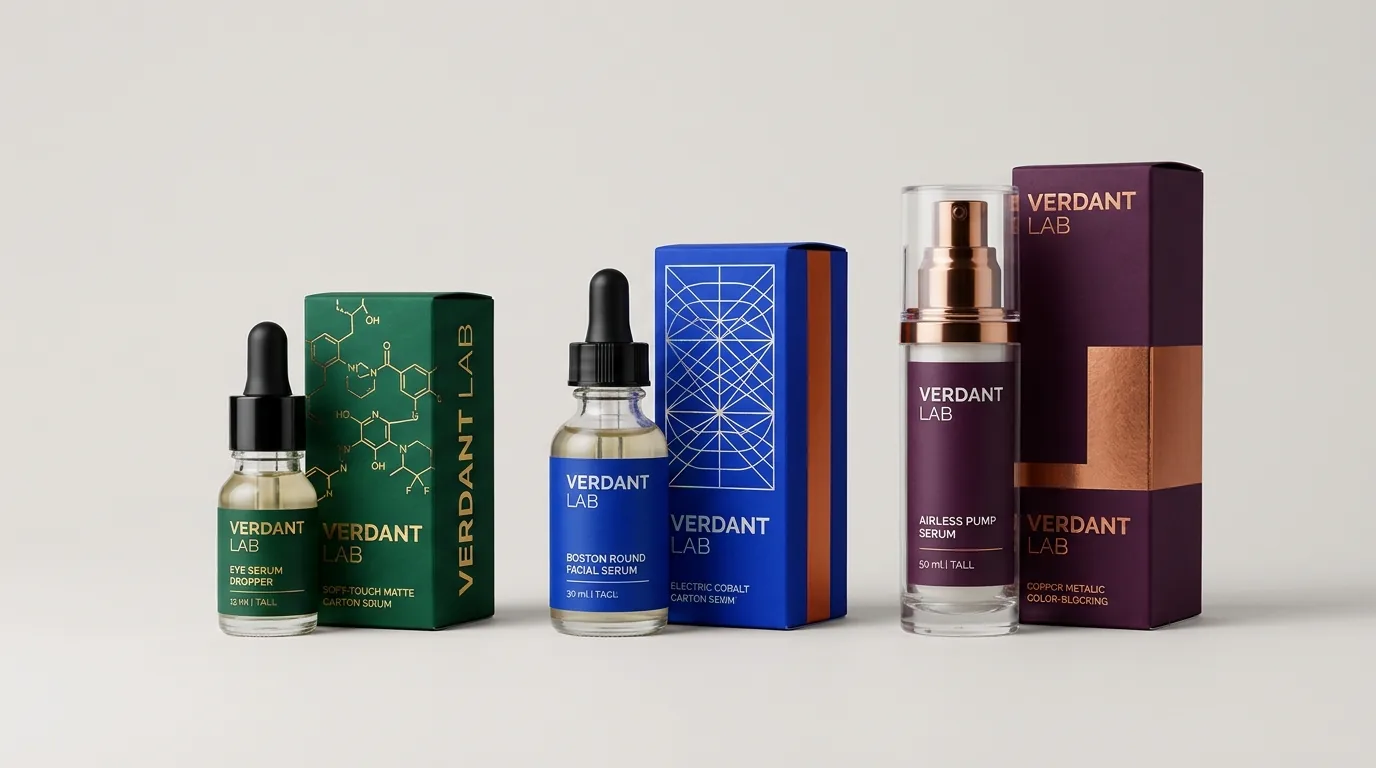
Sizing a serum box starts with measuring the capped bottle's outer diameter and total vertical height from the glass base to the tip of the rubber pipette bulb. Add 1/16 to 1/8 inch to the bottle diameter for the carton's inside length and width so the vial slides in smoothly without binding, and add 1/8 inch to the height so the top tuck flap closes flat without pressing down on the rubber dropper bulb. Typical inside sizes are 1.375 × 1.375 × 3.75 in for a 15 ml (0.5 oz) eye serum, 1.5 × 1.5 × 4.25 in for a standard 30 ml (1 oz) Boston round dropper, 1.75 × 1.75 × 4.625 in for a thick-walled 30 ml flat-shoulder bottle with a neck collar, and 2 × 2 × 5 in for a 50 ml (1.7 oz) treatment pump. Every CubitPack dieline is built to order with no die fees.
How do I measure a glass dropper bottle or airless pump for a box?
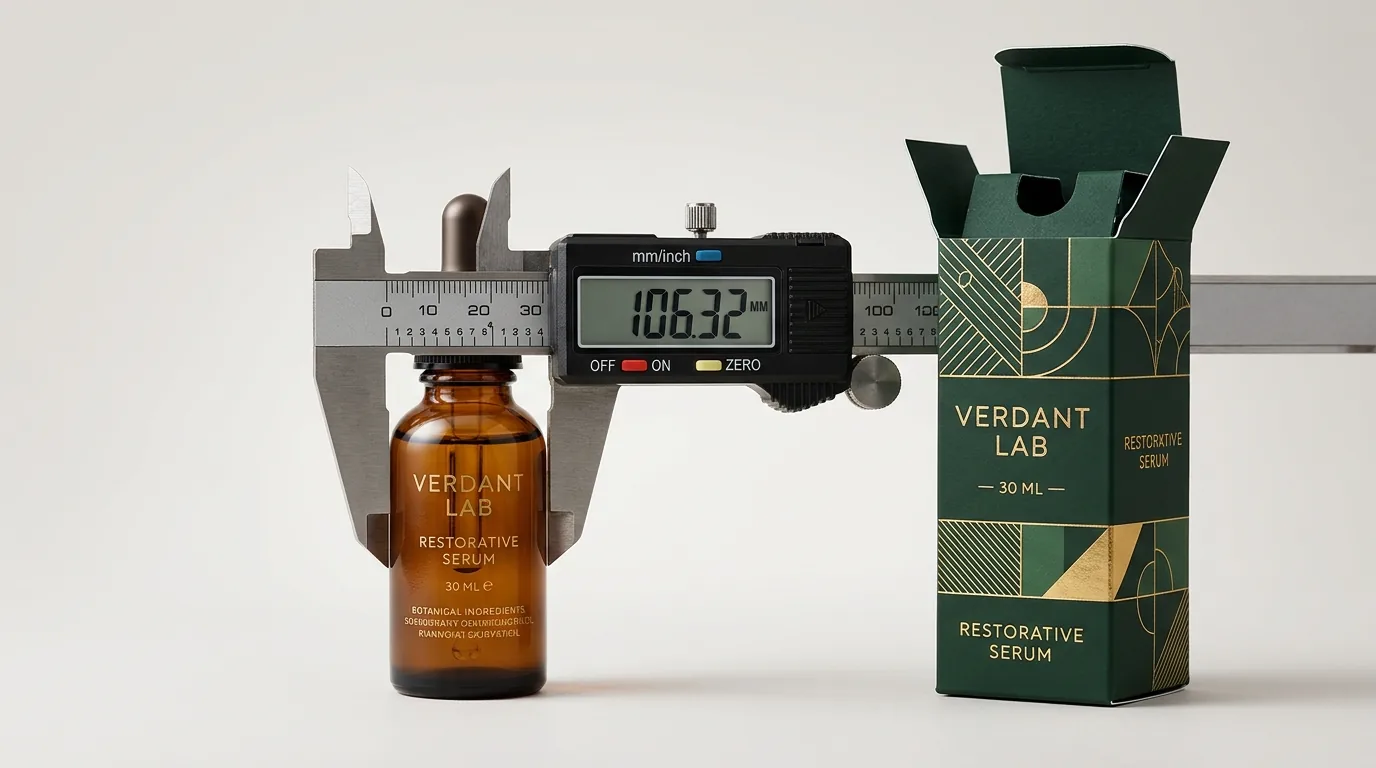
Never rely on the milliliter volume stamped on the bottom of a bottle to pick your carton size. Two 30 ml glass dropper bottles from different mold makers can vary by more than a quarter inch in width and half an inch in height because of heavy glass sham bases, wide flat shoulders or oversized metal dropper collars. Always measure a physical bottle with its dropper assembly or pump actuator screwed on to full torque. Use digital calipers or a flat millimeter/inch ruler across the widest part of the base to find the diameter. Next, stand the bottle on a flat table and measure straight up to the highest point of the rubber bulb or pump head. Because a round bottle sits inside a square carton, the bottle's diameter plus clearance sets both the length (left-to-right front width) and the width (front-to-back depth) of your printed serum cartons. Write the three numbers in inches as Length × Width × Height.
- Base diameter: measure across the widest part of the glass cylinder or square shoulder.
- Total capped height: measure from the flat table surface to the top tip of the rubber pipette bulb or overcap.
- Shoulder height and neck width: record where the glass bottle narrows if you plan to add a die-cut card neck brace.
- Standard clearance (no insert): add 1/16 to 1/8 in (0.0625 to 0.125 in) to length and width, and 1/8 in to height.
- Insert clearance: add 1/4 to 3/8 in to length and width when using a folded paperboard cradle around the bottle.
What are the standard inside box dimensions for 15 ml, 30 ml and 50 ml serums?
While CubitPack cuts every order to your exact dieline with zero die or plate charges, most skincare brands build around five bottle formats: 15 ml eye or lash vials, 30 ml Boston round droppers, 30 ml heavy flat-shoulder cylinders, 50 ml airless treatment pumps, and 60 ml scalp oil bottles. Compare the starting inside dimensions in the table below before checking your own glass spec sheet. Pay close attention to the difference between standard Boston round glass (which has gently sloped shoulders and thinner walls) and luxury heavy-wall cosmetic glass (which uses a thick glass punt at the bottom and sharp 90-degree shoulders). A heavy-wall 30 ml bottle is almost as wide and tall as a standard 50 ml bottle, so swapping glass suppliers midway through a launch always requires re-checking your carton dieline.
| Bottle size & style | Typical inside box size (L × W × H) | Recommended carton setup |
|---|---|---|
| 10 ml rollerball or ampoule vial | 1 × 1 × 3.5 in | Straight tuck end, no insert |
| 15 ml (0.5 oz) Boston round dropper | 1.375 × 1.375 × 3.75 in | Straight tuck end |
| 15 ml (0.5 oz) airless eye serum pump | 1.5 × 1.5 × 4.125 in | Straight tuck end |
| 30 ml (1 oz) Boston round dropper (snug) | 1.5 × 1.5 × 4.25 in | Straight or reverse tuck end |
| 30 ml (1 oz) heavy flat-shoulder dropper + collar | 1.75 × 1.75 × 4.625 in | Straight tuck end + neck tab |
| 50 ml (1.7 oz) glass dropper or airless pump | 2 × 2 × 5 in | Auto lock bottom + neck tab |
| 60 ml (2 oz) hair & scalp dropper bottle | 2.25 × 2.25 × 5.25 in | Auto lock bottom |
| Two 30 ml bottles (AM/PM regimen duo) | 3.5 × 1.75 × 4.5 in | Auto lock or tray & sleeve |
Why do Boston round and flat-shoulder 30 ml bottles need different box sizes?
Walk down any beauty aisle and you will see two main 30 ml (1 fl oz) glass silhouettes. The first is the classic apothecary Boston round, which measures roughly 1.31 inches (33 mm) across the base and 4.06 inches (103 mm) tall with a standard 20-400 dropper cap. Adding 3/16 inch of total clearance gives you the classic 1.5 × 1.5 × 4.25 in carton. The second silhouette is the thick-walled flat-shoulder cylinder favored by clinical and prestige skincare lines. That extra glass thickness pushes the outer diameter to 1.45 or 1.55 inches (37 to 39 mm) and raises the overall height to 4.35 inches (110 mm) or more, especially when paired with a metallized overshell collar or a push-button dropper cap. Trying to force a flat-shoulder bottle into a 1.5-inch carton bows the side walls outward and pops the bottom tuck flap open. Stepping up to 1.75 × 1.75 × 4.625 in gives the thicker glass room to slide in cleanly and leaves space for an internal shoulder brace.
Know your size? Compare pricing across up to 3 quantities.
Request a Quote →How much space does a card neck insert or cradle add to a serum carton?
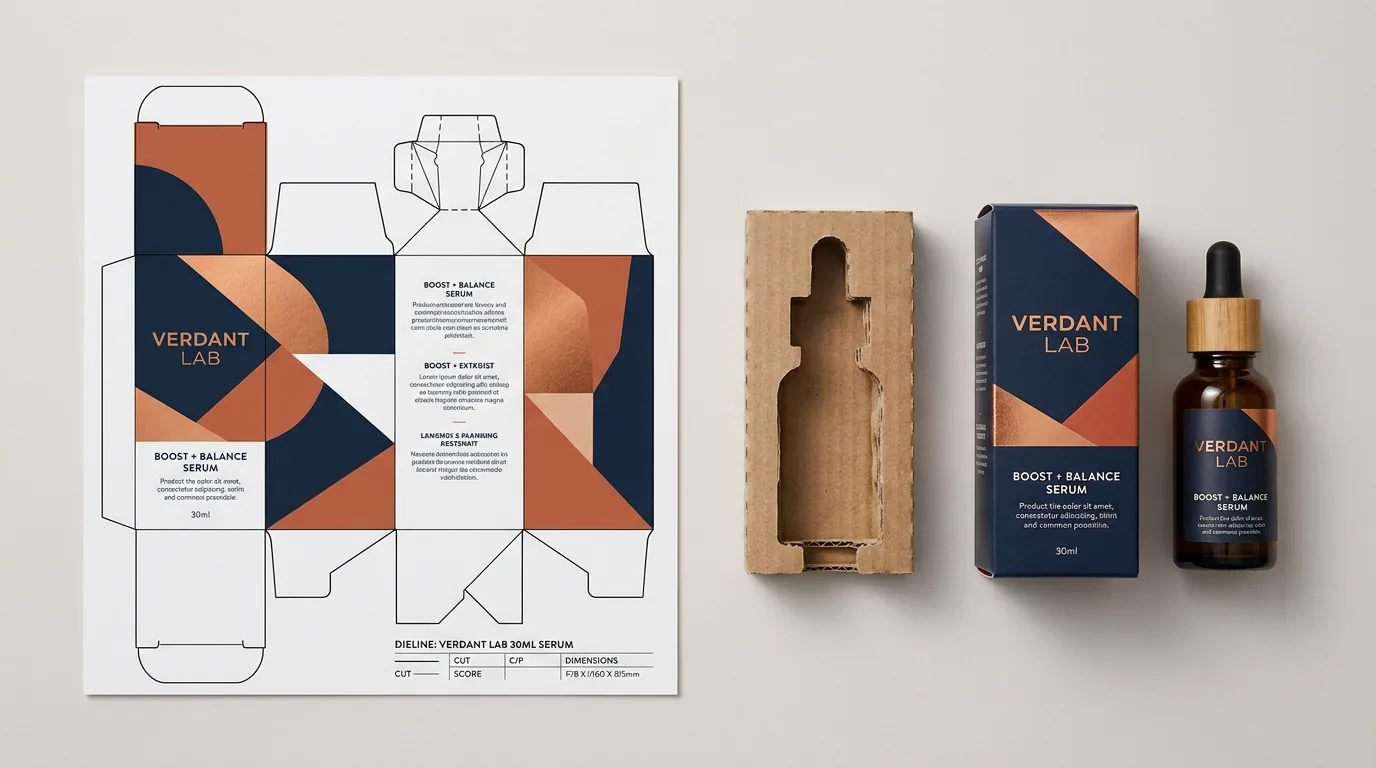
A glass dropper bottle has a narrow neck and a fragile glass pipette stem suspended inside. When a parcel drops on its top corner during direct-to-consumer shipping, an unbraced bottle can slide upward and crush the rubber bulb against the top flap, or tilt sideways and crack at the shoulder. A paperboard neck collar solves that problem without adding plastic foam. There are two ways to build a serum neck brace. The simplest is an extended fifth-panel or extended dust-flap tab built right into the one-piece straight tuck end box dieline: when your packer folds the top flaps, a die-cut ring drops down over the bottle neck and rests on the glass shoulder. That built-in tab adds zero extra width to the box and requires only about 1/16 inch of extra height allowance. The second option is a separate folded U-channel or full four-wall card sleeve with a die-cut hole at the top and a double-layered pad under the glass base. Because the separate insert wraps around the outside of the bottle walls, add 1/4 inch to 3/8 inch to both the length and width of the outer carton so the insert and bottle slide in together.
When should I widen a serum box for INCI text or multi-bottle kits?
Sometimes your formula or your retail channel dictates a slightly wider carton than the bottle alone requires. A 10 ml or 15 ml eye serum vial may only be 0.95 inches wide, which would fit inside a 1.125 × 1.125 in box. However, four panels of 1.125 inches rarely leave enough flat surface area for a readable 6 pt INCI ingredient list, usage warnings, distributor address, PAO symbol and a standard retail UPC barcode. In those cases, skincare brands intentionally step the outer carton up to 1.5 × 1.5 in or a rectangular 1.75 × 1.25 in footprint and add a folded card insert inside to center the slim vial. You get a wider front billboard on retail shelves, plenty of room for scannable barcodes and legible compliance text, and an extra air cushion around the glass. For two-bottle AM/PM regimens or three-vial discovery kits, measure the bottles lined up with at least 1/8 inch of card partition thickness between each vial so glass walls never clink together. You can also explore dedicated custom box inserts and custom skincare boxes when pairing a dropper serum with a wider moisturizer jar in one gift set.
- 15 ml slim vials: widen the carton to 1.5 in with an inner card sleeve if your INCI list exceeds 25 ingredients.
- UPC barcode panel: keep at least one flat panel 1.5 inches wide so a standard 80% magnification barcode scans with proper quiet zones.
- Two-bottle duo box: add both bottle diameters + 1/8 in center divider + 3/16 in outer wall clearance (typically 3.5 × 1.75 × 4.5 in).
- Three-bottle trio kit: allow 1/8 in between each cavity and upgrade the base to an auto lock bottom or tray-and-sleeve structure.
What are the most common serum box sizing mistakes?
A sixteenth of an inch makes the difference between a crisp fold and a bowed top flap on a narrow serum carton. Avoid these five sizing errors
- Measuring the glass bottle body without the dropper cap screwed in, leaving the carton 1 inch too short for the rubber bulb.
- Ordering a snug 1.5 × 1.5 in box and then deciding to add a separate corrugated or card liner without increasing the outer box width.
- Using catalog volume (30 ml) instead of caliper measurements when switching from a standard Boston round to a heavy flat-shoulder bottle.
- Giving outside dimensions instead of inside dimensions on your quote. All folding cartons are engineered from inside length × width × height.
- Forgetting to check how the rubber pipette bulb sits under the dust flaps, which can tilt the dropper sideways if height is too tight.
Find your size
Suggested inside size: 1.375 × 1.375 × 3.75 in
A starting point. Your account manager confirms the size with you before the proof.
Quote this size →Packaging for this
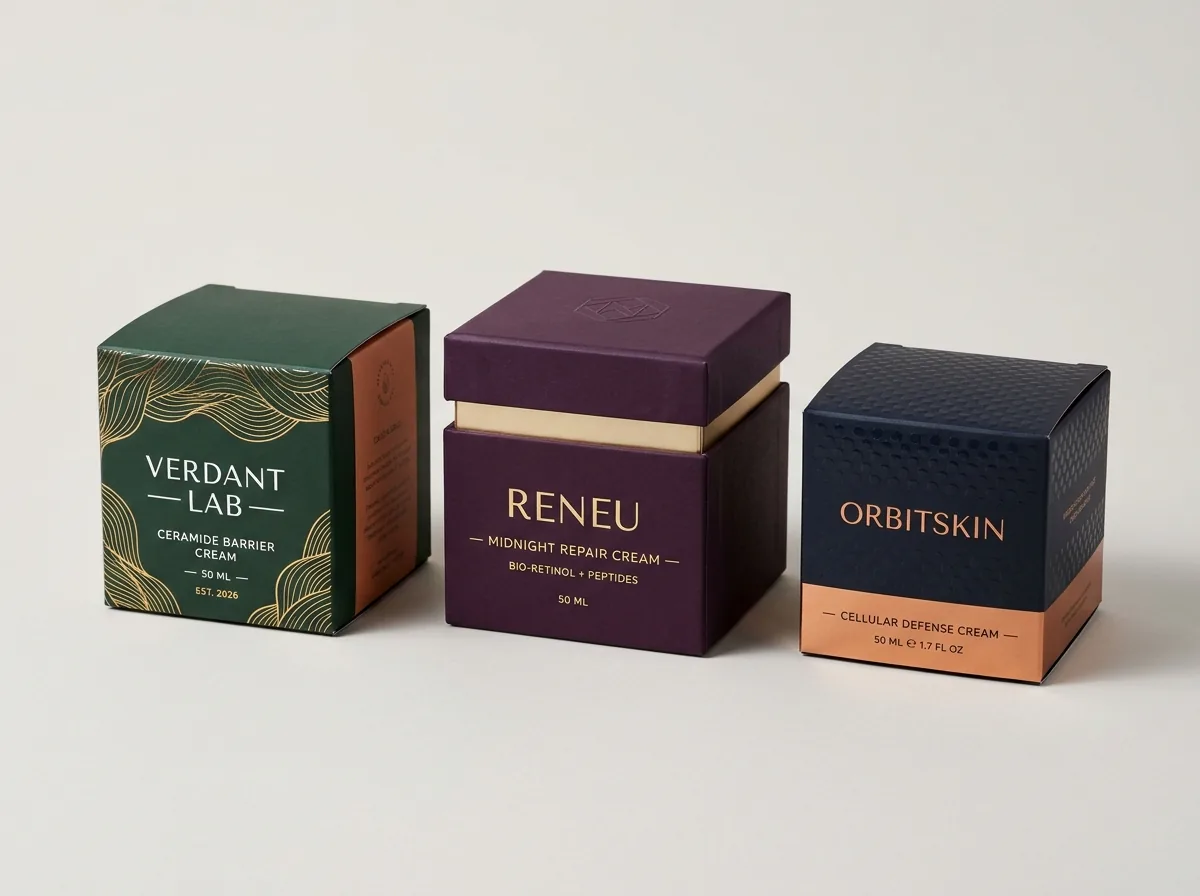
Ready to order serum boxes? Compare up to 3 quantities with a free 3D mockup.
Request a Quote →Questions about serum boxes
What is the most common box size for a 1 oz (30 ml) serum bottle?
The two most common inside sizes are 1.5 × 1.5 × 4.25 inches for a standard glass Boston round dropper bottle, and 1.75 × 1.75 × 4.625 inches for a heavy-wall flat-shoulder glass bottle or a bottle held by an internal card collar. Measure your capped bottle to confirm which footprint fits.
Are serum box dimensions listed as inside or outside measurements?
Always inside measurements: Length × Width × Height in inches. Because paperboard has its own thickness, and optional internal neck inserts take up space, quoting by inside dimensions guarantees your glass bottle slides in smoothly without bowing the walls.
How much taller than the dropper bottle should my serum box be?
Add about 1/8 inch (0.125 in) to the total height of your capped dropper bottle, or 3/16 inch if you include a bottom card pad and top neck brace. That small gap prevents the top dust flaps from pressing down on the flexible rubber pipette bulb.
Can I use a rectangular box instead of a square box for a round serum bottle?
Yes. Some brands use a slightly wider front face, such as 1.875 × 1.5 × 4.5 inches, with a fitted card insert inside. A wider front panel gives your product name more shelf presence and provides wider front and back panels for multi-language text.
Do I pay a custom die fee if my bottle needs an exact 1/16-inch size?
No. CubitPack charges zero die or plate fees on custom serum boxes. Whether your bottle needs 1.4375 × 1.4375 × 4.1875 inches or a standard 1.5 × 1.5 × 4.25 inches, we build your custom dieline and 3D proof at no extra cost.
Can I test the fit of my serum bottle before the full 1,000-box run?
Yes. Every order includes a free 2D dieline proof and 3D mockup before payment, and you can also order a paid printed sample of your exact box and neck insert (credited toward your full order) to test physical bottle fit in your hands.
Still have a question? Ask a packaging specialist.
Request a Quote →Request your serum boxes quote
Tell us your size and quantities, and one dedicated account manager prepares pricing for each tier.
- Free design & AI-to-print studio + 3D mockup
- No die or plate charges · 4–5 day rush available
- Free shipping to all 50 states
- 10% off your first order
The inside dimensions in this guide were calculated from standard 15 ml, 30 ml and 50 ml Boston round and flat-shoulder glass dropper molds (20-400 and 22-400 neck finishes) with 1/16 to 1/8 inch wall clearance and 1/4 inch insert allowances. A CubitPack packaging specialist reviewed every measurement. Spot something off? Let us know and we will fix it.
Sources
What changed
- October 22, 2026: First published.
- October 22, 2026: Updated specifications, terminology, and verified source links.
More guides
New packaging guides by email
Sizes, materials and design tips. Unsubscribe anytime.