
How do I design shade numbers, swatch bands and INCI text on custom foundation boxes?
Short answer: Build one master dieline for your entire foundation collection where the brand logo, finish callout and INCI ingredient panel stay fixed, and isolate the shade number, undertone code, printed swatch band and barcode into a swap-out zone on the top tuck flap and lower front face of your custom foundation boxes.
On this page
- How do I structure a master dieline for 20 to 50 foundation shades
- What belongs on each panel of a retail foundation carton
- How do I keep printed skin-tone swatch bands from shifting warm or cool
- How can I use foil stamping, embossing or spot UV across 30 shades without extra fees
- How do I keep 6 pt INCI ingredient text and barcodes sharp on dark boxes
- Should I use a printed swatch band or a die-cut bottle window
- Common mistakes
- FAQs
Request a custom quoteFree dieline & 3D mockup
Launching a complexion line means managing 15 to 50 separate SKUs that look unified from three feet away yet unmistakably distinct when a shopper or warehouse picker reaches for a specific shade. Instead of designing each carton from scratch, set up a modular master artwork file on one shared dieline. Place a bold alphanumeric shade code (such as 140C or 320W) and a color-calibrated swatch bar across the top tuck flap and the lower front panel so the shade is readable whether cartons sit upright in acrylic store drawers or stand face-out on shelves. Keep your metallic foil stamping or embossing plate restricted to the fixed brand logo so one tooling setup serves every SKU. When you print with CubitPack, our prepress team checks every shade file, guarantees Pantone color matching, and sends a digital proof and 3D mockup before you pay.
How do I structure a master dieline for 20 to 50 foundation shades?
When a customer or retail associate scans a wall of custom printed foundation cartons, they look for three things in order: the formula name, the shade depth number, and the undertone letter (Cool, Warm, Neutral or Olive). If those elements jump around between SKUs or sit in tiny 6 pt type on the back panel, shoppers open boxes to check the bottle inside, leaving torn flaps and unsellable testers on the shelf. Divide your dieline into two layers in Adobe Illustrator: a locked Master Layer that stays identical across every shade (brand wordmark, product claims, usage directions, company address, and shared INCI 'May Contain (+/-)' pigment list) and a Variable Shade Layer that holds the top-flap color flood, the front swatch band, the shade number/name, and the unique UPC/EAN barcode. That setup lets our prepress team preflight 30 shades in minutes and prevents copy-paste mistakes.
- Top tuck flap: flood the entire flap in the shade's swatch color and print the shade number in high-contrast black or white type (at least 12-14 pt).
- Upper front panel: keep your brand logo, metallic foil stamp or embossing identical across all shades.
- Lower front band: repeat the shade number, descriptive shade name (e.g., 240 Warm Sand) and net contents (30 mL / 1.0 fl. oz.).
- Back and side panels: place a single shared INCI ingredient declaration using a 'May Contain (+/-)' block for iron oxides and titanium dioxide.
- Barcode zone: reserve a 1.25 × 0.75 inch white box for each shade's unique retail barcode.
What belongs on each panel of a retail foundation carton?
Outer cosmetic cartons sold in the United States must satisfy FDA Fair Packaging and Labeling Act (FPLA) rules, plus OTC Drug Facts formatting if your foundation claims an SPF rating, without crowding your front branding. Because a 30 ml bottle carton gives you four vertical walls around 1.5 to 1.75 inches wide and 4.75 to 5.0 inches tall, every panel has a dedicated job. Use the panel-by-panel layout map below when briefing your designer or handing your files to CubitPack's free design help team.
| Carton panel | Primary content & required copy | Fixed vs variable across shades |
|---|---|---|
| Top tuck flap | Full-bleed shade swatch color + bold shade number & undertone (e.g. 210N) | Variable per shade SKU |
| Front panel (Principal Display Panel) | Brand logo, product identity ('Liquid Foundation'), finish, shade band & net wt / fl oz | Logo/identity fixed; lower shade bar variable |
| Back panel | Full INCI ingredient list with (+/-) pigment block, directions, PAO jar icon (e.g. 12M) | Fixed across range (if using +/- pigment list) |
| Left side panel | Coverage & finish guide, skin type icons, or OTC SPF Drug Facts table continuation | Fixed across range |
| Right side panel | Distributor name & street address, country of origin, recycling symbols, UPC barcode | Address fixed; UPC barcode variable per SKU |
| Interior walls (optional inside print) | Undertone chart, sponge/brush application steps, or refill instructions | Fixed across range |
How do I keep printed skin-tone swatch bands from shifting warm or cool?
Printing complexion shades on paperboard is one of the toughest color-management challenges in packaging. In standard 4-color CMYK printing, a 3% shift in magenta or yellow on press can turn an olive or neutral beige swatch band noticeably peach or ruddy. Adding gloss, matte or soft-touch lamination also slightly deepens the perceived tone of the ink underneath. To keep your printed shade bands true to the liquid formula inside the bottle, build your swatch palette using calibrated CMYK builds tested under your chosen lamination, or assign Pantone color printing spot inks for key brand and shade bars. At CubitPack, our Pantone match is guaranteed: if a Pantone color is clearly off, we reprint. For brand-new shade ranges, we also offer paid printed samples (credited to your full order) so you can hold the laminated carton beside a drawdown of your liquid foundation before approving the full run.
Know your size? Compare pricing across up to 3 quantities.
Request a Quote →How can I use foil stamping, embossing or spot UV across 30 shades without extra fees?
Many founders worry that adding foil stamping or embossing to a 30-shade foundation line will multiply setup costs thirty times over. The secret is keeping your mechanical finishing layers in the exact same coordinate position on every shade file while only changing the ink plates underneath. For example, if your brand logo and border are stamped in champagne gold foil on the upper half of the front panel, and your variable shade name is printed in CMYK ink on the lower third, all 30 shades use the exact same foil stamping die. Even better, CubitPack charges zero die or plate fees. You can also use spot UV over a soft-touch matte carton to visually signal formula finish, such as a high-gloss spot UV swatch bar for a dewy radiant foundation vs an unvarnished velvet swatch bar for a matte oil-control formula.
How do I keep 6 pt INCI ingredient text and barcodes sharp on dark boxes?
Long cosmetic INCI ingredient lists (especially on SPF foundations that also require an FDA Drug Facts box) must fit onto narrow 1.5-inch carton panels. When printing small 5.5 pt to 6 pt text on dark espresso, black or deep plum foundation boxes, avoid building the background out of four heavy CMYK channels that can fill in fine white reversed-out letters. Instead, keep small reversed-out ingredient text in a medium-weight sans-serif font (never ultra-thin serif strokes), or place the INCI block inside a clean high-contrast panel. For retail UPC barcodes, always print solid black bars on a white or very pale warm-cream box; never print barcodes in metallic gold foil or dark brown ink over a deep shade swatch, as infrared retail scanners cannot read low-contrast or reflective bars.
- Minimum font size: keep INCI ingredient lists at 5.5 pt to 6 pt or larger with at least 1.5 pt leading between lines.
- Reversed-out white type on dark boxes: use medium or semi-bold sans-serif strokes so ink spread does not close thin letter loops.
- Barcode quiet zone: leave at least 1/8 inch of solid white margin to the left and right of the black UPC bars.
- SPF Drug Facts box: follow standard FDA OTC hairlines, bullet spacing and active ingredient header formatting.
Should I use a printed swatch band or a die-cut bottle window?
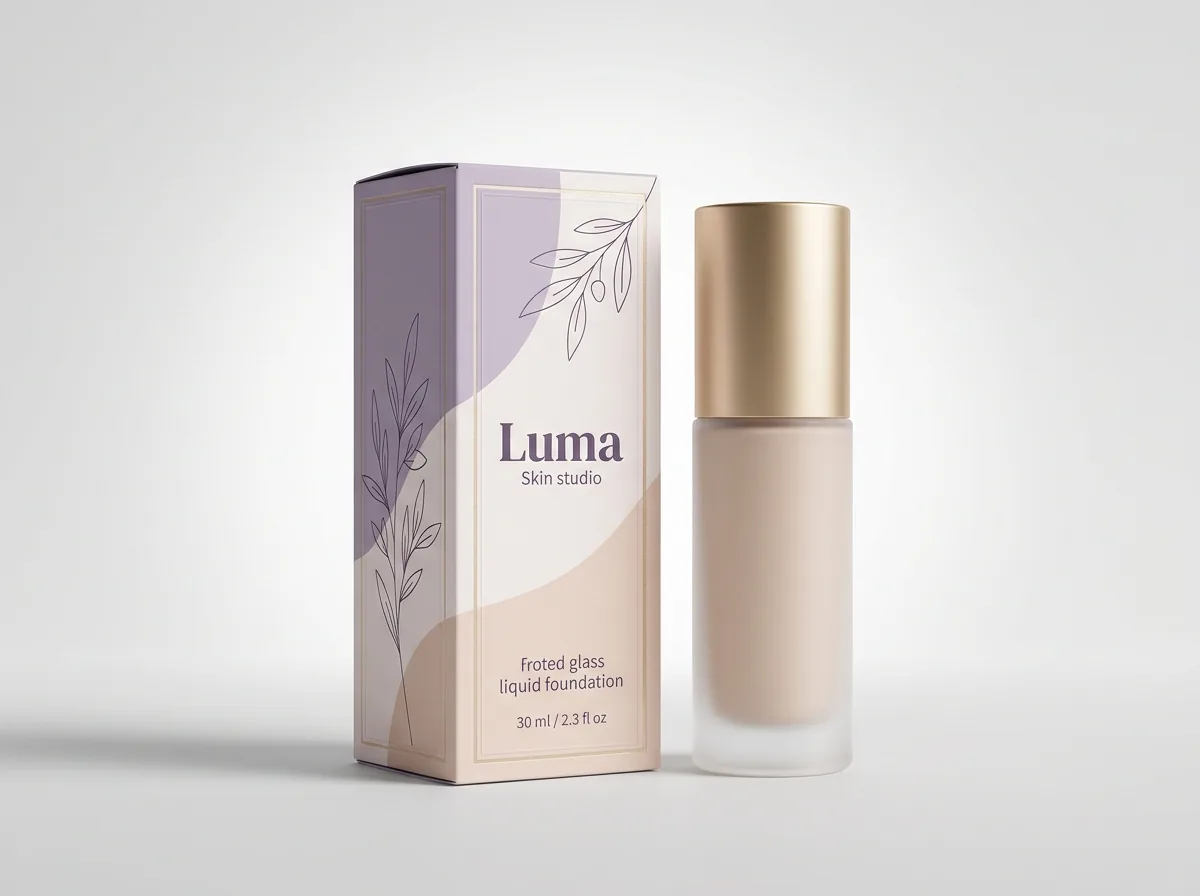
Beauty brands use two different methods to show the true complexion shade on the shelf: a printed color swatch band on solid paperboard, or a vertical die-cut window on the front panel of custom window boxes that lets shoppers see the frosted glass bottle inside. A die-cut peek window works well when your foundation is filled into clear or lightly frosted glass and paired with an internal card neck collar that stops the bottle from spinning backward. However, if your formula is light-sensitive, contains SPF actives, or sits in an opaque coated bottle or compact case, a window shows nothing of the actual shade. In those cases, a calibrated top-flap and front-panel swatch band, combined with a Spot UV gloss or soft-touch matte texture that mirrors the formula finish, gives customers a reliable shade cue while keeping all four carton walls solid and protective.
What are the most common foundation box artwork and shade-band mistakes?
Multi-shade cosmetic runs leave zero room for prepress guesswork. Check your files against these five mistakes before approving your proof
- Leaving the top tuck flap blank or identical across all shades, which makes it impossible to pick shades when cartons sit upright in store drawers or warehouse bins.
- Writing a separate INCI ingredient list for every shade instead of using a unified 'May Contain (+/-)' pigment block on the back panel.
- Printing retail UPC barcodes in metallic foil or over a dark skin-tone background where checkout scanners fail to read them.
- Using 4-color rich black for tiny 5 pt ingredient text, where a slight press registration shift makes the letters blurry.
- Forgetting to extend the top-flap shade swatch color 1/8 inch past the cut line into the bleed area, leaving an unprinted white hairline along the folded edge.
Find your size
Suggested inside size: 1.5 × 1.5 × 4.75 in
A starting point. Your account manager confirms the size with you before the proof.
Quote this size →Packaging for this
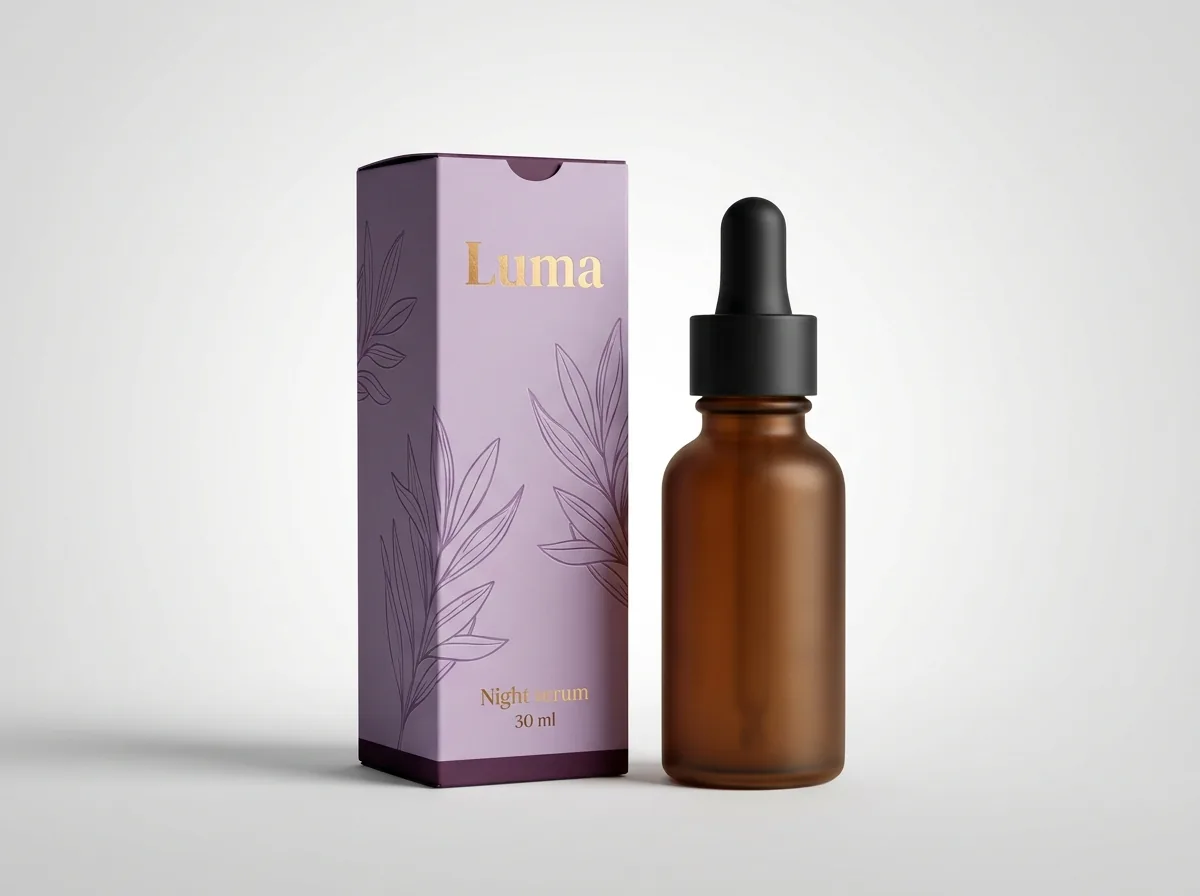
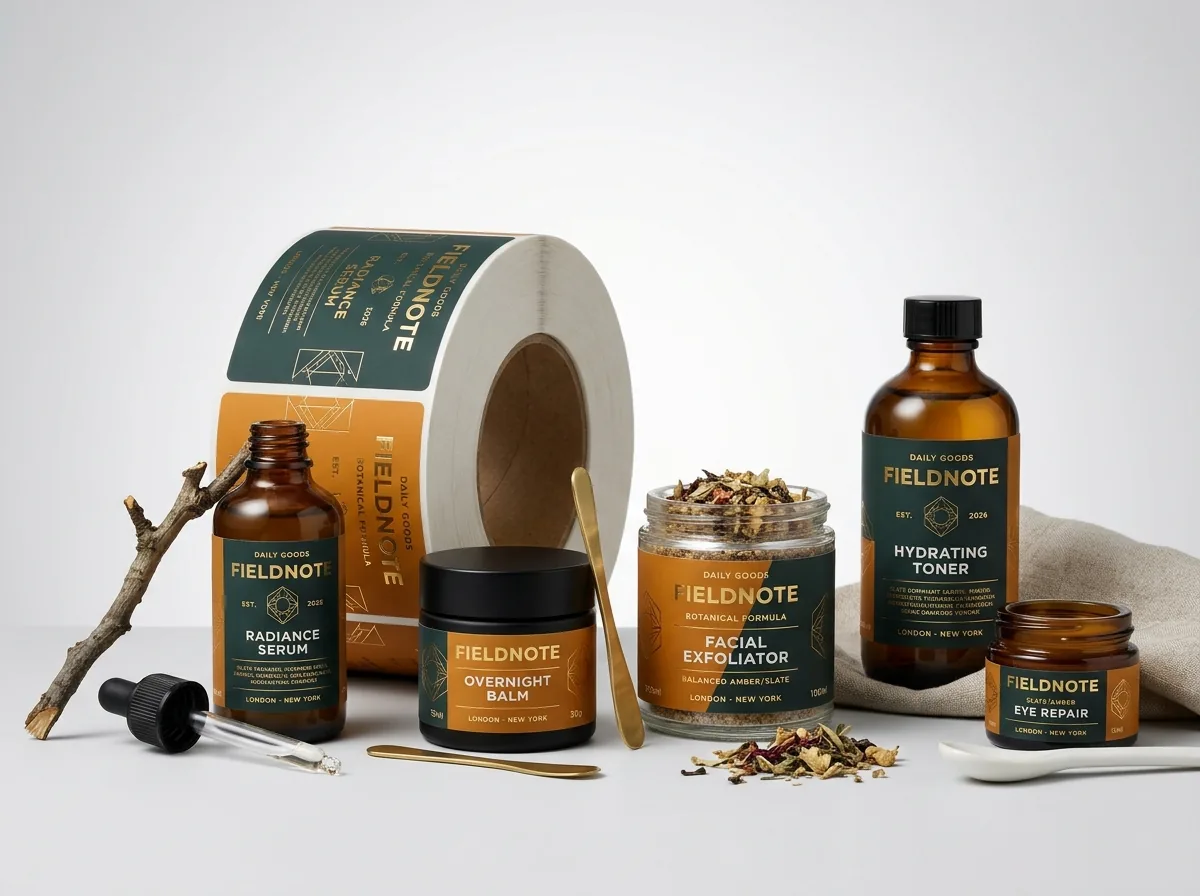
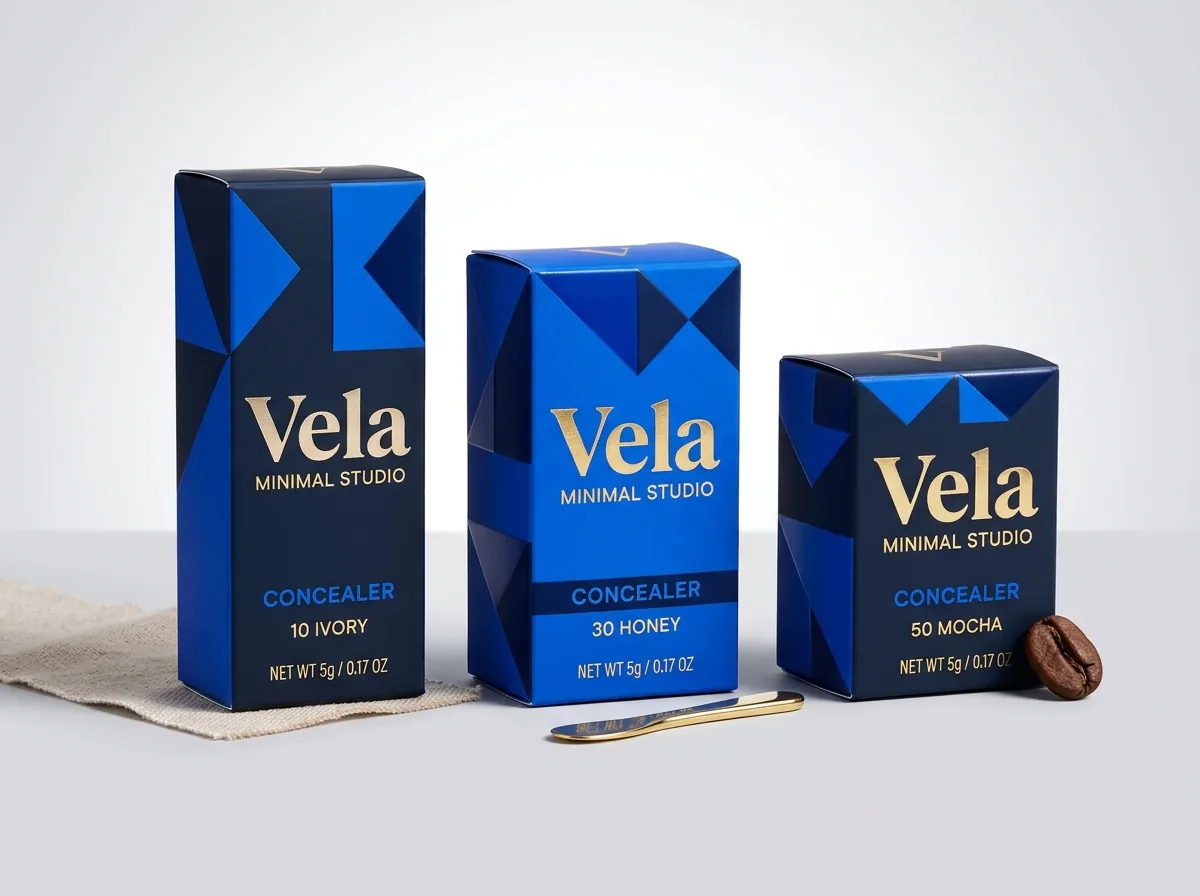
Ready to order foundation boxes? Compare up to 3 quantities with a free 3D mockup.
Request a Quote →Questions about foundation boxes
Can I use one INCI ingredient list across all my foundation shades?
Under US FDA cosmetic labeling rules (21 CFR 701.3), color cosmetics offered in a shade line that share the same base formula can list shared base ingredients first followed by a 'May Contain (+/-)' list of color additives. That lets all shades share one back-panel layout.
How many foundation shades can I combine in a 1,000-box order?
You can split your order across multiple shade designs on the same dieline. Pick 2 designs or 3+ designs in Step 2 of the quote form and paste your shade count and quantity breakdown in the notes so your account manager quotes the whole range.
Should I use CMYK or Pantone for foundation shade swatch bands?
If you have 30 shades, printing 30 separate custom Pantone spot inks is rarely practical, so most brands use color-calibrated CMYK for the individual shade bars and Pantone for the main brand color, verified first with a paid printed sample (credited to your order).
What if I prefer stick-on shade labels on a single master foundation box?
For small batch sizes per shade, some indie brands print one master foundation carton in bulk and apply custom printed round or rectangular shade stickers to the top flap. We can quote both the master cartons and custom cosmetic labels together.
Does soft-touch lamination change how the printed shade band looks?
Soft-touch and matte laminations diffuse reflected light, which makes skin-tone inks look slightly softer and less saturated than gloss lamination. Our prepress team accounts for your chosen finish, and you can verify the exact look on a printed sample.
What if I only have a concept or AI mockup for my foundation box?
Upload your AI image or rough sketch in the quote form. Our design team will rebuild it into clean vector typography, lay out your shade bands and INCI text on the custom dieline, and send you a 3D mockup for free.
Still have a question? Ask a packaging specialist.
Request a Quote →Request your foundation boxes quote
Tell us your size and quantities, and one dedicated account manager prepares pricing for each tier.
- Free design & AI-to-print studio + 3D mockup
- No die or plate charges · 4–5 day rush available
- Free shipping to all 50 states
- 10% off your first order
This guide combines US FDA cosmetic outer-carton labeling rules (21 CFR Part 701) with offset prepress standards for multi-SKU cosmetic cartons. Checked by a CubitPack packaging specialist. See a mistake? Let us know and we will fix it.
Sources
What changed
- October 22, 2026: First published.
- October 22, 2026: Updated specifications, terminology, and verified source links.
More guides
New packaging guides by email
Sizes, materials and design tips. Unsubscribe anytime.