
What size custom backing card fits enamel pins, earrings, necklaces, and keychains?
Short answer: Size custom backing cards by adding at least 3/8 inch of visible margin on each side of your item plus 5/8 inch at the top for pegboard slots: use 2 × 2 in for studs, 2 × 3.5 in for standard pins, 2.5 × 3.5 in for keychains, and 3 × 4 in for necklaces.
On this page
- What are the standard backing card dimensions for enamel pins, earrings, necklaces, hair clips, and keychains
- How much border margin and pegboard top headroom should I add around my product
- How do I pair backing card widths with clear OPP cello pouches so pin clutches slide in cleanly
- What backing card sizes drop directly inside rigid jewelry drawer and two-piece gift boxes
- How can I standardize one card dimension across multiple SKUs to save on order volume
- Common mistakes
- FAQs
Request a custom quoteFree dieline & 3D mockup
Choosing the right backing card dimension comes down to three measurements: the physical footprint of your pin, jewelry piece, or hair accessory, whether the card hangs on a retail peg hook or rests inside a gift box, and the interior width of any clear OPP poly pouch. Too small a card crowds your logo and lets earring dangles or metal keyrings swing past the bottom edge, scuffing adjacent items in transit. Too wide a card splits cello bag side seams or refuses to sit flat inside standard jewelry drawers. At CubitPack, we cut custom flat and folded display cards to any exact width and height starting from 250 standalone units, with free dieline setup, zero cutting-die or plate charges, a digital 2D proof and 3D mockup before payment, 10 to 14 business day turnaround (4 to 5 day rush available), and free 50-state US shipping.
What are the standard backing card dimensions for enamel pins, earrings, necklaces, hair clips, and keychains?
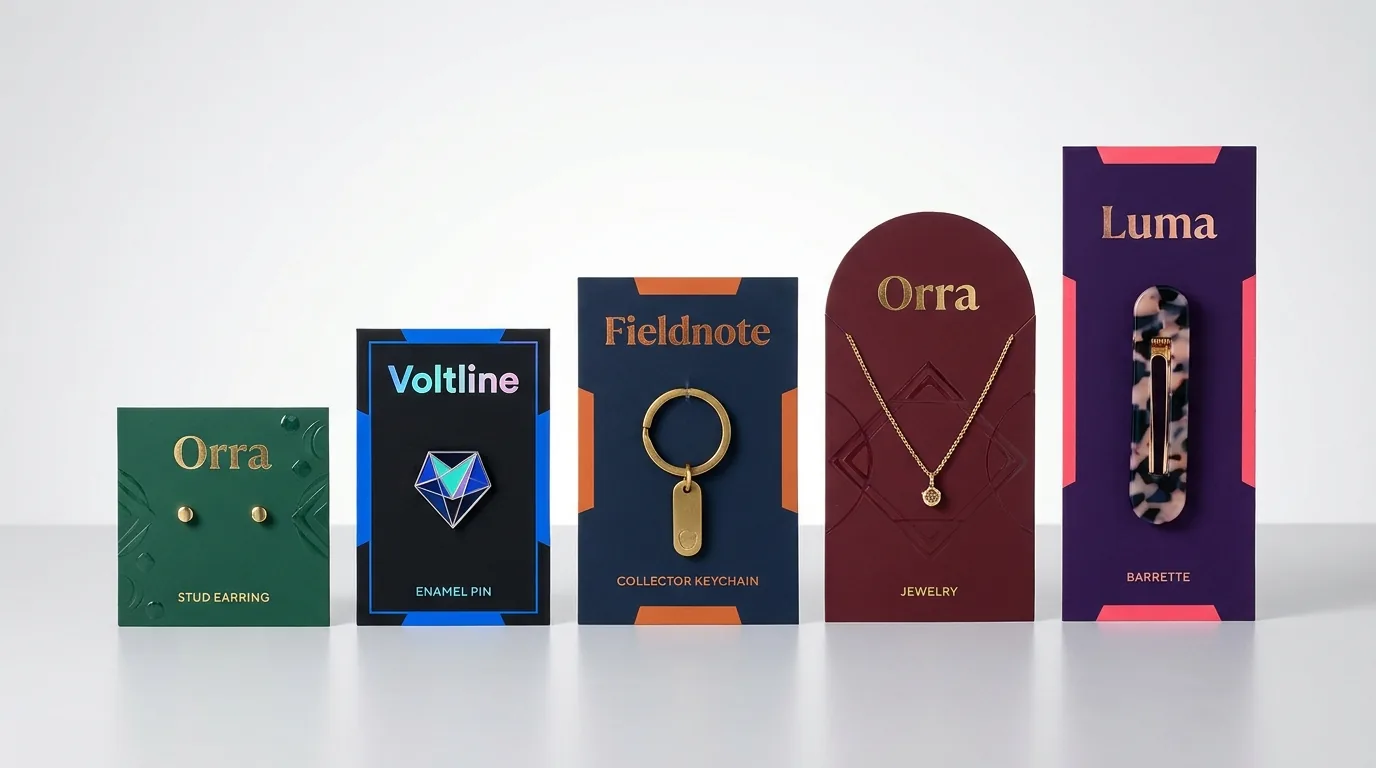
While CubitPack cuts die-cut retail backing cards to any custom fraction of an inch with zero die charges, six proven retail card footprints match existing boutique peg racks, collector binder sleeves, clear poly bags, and gift box trays. Review how your item hardware compares across these six sizes before locking your artwork canvas
- 2 × 2 inch square stud cards keep minimal ear stacks compact inside custom earring boxes without overwhelming delicate 3 mm to 6 mm gemstone bezels.
- 2 × 3.5 inch vertical cards remain the everyday workhorse for 1.25 inch single-post and dual-post lapel pins because makers can print vertical background illustrations that frame the metal pin.
- 2.5 × 3.5 inch collector cards match standard trading-card pocket pages, making them popular with convention pin series, artist alleys, and blind-pack collectibles.
- 3 × 4 inch and 3.5 × 5 inch cards provide the horizontal shoulder width required for 45-degree necklace chain slits, wide French-barrette clasps, and Euro sombrero hang slots.
| Card dimension (W × H) | Primary products & max item width | Typical cutout layout | Matching cello bag or box interior |
|---|---|---|---|
| 2 × 2 in square | Mini stud pairs, nose studs, 0.75 in collar pins (up to 1.25 in wide) | 2 paired 1.2 mm post holes, centered logo above | 2.25 × 2.5 in OPP bag · 2.5 × 2.5 in earring box |
| 2 × 3.5 in business ratio | 1.0 to 1.5 in hard/soft enamel pins, huggie hoops, 1.75 in drop earrings | 1-2 vertical post holes + optional 1/4 in peg hole | 2.25 × 4 in OPP bag · 3.5 × 3.5 in drawer box |
| 2.5 × 3.5 in trading ratio | 1.75 in collector pins, acrylic charms, compact brass keychains | Dual pin holes or top keyring notch + Euro hang slot | 2.625 × 3.75 in collector sleeve · 2.75 × 4 in bag |
| 3 × 4 in boutique portrait | 16-20 in pendant necklaces, 3-pair ear stacks, 2.5 in snap barrettes | 45-degree shoulder slits or 6-hole stud grid + Euro slot | 3.25 × 4.5 in hang pouch · 3.5 × 4.5 in jewelry box |
| 3.5 × 5 in medium display | 3.5 in acetate claw clips, 3 in woven patches, enamel pin 3-packs | Horizontal clip windows or pinched waist + Euro slot | 3.75 × 5.5 in OPP bag · 4 × 6 in mailer box |
| 4 × 6 in multi-piece / folded | Statement necklace & earring sets, scrunchy trios, multi-charm kits | Multi-slit grid or pre-scored rear chain pocket + Euro slot | 4.25 × 6.5 in retail pouch · 5 × 7 in gift box |
How much border margin and pegboard top headroom should I add around my product?
Sizing a card solely to the width of a pin or pendant leaves zero visual breathing room and forces your brand wordmark right under the metal piece. Once you add a pegboard cutout, detailed in our companion backing card pin hole and hang slot placement guide, apply this four-edge margin formula to calculate finished width and height
- Left and right side margins (minimum 3/8 in / 9.5 mm per side): A 1.25 inch wide enamel pin needs at least a 2.0 inch wide card (1.25 + 0.375 + 0.375 = 2.0 in) so background artwork frames the silhouette and edges resist bending when buyers pick the card up.
- Top zone without a hang hole (1/2 in to 3/4 in): Reserve at least 0.5 to 0.75 inches above the top of your pin or stud pair so your foil-stamped logo or collection title reads clearly without touching metal hardware.
- Top zone with a round peg hole or Euro sombrero slot (5/8 in to 7/8 in additional height): A Euro slot needs a 0.25 inch solid paper bridge above the cutout, 0.375 inches for the slot height itself, and at least 0.25 inches below the slot before your logo starts.
- Bottom dangle and swing clearance (minimum 1/2 in below lowest point): Measure drop earrings, charm keychains, and pendant stones hanging under gravity, then keep the card bottom 0.5 inches below the lowest jump ring or tassel so metal never hits store shelves.
How do I pair backing card widths with clear OPP cello pouches so pin clutches slide in cleanly?
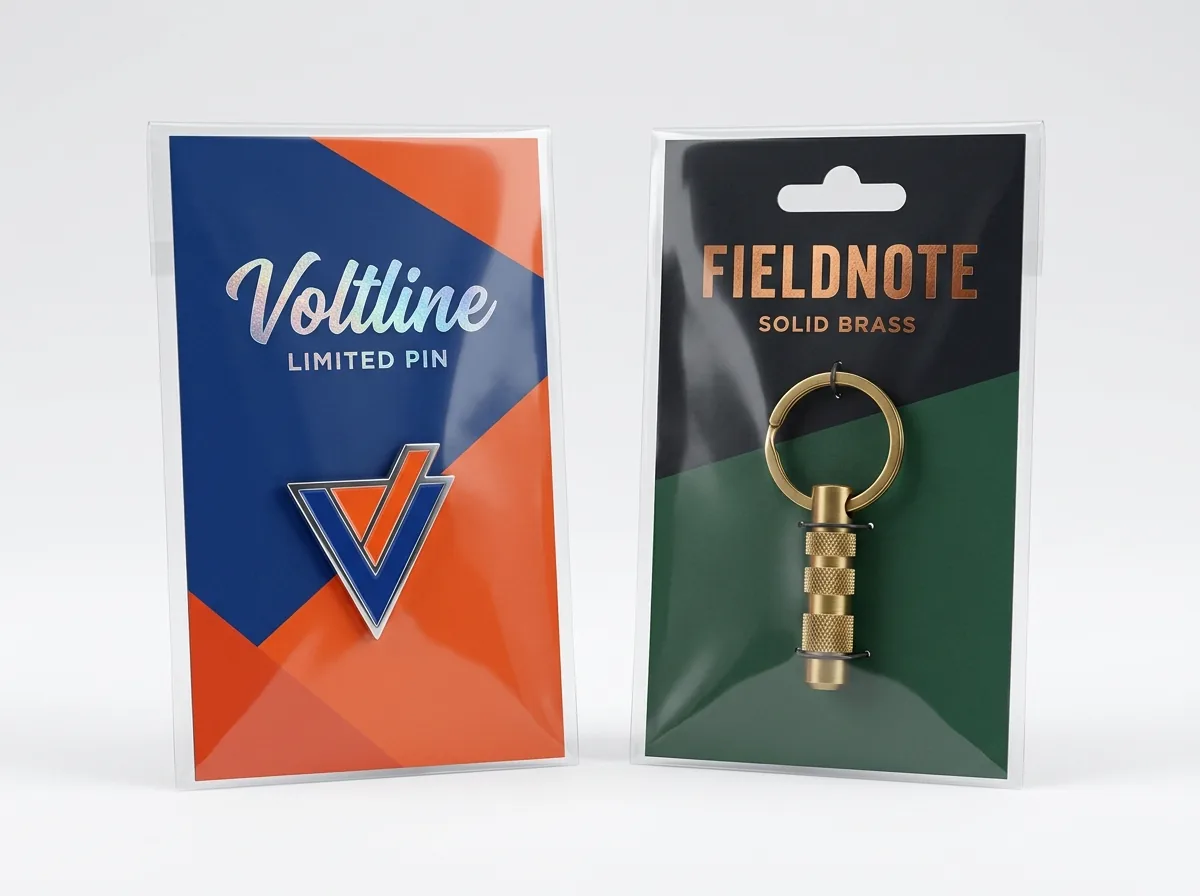
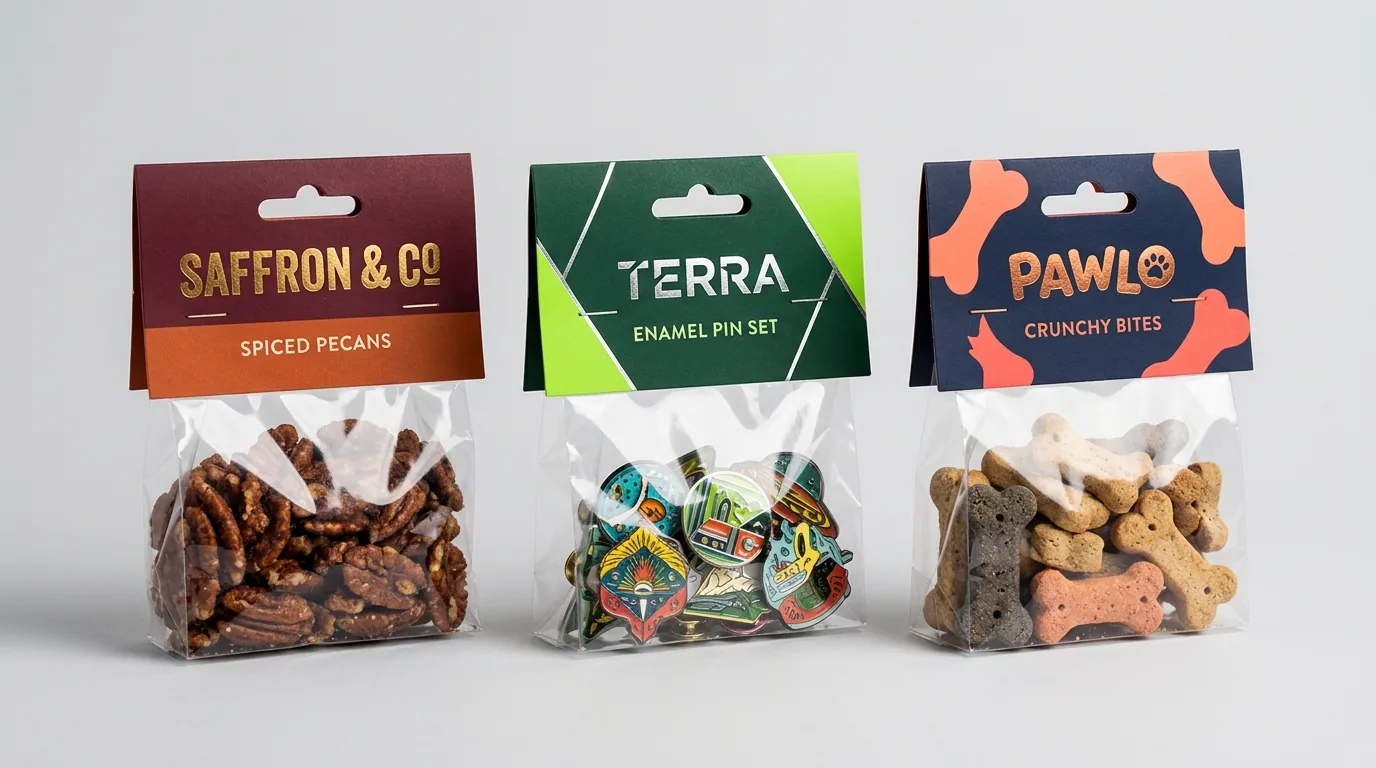
Boutique wholesalers, museum gift shops, and market vendors frequently slip carded pins, patches, and earrings inside clear self-seal polypropylene (OPP) sleeves or printed custom flat pouches to keep dust and fingerprints off finishes. Because flat poly bags have zero side gussets, protruding hardware steals horizontal bag width as soon as the bag wraps over the product
- Flat patches, stickers, and thin wire earrings (+1/8 in / 3 mm bag width margin): When combined card-plus-item thickness stays under 3 mm, a 3.0 inch wide card slides smoothly into a 3.125 inch or 3.25 inch wide clear sleeve without buckling.
- Enamel pins with black rubber or brass butterfly clutches (+1/4 in / 6 mm bag width margin): Standard pin posts plus rubber clutches project 8 mm to 10 mm behind the card, pulling the front and back bag walls inward. Pair a 2 × 3.5 inch pin card with a 2.25 × 4 inch bag, never a 2 × 4 inch bag.
- Chunky acetate claw clips, scrunchies, and split-ring keychains (+3/8 in to +1/2 in bag width margin): Measure the Z-height (front-to-back thickness) of the clip teeth or lobster clasp and add half of that thickness to your bag width allowance so heat-sealed side seams never split.
- Bottom lip fold clearance (+1/2 in bag length): Order clear self-seal bags at least 0.5 inches taller than your backing card height (plus product thickness) so the adhesive resealable flap folds tightly across the back without creasing the bottom edge of your board.
Know your size? Compare pricing across up to 3 quantities.
Request a Quote →What backing card sizes drop directly inside rigid jewelry drawer and two-piece gift boxes?
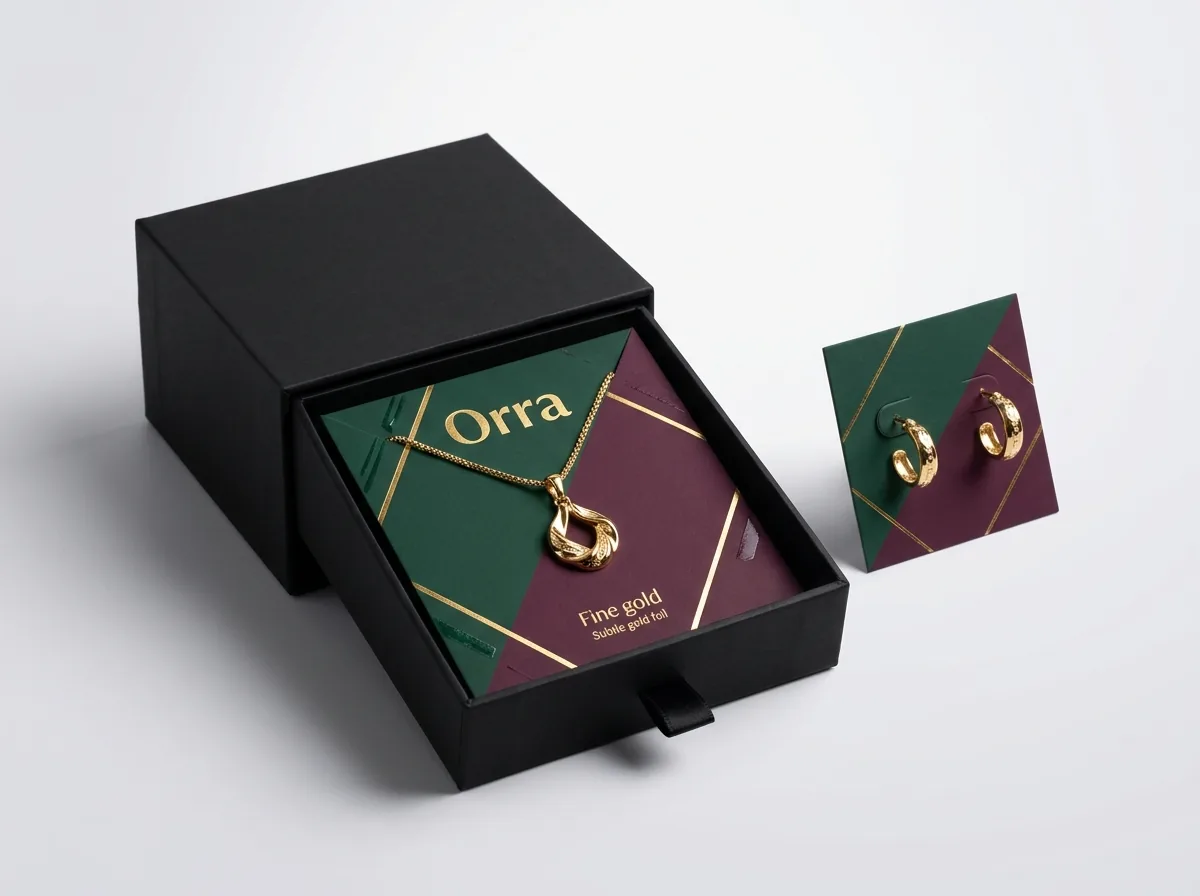
Many omni-channel jewelry and accessory brands design one dual-purpose card that hangs on retail showroom displays and also drops straight inside custom jewelry boxes or custom necklace boxes for online DTC orders. Coordinating card dimensions with inner box cavities eliminates separate foam pads for seasonal drops
- Deduct 1/8 inch (3 mm) from inside tray length and width: If your sliding rigid drawer box measures 3.5 × 3.5 × 1.25 inches inside, trim your square card to 3.375 × 3.375 inches (or center a 2 × 3.375 inch vertical card) so packers lift it in and out without scraping soft-touch walls.
- Account for rear clutch or chain-pocket height inside shallow lids: Standard 10 mm pin clutches or folded rear necklace pockets require at least 5/8 inch (16 mm) of interior box depth so closing a two-piece lid never presses earring posts crooked.
- Pair stiffer cardstock calipers when skipping a foam base: When a backing card acts as the primary tray insert inside a mailer or rigid box, check our cardstock thickness comparison for retail backing cards and use our paperboard thickness converter to compare caliper stiffness.
What sizing mistakes ruin enamel pin and jewelry backing cards?
Double-check your width, height, and bag pairings against these five common dimension errors before approving your digital dieline proof
- Ordering a 2.0 inch wide card for a 2.0 inch wide cello bag, forgetting that 10 mm rubber pin clutches pull the bag walls inward and split the side seams.
- Adding a 1.25 inch wide Euro sombrero hang slot to a narrow 1.5 inch wide strip card, leaving fragile side shoulders that kink on retail peg hooks.
- Measuring dangle earrings only across the top stud bezel while letting 2.5 inch drop charms hang past the bottom edge of a short 2 × 2 inch card.
- Cutting box-insert backing cards to the exact nominal outside dimension of a rigid jewelry box instead of 1/8 inch smaller than the inside tray cavity.
- Creating four slightly different custom card sizes (2 × 3, 2.25 × 3.5, 2.5 × 3.75, 2.75 × 4 in) across one collection when a single shared 2.5 × 3.5 in or 3 × 4 in footprint fits all four items.
Packaging for this

Ready to order backing cards? Compare up to 3 quantities with a free 3D mockup.
Request a Quote →Questions about backing cards
What is the standard backing card size for single and dual-post enamel pins?
The two industry-standard enamel pin card sizes are 2 × 3.5 inches (classic vertical business-card ratio for 1.0 to 1.5 inch pins) and 2.5 × 3.5 inches (trading-card ratio for 1.5 to 1.75 inch collector pins or pins needing a wide Euro hang slot).
What size backing card works for stud earrings vs dangle earrings and necklaces?
Single pairs of mini studs fit cleanly on a 2 × 2 inch square card. Drop or hoop earrings up to 2 inches tall use a 2 × 3.5 inch vertical card, while pendant necklaces and multi-pair ear stacks step up to 3 × 4 inches.
How much wider should my clear cello bag be than my custom backing card?
Order clear OPP cello pouches 1/8 inch wider than your backing card for flat woven patches or thin wire earrings, 1/4 inch wider for enamel pins with rubber clutches, and 3/8 to 1/2 inch wider for bulky claw clips or metal keyrings.
Does CubitPack charge extra for custom backing card sizes or arch silhouettes?
No. CubitPack charges zero cutting-die or printing plate fees, so custom square, collector, oversized, arch-top, scalloped, or pinched-waist backing card dimensions carry no extra tooling setup charge, starting from 250 standalone cards.
How much top height do I need to add when including a retail pegboard hang slot?
Add 5/8 inch to 7/8 inch of height at the top of your card when adding a 1/4 inch round peg hole or a 1.25 × 0.375 inch Euro sombrero slot. That reserves a tear-resistant 1/4 inch top bridge plus clean logo clearance.
Can I order custom backing cards sized to match my CubitPack jewelry boxes?
Yes. When you order custom backing cards alongside custom rigid drawer or two-piece jewelry boxes, our designers build both dielines together, trimming the card 1/8 inch inside the tray cavity and matching your paired box minimum order quantity.
Still have a question? Ask a packaging specialist.
Request a Quote →Request your backing cards quote
Tell us your size and quantities, and one dedicated account manager prepares pricing for each tier.
- Free design & AI-to-print studio + 3D mockup
- No die or plate charges · 4–5 day rush available
- Free shipping to all 50 states
- 10% off your first order
We checked retail pegboard Euro-slot dimensions, OPP cello pouch gussetless width allowances, and rigid jewelry tray clearance tolerances against commercial dieline practices, TAPPI paperboard standards, and GS1 barcode placement guidelines. A packaging specialist verified every size row and clearance formula. Spot something wrong? Tell us and we will fix it.
Sources
- Paperboard sheet tolerances, top hang-bridge tear strength principles, and caliper depth allowances.
- Minimum back-panel barcode footprint and quiet-zone margins on compact 2 x 3.5 in and 3 x 4 in retail cards.
- Bottom-edge swing clearance and tray fit tolerances preventing edge rub inside transit mailers and gift boxes.
What changed
- November 16, 2026: First published with 6-tier backing card dimension table, four-edge border and Euro-slot headroom math, OPP cello bag width clearances, and rigid jewelry box tray fit rules.
More guides
New packaging guides by email
Sizes, materials and design tips. Unsubscribe anytime.