
16 pt vs 24 pt vs double-thick cardstock: which weight keeps retail backing cards flat?
Short answer: When specifying cardstock thickness for custom backing cards, match board caliper to item weight: industry-standard 16 pt (0.016 in) suits light studs and woven patches under 8 g, 24 pt (0.024 in) supports dual-post enamel pins up to 25 g, and double-thick 32-38 pt duplex holds heavy keychains and claw clips.
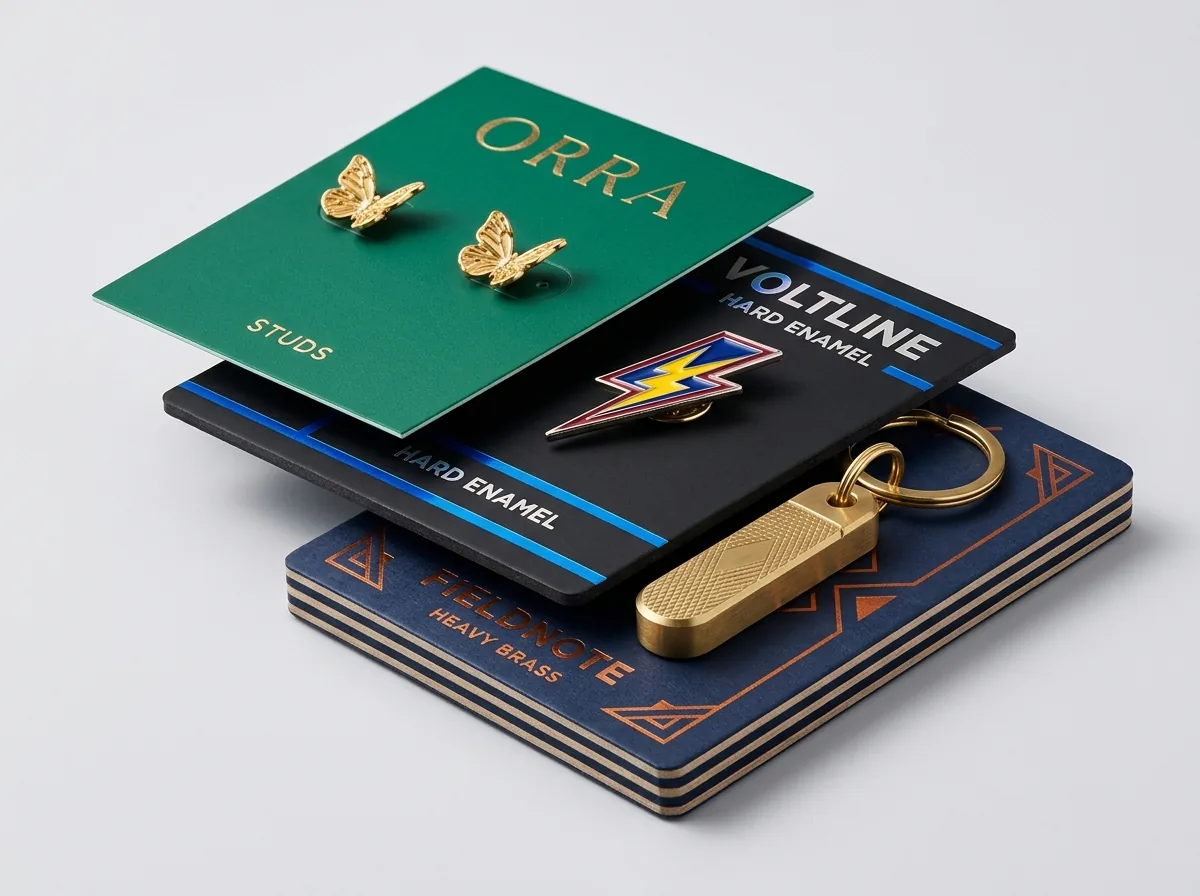
On this page
- How do 16 pt, 24 pt, and 32-38 pt double-thick cardstock compare for retail backing cards
- Which product weight threshold determines when a backing card bows on a peg hook
- How does vertical vs horizontal paper grain direction change hang-slot tear resistance
- Do soft-touch, matte, or gloss laminations add measurable stiffness and tear strength
- How do white card, natural brown kraft, and recycled paperboard compare for print and foil
- Common mistakes
- FAQs
Request a custom quoteFree dieline & 3D mockup
In US commercial packaging, paperboard thickness is measured in points (pt), where 1 point equals 0.001 inches (0.0254 mm) of caliper under TAPPI T 411 testing. Ordering standard 12 pt or 14 pt office business cards for metal merchandise is the top reason display cards curl into a U-shape when rubber pin clutches clamp down or tear through pegboard hooks in transit. Because bending stiffness increases roughly with the cube of board thickness, stepping from a 16 pt sheet up to a 24 pt sheet more than triples resistance to bowing, while duplexing two plies into a 32 pt to 38 pt board creates an almost rigid plaque feel. At CubitPack, we help match white, kraft, or recycled board options to your exact hardware weight starting at 250 cards, with free design help, zero die charges, and free 50-state US shipping.
How do 16 pt, 24 pt, and 32-38 pt double-thick cardstock compare for retail backing cards?
You can convert points, millimeters, and approximate basis weights anytime in our paperboard thickness converter. Across retail jewelry, collector pin, and hardware display packaging, three industry caliper tiers handle nearly every product category on printed product backing cards
- 16 pt cardstock works reliably when the card sits supported inside custom earring boxes or sealed inside a tight clear cello sleeve with lightweight studs or textile patches.
- 18 pt to 20 pt paperboard hits the sweet spot for pre-scored folded cards (such as rear chain-pocket necklace cards), remaining stiff on the front face while creasing cleanly along a score channel without fiber cracking.
- 24 pt heavyweight board prevents horizontal pinching between two tight rubber pin clutches on 1.5 inch and 1.75 inch hard enamel collector pins.
- 32 pt to 38 pt duplexed (multi-ply pasted) board stays flat on open boutique peg hooks without a poly bag, even when carrying chunky metal carabiner keyrings or multi-clip sets.
| Industry caliper tier | Thickness (in / mm) & approx. GSM | Safe mounted item weight | Ideal retail products & display style |
|---|---|---|---|
| 16 pt standard display card | 0.016 in (0.41 mm) · ~310-350 GSM | Up to 8 g (0.28 oz) | Mini stud earrings, wire hoops, iron-on patches, sticker packs in boxes |
| 18-20 pt medium folding board | 0.018-0.020 in (0.46-0.51 mm) · ~360-400 GSM | 8 g to 15 g (0.53 oz) | 1.25 in single-post pins, pendant chains, folded 4-panel pouch cards |
| 24 pt heavy retail hang board | 0.024 in (0.61 mm) · ~450-500 GSM | 15 g to 30 g (1.05 oz) | 1.5-2.0 in dual-post hard enamel pins, statement dangles, snap barrettes |
| 32-38 pt double-thick duplex | 0.032-0.038 in (0.81-0.97 mm) · ~650-800 GSM | 30 g to 65 g (2.30 oz) | Solid brass keychains, large acetate claw clips, luxury solid-gold jewelry |
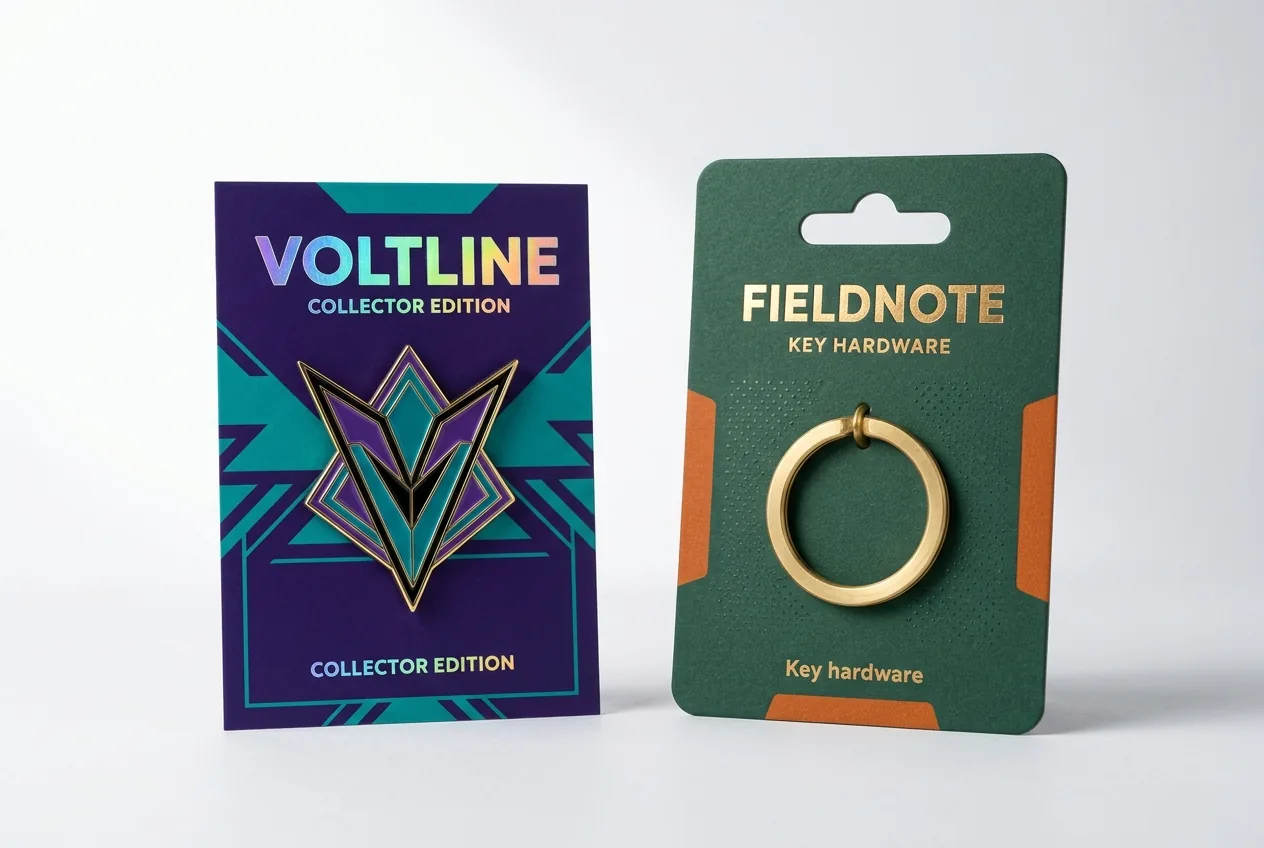
Which product weight threshold determines when a backing card bows on a peg hook?
Card deflection comes from two separate forces: downward gravity pulling against the top Euro hang slot, and inward clamping torque when two pin clutches or a tight French barrette snap onto the center of the sheet. Pair your caliper choice with proper card proportions from our enamel pin and jewelry backing card sizes guide
- Under 8 grams (stud pairs, thin chains, woven patches): Minimal torque acts on the board face, so standard laminated cardstock holds a crisp flat silhouette both in flat mailers and on countertop peg trees.
- 10 to 25 grams (1.5 in to 2.0 in zinc-alloy or brass hard enamel pins): Dual rear posts spaced 10 mm apart pull the back of the card together when rubber clutches are pushed flush. Stepping up in caliper plus adding soft-touch or matte film keeps the card face from dishing inward.
- 30 to 65 grams (solid brass keychains, bottle-opener fobs, full-size acetate claw clips): Heavy bottom-hung items act like a pendulum during parcel shipping and on retail spinner racks, requiring heavy-caliper board paired with a wide 1.25 inch Euro sombrero slot rather than a tiny round hole.
- Over 65 grams (multi-tool fobs, heavy cuff bracelets, layered statement chains): Transition from a hang card to a die-cut EVA foam or paperboard tray inside custom jewelry boxes or custom box inserts so weight rests on a structural base.
How does vertical vs horizontal paper grain direction change hang-slot tear resistance?
Two cards cut from the exact same paperboard sheet can behave differently on a peg hook depending on cellulose fiber orientation (grain direction). Combine proper grain alignment with clean punch margins from our backing card pin hole and hang slot placement guide
- Grain-long (vertical fibers running top to bottom) resists forward curling: On tall 2 × 3.5 in, 2.5 × 3.5 in, and 3 × 4 in flat hang cards, running paper fibers vertically maximizes cantilever stiffness from the top peg hook down to the bottom edge so the card hangs plumb against pegboards.
- Cross-grain tear strength at the top hang bridge: Paper tears more easily parallel to the grain than across it. Maintaining at least a 1/4 inch (6.5 mm) top bridge and laminating both sides locks fibers in both axes so peg hooks cannot split the top edge.
- Folded chain-pocket cards require score-parallel grain: When ordering a pre-scored bifold card that folds horizontally to trap excess custom necklace boxes chains, aligning the grain parallel to the horizontal crease prevents coated ink or dark color blocks from cracking along the fold.
- Two-sided ink and coating balance prevents humidity warp: Applying uniform ink coverage or matching lamination film on both the front and reverse panels equalizes moisture expansion across open-air summer craft markets and dry winter boutique showrooms.
Know your size? Compare pricing across up to 3 quantities.
Request a Quote →Do soft-touch, matte, or gloss laminations add measurable stiffness and tear strength?
Biaxial polypropylene (BOPP) thermal lamination films bond a thin, tear-resistant polymer skin onto one or both faces of paperboard cardstock, upgrading durability far beyond raw uncoated stock
- Two-sided soft-touch lamination or matte lamination acts like rip-stop reinforcement around 1.2 mm earring post holes, 45-degree necklace slits, and Euro hang slots, preventing metal wires from sawing into paper fibers.
- Metal rub and tarnish barrier: Plated brass pins, sterling jump rings, and steel barrette clasps leave dark metallic rub marks on uncoated white cardstock during parcel vibration; laminated surfaces wipe clean and protect deep navy, emerald, or matte-black ink coverage.
- Contrast foundation for specialty finishes: Soft-touch film provides an ultra-flat, zero-glare base that makes foil stamping and raised spot UV patterns pop sharply on boutique counters.
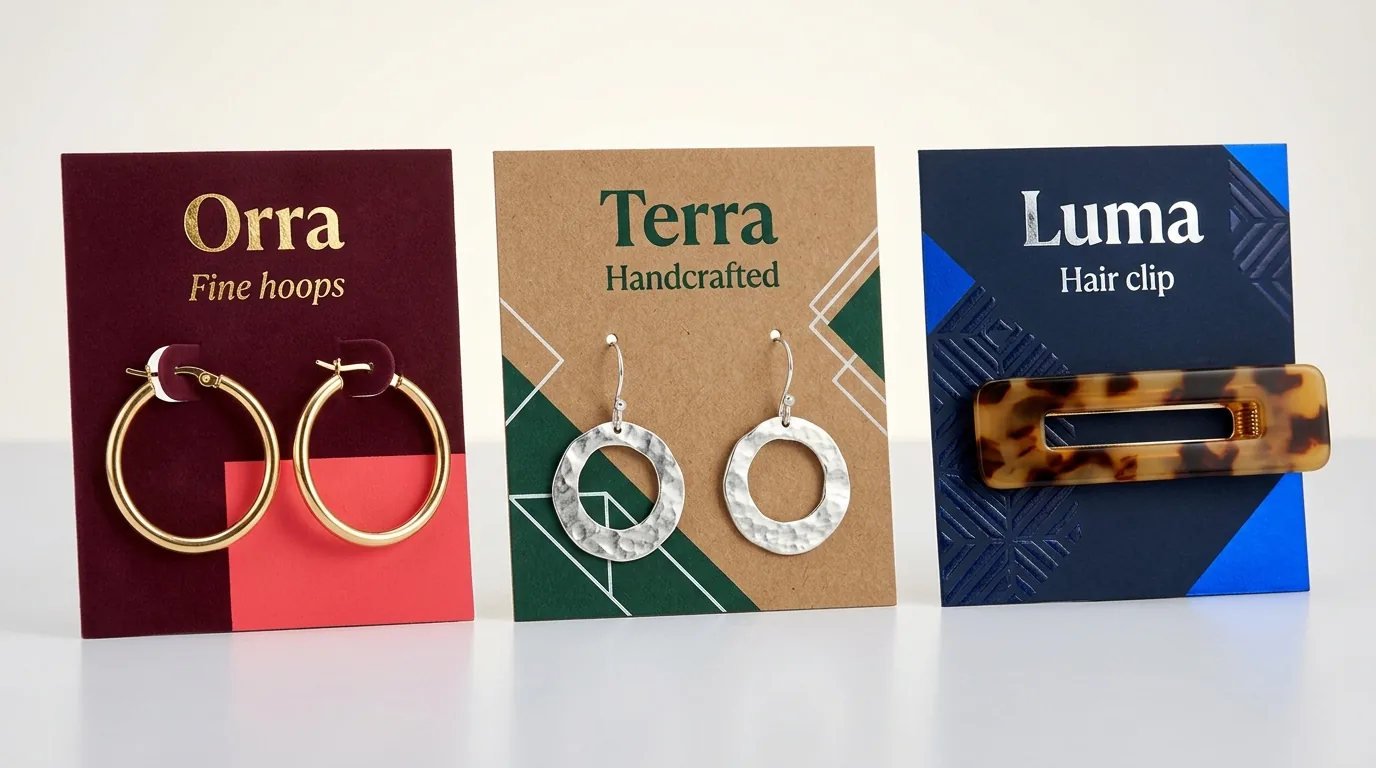
How do white card, natural brown kraft, and recycled paperboard compare for print and foil?
Beyond caliper thickness, fiber furnish determines ink vibrancy, cut-edge color, and tactile character across your jewelry, pin, or keychain collection when ordering custom die-cut backing cards
- Smooth coated white card (paperboard): Bright neutral white surface engineered for full-color CMYK pin illustrations, skin-tone graphics, crisp Pantone spot matching, and razor-sharp reverse UPC barcodes that scan through clear OPP poly bags.
- Unbleached brown kraft board: Visible warm wood fibers suited to hand-forged silver jewelry, brass key fobs, and outdoor woven patches, printed with opaque white ink underlays, rich black ink, or warm copper and gold foil.
- Stiff recycled board: Clean matte tactile surface favored by minimalist artisan studios, paired with FSC paperboard availability on request through partner facilities and zero cutting-die or plate charges.
- Multi-SKU stock consolidation for volume savings: Sharing one board stock, outer trim size, and lamination across 2 or 3+ collection designs unlocks higher quantity price tiers from 250 up to 5,000+ cards, backed by our Price Beat guarantee on comparable written US quotes.
What cardstock thickness mistakes cause backing cards to warp or tear?
Avoid these five material and finishing missteps when specifying retail display cards
- Mounting heavy 20-gram dual-post hard enamel pins or brass keychains onto flimsy 12-14 pt business-card stock that bows into a curve as soon as clutches tighten.
- Skipping matte, gloss, or soft-touch lamination on dark ink pegboard cards, allowing metal jump rings to scuff ink and peg hooks to fray raw hole edges.
- Ordering ultra-thick un-scored board and attempting to fold it by hand for necklace pockets, which cracks the outer ink layer along the bend.
- Printing dark full-bleed ink on only one side of an unlaminated thin sheet without back balance, which can induce slight sheet curl in humid boutique air.
- Using heavy metal hardware over 65 grams on a flat hang card instead of stepping up to a supported box tray or structural insert.
Packaging for this
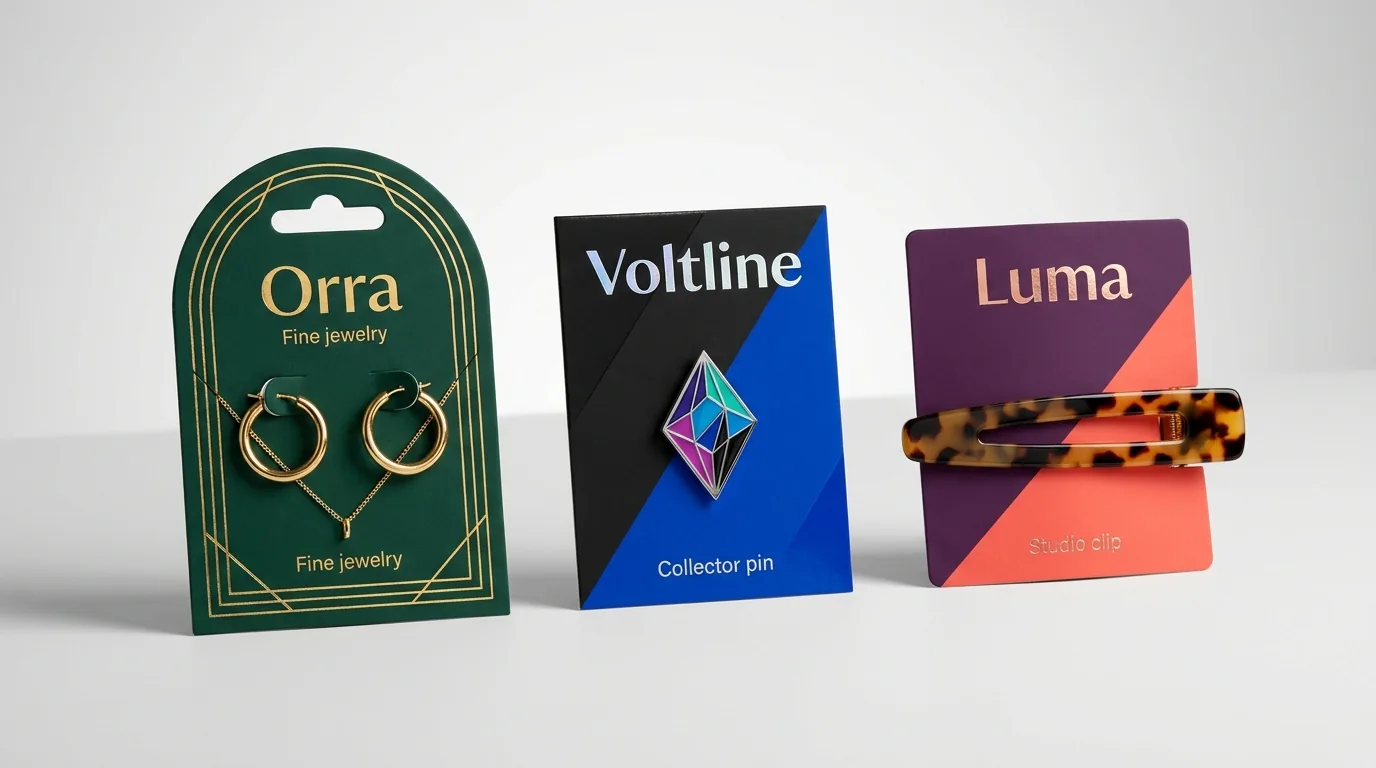
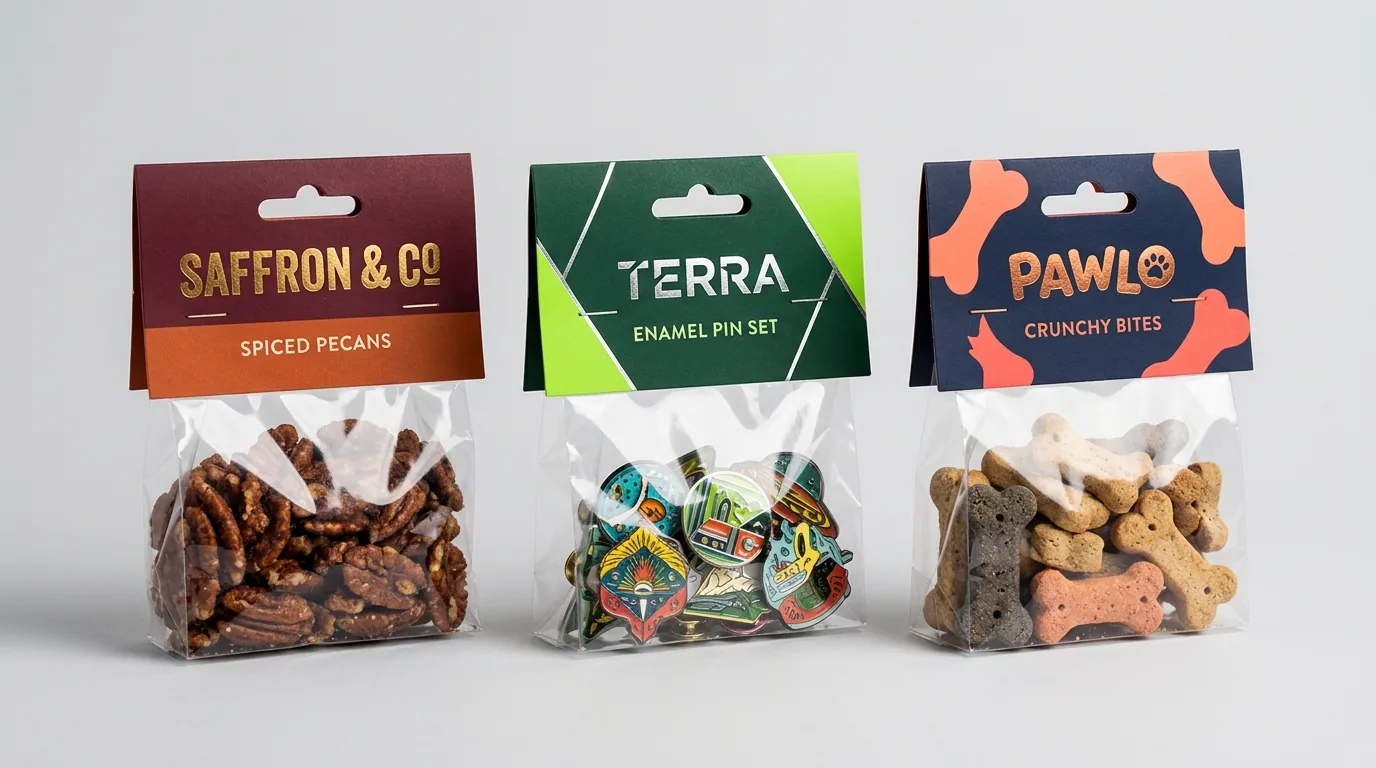
Ready to order backing cards? Compare up to 3 quantities with a free 3D mockup.
Request a Quote →Questions about backing cards
What does 'pt' mean in cardstock thickness for custom backing cards?
In US paperboard manufacturing, 1 point (pt) equals one-thousandth of an inch (0.001 in or 0.0254 mm) of sheet thickness measured with a micrometer. A 16 pt card is 0.016 inches thick, while a 24 pt card is 0.024 inches thick.
Is 16 pt or 24 pt cardstock better suited for hard enamel pin backing cards?
Lightweight 0.75 to 1.0 inch single-post pins inside cello sleeves sit cleanly on 16 pt to 18 pt cardstock. Larger 1.5 to 2.0 inch dual-post hard enamel pins benefit from 24 pt board so rear rubber clutches cannot bow the card.
When do I need double-thick duplex cardstock for retail display cards?
Double-thick duplexed cardstock (typically 32 pt to 38 pt) is suited to heavy 30 to 65 gram solid brass keychains, large acetate claw clips, and open-display fine jewelry cards that hang on boutique hooks without an outer cello bag.
Does laminating a custom backing card make it more tear-resistant on peg hooks?
Yes. Applying matte, gloss, or soft-touch film lamination bonds a tough polymer layer across the paperboard fibers, dramatically increasing tear resistance around Euro hang slots, 1.2 mm earring holes, and angled necklace chain slits.
Can I inspect CubitPack board stocks and finishes before placing a full order?
Yes. You can order our $50 physical sample kit, which includes paperboard and finish swatches, and we credit the entire $50 toward your first custom packaging order. Every order also includes a free digital proof and 3D mockup before payment.
What is the minimum order and turnaround for custom printed backing cards?
Standalone custom backing card orders start at 250 units (or match your paired box minimum when ordered together), with zero die or plate charges, 10 to 14 business day standard production, 4 to 5 day rush options, and free US shipping.
Still have a question? Ask a packaging specialist.
Request a Quote →Request your backing cards quote
Tell us your size and quantities, and one dedicated account manager prepares pricing for each tier.
- Free design & AI-to-print studio + 3D mockup
- No die or plate charges · 4–5 day rush available
- Free shipping to all 50 states
- 10% off your first order
We verified point-to-millimeter caliper definitions, bending stiffness scaling, and paper grain tear mechanics against TAPPI T 411 thickness and TAPPI T 489 stiffness testing principles. A packaging specialist checked every product gram-weight pairing and lamination recommendation. Spot something wrong? Tell us and we will fix it.
Sources
- Definition of paperboard caliper points (1 pt = 0.001 in = 0.0254 mm) and micrometer sheet thickness testing.
- Cubic caliper-to-stiffness relationship and machine-direction (grain-long) vs cross-direction deflection behavior.
- Dynamic pendulum stress on peg-mounted hardware and surface scuff protection from BOPP lamination films.
What changed
- November 16, 2026: First published comparing 16 pt, 18-20 pt, 24 pt, and 32-38 pt duplex cardstock tiers, item gram-weight thresholds, grain direction, and BOPP film tear reinforcement.
More guides
New packaging guides by email
Sizes, materials and design tips. Unsubscribe anytime.