
Straight tuck end vs tray and sleeve concealer boxes: which fits your line?
Short answer: Choose straight tuck end boxes for single liquid doe-foot wands, click pens, and blemish sticks standing upright in retail trays, and choose tray and sleeve boxes for 3-piece color corrector kits, contour trios, or magnetic refill pans. Both styles of custom concealer boxes start at 1,000 units.
On this page
- How do the main concealer box styles compare side by side
- Why do single doe-foot concealer wands use straight tuck or reverse tuck boxes
- When is a tray and sleeve box worth it for concealer sets and refills
- When should I add a die-cut window or switch to an auto-lock bottom
- How does your sales channel affect your concealer box choice
- Common mistakes
- FAQs
Request a custom quoteFree dieline & 3D mockup
The right concealer box style depends on whether you are packaging a single complexion SKU for high-density retail shelves or a multi-piece kit designed for a drawer-style unboxing. Single 6 ml to 10 ml doe-foot wands, click-pen brushes, and squeeze tubes almost always use a straight tuck end (STE) or reverse tuck end (RTE) folding carton, often paired with a vertical window slot and a color-coded top flap. Because both flaps on a straight tuck end hinge toward the rear panel, the front face has no raw cut board edge at the top or bottom. By contrast, a two-piece tray and sleeve slides open horizontally like a matchbox, making it the go-to structure for 3-wand color-correcting sets, cream contour palettes, and flat refill pans. CubitPack produces all styles of custom printed concealer boxes with zero die or plate charges.
How do the main concealer box styles compare side by side?
Complexion lines rarely use just one container format. A brand might launch 30 shades of a liquid doe-foot concealer alongside a thick glass under-eye pot and a 3-piece peach, green, and lavender color-correcting kit. Each format puts different demands on the carton's closure, base strength, and shelf presentation. Use the comparison table below to match your applicator and sales channel to the five most common structural styles we engineer for concealer packaging boxes. Every structure is available on white card, unbleached kraft, or recycled paperboard starting at 1,000 units.
| Box style | Best concealer format | Key advantage & trade-off |
|---|---|---|
| Straight tuck end (STE) | Single 6–12 ml doe-foot wands, click pens, blemish sticks | Cleanest front panel edges; slightly wider sheet layout than RTE |
| Reverse tuck end (RTE) | High-volume single wands and 10–15 ml squeeze tubes | Nests tightly on press sheets for 30+ SKUs; bottom edge faces front |
| Window tuck box | Clear PETG or glass liquid vials and tinted neutralizers | Shows real liquid pigment without opening; requires clear bottle wall |
| Auto-lock bottom | Heavy 5–10 g frosted glass cream concealer pots | Pre-glued crash base holds heavy glass; uses more board at base |
| Tray and sleeve | 3-wand corrector trios, contour sets, magnetic refill pans | Rigid two-piece drawer unboxing; two components to assemble |
| Counter display (POP) tray | 12 to 24 upright concealer cartons plus front testers | Organizes shade rows on store counters; outer merchandising unit |
Why do single doe-foot concealer wands use straight tuck or reverse tuck boxes?
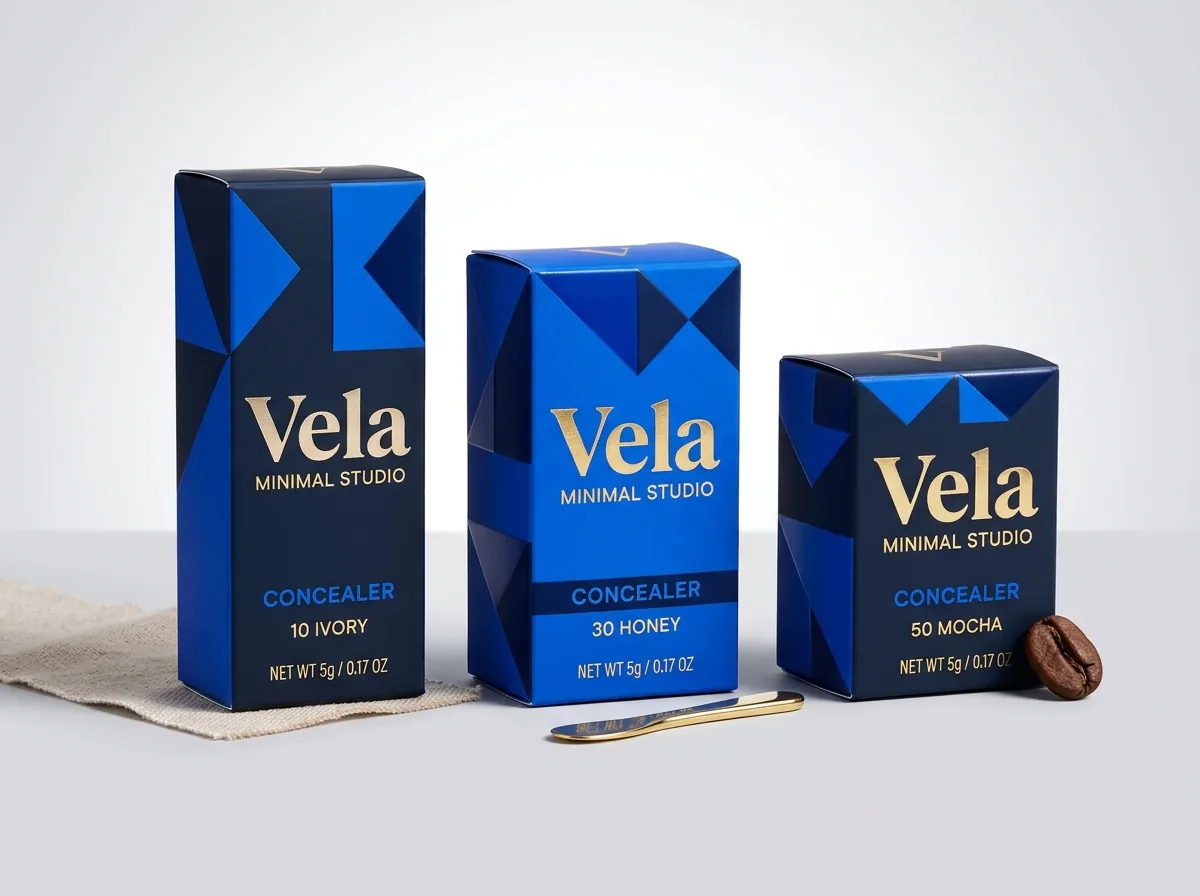
When you walk down a prestige beauty aisle, nearly every single-wand liquid concealer sits inside either a straight tuck end box or a reverse tuck end box. Both are one-piece folding cartons that ship flat, pop open in a second, and close with friction tuck flaps at the top and bottom. The difference lies in which panel the two closures hinge from. On a straight tuck end carton, both the top lid and the bottom flap hinge from the rear panel and tuck forward behind the front face. That means the front panel is one continuous, uninterrupted sheet of paperboard from top score to bottom score, with no raw cut edge showing at the base. Makeup brands love that clean front edge when printing metallic foil borders or soft-touch dark cartons. On a reverse tuck end carton, the top flap hinges from the back while the bottom flap hinges from the front, allowing adjacent dielines to interlock closer together on the press sheet when ganging 30 or 40 shades.
When is a tray and sleeve box worth it for concealer sets and refills?
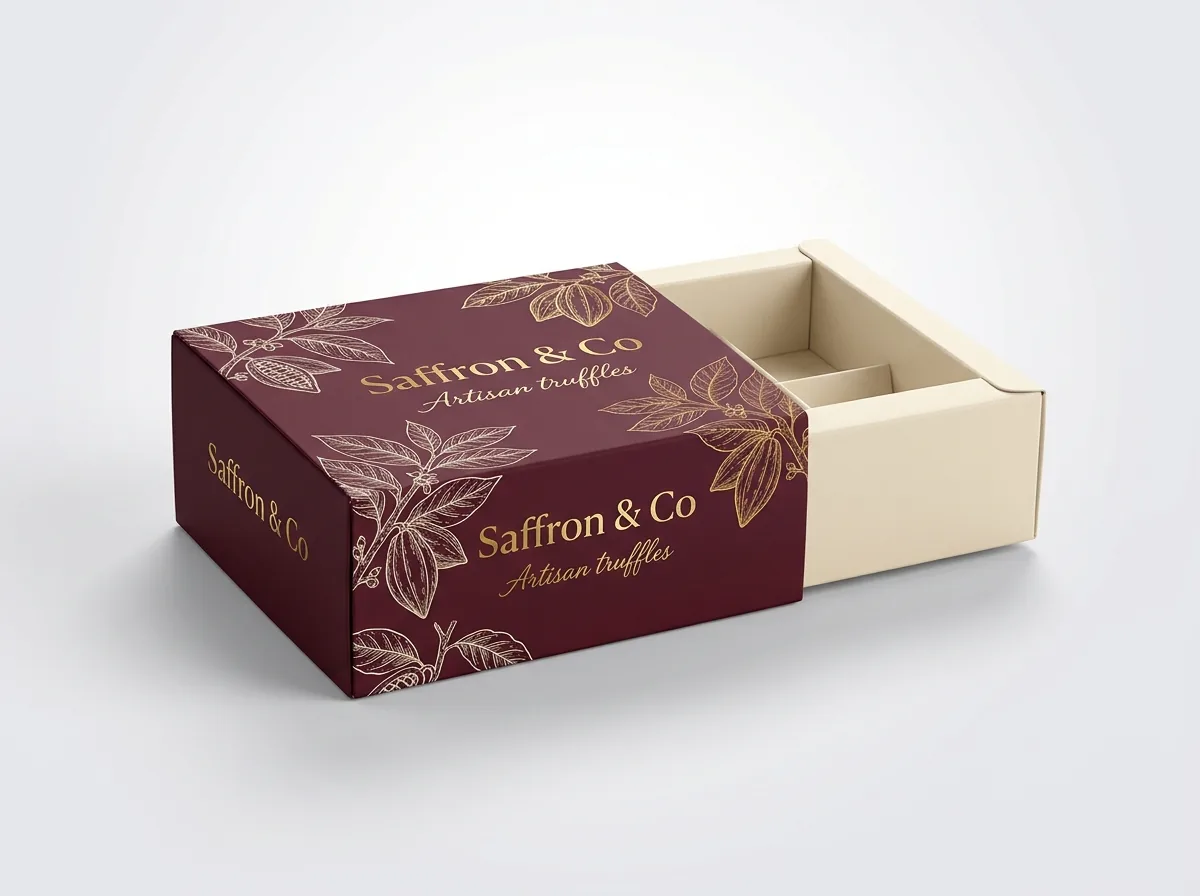
While a single wand slides naturally out the top of a vertical tuck box, packing three color-correcting wands or a set of cream refill pans into a top-opening carton makes it awkward for customers to pull out the middle shade. A tray and sleeve box solves that by splitting the package into an outer open-ended sleeve and an inner sliding drawer tray. When the customer slides the inner tray out of the sleeve, all three wands, such as a peach under-eye neutralizer, a green redness corrector, and a yellow brightener, lie face up side by side in a die-cut paperboard cradle. The double-wall overlap of the tray walls inside the outer sleeve also gives the package twice the crush resistance inside padded e-commerce mailers. For flat magnetic concealer refill pans, a slim card sleeve over a shallow die-cut tray protects the pressed cream surface without using any plastic clamshells.
Know your size? Compare pricing across up to 3 quantities.
Request a Quote →When should I add a die-cut window or switch to an auto-lock bottom?
Two structural upgrades frequently pair with concealer cartons: a front shade window and a pre-glued crash-lock base. On a custom window box, we die-cut a narrow vertical slot (typically 0.25 to 0.375 inches wide by 1.75 to 2.25 inches tall) centered on the front panel. When your liquid concealer is filled into a clear PETG or glass bottle, that slot lets retail shoppers verify the exact undertone and depth without breaking the tamper seal on a live unit. An auto-lock bottom box is built for weight rather than height. Thick-walled 5 g to 10 g frosted glass pot concealers have a concentrated footprint that can push open a standard friction-tuck bottom flap if a carton is lifted rapidly. Pre-gluing the bottom flaps into an interlocking crash base ensures the glass jar cannot drop through the bottom, and your fulfillment team can pop the square box open in one motion.
- Straight tuck end + vertical window: ideal for clear 6–10 ml liquid doe-foot wands sold on retail shelves.
- Reverse tuck end (solid walls): ideal for opaque squeeze tubes, metallic vials, and direct-to-consumer orders.
- Auto-lock bottom: ideal for heavy glass under-eye concealer pots and dual-bottle foundation + concealer bundles.
- Tray and sleeve: ideal for 3-piece color corrector trios, pro artist kits, and plastic-free refill pans.
How does your sales channel affect your concealer box choice?
How your customers discover and buy your concealer should guide your final structural choice. In brick-and-mortar beauty stores and pharmacies, concealers are almost always merchandised standing upright in deep slotted acrylic gondola trays or 18-count counter display boxes. Only the top tuck flap and the upper half of the front panel are immediately visible to a standing shopper, making a crisp straight tuck end with a bold top-flap shade badge the clear winner. For direct-to-consumer e-commerce brands and monthly beauty subscriptions, the carton travels inside a padded envelope or custom mailer box. There, crush resistance and the unboxing reveal matter more than gondola slot visibility. Pairing single reverse tuck cartons with a slide-out tray and sleeve for your shade discovery kits gives online shoppers a memorable reveal while keeping single-SKU unit costs lean. If you ship full-range complexion kits to makeup artists and beauty creators, you can also house 20 to 30 straight tuck end concealer cartons inside a partitioned corrugated or rigid vault. That way, each individual wand stays protected in its own color-coded retail carton while the master sleeve or book-style box presents the entire shade spectrum from fair to rich espresso in a single sweep.
What are the most common mistakes when choosing a concealer box style?
Picking the wrong structural closure can slow down fulfillment or leave glass jars under-protected during shipping. Avoid these five structural mistakes when specifying your dieline
- Using a reverse tuck end box with a dark flood-coated front panel and forgetting that the bottom flap's raw white cut edge will show across the front base.
- Packing three loose color-corrector wands into a wide single-cavity tuck box without an inner tray or divider, letting the vials clink and scuff in transit.
- Adding a front die-cut window when your concealer container is an opaque metallic vial or printed squeeze tube that already hides the liquid pigment.
- Using a standard friction tuck bottom for heavy thick-walled glass pot concealers instead of a pre-glued auto-lock bottom or snug square tuck base.
- Designing a wide tray and sleeve box for single retail concealer wands when the store's acrylic gondola slots are sized only for 0.875 inch tuck cartons.
Find your size
Suggested inside size: 0.75 × 0.75 × 5.0 in
A starting point. Your account manager confirms the size with you before the proof.
Quote this size →Packaging for this
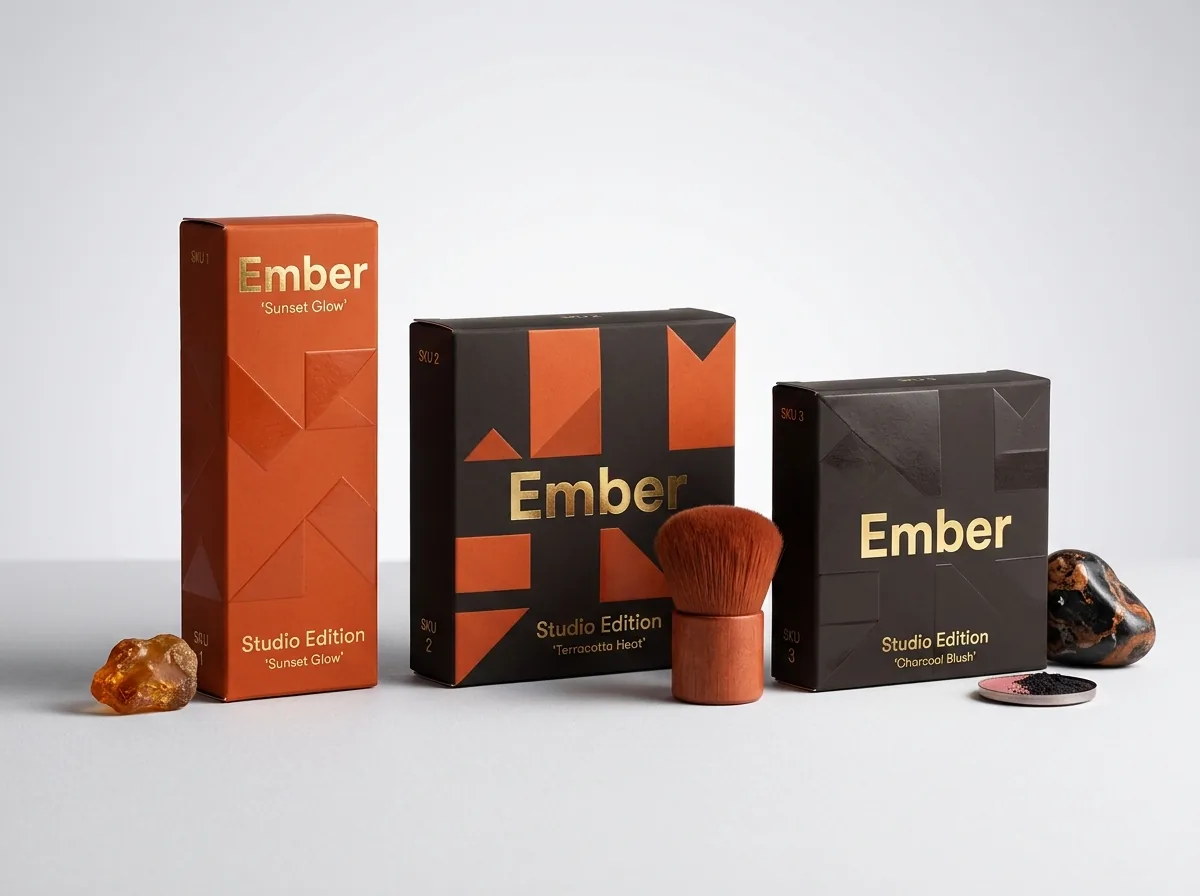
Ready to order concealer boxes? Compare up to 3 quantities with a free 3D mockup.
Request a Quote →Questions about concealer boxes
Does a straight tuck end concealer box cost more than a reverse tuck end box?
On most concealer runs of 1,000 to 10,000 units, the price difference between straight tuck end and reverse tuck end is negligible, and CubitPack never charges die or plate fees for either style. You can ask your account manager to quote both styles side by side.
Can I add a front shade window to both straight tuck and tray and sleeve boxes?
Yes. On a single straight tuck carton, we die-cut a narrow vertical window on the front panel to show the liquid vial. On a tray and sleeve box, we die-cut one or three windows into the top face of the outer sleeve so all three wands remain visible.
Do tray and sleeve concealer boxes ship flat or pre-assembled?
Outer sleeves ship folded and glued flat so they pop open instantly, while inner paperboard trays can be engineered as roll-end self-locking trays that fold flat for shipping or pre-glued trays depending on your fulfillment setup.
When should I choose an auto-lock bottom box for concealer?
Choose an auto-lock bottom box whenever your container is a heavy glass pot (5 g to 10 g with thick frosted walls) or a multi-bottle complexion duo. The pre-glued crash bottom locks automatically when popped open and supports far more weight than a friction flap.
Can I order straight tuck boxes for single shades and tray and sleeve boxes for trios together?
Yes. Many makeup brands order 0.875 × 0.875 × 4.5 inch straight tuck cartons for their individual shade lineup alongside a 3.0 × 1.0 × 4.5 inch tray and sleeve box for their color-correcting trio or sample discovery kit.
Will I see a 3D mockup of my concealer box style before paying?
Yes. Before you pay a cent, our design team builds a flat 2D dieline proof and an interactive 3D mockup showing the exact flap orientation, window cutout, or drawer slide of your chosen concealer box style.
Still have a question? Ask a packaging specialist.
Request a Quote →Request your concealer boxes quote
Tell us your size and quantities, and one dedicated account manager prepares pricing for each tier.
- Free design & AI-to-print studio + 3D mockup
- No die or plate charges · 4–5 day rush available
- Free shipping to all 50 states
- 10% off your first order
This structural comparison is based on standard folding carton dieline geometry (STE, RTE, auto-lock bottom, and two-piece tray and sleeve) used across North American beauty retail and DTC fulfillment. Checked by a CubitPack packaging specialist. Spot something wrong? Tell us and we will fix it.
Sources
What changed
- October 22, 2026: First published.
- October 22, 2026: Updated specifications, terminology, and verified source links.
More guides
New packaging guides by email
Sizes, materials and design tips. Unsubscribe anytime.