
Oval labels vs rectangle and circle labels: which shape fits your container?
Short answer: Choose custom oval labels for slightly tapered jars, bottle necks, squeeze tubes and front crests where square corners lift. Choose rectangle labels when you need maximum room for wrap-around nutrition panels and barcodes, and choose circle labels for flat jar lids, candle dust covers and tissue seals.
On this page
- How do oval, rectangle and circle labels compare side by side
- Why do oval labels resist peeling on tapered jars and squeeze tubes
- When should I pick an oval label over a circle label
- When does a rectangle label beat an oval label
- How do brands combine oval, rectangle and circle labels on one product
- Common mistakes
- FAQs
Request a custom quoteFree dieline & 3D mockup
Label shape is more than a visual frame: it determines how well the adhesive stays bonded on curved walls and how much text fits inside the cut line. A rectangle gives you 100 percent of its width-by-height bounding box for multi-column ingredient lists, nutrition tables and barcodes, making it the workhorse for full cylinder wraps and flat pouch faces. However, on containers with compound curves, slight wall taper or flexible plastic walls, the four 90-degree corners of a rectangle experience the highest peel stress and flag upward first. Both circles and ovals eliminate sharp corners completely, distributing tension smoothly around a continuous arc. While a circle locks you into a 1:1 ratio that can hit the top and bottom shoulders of a narrow jar, an oval lets you stretch horizontally or vertically to fit the exact flat band of your container at no extra die cost.
How do oval, rectangle and circle labels compare side by side?
When brands request a quote for custom printed oval labels, they are usually weighing three practical factors against rectangles and circles: how the edge behaves on curved glass or plastic, how much copy fits inside the safe zone, and how fast packers can align the sticker by hand. Because CubitPack never charges cutting die fees, all three shapes cost the same for any given Width × Height bounding box. Whether you order roll labels for a high-speed tabletop dispenser or flat kiss-cut sticker sheets for small-batch packing, you can switch between an oval, a rectangle and a circle without paying tooling penalties. Use the comparison table below to match the geometry of your container and your text volume to the right outline.
| Feature | Oval labels | Rectangle labels | Circle labels |
|---|---|---|---|
| Usable area (% of W × H) | 78.5% of bounding box | 100% of bounding box | 78.5% of diameter square |
| Corner-lift resistance | High (zero sharp corners) | Moderate (4 corners can flag) | High (zero sharp corners) |
| Fit on slightly tapered jars | Excellent (narrow tips dodge curve) | Prone to diagonal corner creases | Good if diameter is small |
| Width-to-height flexibility | Any wide (W>H) or tall (H>W) ratio | Any wide or tall ratio | Locked to 1:1 equal diameter |
| Hand-alignment forgiveness | Moderate (must level major axis) | Requires level top/bottom edge | Highest (rotates slightly without showing) |
| Best container zones | Tapered jars, bottle necks, tubes, soaps | Full cylinder wraps, pouches, back panels | Jar lids, box seals, flat tins |
Why do oval labels resist peeling on tapered jars and squeeze tubes?
In pressure-sensitive label engineering, the most common failure on small-diameter vials, tapered glass jars and flexible squeeze tubes is called corner flagging. When a stiff label face stock is bent around a tight cylinder or flexed repeatedly on a hand-cream tube, the face stock tries to spring back to its original flat memory. On a rectangular label with sharp 90-degree corners, that spring-back force concentrates at the four outer vertices where adhesive surface area is smallest, causing the corner tips to lift, catch on fingers and collect dust. An elliptical oval removes all four vertices. Every point along the perimeter of an oval is supported by a continuous curve of adjacent adhesive. Even better, on a gently tapered honey pot, bail-wire canning jar or beer bottle neck where the top circumference differs slightly from the bottom circumference, a wide horizontal oval is tallest only at the dead center and tapers away at the left and right wings. That geometry lets the wings wrap smoothly without fighting the taper.
When should I pick an oval label over a circle label?
Both custom circle labels and ovals share the same cornerless peel resistance and the same 78.5 percent mathematical area ratio, yet they solve very different layout problems on a container wall. A circle is locked into a 1:1 aspect ratio: if you want a circle wide enough to span 2.5 inches across the front of a squat 8 oz jar, it must also stand 2.5 inches tall - which often crashes right into the curved glass shoulder at the top and the base heel at the bottom. An oval breaks free of that 1:1 lock. You can keep the 2.5-inch horizontal width for bold shelf visibility while compressing the vertical height to 1.5 inches so the label sits flat inside the straight middle band. Conversely, on a narrow 2 oz mist spray bottle where a 2-inch circle would wrap past the sides, a 1.5 × 2.5 inch vertical oval stays narrow across the front while giving you 2.5 inches of vertical height for stacked typography.
Know your size? Compare pricing across up to 3 quantities.
Request a Quote →When does a rectangle label beat an oval label?
While ovals excel at front-facing brand medallions, tapered vessels and squeeze tubes, custom rectangle labels remain the undefeated choice whenever information density or single-piece full wrapping is your top priority. Because the top, bottom, left and right poles of an ellipse curve inward, those four corner quadrants are missing. If your product requires an FDA Drug Facts panel, a multi-column Supplement Facts box, lengthy multilingual cautions or a large horizontal UPC barcode, forcing all of that rectangular grid data into a single oval wastes space and crowds the curved border. A full-wrap rectangle that circles the entire straight cylinder of a 1 oz serum bottle, a spice jar or a 12 oz beverage can gives you three times the horizontal width in a single peel-and-stick application. Rectangles also align naturally with the straight heat-sealed edges of custom stand-up pouches and coffee bags.
- Pick an oval when: your jar or bottle neck tapers slightly, your tube flexes, or you want a heritage crest that lets glass show around the sides.
- Pick a rectangle when: you want one full-wrap label holding front branding, nutrition tables and barcodes on a straight-walled cylinder or flat pouch.
- Pick a circle when: you are labeling round mason jar lids, metal salve tin tops, candle dust covers or sealing tissue paper inside boxes.
How do brands combine oval, rectangle and circle labels on one product?
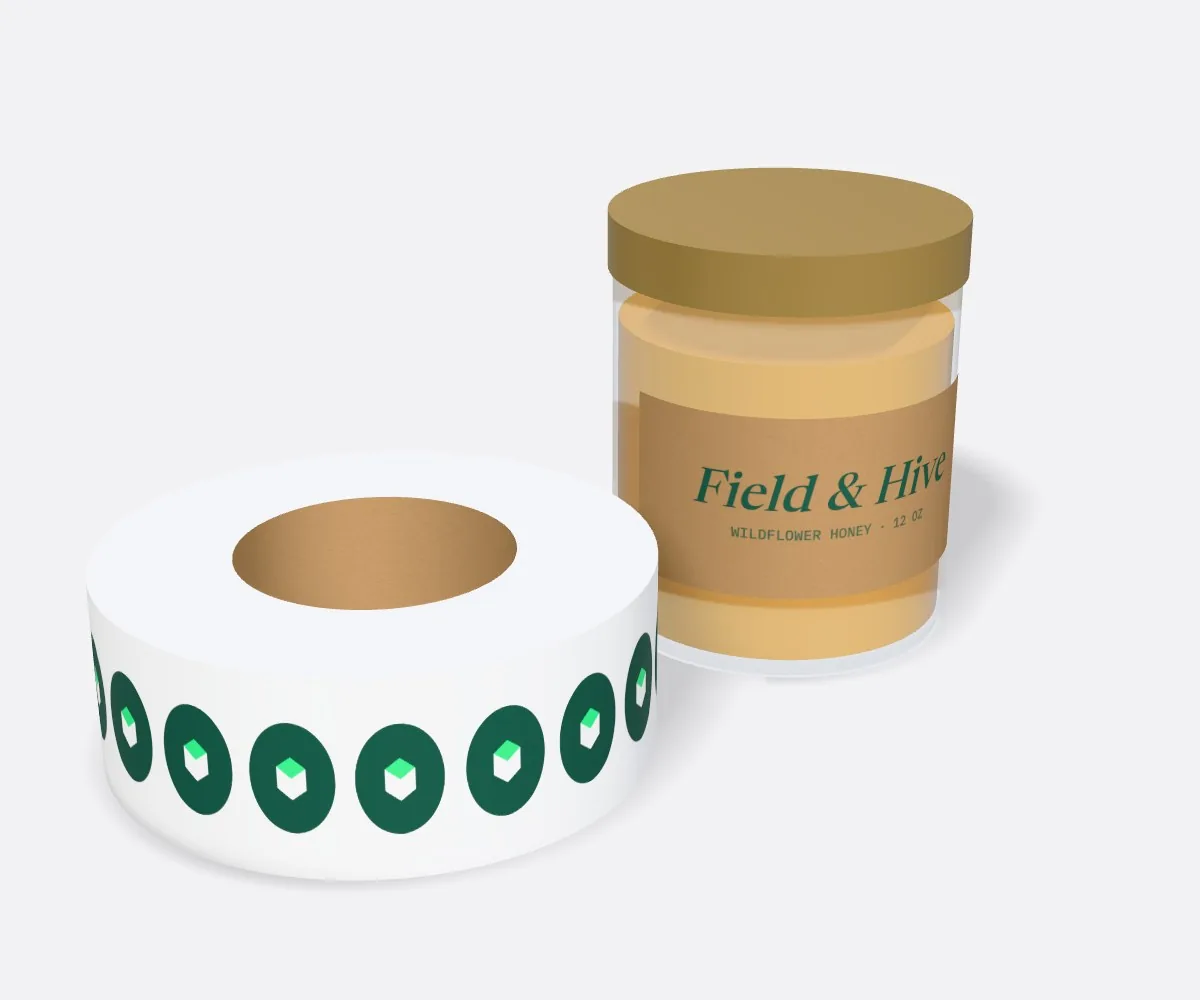
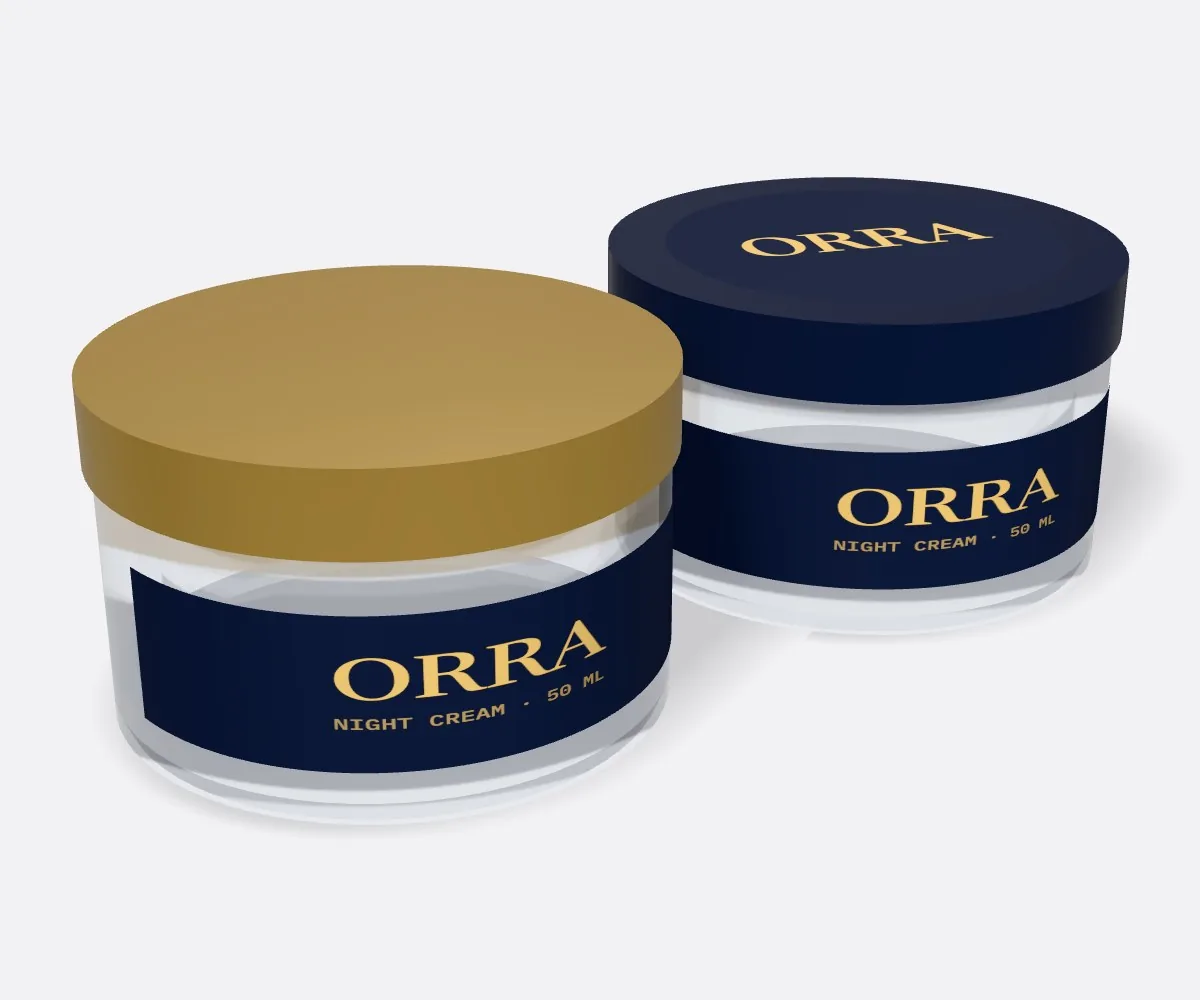
Some of the strongest shelf packages combine two complementary label shapes on the same container so each shape does the job it was built for. On artisan honey, fruit preserves and gourmet pasta sauces, brands place a horizontal 2.5 × 1.5 inch or 3 × 2 inch front oval on the glass belly to showcase the golden honey or red sauce around the curve, then apply a 2-inch round circle sticker on the metal lug cap (or a lollipop tamper strip bridging the lid) and a compact rectangular nutrition/barcode sticker on the back. On craft beer, cider and spirits bottles, distilleries pair a 2.5 × 1.25 inch horizontal oval neck band above the shoulder with a larger rectangular or shield-cut body label below. Because CubitPack prints rolls and sheets under one roof with guaranteed Pantone color matching, your front oval, back rectangle and lid circle are printed to the exact same color spec and quoted together.
- Front oval + back rectangle: keeps the front face clean and open while giving your barcode and ingredients flat 90-degree corners on the back.
- Front oval + top lid circle: ideal for wide-mouth jars, body scrubs and candle vessels where shoppers look down at the cap on lower shelves.
- Neck oval + body rectangle: the classic two-part beverage dress for 12 oz long-neck beer bottles and 750 ml spirits bottles.
What are the most common mistakes when choosing between oval, rectangle and circle labels?
Picking the wrong silhouette for your container wall or copy volume leads to wrinkled edges or cramped text. Watch out for these five mistakes
- Wrapping a tall sharp-cornered rectangle onto a tapered honey jar or bail-wire jar where an oval would glide past the taper without creasing.
- Ordering a large circle label for a squat jar and watching the top and bottom edges ride onto the curved glass shoulder and heel.
- Trying to squeeze a rectangular nutrition facts table and barcode into the narrow poles of a small front-only oval instead of adding a back label.
- Assuming custom oval or arched cut lines cost extra die fees (CubitPack charges zero die or plate fees on any shape).
- Using sharp-cornered rectangular paper labels on flexible cosmetic squeeze tubes where corner flagging starts after a few squeezes.
Find your label size
Suggested label size: 9⅛ × 2¾ in (width × height)
A typical starting point. Your account manager confirms the size on the proof.
Quote this size →Packaging for this
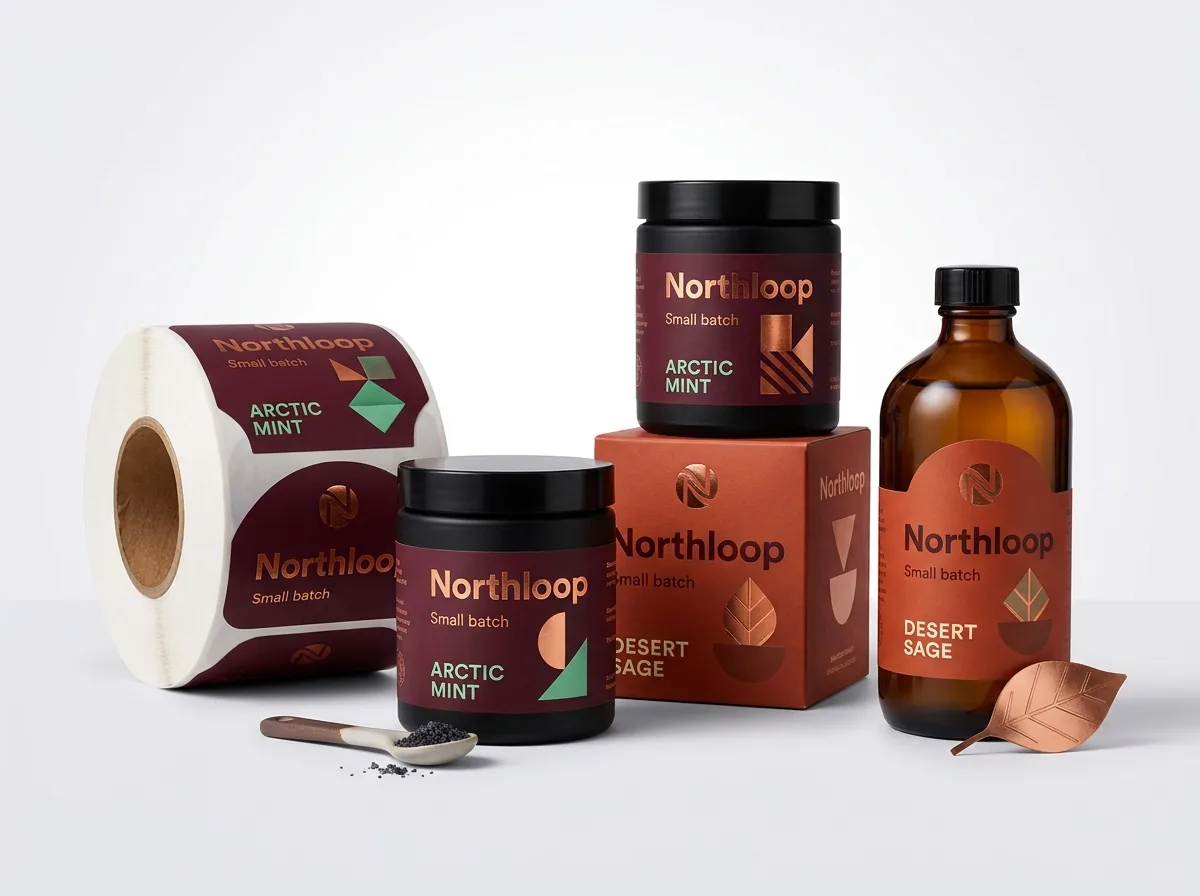
Ready to order oval labels? Compare up to 3 quantities with a free 3D mockup.
Request a Quote →Questions about oval labels
Do custom oval labels cost more than rectangle or circle labels?
No. At CubitPack, we never charge cutting die or printing plate fees. An oval label, a circle label and a rectangle label with the exact same outer Width × Height dimensions, material stock, finish and quantity are quoted on the same square-inch material basis.
Why do rectangle labels lift at the corners on small bottles while ovals stay down?
On tight diameters and flexible squeeze tubes, the label face stock tries to uncurl back into a flat sheet. That spring-back tension concentrates at 90-degree corners where adhesive area is smallest. An oval has a smooth continuous arc with no corners to lift.
How much less text fits on an oval label compared with a rectangle?
An oval (and a circle) covers 78.5% of the surface area of a rectangle with the same outer width and height, and the narrowing top and bottom arcs require curved or centered text. Plan for roughly 25% to 30% fewer words on an oval.
Which shape is easiest to apply straight by hand without a jig?
Circle labels are the fastest to apply by hand onto flat jar lids because slight rotation is less noticeable. On vertical bottle walls, a short front oval is much easier to apply without air bubbles or spiral skewing than a long full-wrap rectangle.
Can a labeling machine apply oval labels from a roll just like rectangles?
Yes. Tabletop and automatic rotary labelers dispense roll oval labels using the same gap sensor that reads the space between rectangular labels on the liner. Just note your required core size and unwind direction in the quote form notes.
Can I order oval front labels and rectangular back labels in the same order?
Yes. Select 2 designs in Step 2 of the quote form and list the dimensions and quantities for both your front oval and your back rectangle (or lid circle) in the notes so your account manager quotes the set together.
Still have a question? Ask a packaging specialist.
Request a Quote →Request your oval labels quote
Tell us your size and quantities, and one dedicated account manager prepares pricing for each tier.
- Free design & AI-to-print studio + 3D mockup
- No die or plate charges · 4–5 day rush available
- Free shipping to all 50 states
- 10% off your first order
The shape comparisons in this guide combine pressure-sensitive corner-flagging principles, geometric area ratios (ellipse area = 78.5% of W × H) and CubitPack's decided policies in our published product specifications. A CubitPack packaging specialist reviewed every comparison row. Spot something wrong? Tell us and we will fix it.
Sources
What changed
- October 22, 2026: First published.
- October 22, 2026: Updated specifications, terminology, and verified source links.
More guides
New packaging guides by email
Sizes, materials and design tips. Unsubscribe anytime.