
What size custom oval label do I need for jars, bottles and soaps?
Short answer: Keep a front oval's horizontal width to about one-third of a round container's circumference and set vertical height ¼ inch shorter than the straight wall. Popular custom oval labels include 2 × 1 in for bar soaps, 2.5 × 1.5 in for 8 oz honey jars, and 2 × 3 in for tall bottles.
On this page
- How do I measure a round or slightly tapered jar for an oval label
- What are the most popular custom oval label sizes by container
- When should I choose a horizontal (wide) oval vs a vertical (tall) oval
- How do I size oval labels for bar soaps, squeeze tubes and bakery boxes
- Should I pair a front oval crest with a back rectangle or lid circle
- Common mistakes
- FAQs
Request a custom quoteFree dieline & 3D mockup
Sizing an elliptical label comes down to two numbers written in order: horizontal Width across the container from left to right, followed by vertical Height from top to bottom. Unlike a full-wrap rectangle that circles the entire cylinder, an oval label is almost always designed as a front-facing crest or neck medallion that shoppers read in a single glance. To keep the left and right tips of the ellipse from wrapping out of sight around the sides of a jar or bottle, limit the horizontal width to roughly 30 to 35 percent of the container's total circumference. For the vertical axis, measure only the flat or gently sloped mid-wall between the top shoulder curve and the bottom base heel, then subtract ¼ inch for breathing room. At CubitPack, every oval is cut to your exact Width × Height in inches with zero die or plate charges.
How do I measure a round or slightly tapered jar for an oval label?
When you apply a rectangular label to a jar whose glass walls taper even slightly from top to bottom, the four sharp corners try to travel along different circumferences and immediately form diagonal wrinkles. Switching to printed oval labels solves that geometry problem because the top and bottom poles of the ellipse narrow to a single point and the left and right tips taper smoothly. To find your exact dimensions, measure the physical container on your desk with a flat ruler and a flexible sewing tape. Never rely on the liquid ounce rating alone, because a squat 8 oz quilted jelly jar and a tall 8 oz paragon jar have completely different straight wall heights and diameters. Once you record the circumference around the belly and the vertical straight height, apply the one-third front-reading formula.
- Wrap a flexible tape around the widest part of the label zone to read the circumference in inches (or multiply diameter by 3.14).
- Divide the circumference by 3 (roughly 30% to 35%) to find the maximum horizontal Width that reads without turning the jar.
- Hold a rigid ruler vertically against the side wall to find the straight or gently sloped band between shoulder and heel.
- Subtract ¼ inch from that vertical band to get your maximum oval Height so the top and bottom tips stay flat.
- Write your final dimension as horizontal Width × vertical Height in inches (for example, 2.5 × 1.5 in for a wide oval).
What are the most popular custom oval label sizes by container?
Because CubitPack cuts every order to your custom elliptical dieline with no die fees, you can specify any exact fraction of an inch. Even so, most honey pots, sauce bottles, beverage necks, lotion pumps and handmade soaps cluster around eight proven proportions. Use the benchmark chart below to compare wide horizontal ovals (where Width is greater than Height) against tall vertical ovals (where Height is greater than Width). Notice how squat food jars and bar soaps pair naturally with a 1.5:1 or 2:1 horizontal ratio, while slender apothecary bottles and olive oil cruets look balanced with a 1:1.5 vertical ratio.
| Oval size (W × H) | Orientation & ratio | Typical containers & uses |
|---|---|---|
| 1.5 × 0.75 in | Horizontal wide (2:1) | Lip balm cap seals, spice jar necks, sample vials and cosmetic compacts |
| 2 × 1 in | Horizontal wide (2:1) | Handmade bar soap belly bands, 2 oz honey bears and votive candle tins |
| 2.5 × 1.25 in | Horizontal wide (2:1) | 12 oz craft beer and cider bottle necks, hot sauce shoulders and clam seals |
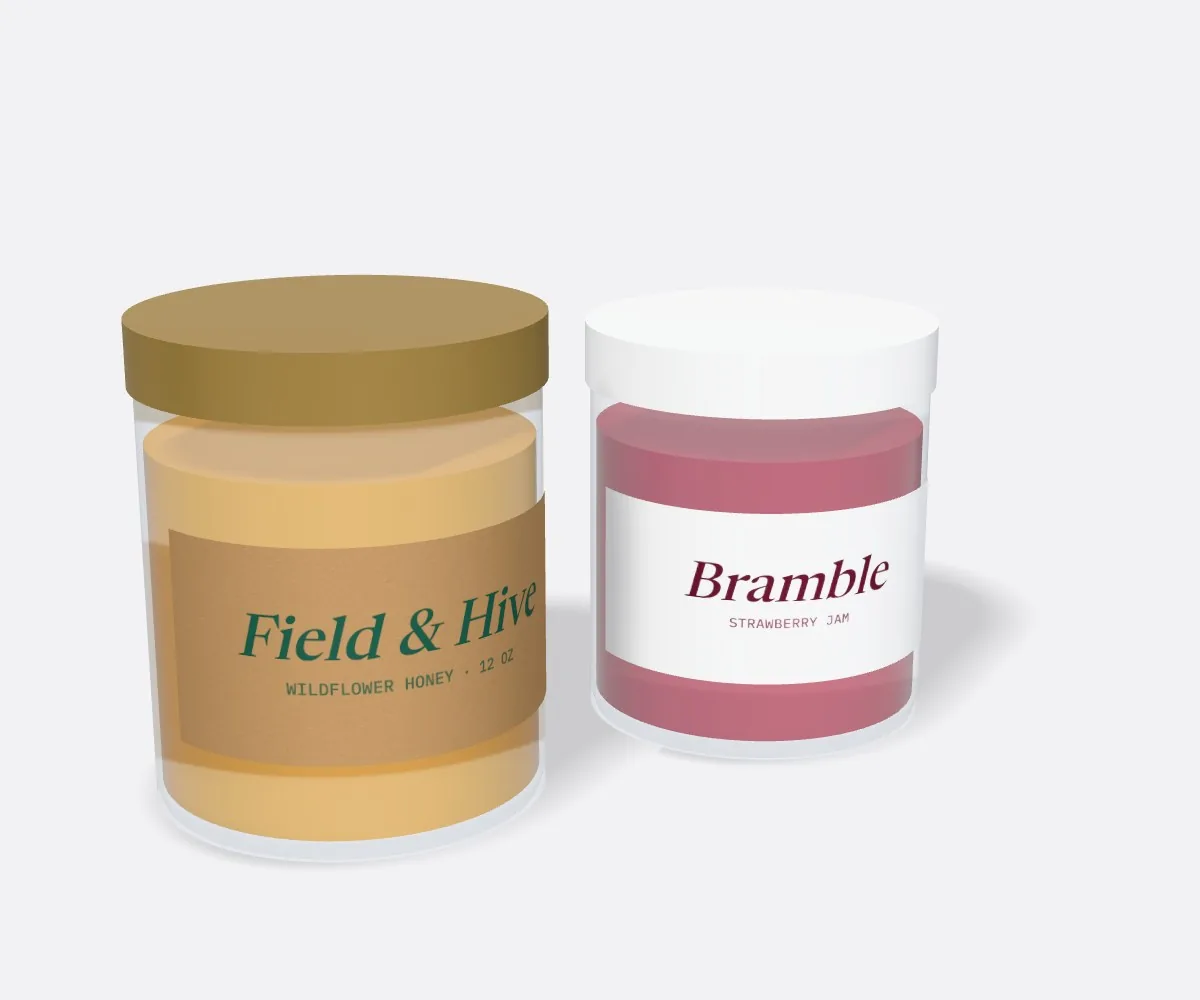
| 2.5 × 1.5 in | Horizontal classic (5:3) | 4 oz to 8 oz mason jars, hexagonal honey pots, jam jars and barbecue sauces |
| 3 × 2 in | Horizontal medium (3:2) | 12 oz to 16 oz salsa tubs, body butter jars, bakery clamshells and bread bags |
| 1.5 × 2.5 in | Vertical slender (3:5) | 2 oz to 4 oz Boston round dropper bottles, beard oils and travel lotions |
| 2 × 3 in | Vertical classic (2:3) | 8 oz lotion pump bottles, apothecary syrups, hair serums and balsamic vinegar |
| 3 × 4.5 in | Vertical crest (2:3) | 16 oz olive oil bottles, 750 ml wine and spirits crests and cold brew carafes |
When should I choose a horizontal (wide) oval vs a vertical (tall) oval?
The golden rule of elliptical label design is to mirror the silhouette of the container panel or the direction of the curve you are fighting. On a short, wide container - such as a 6 oz quilted preserve jar, a round metal salve tin or a bakery pastry box - a horizontal oval (such as 2.5 × 1.5 in or 3 × 2 in) stretches across the broad belly while keeping vertical height short enough to dodge the top neck threads and bottom heel radius. Horizontal ovals are also the industry standard for tapered bottle necks on 12 oz beer, cider and soda bottles. Because a bottle neck flares rapidly from cap to shoulder, a tall label would buckle immediately; a slim 2.5 × 1.25 inch wide oval rides along a narrow horizontal ring of the neck where the taper change is minimal. Conversely, on a tall cylindrical 8 oz lotion pump, a 12 oz syrup flask or a 750 ml spirits bottle, a vertical 2 × 3 inch or 3 × 4.5 inch oval elongates the bottle and frames stacked typography, botanical illustrations and heritage crests.
Know your size? Compare pricing across up to 3 quantities.
Request a Quote →How do I size oval labels for bar soaps, squeeze tubes and bakery boxes?
Beyond glass custom jar labels and custom bottle labels, oval labels are a favorite for three non-cylindrical packages: handmade bar soaps, flexible cosmetic squeeze tubes and clear hinged bakery clamshells. On a standard 4 oz to 5 oz cold-process soap bar measuring roughly 3.5 × 2.25 × 1 inches, makers wrap a 1.5-inch wide strip of kraft paper or shrink film around the center and seal the front with a 2 × 1 inch or 2.25 × 1.25 inch horizontal oval sticker. Extending the oval ¼ inch past the top and bottom edges of a narrow paper band locks the band directly to the soap wrap so it cannot slide off. On flexible plastic squeeze tubes for hand cream or body scrub, pick a vertical oval whose width is at least ¼ inch narrower than the flat pressed face of the tube. Because an oval has no sharp corners, the edges will not pop up when customers squeeze the middle of the tube. On hinged pastry and salad clamshells, a 3 × 2 inch oval placed across the front opening lip acts as both the brand billboard and a tamper-evident closure.
Should I pair a front oval crest with a back rectangle or lid circle?
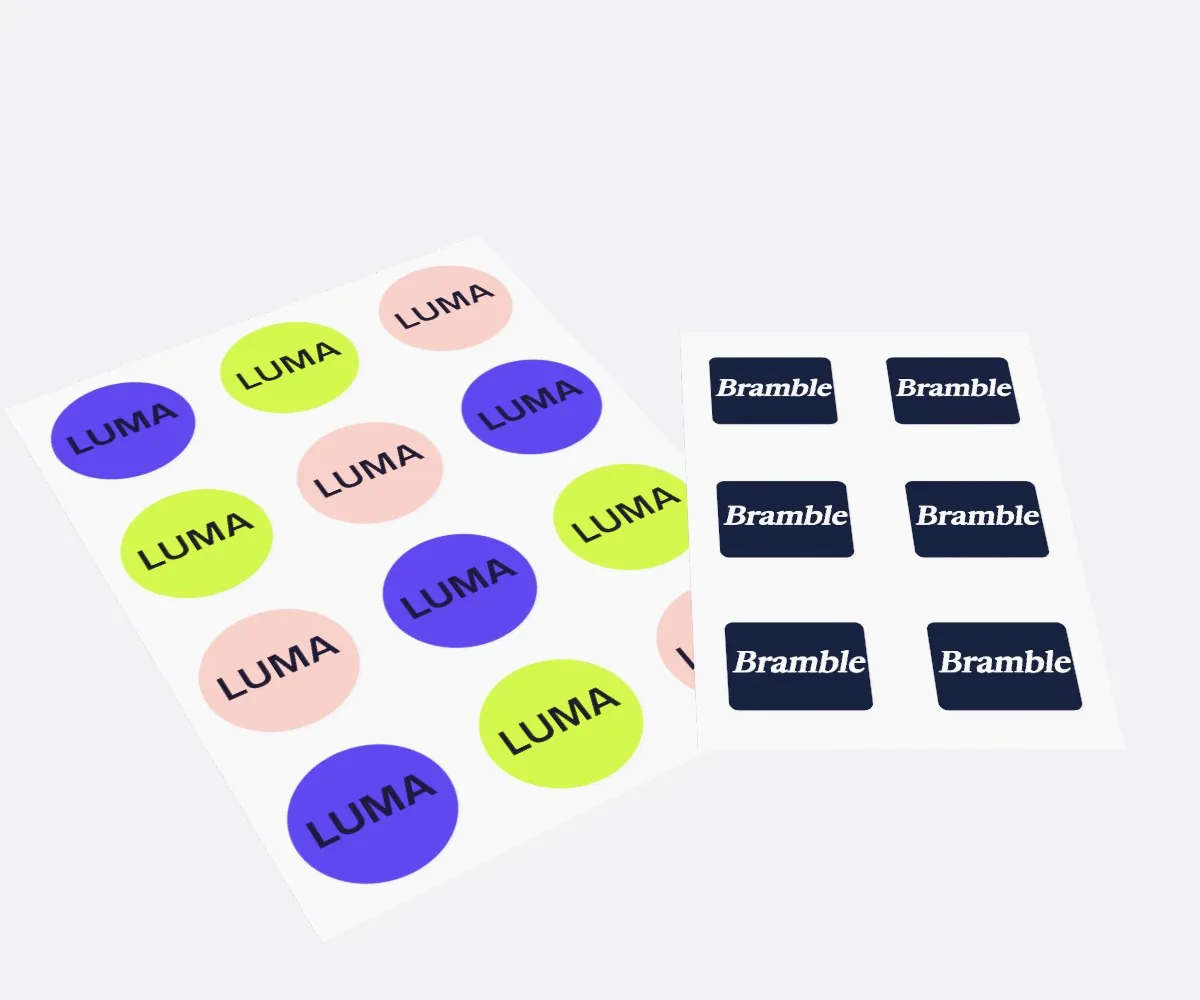
Because an ellipse narrows at the top, bottom, left and right poles, its usable area for dense multi-line text is roughly 21 percent smaller than a rectangle of the exact same width and height (the area of an ellipse is π × half-width × half-height, or about 78.5 percent of the bounding box). Trying to cram a front brand logo, net weight, full ingredient declaration, distributor address and scannable UPC barcode onto one 2.5 × 1.5 inch front oval forces the font size down to an unreadable 4-point blur. Instead, food, beverage and cosmetic brands split their hierarchy across two pieces. Use a front oval crest on custom clear labels or custom foil labels purely for your logo, product name, scent or flavor and net weight. Then place your nutrition facts, barcode and directions on a secondary back label or a round bottom/lid sticker. In Step 2 of the CubitPack quote form, select 2 designs and list both your front oval dimensions and your back or lid dimensions in the notes.
- Honey & jam jars: pair a 2.5 × 1.5 in front oval with a 1.5 in or 2 in custom circle label on the metal lid.
- Lotion & serum bottles: pair a 2 × 3 in vertical front oval with a 1.75 × 2.5 in custom rectangle label on the back for ingredients and barcode.
- Bar soaps & candles: pair a 2 × 1.25 in front brand oval on the band with a matching 2 × 1.25 in ingredient oval on the underside.
- Craft beverages: pair a 2.5 × 1.25 in horizontal neck oval with a 3.5 × 3 in body wrap below the shoulder.
What are the most common oval label sizing mistakes?
Almost every oval sizing misstep comes from reversing Width and Height or treating an ellipse as if it had square corners for text. Avoid these five errors before approving your proof
- Writing Height × Width instead of Width × Height, which turns a wide horizontal jar oval into a tall vertical bottle oval.
- Making a front oval wider than 35% of a round bottle's circumference, causing the left and right ends of your brand name to curve out of sight.
- Forgetting that an oval holds 21.5% less surface area than a rectangle of the same width and height when laying out long ingredient lists.
- Sizing a tall vertical oval over the curved neck shoulder of a mason or honey jar instead of staying inside the flat vertical wall band.
- Placing a wide UPC barcode right against the narrow bottom pole of an oval where the curving cut line clips the outer quiet zone.
Find your label size
Suggested label size: 9⅛ × 2¾ in (width × height)
A typical starting point. Your account manager confirms the size on the proof.
Quote this size →Packaging for this
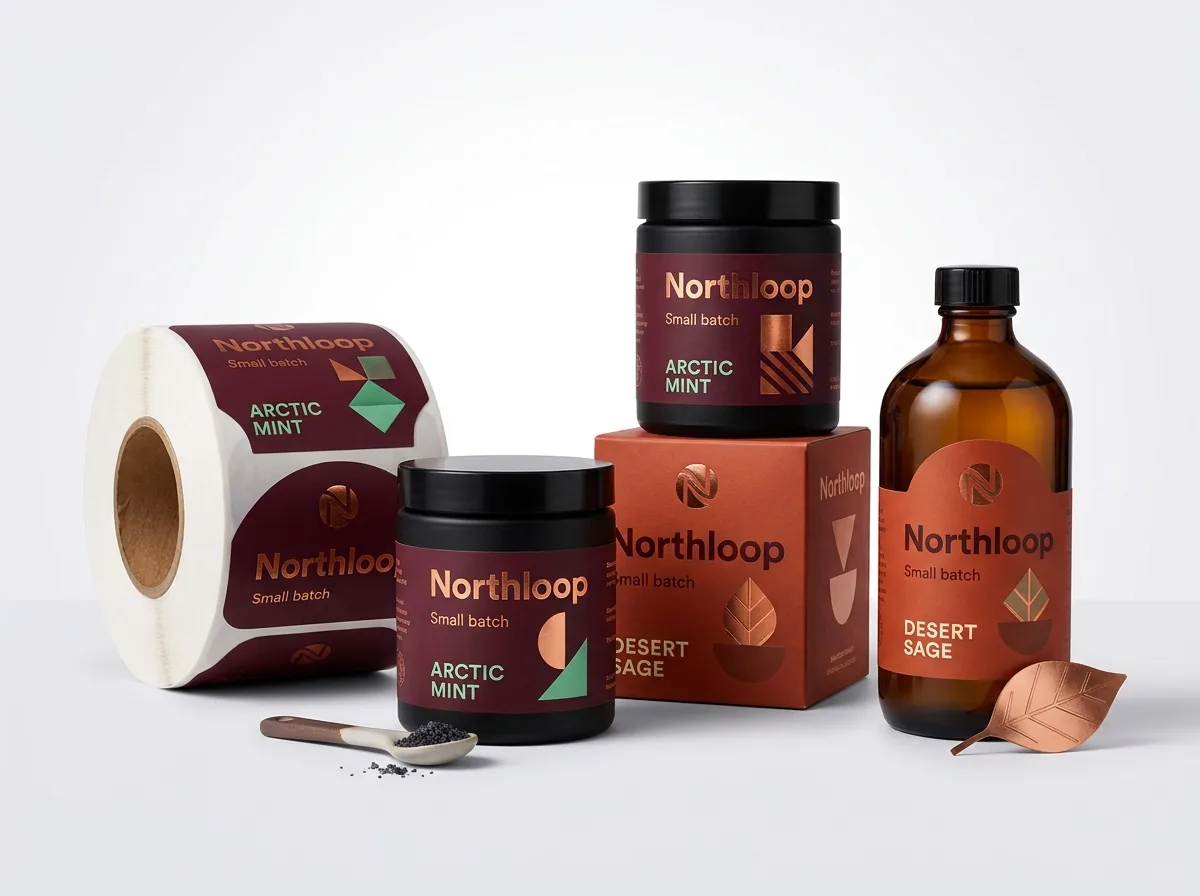
Ready to order oval labels? Compare up to 3 quantities with a free 3D mockup.
Request a Quote →Questions about oval labels
Does Width or Height come first when ordering custom oval labels?
Width always comes first, followed by Height (W × H in inches). Width is the horizontal measurement from left to right as the label sits on your upright container, and Height is the vertical measurement from top to bottom. Thus 3 × 2 in is a wide horizontal oval and 2 × 3 in is a tall vertical oval.
What size oval label fits a standard 8 oz honey or mason jar?
A 2.5 × 1.5 inch or 2.75 × 1.75 inch horizontal oval is the most popular front size for 8 oz mason jars, quilted jelly jars and 8 oz glass honey pots. It covers roughly one-third of the jar's circumference while leaving plenty of glass visible to show the honey or jam.
How do you calculate the printable area inside an oval label?
The surface area of an ellipse equals π (3.14) multiplied by half the width and half the height, which is 78.5% of a rectangle with the same outer dimensions. Keep important text at least ⅛ inch inside the curved cut line so letters never touch the narrowing arc.
Can I order a custom oval proportion that is plumper or narrower than standard templates?
Yes. Because CubitPack cuts every order to a custom vector dieline with no die or plate charges, you can specify any exact width-to-height ratio - from a nearly circular 2.5 × 2.25 inch medallion to a sleek 3.5 × 1 inch neck band.
What size oval label works best for handmade bar soaps?
Most 4 oz to 5 oz artisan soap bars use a 2 × 1 inch, 2.25 × 1.25 inch or 2.5 × 1.5 inch horizontal oval sticker placed on the front of a kraft belly band, glassine wrap or shrink wrap.
Can I order a front oval label and a round lid seal in the same quote?
Yes. Select 2 designs in Step 2 of the quote form and write both your front oval size and your round lid or rectangular back label size in the notes box. Your account manager will quote the combined production run together.
Still have a question? Ask a packaging specialist.
Request a Quote →Request your oval labels quote
Tell us your size and quantities, and one dedicated account manager prepares pricing for each tier.
- Free design & AI-to-print studio + 3D mockup
- No die or plate charges · 4–5 day rush available
- Free shipping to all 50 states
- 10% off your first order
The oval sizing formulas in this guide use standard cylinder circumference geometry (30% to 35% front viewing arc) and ellipse area equations (π × a × b), alongside CubitPack's decided policies in our published product specifications. A CubitPack packaging specialist verified every container benchmark. Spot something wrong? Tell us and we will fix it.
Sources
What changed
- October 22, 2026: First published.
- October 22, 2026: Updated specifications, terminology, and verified source links.
More guides
New packaging guides by email
Sizes, materials and design tips. Unsubscribe anytime.