
How do I format small type and allergens on custom ingredient labels?
Short answer: Set small 5 pt to 6 pt ingredient text in single-channel 100% K black on a white or light background, maintain at least a 1/16 inch (0.0625 inch) lowercase 'o' height, list ingredients in descending order by weight, and call out the 9 major food allergens. Order custom ingredient labels from 500 pieces.
On this page
- How do I keep 5 pt to 6 pt ingredient text razor-sharp on press
- What are the FDA font size and ordering rules for food ingredient lists
- How should I format the 9 major food allergens (including sesame)
- How do cosmetic INCI ingredient lists differ from food panels
- How do I set up multi-SKU ingredient label files for fast prepress
- Common mistakes
- FAQs
Request a custom quoteFree dieline & 3D mockup
To format small type and allergens on custom ingredient labels so they pass retail inspection and print razor-sharp, set all 5 pt to 6 pt body copy in single-channel 100% K black (C:0 M:0 Y:0 K:100) on a high-contrast white or opaque-backed background, never in 4-color rich black. Choose a clean humanist sans-serif font that maintains at least a 1/16 inch (0.0625 inch) physical lowercase 'o' height. On food labels, list ingredients by common name in descending order of predominance by weight, group sub-ingredients in parentheses, and declare all 9 major food allergens (milk, eggs, fish, Crustacean shellfish, tree nuts, peanuts, wheat, soybeans, and sesame) either in parentheses or in a bold 'Contains:' line directly below. On cosmetic labels, list INCI names in descending weight order above 1%, followed by 1% or less ingredients in any order. Order printed ingredient labels at CubitPack from 500 units.
How do I keep 5 pt to 6 pt ingredient text razor-sharp on press?
The single most important prepress rule for custom ingredient labels is setting all body text, allergen lines, hairlines, and barcode bars in single-channel 100% K (black) ink (C:0 M:0 Y:0 K:100) rather than 4-color rich black or RGB black. When a designer exports a label from RGB mode or uses a default rich black swatch, the press has to lay down cyan, magenta, yellow, and black dots on top of each other to build tiny 5 pt letters. Even a hair-thin 0.002 inch plate or web shift creates a fuzzy colored halo around the edges of fine stems, commas, and parentheses. By locking small type to 100% K on a single black plate, every parenthesis, percentage sign, and botanical Latin name prints with crisp, solid edges. Pair that color setup with a high-x-height humanist sans-serif typeface (such as Helvetica Neue, Inter, Roboto, or Frutiger) at 5.0 pt to 6.5 pt with +1% to +2% tracking and at least 0.5 pt to 1.0 pt of extra leading so ascenders and descenders never collide across lines.
| Prepress element | Recommended specification | What to avoid & why |
|---|---|---|
| Black text color mode | 100% K only (C:0 M:0 Y:0 K:100) set to overprint | 4-color rich black or RGB black (causes 4-plate registration halos) |
| Minimum positive font size | 5.0 pt to 6.0 pt sans-serif (1/16 in lowercase 'o') | Serif or script fonts below 6 pt (thin serifs break on press) |
| Knockout (white-on-dark) text | 6.0 pt minimum in Medium or Semi-Bold weight | 4.5 pt Light white text on rich black (dark ink fills fine strokes) |
| Clear or foil stock backing | 100% opaque white ink flood behind the text block | Unbacked black text on clear film (disappears against dark contents) |
| Minimum rule & border stroke | 0.25 pt (positive line) / 0.50 pt (knockout line) | 0.10 pt hairline dividers (drop out during plate exposure) |
| Barcode setup | 80%–100% UPC-A in 100% K on white with 0.125 in quiet zone | Red, metallic gold, or gray bars (red laser scanners cannot read red) |
What are the FDA font size and ordering rules for food ingredient lists?
Under FDA food labeling regulations (21 CFR 101.2 and 21 CFR 101.4), the ingredient list on packaged foods and beverages must appear on either the principal display panel or the information panel in prominent, conspicuous type with a lowercase letter 'o' height of at least 1/16 inch (0.0625 inches, or roughly 1.6 mm), unless the container qualifies for a small-package exemption. Keep in mind that 1/16 inch refers to the physical height of the printed lowercase letter 'o' on the label, not the software point size. Because different fonts have different x-heights, a 5.5 pt condensed sans-serif lowercase 'o' may measure the full 0.0625 inches while a 6.0 pt geometric font with a small x-height falls short. Always draw a 0.0625 inch tall reference rectangle right beside a lowercase 'o' at 100% zoom in Illustrator before approving your dieline. Ingredients must be listed by their common or usual name in descending order of predominance by weight at the time the food is manufactured: the ingredient that weighs the most goes first, and the ingredient that weighs the least goes last.
- Sub-ingredients in parentheses: When a component is itself a multi-ingredient food (such as dark chocolate chips or Worcestershire sauce), list the parent name in its weight position followed by its sub-ingredients in parentheses in descending weight order.
- Ingredients present at 2% or less: Minor ingredients making up 2% or less by weight can be grouped at the end of the ingredient list following a phrase such as 'Contains 2% or less of: Sea Salt, Baking Soda, Natural Flavor.'
- Chemical preservatives: State both the common name of the preservative and its function, such as 'Potassium Sorbate (to preserve freshness)' or 'Ascorbic Acid (antioxidant).'
How should I format the 9 major food allergens (including sesame)?
Under the Food Allergen Labeling and Consumer Protection Act (FALCPA) and the FASTER Act (which added sesame as the 9th major US allergen effective January 1, 2023), packaged foods regulated by the FDA must clearly declare any of the 9 major food allergens: milk, eggs, fish, Crustacean shellfish, tree nuts, peanuts, wheat, soybeans, and sesame. You have two compliant ways to declare major food allergens on your custom food labels or back ingredient stickers: in parentheses within the ingredient list itself whenever the common ingredient name does not already name the food source (for example, 'Whey (Milk), Lecithin (Soy), Tahini (Sesame)'), or in a separate 'Contains:' statement placed immediately after or adjacent to the ingredient list in a type size no smaller than the ingredient list (for example, 'Contains: Milk, Wheat, Soy, Sesame, and Tree Nuts (Almonds, Pecans).'). For tree nuts, fish, and Crustacean shellfish, you must declare the specific type of nut or species (such as Almonds, Cashews, Cod, or Shrimp), not just the broad category word. Even when using a separate 'Contains:' statement, grocery buyers and co-packers strongly recommend bolding both the in-list allergens and the 'Contains:' summary line so shoppers can verify allergens in a glance.
Know your size? Compare pricing across up to 3 quantities.
Request a Quote →How do cosmetic INCI ingredient lists differ from food panels?
If you package skincare serums, creams, haircare, bath salts, or soaps that make cosmetic claims, your back or bottom sticker follows FDA cosmetic ingredient rules (21 CFR 701.3) and International Nomenclature of Cosmetic Ingredients (INCI) naming conventions rather than food rules. Unlike food panels, where every ingredient down to the smallest spice is ordered strictly by weight, cosmetic INCI panels divide ingredients into three tiers so brands can protect proprietary trace fragrance and active ratios while giving shoppers full transparency. First, all ingredients present at a concentration greater than 1% are listed in descending order of predominance by weight (for example, 'Aqua (Water), Aloe Barbadensis Leaf Juice, Glycerin, Caprylic/Capric Triglyceride'). Second, any non-color ingredients present at a concentration of 1% or less may be listed in any order immediately following the >1% ingredients. Third, color additives of any concentration may be listed in any order at the end of the declaration (or after 'May Contain [+/-]:' for shade ranges). On compact 1 oz or 2 oz jars, brands typically print the INCI list on a 1.25 in or 1.5 in custom circle label under the base or with matte lamination on the outer carton.
How do I set up multi-SKU ingredient label files for fast prepress?
When ordering back ingredient stickers across 10, 20, or 30 flavors or formulas, build one master Adobe Illustrator template locked to a single dieline size (such as 2.5 × 3.5 inches) with three organized layers: a locked 'Dieline' layer containing the thru-cut line in a spot color; an 'Artwork & Borders' layer containing your header logo, divider hairlines, and lot stamp box; and a 'Variable Copy & Barcode' layer containing the SKU title, descending ingredient list, allergen line, and UPC barcode. Once you verify that your longest recipe fits comfortably at 5.5 pt with a 1/16 inch lowercase 'o' height, save each flavor as a separate print-ready PDF with outlined fonts and 0.125 inch bleed. Sharing the exact same dieline across every SKU lets you group all your flavors into a single quote and keeps your packing line running without mechanical stops.
What are the most common ingredient label formatting mistakes?
Registration blur on 4-color black type, undersized x-heights, and missing sesame callouts cause the most label reprints. Avoid these five mistakes
- Leaving 5 pt to 6 pt ingredient text and barcode bars in RGB black or 4-color CMYK rich black instead of converting them to single-channel 100% K (C:0 M:0 Y:0 K:100).
- Assuming any 6 pt font meets the FDA 1/16 in (0.0625 in) rule without measuring the actual physical height of the lowercase letter 'o' at 100% scale.
- Forgetting to include sesame (the 9th major US food allergen since 2023) or failing to name specific tree nut or fish species in the allergen statement.
- Printing small black ingredient copy directly onto unbacked clear film without a 100% opaque white ink underlay block behind the text panel.
- Using gloss lamination over a blank lot-code box where non-thermal rubber ink stamps smear unless an unvarnished or matte zone is provided.
Find your label size
Suggested label size: 9⅛ × 2¾ in (width × height)
A typical starting point. Your account manager confirms the size on the proof.
Quote this size →Packaging for this
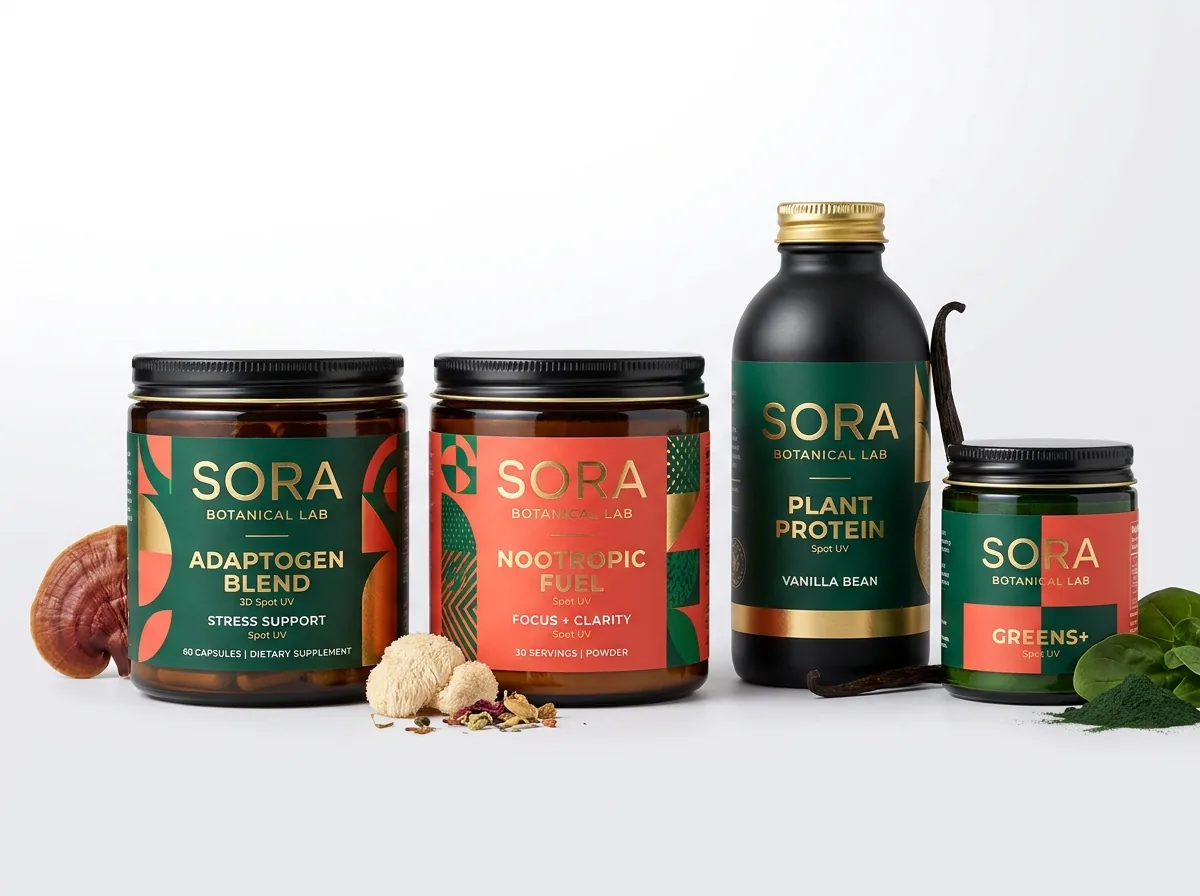
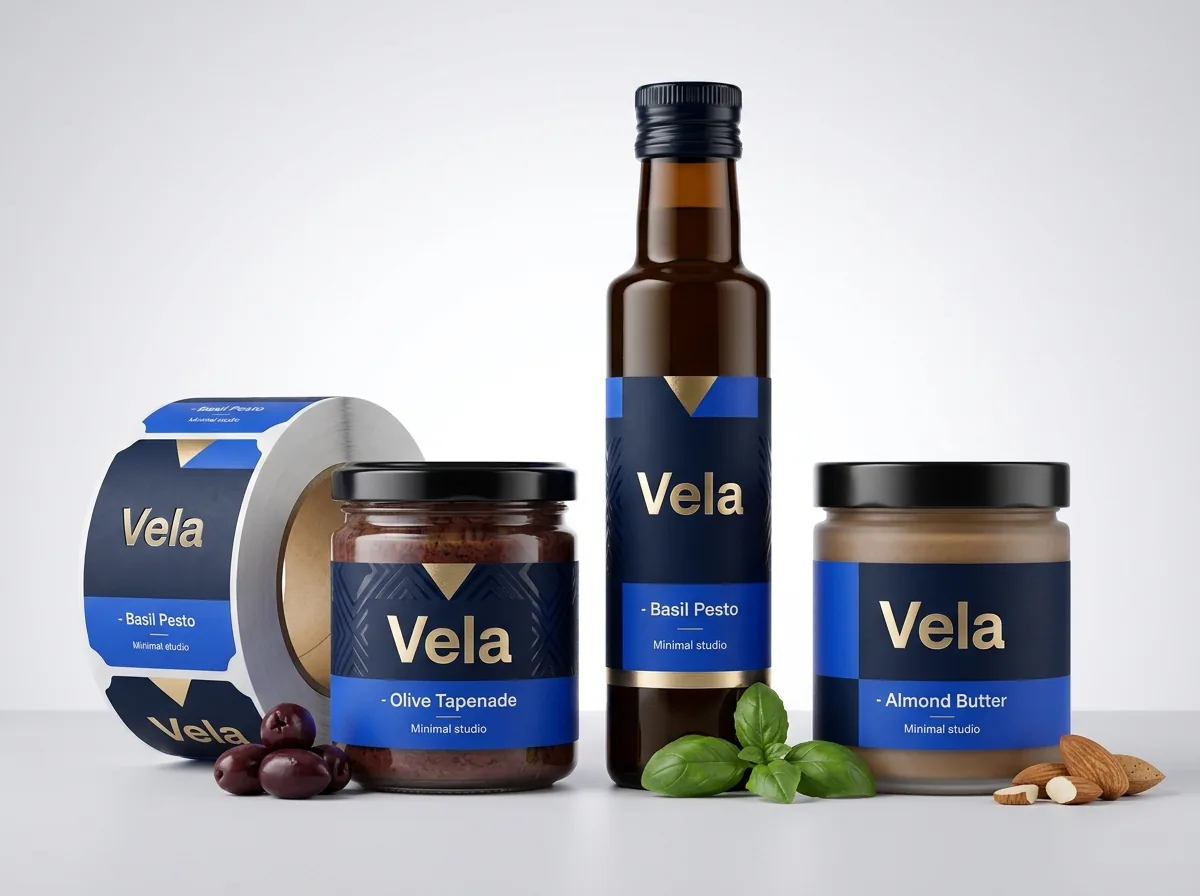
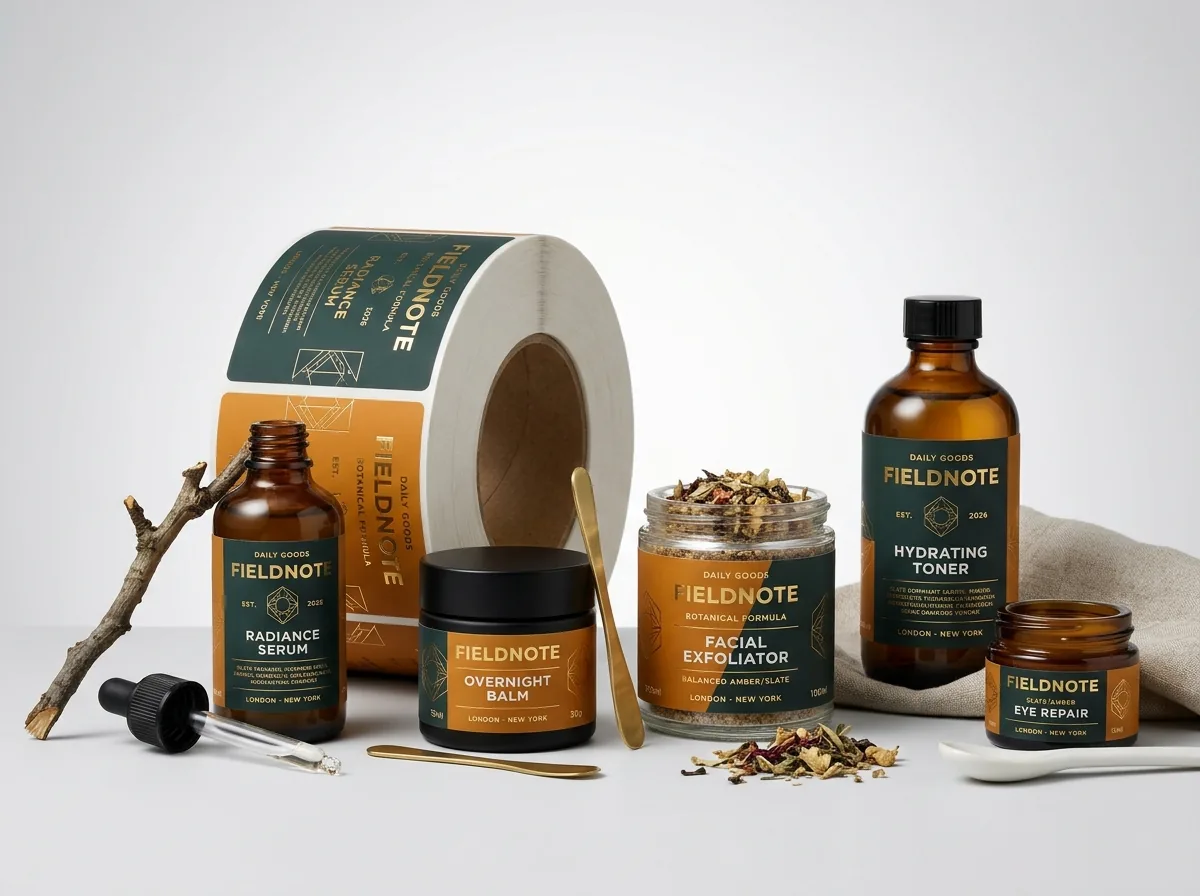
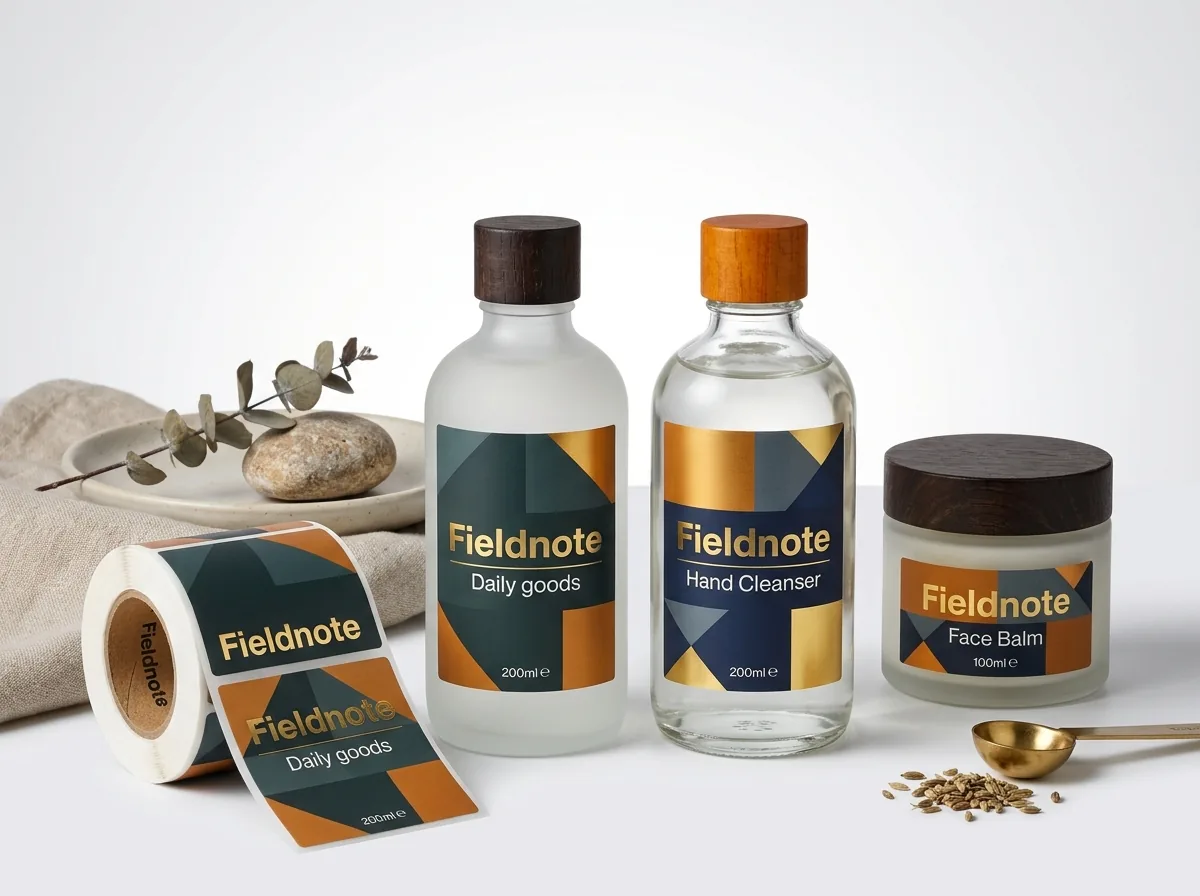
Ready to order ingredient labels? Compare up to 3 quantities with a free 3D mockup.
Request a Quote →Questions about ingredient labels
Why should 5 pt ingredient text be set in 100% K black instead of rich black?
Rich black prints using four separate plates (Cyan, Magenta, Yellow, and Black). Even tiny press vibrations cause colored halos around 5 pt letters. Setting small text in single-channel 100% K (C:0 M:0 Y:0 K:100) prints every character from a single black plate for razor-sharp edges.
What is the FDA minimum font size for a food or cosmetic ingredient list?
FDA food (21 CFR 101.2) and cosmetic (21 CFR 701.3) rules generally require ingredient declarations to use prominent type with a lowercase letter 'o' height of at least 1/16 inch (0.0625 inch), unless a small-package exemption applies.
What are the 9 major food allergens that must be declared on US food labels?
The 9 major US food allergens under FALCPA and the FASTER Act are milk, eggs, fish, Crustacean shellfish, tree nuts, peanuts, wheat, soybeans, and sesame. Tree nuts, fish, and shellfish must also state the specific nut or species.
How do I order ingredients on a cosmetic INCI label?
List ingredients present at more than 1% in descending order of weight, followed by non-color ingredients present at 1% or less in any order, and color additives at the very end.
Can your prepress team check if my small ingredient text will print cleanly?
Yes. Every order includes a free prepress file check, a 2D digital proof, and a 3D mockup before payment. If your small text is set in 4-color black or strokes are too thin, our specialists flag it before printing.
What file format should I upload for custom ingredient labels?
Upload a vector PDF, Adobe Illustrator (.ai), or EPS file with all fonts outlined (converted to curves), small black text and barcodes set to 100% K, and 0.125 inch bleed outside the cut line.
Still have a question? Ask a packaging specialist.
Request a Quote →Request your ingredient labels quote
Tell us your size and quantities, and one dedicated account manager prepares pricing for each tier.
- Free design & AI-to-print studio + 3D mockup
- No die or plate charges · 4–5 day rush available
- Free shipping to all 50 states
- 10% off your first order
This prepress and formatting guide references FDA 21 CFR 101.2 and 101.4 food labeling rules, FALCPA and FASTER Act 9-allergen requirements, FDA 21 CFR 701.3 cosmetic INCI ordering rules, and flexo/digital single-channel 100% K prepress standards. Checked by a CubitPack packaging specialist. Spot an error? Tell us and we will fix it.
Sources
What changed
- October 22, 2026: First published.
- October 22, 2026: Updated specifications, terminology, and verified source links.
More guides
New packaging guides by email
Sizes, materials and design tips. Unsubscribe anytime.