
How do I design custom honey boxes for raw jars, manuka, and cut comb?
Short answer: Design standout custom honey boxes by matching the window and board to your honey type (hex cutouts on kraft for raw floral jars, UV-blocking soft-touch cartons with gold foil for manuka), adding die-cut loops for wooden dippers, and reserving back-panel room for FDA net weight and infant safety notes.
On this page
- How do I match board stock, windows, and finishes to raw floral vs manuka honey
- How do gold foil stamping and 3D honeycomb embossing work together on a dieline
- How do you engineer a cardboard insert that holds both a honey jar and a wooden dipper
- What FDA labeling rules and infant safety advisories belong on retail honey cartons
- How can apiaries share one carton dieline across multiple floral harvests
- Common mistakes
- FAQs
Request a custom quoteFree dieline & 3D mockup
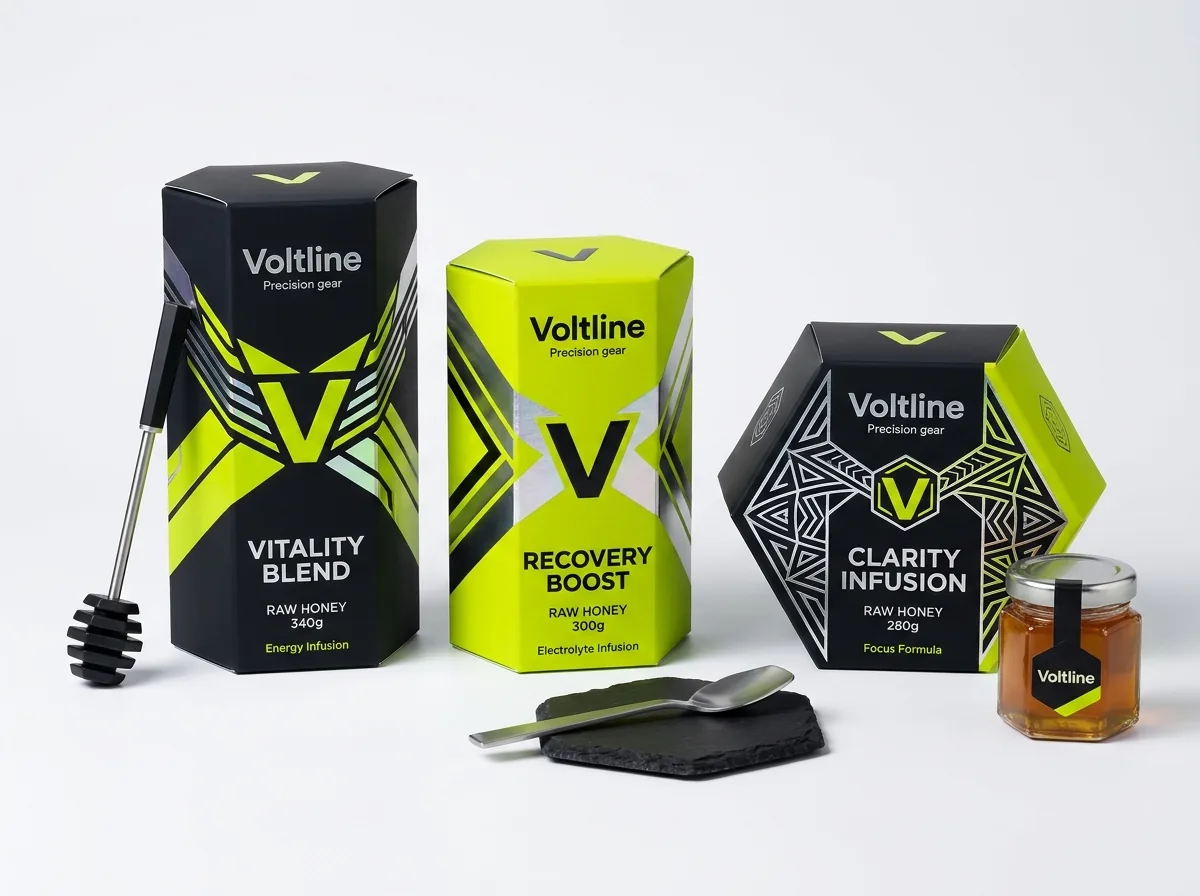
Designing custom honey packaging means balancing tactile storytelling with serious structural and regulatory details. A jar of raw spring wildflower honey sells through visual warmth: unbleached brown kraft board, botanical ink illustrations, and a six-sided hexagonal window cutout that lets sunlight glow through the golden liquid. A high-MGO jar of New Zealand manuka honey or propolis infused honey requires the exact opposite: a light-proof soft-touch paperboard carton stamped with metallic gold foil, raised 3D honeycomb embossing, and clear UMF/MGO potency badges. Add in die-cut cardboard loops that secure a wooden honey dipper without scratching the glass, wipe-clean lamination against sticky drips, and mandatory FDA net weight and infant botulism disclosures, and every panel of your dieline has a specific job. CubitPack provides free structural design help, custom dielines, and 3D mockups on every order from 1,000 boxes.
How do I match board stock, windows, and finishes to raw floral vs manuka honey?
Shoppers judge honey quality in three seconds by the texture of the carton and how it frames (or shields) the jar inside. Raw local apiary honeys and varietal blossom harvests (Clover, Orange Blossom, Sourwood, Tupelo, and Buckwheat) thrive on natural tactile warmth, whereas medicinal manuka, royal jelly, and infused wellness honeys command premium prices through clinical authority and luxury finishes. When laying out printed honey cartons, start by choosing whether your jar should be visible through a front honeycomb cutout or fully enclosed against overhead store lights. Use the specification table below to pair your honey variety with the ideal board, window, and surface finish.
| Honey category | Best board & window setup | Signature finishing touch |
|---|---|---|
| Raw wildflower & local apiary | Natural brown kraft + open hex window | Opaque white ink + charcoal botanical art |
| Varietal blossom flights | White card + color-coded floral bands | Matte lamination + spot UV honey drips |
| UMF / MGO manuka honey | Solid white card (no window, UV-blocking) | Soft-touch coat + gold foil MGO badge |
| Raw cut-comb cassettes | Kraft or white tray-and-sleeve drawer | Patched top window + food-safe barrier on request |
| Reserve & holiday gift trios | E-flute corrugated mailer + jar divider | 3D honeycomb embossing + inside-lid floral map |
How do gold foil stamping and 3D honeycomb embossing work together on a dieline?
Few products in the food aisle have a natural geometric motif as recognizable as the six-sided honeycomb cell. Combining blind or registered embossing with metallic foil stamping turns that hexagonal geometry into a physical texture shoppers feel the moment they pick up the box. For maximum contrast on manuka or reserve honey cartons, apply a velvety soft-touch matte lamination across a deep charcoal, forest green, or midnight navy background. Next, stamp your brand crest, bee emblem, and MGO/UMF potency number in warm gold or amber metallic foil. Finally, add a blind-embossed hexagonal honeycomb pattern across the top third of the carton or around the border of your custom window boxes. Keep embossed hex cells at least 1/4 inch away from fold score lines so the raised paperboard relief stays crisp when the carton is folded. On natural brown kraft board, pairing a single pass of opaque white ink with warm copper or gold foil creates an authentic farmhouse apothecary look without needing full-bleed background ink.
How do you engineer a cardboard insert that holds both a honey jar and a wooden dipper?
Bundling a turned wooden honey dipper (honey wand) with an 8 oz or 12 oz jar turns a pantry staple into an instant gift, but tossing a loose wooden stick into a box alongside a glass jar causes two problems: the wooden handle rattles around and scuffs the jar label, or the dipper drops flat to the bottom of the carton out of sight. Our structural team engineers two clean solutions inside custom cardboard inserts. On a single-jar gift box, we extend the inside carton Length by 1.125 inches and fold an internal side wall with two die-cut horizontal strap loops that grip the wooden dipper handle upright right next to the glass jar, visible through a side or front window. On a 3-jar E-flute corrugated tasting mailer, we die-cut a recessed cradle channel across the front margin or inside the center divider wall so the 6-inch dipper snaps flush into its own slot.
- Measure both the turned wooden dipper head diameter (typically 0.875 to 1.0 in) and total stick length (5.0 or 6.0 in).
- Use two die-cut retaining loops spaced 2.5 inches apart to hold the narrow wooden shaft without tilting.
- Keep a full paperboard or E-flute wall between the dipper head and the glass jar so the wood never rubs the label.
- On raw cut-comb boxes, request food-safe liners and wax/moisture barriers if wrapped comb touches the tray.
Know your size? Compare pricing across up to 3 quantities.
Request a Quote →What FDA labeling rules and infant safety advisories belong on retail honey cartons?
When a honey jar is sold inside an enclosed carton or gift box, the outer box must carry all required FDA consumer disclosures on its exterior panels (unless an open window leaves the entire required statement on the jar label clearly visible). Under FDA 21 CFR 101 and the FDA Guidance for Industry on Proper Labeling of Honey and Honey Products, pure honey cartons must state Honey (or the floral source, such as Clover Honey or Wildflower Honey) as the statement of identity on the principal display panel, with net weight declared in both avoirdupois ounces/pounds and metric grams on the bottom 30 percent of the front face - for example, NET WT 12 OZ (340 g) or NET WT 16 OZ (1 LB) 454 g. If your product is infused with cinnamon, chili, ginger, or truffle, the front identity statement and ingredient list must name both honey and the added flavoring ingredients. In addition, virtually all US honey packers and retail buyers require the standard infant botulism safety statement on the back or side information panel: Do not feed honey to infants under one year of age. Leave a clean, high-contrast box near the nutrition facts panel on both your outer carton and your custom honey labels for that advisory, plus a gentle note explaining that raw honey naturally crystallizes and can be warmed in a water bath.
How can apiaries share one carton dieline across multiple floral harvests?
Beekeepers often harvest different varietal honeys from spring through autumn - such as Orange Blossom in spring, Clover and Wildflower in summer, and dark Buckwheat or Goldenrod in fall. So long as you bottle every harvest in the exact same 8 oz hex jar or 12 oz queenline jar, every varietal fits the exact same auto lock bottom carton dieline. You can combine multiple floral designs in a single multi-version production run to reach higher quantity price breaks, or print one evergreen apiary carton with an open hexagonal front window so the jar label inside displays the specific floral harvest and batch date. Many apiaries also print a color-coded floral stripe along the top tuck flap of each varietal carton so market staff can pull the right blossom honey from master cases at a glance without lifting every jar out of the shipping box.
What are the most common honey box design mistakes?
Overlooking honey's weight, stickiness, or labeling rules can trip up even experienced apiaries. Check these five design mistakes before approving your proof
- Listing net quantity in fluid ounces (FL OZ) instead of net weight (NET WT OZ / LB and grams) on the bottom 30% of the front panel.
- Forgetting the standard infant safety advisory ('Do not feed honey to infants under one year of age') on the back or side panel.
- Placing 3D honeycomb embossing right across vertical fold score lines, which crushes the raised cells when the carton is folded.
- Designing a gift box with a loose wooden honey dipper that rattles against the glass jar instead of locking into die-cut insert loops.
- Leaving retail honey tasting cartons unlaminated where a single sticky drop on bare paperboard leaves a dark stain.
Find your size
Suggested inside size: 2.0 × 2.0 × 2.375 in
A starting point. Your account manager confirms the size with you before the proof.
Quote this size →Packaging for this
Ready to order honey boxes? Compare up to 3 quantities with a free 3D mockup.
Request a Quote →Questions about honey boxes
Should honey cartons list net weight (NET WT OZ) or fluid ounces (FL OZ)?
In the United States, packaged honey is labeled by net weight in avoirdupois ounces/pounds and metric grams (for example, NET WT 12 OZ / 340 g or NET WT 16 OZ (1 LB) / 454 g), placed in the lower 30% of the front panel.
Why do manuka honey boxes avoid front windows?
Bioactive compounds in manuka honey (such as methylglyoxal / MGO and natural enzymes) are sensitive to prolonged ultraviolet light exposure. An enclosed carton shields the pot from store lighting and provides four full walls for UMF/MGO grading details.
Can I combine gold foil stamping and honeycomb embossing on the same box?
Yes. You can register gold foil stamping directly over raised embossed honeycomb cells or pair a gold foil logo with blind-embossed hexagonal patterns across a soft-touch or natural kraft carton.
How do you keep sticky honey drips from staining retail cartons?
Adding matte, gloss, or soft-touch film lamination over the outside of the paperboard seals the surface so accidental honey smudges during bottling or farmers market tastings wipe off cleanly with a damp cloth.
Do cut-comb honey boxes need food-safe board?
If raw cut-comb honey sits inside a sealed plastic cassette or glass jar, standard kraft or white paperboard works well for the outer sleeve. If wrapped comb or beeswax touches the board directly, request food-safe materials and barriers on your quote.
Can I print an educational note about honey crystallization inside the box?
Yes. Inside printing on the top dust flaps or interior walls is a favorite spot for explaining that raw unfiltered honey naturally crystallizes and can be gently warmed in water.
Still have a question? Ask a packaging specialist.
Request a Quote →Request your honey boxes quote
Tell us your size and quantities, and one dedicated account manager prepares pricing for each tier.
- Free design & AI-to-print studio + 3D mockup
- No die or plate charges · 4–5 day rush available
- Free shipping to all 50 states
- 10% off your first order
This guide combines FDA 21 CFR 101 and FDA honey labeling guidance, print finishing tolerances for foil stamping and embossing, and CubitPack structural insert specs. A packaging specialist verified every section. Spot something wrong? Tell us and we will fix it.
Sources
What changed
- October 22, 2026: First published.
- October 22, 2026: Updated specifications, terminology, and verified source links.
More guides
New packaging guides by email
Sizes, materials and design tips. Unsubscribe anytime.