
What size nut box do I need for snack packs and gift trays?
Short answer: Size custom nut boxes by testing the bulk volume of your lightest nut species rather than net weight alone. An 8 oz vertical retail carton typically measures 4.25 × 2.25 × 6.25 inches, a 1 lb (16 oz) 4-compartment gift tray measures 7.5 × 7.5 × 2.0 inches, and a 2 lb 8-cell chest measures 12.0 × 9.0 × 2.25 inches.
On this page
- Why do different nut species need different box volumes for the same net weight
- What are the standard nut box dimensions from 4 oz cartons to 2 lb gift chests
- How do I size 4, 6, and 8-compartment holiday nut gift trays and dividers
- How do I size a vertical window carton around an inner nut pouch
- How do I size orchard gable carry boxes and checkout counter displays
- Common mistakes
- FAQs
Request a custom quoteFree dieline & 3D mockup
Choosing the right nut box dimensions requires balancing net weight against kernel bulk density and compartment geometry. Because whole roasted almonds, jumbo cashews, and chocolate-panned peanuts pack tightly with very little air space, 4 ounces of almonds takes roughly 20% to 25% less cubic volume than 4 ounces of curved walnut halves, pecan halves, or in-shell pistachios. On vertical grocery folding cartons (4 oz to 16 oz), measure the swollen width, depth, and standing height of your filled inner barrier pouch and add 1/8 inch of clearance. On flat 4-, 6-, and 8-compartment holiday gift trays (1 lb to 2 lb), set every cell to accommodate your fluffiest nut variety and match the internal cardboard divider height to the full 2.0 to 2.25 inch tray depth so salted kernels never jump over into sweet cells. At CubitPack, every size is cut to order with no die charges.
Why do different nut species need different box volumes for the same net weight?
If you pack a 16 oz (1 lb) 4-compartment gift box with 4 ounces each of roasted almonds, salted cashews, cinnamon-glazed pecan halves, and in-shell pistachios, all four compartments cannot just be sized to the almonds. Whole blanched or roasted almonds have a dense, streamlined oval shape that settles with minimal void space. Curved pecan halves, craggy walnut halves, and open-shell pistachios bridge against each other and trap air pockets between kernels, occupying 25% to 30% more cubic inches for the exact same four-ounce weight. Always size every compartment in a multi-cell gift tray - or your shared vertical carton dieline - around your bulkiest nut variety. When you order printed nut cartons and gift trays from CubitPack, our design team calculates the cubic inch capacity of each compartment so neither your lightest pecan cell overflows nor your densest cashew cell looks half empty under the window.
- High density (compact volume per oz): whole roasted almonds, blanched peanuts, macadamia halves, chocolate-dipped nuts.
- Medium density (standard volume per oz): whole jumbo cashews, hazelnut kernels, honey-roasted mixed nuts, trail mix.
- Low density (bulky volume per oz): mammoth pecan halves, walnut halves, in-shell pistachios, puffed praline clusters.
What are the standard nut box dimensions from 4 oz cartons to 2 lb gift chests?
While CubitPack cuts every order to your exact inside dimensions (Length × Width × Height in inches) with zero die or plate fees, most nut roasters, orchards, and corporate gift packers build their lineup around six core capacities: 4 oz single-serve cartons, 8 oz and 12 oz vertical grocery boxes, 12 to 16 oz farm-stand gable boxes, and 1 lb, 1.5 lb, and 2 lb partitioned gift assortments. Use the reference table below to benchmark your inside measurements before testing your own kernels or inner pouches.
| Net weight & pack format | Typical inside size (L × W × H) | Best box style |
|---|---|---|
| 4 oz–5 oz single-serve snack or bar nut mix | 3.5 × 2.0 × 5.0 in | Straight tuck end or window carton |
| 8 oz–10 oz vertical grocery nut carton | 4.25 × 2.25 × 6.25 in | Auto lock bottom with front window |
| 12 oz–16 oz vertical family-size nut carton | 5.0 × 2.5 × 7.25 in | Auto lock bottom carton |
| 12 oz–16 oz orchard carry pack (1 or 2 bags) | 6.0 × 3.5 × 4.5 in | Gable carry box with top handle |
| 12 oz 3-compartment nut trio flight (3 × 4 oz) | 9.0 × 3.5 × 2.0 in | Tray and sleeve with window strip |
| 16 oz (1 lb) 4-compartment nut gift tray (4 × 4 oz) | 7.5 × 7.5 × 2.0 in | Two-piece box or sliding tray & sleeve |
| 24 oz (1.5 lb) 6-compartment assortment (6 × 4 oz) | 10.5 × 7.25 × 2.0 in | Two-piece lift-off lid or mailer box |
| 32 oz (2 lb) 8-compartment holiday nut chest | 12.0 × 9.0 × 2.25 in | Corrugated mailer or rigid-style two-piece |
| 12-count display of 1.5 oz–2 oz pocket nut packs | 5.25 × 6.5 × 5.5 in | Perforated counter display box (PDQ) |
How do I size 4, 6, and 8-compartment holiday nut gift trays and dividers?
Multi-compartment gift boxes are the flagship revenue driver for pecan orchards, gourmet nut roasters, and corporate gifting programs between October and January. Unlike vertical cartons where height is the largest number, an assortment tray uses a wide, shallow footprint (typically 2.0 to 2.25 inches deep) so every roasted, salted, candied, and chocolate-coated variety is visible at once when the customer lifts the lid or slides off the sleeve. To calculate the inside Length and Width of a partitioned tray, start with the cell footprint needed for one portion (usually 3.25 × 3.25 inches × 2.0 inches deep for 4 ounces of nuts) and add 1/16 to 1/8 inch for each interlocking custom cardboard insert strip. Most importantly, specify full-height divider walls that match the exact 2.0 inch interior height of the tray base. When the lid of your custom two-piece box or outer sleeve closes flush against the top edge of the divider grid, savory sea-salt dust and small kernel pieces cannot bounce over the wall into sweet chocolate or praline cells during parcel transit.
Know your size? Compare pricing across up to 3 quantities.
Request a Quote →How do I size a vertical window carton around an inner nut pouch?
For year-round supermarket and specialty grocery aisles, most brands seal 8 oz, 10 oz, or 12 oz of roasted nuts inside a nitrogen-flushed foil or clear poly pillow bag to prevent lipid oxidation, then pack that sealed bag inside a vertical custom auto lock bottom box. Sizing a bag-in-box nut carton requires measuring a filled, sealed pouch lying on a flat bench rather than calculating from flat film dimensions. When an inner bag is filled with 8 ounces of cashews or trail mix, the lower half of the pouch bulges outward into a rounded teardrop profile. Measure the thickest front-to-back belly bulge of the filled bag and add 1/8 inch to set your carton's inside Width (typically 2.25 to 2.5 inches) so the front and back carton panels stay flat instead of bowing outward on the shelf. Set the carton Length to the horizontal width of the filled bag plus 1/8 inch, and add 3/8 inch to the standing height so the top heat-seal fin tucks neatly underneath the top dust flaps.
- Fill and seal three sample pouches with your actual nut blend before measuring.
- Measure the maximum lower-belly depth of the standing pouch to set carton Width (front-to-back depth).
- Add 1/8 inch to the pouch width and 3/8 inch to standing height for clean top-flap closure.
- Position any front die-cut window over the middle third of the carton so the top seal fin of the inner bag stays hidden.
- Use a pre-glued auto-lock bottom on 12 oz and 16 oz vertical cartons so dense nut weight never pushes the bottom flap open.
How do I size orchard gable carry boxes and checkout counter displays?
At orchard farm stores, autumn festivals, and holiday markets, customers love a one-piece custom gable box with a built-in top handle. When sizing a gable box (such as 6.0 × 3.5 × 4.5 inches for a 12 oz to 16 oz carry pack), remember that the listed Height is measured from the flat bottom to the horizontal shoulder crease where the pitched roof begins - not to the top of the handle arch. That shoulder height is your true usable fill line. For 1.5 oz to 2 oz single-serve trail mix and roasted almond packets sold at cafe registers, size a perforated custom counter display box by multiplying the filled packet thickness (usually 0.65 to 0.85 inches) by 12 units for a single-lane tray or 6 units per row for a two-lane 12-pack tray, adding 1/4 inch of finger clearance per lane so customers can pull the first packet out easily without tearing the front lip. Every size is confirmed on a free digital proof and 3D mockup before payment.
What are the most common nut box sizing mistakes?
Kernel density differences and lower-belly pouch bulge cause most sizing surprises on nut packaging. Check these five points before approving your dieline
- Sizing all four cells of a mixed nut gift tray to dense whole almonds, leaving the pecan-half or in-shell pistachio cell overflowing.
- Ordering compartment dividers 1/4 inch shorter than the tray height, which lets salted nuts spill over into sweet cells during shipping.
- Measuring the flat unfilled width of an inner nut pouch and forgetting how the lower belly bulges outward once filled with 8 oz of kernels.
- Counting the pitched handle arch of a gable box as usable fill height instead of measuring only to the shoulder crease.
- Placing a front carton window too high so shoppers see the crimped top seal and empty headspace of the inner bag.
Find your size
Suggested inside size: 3.5 × 2.0 × 5.0 in
A starting point. Your account manager confirms the size with you before the proof.
Quote this size →Packaging for this
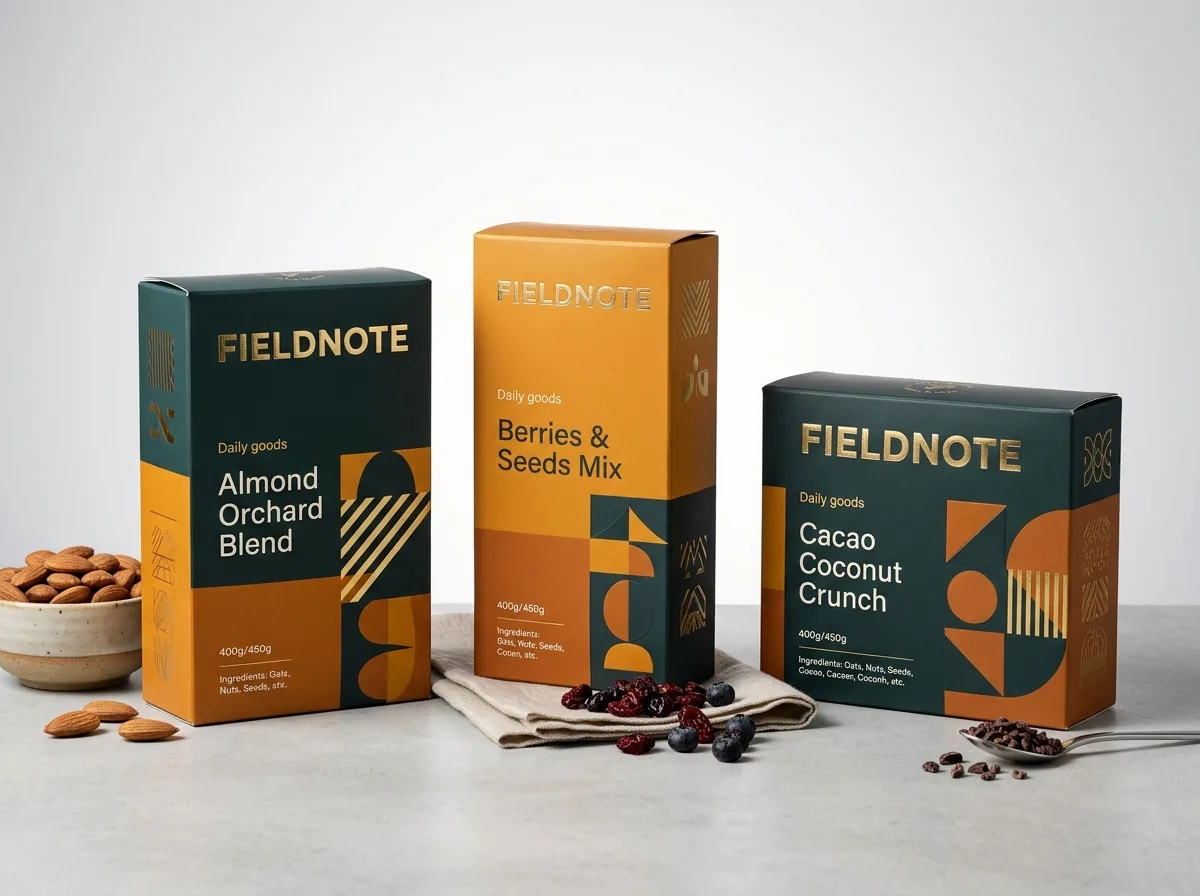
Ready to order nut boxes? Compare up to 3 quantities with a free 3D mockup.
Request a Quote →Questions about nut boxes
Are nut box and gift tray dimensions listed as inside or outside measurements?
All custom nut boxes at CubitPack are quoted by inside dimensions: Length × Width × Height in inches. That guarantees your inner pouches, thermoformed cups, or interlocking cardboard divider grids fit the usable interior space cleanly.
What size box do I need for a 1 lb (16 oz) 4-compartment mixed nut gift set?
A 16 oz (1 lb) assortment divided into four 4 oz compartments typically uses a 7.5 × 7.5 × 2.0 inch square box (or 8.0 × 8.0 × 2.25 inches if your mix includes bulky walnut halves, pecan halves, or in-shell pistachios).
How do you stop nuts from mixing between compartments during shipping?
We cut the interlocking cardboard divider strips to the exact full interior height of the tray (such as 2.0 inches) and pair them with a snug telescoping lid, outer sleeve, or top cushion pad that presses flush against the divider tops.
Can you make unequal compartment sizes in the same nut gift box?
Yes. Because we cut every divider dieline to order with no die charges, we can position the slotted crossbars to create larger cells for bulky pecans or dried fruit and narrower cells for dense almonds or chocolate-covered espresso beans.
How much clearance should I leave around an 8 oz inner bag of nuts?
Measure the filled, sealed pouch at its widest lower-belly bulge and add 1/8 inch to Length and Width, plus 3/8 inch to Height. That prevents the front carton panel from bowing outward while hiding the top seal fin under the tuck flap.
How can I test my nut compartment sizes before printing 1,000 boxes?
Every order includes a free digital dieline proof and 3D mockup before payment. You can also test our 100% scale flat dieline with your actual roasted nuts, order our $50 sample kit (credited to your order), or request a paid physical prototype.
Still have a question? Ask a packaging specialist.
Request a Quote →Request your nut boxes quote
Tell us your size and quantities, and one dedicated account manager prepares pricing for each tier.
- Free design & AI-to-print studio + 3D mockup
- No die or plate charges · 4–5 day rush available
- Free shipping to all 50 states
- 10% off your first order
The dimensions in this guide are based on bulk density measurements across whole almonds, cashews, pecan halves, walnut halves, and in-shell pistachios, plus standard interlocking cardboard divider tolerances. A CubitPack packaging specialist checked every row. Spot an error? Let us know and we will fix it.
Sources
What changed
- October 22, 2026: First published.
- October 22, 2026: Updated specifications, terminology, and verified source links.
More guides
New packaging guides by email
Sizes, materials and design tips. Unsubscribe anytime.