
How do I calculate layflat width and cut height for custom shrink sleeves?
Short answer: To size custom shrink sleeves, multiply your container's widest outside diameter in millimeters by 3.1416, divide by 2, and add 2 to 3 mm of slip clearance to get Layflat Width. For Cut Height, measure vertical coverage, add 3 to 5 mm for bottom-heel wrap, plus 3% to 8% longitudinal allowance.
On this page
- Why do converters measure shrink sleeves by layflat width instead of diameter
- What are standard layflat widths and cut heights for cans, shots, and bottles
- How do bottom heel tucks and vertical MD shrink affect cut height
- Should I order continuous roll-fed sleeve tubing or pre-cut individual shrink bands
- How do I verify my shrink sleeve dimensions before full production
- Common mistakes
- FAQs
Request a custom quoteFree dieline & 3D mockup
Unlike flat adhesive stickers measured by open width and height, a heat-shrink sleeve is converted as a continuous solvent-welded tube pressed completely flat between two crisp side creases. That flattened tube dimension is called Layflat Width, and confusing it with container diameter is the single costliest ordering mistake in beverage and CPG packaging. Because an unshrunk tube must slide freely over the widest shoulder, body rib, or closure ring before entering a steam or radiant heat tunnel, converters calculate half the maximum container circumference and add 2 mm for high-speed automatic sleeving spindles or 3 mm for hand-applied cut bands. At CubitPack, custom shrink sleeves start at 500 units and ship free across all 50 US states in 10–14 business days (with 4–5 business day rush available), including free dieline sizing, zero die or plate charges, and a 3D mockup before payment.
Why do converters measure shrink sleeves by layflat width instead of diameter?
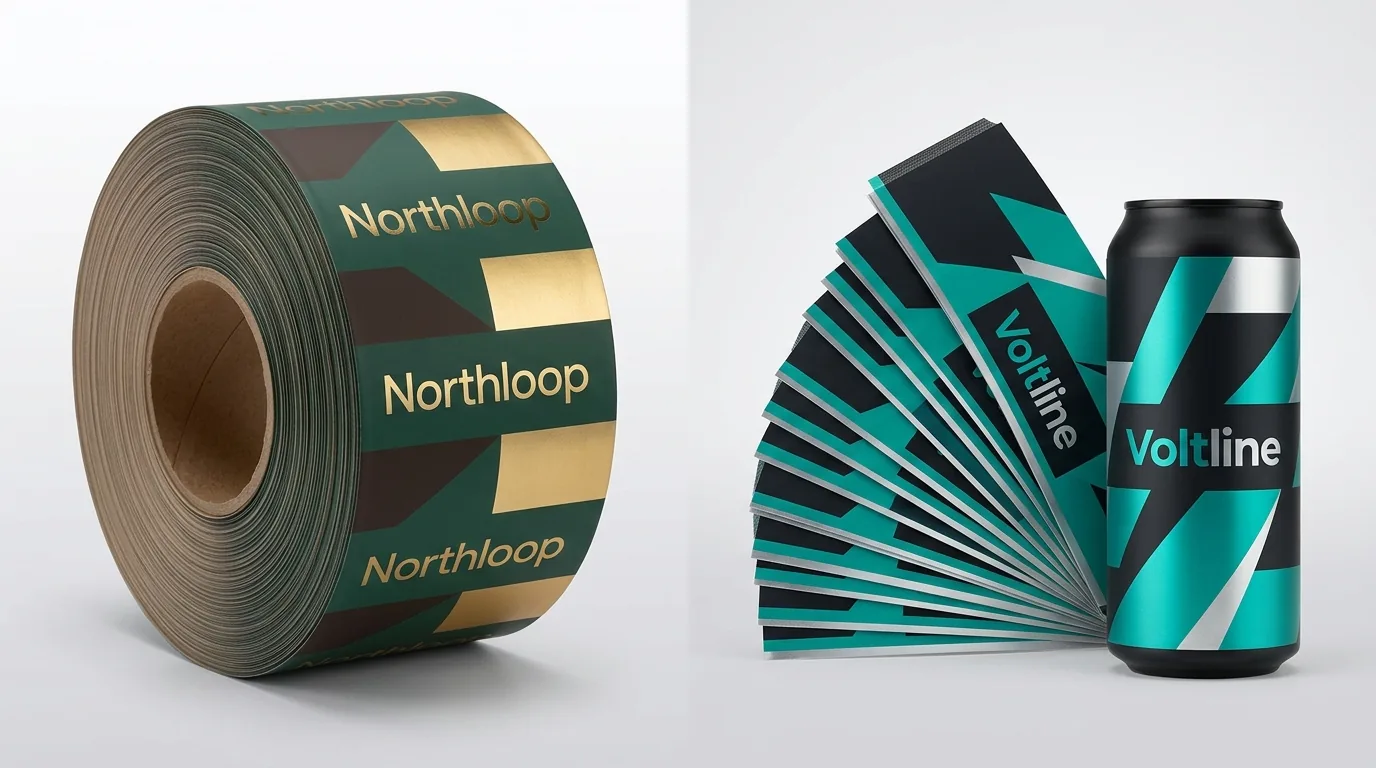
When flat printed polymer web is folded around a forming plow and welded along a 4 to 8 mm vertical T-seam per Tag and Label Manufacturers Institute (TLMI) converting standards, the finished tube is wound flat onto cores or cut into flat open bands. Measuring that pressed-flat width with a ruler is instantaneous on press and at incoming QC, whereas measuring the diameter of a flexible film ring in midair is impossible. Before requesting a quote on 360-degree printed shrink sleeves or testing container wraps in our label size calculator, follow this four-step caliper sequence
- Step 1 - Measure maximum outside diameter (D_max) in millimeters with digital calipers: Sweep calipers across the cap bead, neck ring, shoulder swell, main body wall, and base chime. Even a 1.5 mm blown-glass mold seam or decorative shoulder rib determines whether an unshrunk sleeve drops smoothly or hangs up mid-bottle.
- Step 2 - Convert widest diameter into half-circumference: Multiply D_max by pi (3.1416) to get full container circumference, then divide by 2. On a standard 66.0 mm (211 diameter) 16 oz aluminum brite can, circumference is 207.3 mm and exact half-circumference is 103.7 mm.
- Step 3 - Add slip clearance (+2 mm machine or +3 mm hand): Automatic inline rotary and mandrel sleevers shoot open tubes downward at high speed and run tight +1.5 to +2.5 mm layflat clearance (making a 66 mm can sleeve 106 mm layflat). Hand-applied pre-cut bands benefit from +2.5 to +3.5 mm layflat clearance so packing crews slip bands over caps rapidly without crumpling thin film edges.
- Step 4 - Check narrowest diameter (%TD shrink demand): Convert your chosen Layflat Width back into open sleeve diameter (D_sleeve = 2 x Layflat / 3.1416), then compute %TD Shrink = ((D_sleeve - D_min) / D_sleeve) x 100 at your narrowest neck or cap zone. If %TD exceeds 60%, specify a high-shrink film grade.
What are standard layflat widths and cut heights for cans, shots, and bottles?
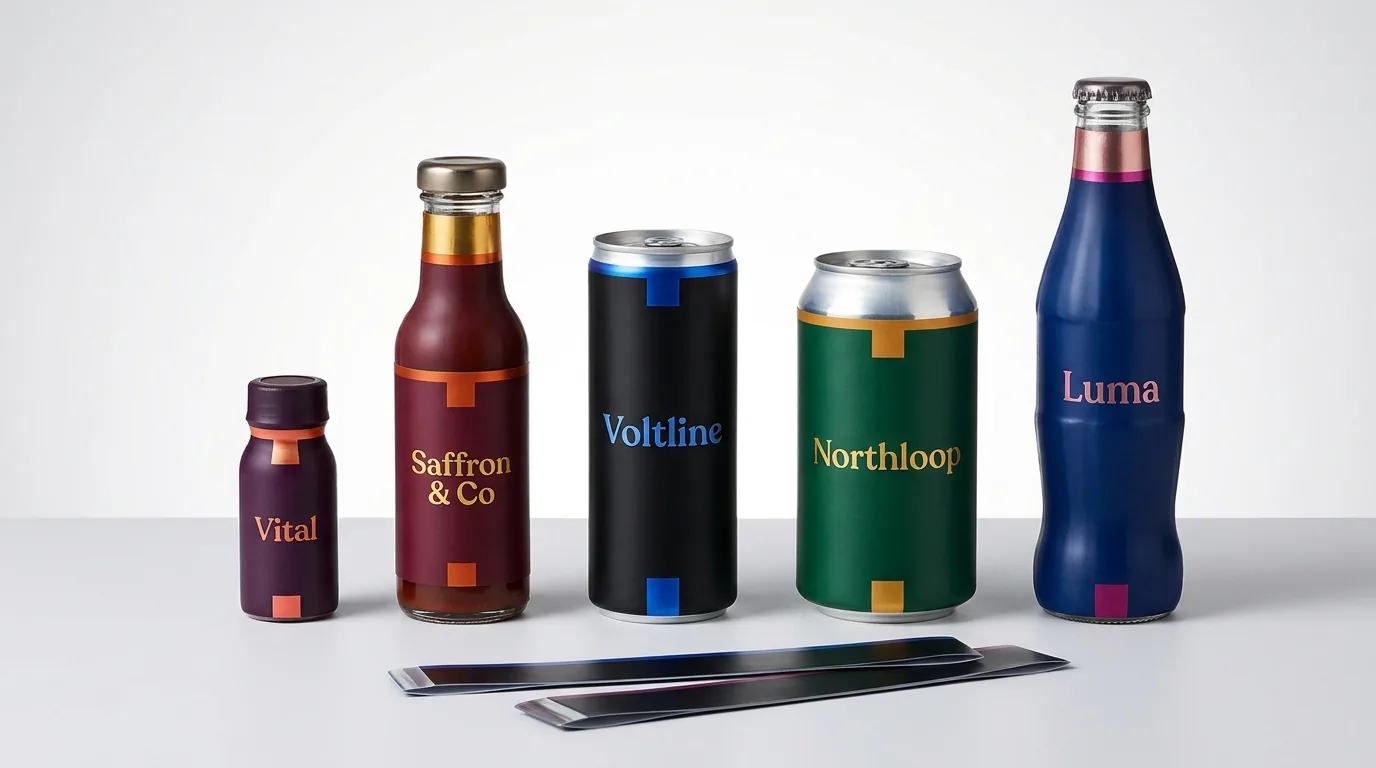
While every custom order is seamed to your exact millimeter layflat and repeat cut length with zero die or plate charges, most North American beverage cans, wellness shots, woozy hot sauce bottles, and supplement packers fall into proven dimensional bands. Compare your container against our film selection guide for PETG, OPS, and PLA and use this six-format reference matrix as a baseline
| Container format | Widest OD (mm / in) | Typical Layflat Width | Typical Cut Height & coverage |
|---|---|---|---|
| 2 oz wellness / energy shot | 33 mm (1.30 in) | 55 mm (2.17 in) | 95 mm (3.74 in) · Full body + cap tamper perf |
| 5 oz woozy hot sauce bottle | 43 mm (1.69 in) | 70 mm (2.76 in) | 165 mm (6.50 in) · Full body + long-neck seal |
| 12 oz sleek aluminum can | 58 mm (2.28 in) | 94 mm (3.70 in) | 158 mm (6.22 in) · 360° body (heel to neck chime) |
| 12 oz standard brite can (211) | 66 mm (2.60 in) | 106 mm (4.17 in) | 122 mm (4.80 in) · 360° body below top flange |
| 16 oz tallboy brite can (211) | 66 mm (2.60 in) | 106 mm (4.17 in) | 160 mm (6.30 in) · 360° craft beverage body |
| 16 oz contoured RTD bottle | 70 mm (2.76 in) | 113 mm (4.45 in) | 195 mm (7.68 in) · Contoured body + cap seal |
How do bottom heel tucks and vertical MD shrink affect cut height?
Sizing horizontal Layflat Width gets the tube onto your container, while sizing vertical Cut Height keeps graphics locked cleanly at the base and cap line. Even though heat-shrink films are oriented primarily in the transverse horizontal direction, every polymer web exhibits 3% to 8% longitudinal Machine Direction (MD) movement inside a shrink tunnel per FINAT technical testing. If you measure a bottle's standing height flush from tabletop to cap and forget heel tuck and MD allowance, tunnel heat will pull the sleeve upward and expose bare glass or aluminum at the base
- Add a 3 to 5 mm bottom-heel tuck underneath the container base radius: Letting the bottom edge overhang the tabletop plane by 3 to 5 mm before shrinking allows the lower tunnel zone to curl that lip tightly under the container heel first, mechanically anchoring the sleeve so upper shoulder tension cannot yank it upward.
- Stop 1.5 to 2.0 mm below the seamed top flange on aluminum beverage cans: On 12 oz and 16 oz brite cans, leaving a clean 2 mm clearance below the upper lid double-seam prevents film lips from interfering with 4-pack or 6-pack Snap-Pak plastic carriers and keeps drinking rims bare.
- Extend 8 to 12 mm onto the cap top or closure knurling for full-body tamper combos: When one sleeve covers both body and cap on juices, cold brews, or custom bottle labels upgrades, wrapping 8 to 12 mm over the top cap edge creates a unmistakable dome lock above the horizontal neck micro-perforation.
- Multiply total vertical coverage by 1.04 to 1.07 for MD shrink compensation: Once vertical body height, bottom-heel tuck, and top cap overlap are summed, adding 4% to 7% accounts for vertical shortening as high-shrink shoulders pull inward.
Know your size? Compare pricing across up to 3 quantities.
Request a Quote →Should I order continuous roll-fed sleeve tubing or pre-cut individual shrink bands?
Your target production speed and co-packer equipment dictate whether your sized sleeves ship as continuous flat tubing on cardboard cores or pre-cut individual open bands stacked in cartons. Brands moving up from pressure-sensitive custom roll labels or pairing bottled shots with custom display boxes typically weigh three operational factors
- Pre-cut individual bands for 500 to 5,000-unit pilot and seasonal runs: Each sleeve is rotary-cut to your exact Cut Height, perforated if needed, and bundled flat. Operators pinch open a band, drop it over the bottle or can onto the conveyor, and send it straight through a compact benchtop steam or radiant tunnel with zero applicator changeover.
- Continuous core-wound tubing for 5,000+ unit automated sleeving lines: Inline rotary and mandrel sleevers unwind continuous flat tubing over a 3D bullet mandrel, register the print repeat using an optical eye-mark or clear gap, slice each sleeve with a rotary knife collar, and shoot it onto moving containers at 60 to 300+ units per minute.
- Shared layflat sizing across multi-flavor SKUs: Keeping identical Layflat Width and Cut Height across four cold-brew or hot-sauce flavors lets hand crews or automated sleevers switch flavors in seconds without adjusting tunnel baffles or mandrel tooling.
How do I verify my shrink sleeve dimensions before full production?
Calculating Layflat Width and Cut Height on paper gets your quote started in minutes, and our prepress workflow eliminates guesswork before a single meter of film goes on press. Review our companion artwork pre-distortion and perforation guide and benchmark competitor pricing under our Price Beat guarantee when ordering roll-fed and pre-cut shrink sleeves
- Free custom dieline and 3D shrink mockup before payment: Send your container drawing or caliper measurements (cap OD, neck OD, shoulder OD, body OD, heel radius, and vertical heights). We build your custom layflat dieline with seam and perforation callouts and render an interactive 3D mockup before you pay.
- 500-unit minimum and multi-quantity RFQ comparison: Order from 500 shrink sleeves (with smaller trial runs considered case by case) and enter up to three quantities in Step 1 of the quote form to compare volume price tiers.
- 10–14 business day turnaround with 4–5 day rush and free US shipping: Standard orders ship in 10–14 business days after proof approval and payment (rush 4–5 business days quoted per order), delivered free across all 50 US states.
What are the five most common shrink sleeve sizing mistakes?
Double-check your caliper notes against these five dimensional pitfalls before approving your sleeve dieline
- Typing container diameter (66 mm) instead of flattened half-circumference plus clearance (106 mm layflat), producing sleeves far too narrow to fit over the can.
- Measuring body diameter while ignoring a wider flared cap ring or shoulder bead that blocks pre-cut sleeves during top-down loading.
- Cutting height flush with the flat bottle bottom instead of adding a 3 to 5 mm under-heel tuck, causing upward sleeve creep and smiley-arc distortion.
- Adding excessive +6 to +8 mm layflat clearance on straight-walled cans, forcing unnecessary horizontal film travel that creates longitudinal wrinkles.
- Extending beverage can sleeves all the way onto the upper lid chime where excess film interferes with multi-pack carrier rings.
Packaging for this



Ready to order shrink sleeves? Compare up to 3 quantities with a free 3D mockup.
Request a Quote →Questions about shrink sleeves
What is the exact formula to convert bottle diameter to shrink sleeve layflat width?
Multiply your container's widest outside diameter in millimeters by 3.1416, divide that circumference by 2, and add 2 mm for automatic machine sleeving or 3 mm for hand-applied pre-cut bands. For example, a 66 mm standard beverage can uses a 106 mm layflat width.
Should I measure my container in millimeters or inches for shrink sleeves?
Industry seaming plows, mandrel tooling, and rotary cutters are calibrated in millimeters because even a 1.5 mm variance changes slip clearance on automatic lines. You can submit either millimeters or inches on your quote, and we convert and verify both on your dieline.
How do I know if my bottle neck is too narrow for one full-body shrink sleeve?
Calculate required transverse shrink: subtract your narrowest neck diameter from open sleeve diameter, divide by open sleeve diameter, and multiply by 100. Contours under 65% work across most shrink films, while steep 65% to 75% necks call for high-shrink PETG film and steam tunnels.
What layflat width fits standard 12 oz and 16 oz aluminum beverage cans?
Standard North American 211-diameter 12 oz and 16 oz aluminum brite cans measure 66 mm across the body and use a 105 to 106 mm layflat width, paired with a 122 mm cut height on 12 oz cans or 160 mm on 16 oz tallboys.
How much extra height do I add if my shrink sleeve seals over the bottle cap?
Measure from 4 mm underneath the bottom heel up the full container profile to the top edge of the cap, then add 8 to 10 mm of over-cap lip wrap plus 5% vertical MD allowance so the top ring locks securely above your neck perforation.
What is CubitPack's minimum order and turnaround for custom-sized shrink sleeves?
Custom shrink sleeves start at 500 units (with smaller trial runs reviewed case by case) and zero die or plate charges. Standard turnaround is 10–14 business days after digital proof and 3D mockup approval and payment, with 4–5 business day rush available and free US shipping.
Still have a question? Ask a packaging specialist.
Request a Quote →Request your shrink sleeves quote
Tell us your size and quantities, and one dedicated account manager prepares pricing for each tier.
- Free design & AI-to-print studio + 3D mockup
- No die or plate charges · 4–5 day rush available
- Free shipping to all 50 states
- 10% off your first order
We verified shrink sleeve layflat formulas, slip clearance tolerances, bottom-heel lock allowances, and longitudinal MD shrink factors against Tag and Label Manufacturers Institute (TLMI) converting guidelines and FINAT shrink sleeve technical manuals. A packaging specialist checked every container size row and formula. Spot something wrong? Tell us and we fix it.
Sources
- Layflat width half-circumference math, +2 to +3 mm hand vs machine slip clearance, and T-seam tolerances.
- Transverse direction (%TD) shrink demand equations, 3%–8% machine direction (MD) vertical movement, and bottom-heel lock rules.
- 500-unit minimum order, 10–14 business day turnaround, 4–5 day rush, free design help, zero plate/die fees, and free US shipping.
What changed
- November 16, 2026: First published with 4-step caliper layflat formula, 6-container US layflat and cut height lookup chart, and bottom-heel lock diagrams.
More guides
New packaging guides by email
Sizes, materials and design tips. Unsubscribe anytime.