
What to include on a small business custom thank you card?
Short answer: Include five core elements on custom thank you cards: a warm gratitude headline and founder sign-off on the front, plus one clear next-step incentive (such as a 15% repeat-order code or a 0.8 × 0.8 in review QR code), a social tag invitation and customer support contact on the back.
On this page
- How should you divide the front and back of a two-sided thank you card
- What thank you card wording templates work for e-commerce, beauty and gift brands
- How do you size QR codes and handwriting boxes so they work every time
- How do you set up bleeds, safe zones and foil layers in your print file
- Common mistakes
- FAQs
Request a custom quoteFree dieline & 3D mockup
A small business thank you card works hardest when it separates emotional warmth from commercial requests. If you cram your logo, a three-paragraph founder story, a discount code, three social handles, care instructions and a QR code onto one side of a 3.5 × 2 inch or 4 × 6 inch card, the buyer reads none of it. Instead, use two-sided printing (Both sides (front + back)) to pace the experience. Dedicate the front 100% to human gratitude, brand atmosphere and a printed signature or handwritten first name so the card feels like a genuine gift when the box opens. Place your single transactional call to action (either a repeat-purchase discount code, a photo-review QR code, or a fast reorder link), along with your customer support email and social handle, in a clean modular grid on the back panel.
How should you divide the front and back of a two-sided thank you card?
When customers lift the lid of their parcel, they decide within 3 seconds whether your card is a meaningful note worth keeping or a disposable marketing flyer. Designing two-sided thank you cards (Both sides (front + back) in Step 2 of the quote form) lets you keep the front looking like stationery while the back handles customer retention. On a standard 4 × 6 inch flat card (or a 5 × 3.5 inch folded card), organize the five essential elements across the front and back panels using the table below.
| Card zone | Element to include | Recommended size / length | Why it belongs here |
|---|---|---|---|
| Front: Top or center | Warm gratitude headline + logo mark | 3 to 7 words in 18 to 28 pt type | Sets an appreciative tone the instant the box opens |
| Front: Body | Personal note from the founder or team | 25 to 45 words in 10 to 12 pt type | Builds human connection without feeling like an ad |
| Front: Bottom | Printed signature + blank line for pen | 2.0 × 0.75 in clear uncoated zone | Lets packers write the buyer's name or their own initials |
| Back: Primary CTA | One single offer (discount code OR review QR) | 0.8 × 0.8 in QR + 14 pt promo code | Giving one clear choice doubles scan and redemption rates |
| Back: Footer | Social tag prompt + direct support email | 8 to 10 pt type with 0.25 in margins | Catches unhappy buyers privately before public bad reviews |
What thank you card wording templates work for e-commerce, beauty and gift brands?
The strongest thank you card copy sounds like a founder speaking to one person across a counter, not a corporate press release. Keep your front message between 25 and 45 words so it reads effortlessly at arm's length, and pair it with a specific, low-friction back call to action. Here are three field-tested wording frameworks you can adapt for 500, 1,000, 2,500 or 5,000 card print runs across beauty, apparel, food and gift brands.
- **Framework 1: Repeat-Order Retention (Apparel, Roasters & Consumables).** Front: 'Thank you for supporting independent craft. Every batch is roasted and packed by our small team, and we are thrilled this box found its way to your kitchen. Enjoy every cup, [Founder Signature].' Back: 'Ready for your next bag? Use code WELCOME15 at checkout for 15% off your second order, or scan the 0.8 × 0.8 in QR code below to restock in two taps.'
- **Framework 2: UGC & Social Unboxing (Cosmetics, Jewelry & Boutique Gifts).** Front: 'Made for your daily ritual. Thank you for choosing our studio and bringing our formulas into your routine. Packed with care by: _______.' Back: 'Show us your unboxing! Tag @BrandHandle on Instagram or TikTok with a photo of your new pieces, and we will DM you a secret gift code for your next order.'
- **Framework 3: Product Satisfaction & Support Net (Electronics, Home Goods & Supplements).** Front: 'Welcome to the family. We built this product to work hard for you every single day, and we stand behind every box we ship.' Back: 'Love your order? Scan the QR code to leave a 30-second verified review. Need help with sizing, setup or shipping? Email our team directly at support@brand.com and we will make it right within 24 hours.'
How do you size QR codes and handwriting boxes so they work every time?
Two physical failures ruin otherwise great thank you cards: QR codes that phone cameras cannot focus on, and handwriting boxes that smear when a packer signs them with a pen. Both problems are easy to prevent in your artwork file before we generate your free 3D mockup and dieline proof. For QR codes, export the code as a crisp vector SVG or EPS file rather than a low-resolution PNG screenshot. Size the code to at least 0.8 × 0.8 inches (20 × 20 mm) with a 0.1 inch (2.5 mm) blank white quiet zone around all four sides. Print the modules in 100% black or a dark Pantone ink on a light, non-reflective background (Matte lamination, Soft-touch or None (uncoated)). Never render a QR code in metallic gold or silver foil, and never place Gloss UV over the squares, because overhead room lights bounce off shiny surfaces and blind smartphone camera lenses. For handwriting zones (such as a Packed by: ______ line on the front or the inside of a 5 × 3.5 inch folded card), leave a high-contrast white or pale cream box measuring at least 2.0 × 0.75 inches. If your team writes notes with standard ballpoint, rollerball or gel pens, choose None (uncoated) or ask for one-sided lamination () so the writing side remains porous and absorbs ink in under 3 seconds. Pairing your card with a matching custom stickers sheet or sealing your inner wrap with custom tissue paper turns the whole parcel into a cohesive gift.
Know your size? Compare pricing across up to 3 quantities.
Request a Quote →How do you set up bleeds, safe zones and foil layers in your print file?
Whether you supply a print-ready Adobe Illustrator or PDF file or ask CubitPack for free artwork setup, commercial guillotine cutters and foil stamping presses require specific mechanical tolerances so your cards trim cleanly without white slivers or clipped letters. Check these five prepress benchmarks before approving your proof for a 500, 1,000, 2,500 or 5,000 card production run (10 to 12 business days standard after proof approval, or 6 to 8 business days rush)
- 0.125 inch (3 mm) outer bleed on all four edges: Extend background colors, dark borders and full-bleed photos 0.125 inches past the final trim line. A 4 × 6 inch card file with bleed measures 4.25 × 6.25 inches.
- 0.125 inch to 0.25 inch inner safe zone: Keep all body copy, logos, QR codes and thin framing borders at least 0.125 inches (and ideally 0.25 inches on 5 × 7 inch cards) inside the trim line (and 0.125 inches away from the center score line on folded cards).
- CMYK color mode + 300 DPI images: Convert RGB screen colors to CMYK or specify Pantone spot numbers so brand colors print predictably, and embed all raster photography at 300 DPI at 100% scale.
- 100% K vector layers for Foil, Emboss and Spot UV: Place Gold foil, Silver foil, Emboss, Deboss or Spot UV elements on separate named vector layers set to 100% black (K), using lines at least 0.5 pt thick and text at least 8 pt.
- 2 × 0.125 inch (3 mm) corner radius for rounded corners: If you select Rounded corners as an add-on, keep corner logos and page numbers at least 0.25 inches away from all four corners so the die radius never clips them.
| Card element | Side | Spec / benchmark |
|---|---|---|
| Gratitude headline + personal note | Front | 25–45 words · 10–12 pt body · 18–28 pt headline |
| Handwriting / signature box | Front or inside | 2.0 × 0.75 in uncoated or light matte zone |
| Single primary CTA + QR code | Back | 0.8 × 0.8 in vector QR + 0.1 in quiet zone |
| Social handle + support email | Back footer | 8–10 pt type · private support safety net |
| Bleed & safe margin | Both sides | 0.125 in (3 mm) bleed · 0.125–0.25 in safe zone |
What mistakes lower conversion on small business thank you cards?
Before sending your thank you card artwork to press, check that your layout avoids these five conversion and prepress pitfalls
- Asking the customer to do three things at once: Putting a discount code, a review request, a referral program AND a TikTok contest on the same card splits attention. Pick one primary call to action per print run.
- Using generic, forgettable coupon codes: Codes like SAVE10 look like mass-mailed coupons. Use warm, insider codes like THANKYOU15, VIPCLUB or WELCOMEBACK that reinforce the personal message on the front.
- Printing tiny 6 pt type on dark backgrounds: Reverse white text smaller than 8 pt on rich black or dark navy backgrounds can fill in slightly on press (dot gain). Keep reverse text at 8.5 pt or larger with medium weight.
- Forgetting to test the QR code destination on mobile: Always scan your proof QR code with both an iPhone and an Android camera to verify the link opens a fast, mobile-optimized landing page with the discount auto-applied.
- Stopping background color right at the trim line: Without a 0.125 inch bleed extension, a 0.5 mm shift during high-speed guillotine cutting leaves an unwanted white hairline along one edge of a dark card.
Packaging for this
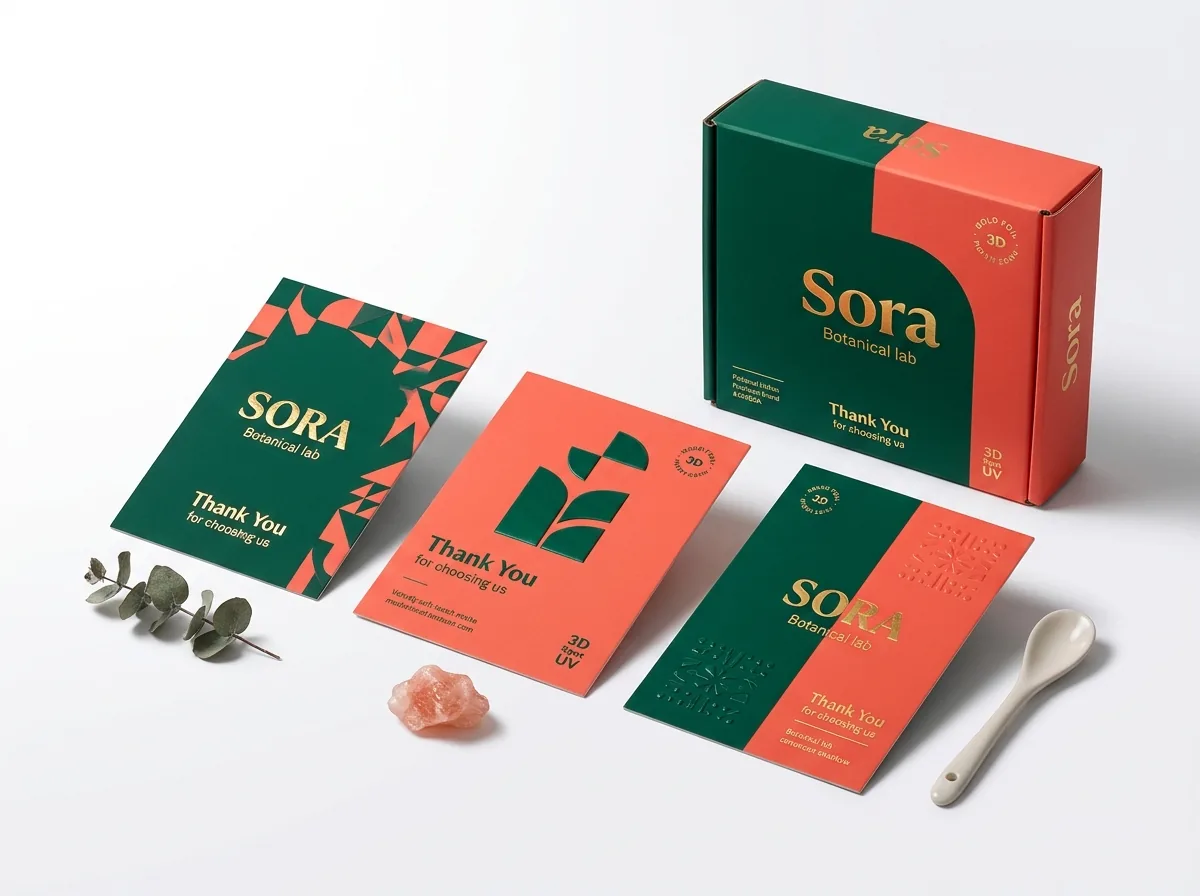
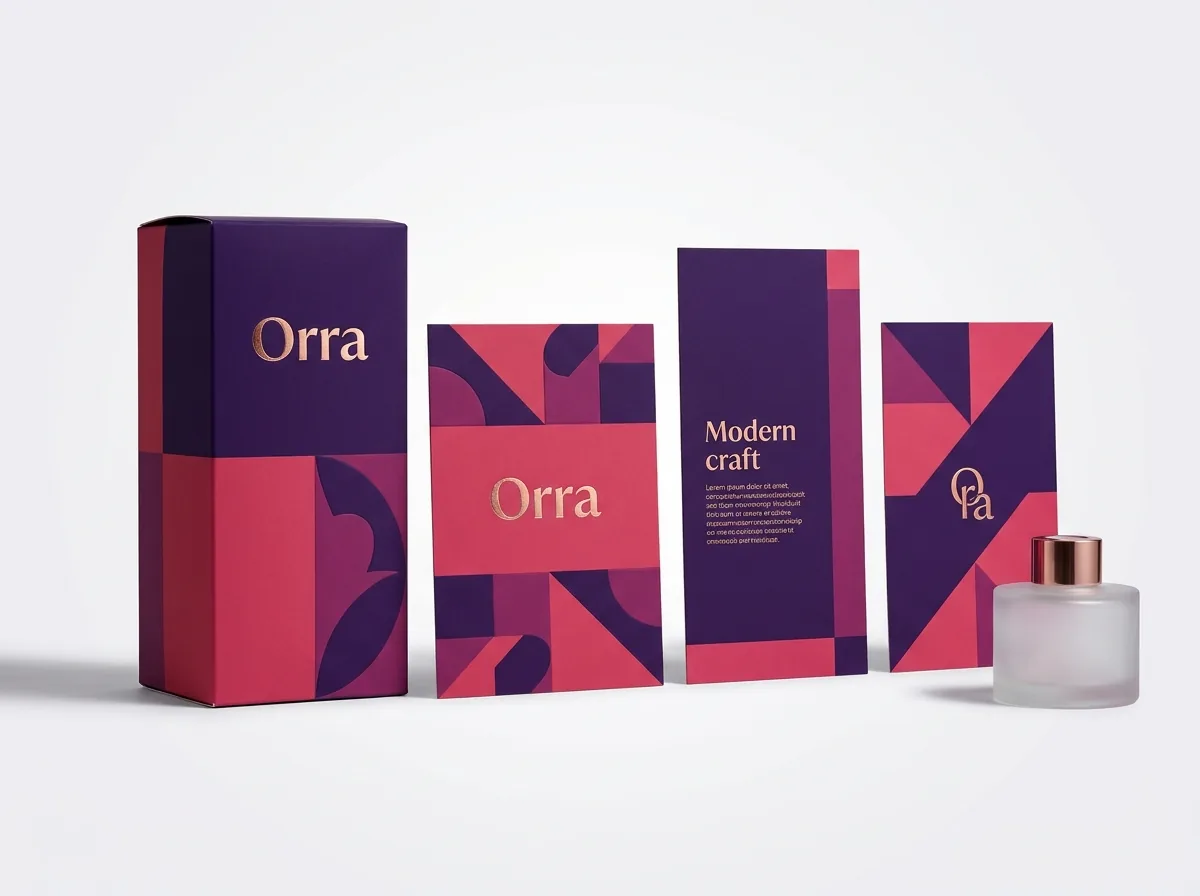
Ready to order thank you cards? Compare up to 3 quantities with a free 3D mockup.
Request a Quote →Questions about thank you cards
Should a small business thank you card include a discount code?
Yes, if your product is consumable or encourages repeat purchases within 30 to 90 days (such as skincare, coffee, supplements, candles or apparel). Place a 10% to 15% insider code on the back panel so the front stays warm and personal. For one-time luxury gifts, swap the discount for a review or care QR code.
What is the minimum readable font size on a printed thank you card?
Keep primary body copy at 10 pt to 12 pt and secondary footer text (such as terms, website URLs and social handles) at 8 pt or larger. If you are printing light or white text reversed out of a dark background, use at least 8.5 pt medium-weight type so ink spread never narrows the letters.
Can I print multiple thank you card designs in one order?
Yes. Many brands split a 1,000, 2,500 or 5,000 card order across seasonal messages, first-time vs repeat buyer offers, or different product lines while sharing the same card size and cardstock (). Mention how many artwork versions you need in the Step 3 notes of your quote request.
How big should the bleed and safe zone be for a 4 × 6 inch thank you card?
Add a 0.125 inch (3 mm) bleed around all four outside edges, making your full artwork canvas 4.25 × 6.25 inches. Keep all text, logos, QR codes and thin border lines at least 0.125 inches (and ideally 0.25 inches) inside the 4.0 × 6.0 inch trim line so nothing gets clipped.
What if I do not have a print-ready PDF or vector file for my card?
CubitPack includes free artwork help, a free 3D mockup and a dieline proof with every order. Send us your logo, brand colors, wording and any QR link in Step 3 of the quote form, and our prepress team will lay out your front and back panels with proper 0.125 inch bleeds and foil layers.
Should I put product instructions on my thank you card or on a separate card?
If your usage tip is a single short sentence, it fits neatly on the back of a 4 × 6 inch thank you card. If your product requires multi-step routines, ingredient warnings or troubleshooting diagrams, keep the thank you card focused on gratitude and pair it with a dedicated custom insert cards piece.
Still have a question? Ask a packaging specialist.
Request a Quote →Request your thank you cards quote
Tell us your size and quantities, and one dedicated account manager prepares pricing for each tier.
- Free design & AI-to-print studio + 3D mockup
- No die or plate charges · 4–5 day rush available
- Free shipping to all 50 states
- 10% off your first order
Written from CubitPack's prepress standards for two-sided card printing (0.125 in bleed, 300 DPI CMYK, 100% K vector foil/UV plates) and ISO/IEC 18004 QR code contrast and quiet-zone specifications. Checked by a packaging specialist against our quote form configuration.
Sources
- CubitPack product specifications: Cards RFQ family options (One side, Both sides, finishes, add-ons, 500/1,000/2,500/5,000 presets), free artwork help, 3D mockup and turnaround times
- ISO/IEC 18004: QR Code Bar Code Symbology Specification: Minimum 0.8 x 0.8 inch print size, 4-module (0.1 in) quiet zone and non-reflective matte contrast rules for smartphone QR scanning
What changed
- October 22, 2026: First published. Front-and-back hierarchy, copy templates, QR sizing and prepress bleed checklist verified against CubitPack cards specs.
- October 22, 2026: Updated specifications, terminology, and verified source links.
More guides
New packaging guides by email
Sizes, materials and design tips. Unsubscribe anytime.