
What size playing card box do I need for Poker, Bridge, Tarot and TCG decks?
Short answer: Add 0.06 inch (1.5 mm) to your card width and height, and multiply your card count by single-card caliper plus 0.06 inch for depth. Standard 54-card Poker custom playing card boxes measure 2.56 × 0.70 × 3.56 in (65 × 18 × 90.5 mm), and 78-card Tarot boxes measure 2.85 × 1.35 × 4.85 in.

On this page
- How do I calculate inside tuck box dimensions from card size, count and gsm caliper
- What are standard inside box dimensions for Poker, Bridge, Tarot and party decks
- How do you size a 78-card Tarot or Oracle box that includes a guidebook
- How do you calculate the size of a 12-deck brick box or a 300-card party game box
- Do gilded edges, holographic cold foil or TCG card sleeves change the box size
- Common mistakes
- FAQs
Request a custom quoteFree dieline & 3D mockup
Playing card boxes demand tighter dimensional tolerances than almost any other folding carton because a deck of 54 or 78 cards behaves like a solid block with delicate paper corners. If the inside of your tuck box is 2 millimeters too wide or deep, the cards fan diagonally during shipping and bruise their corners; if it is 1 millimeter too narrow, the top inner dust flaps pinch the deck and split the side glue seam. Every inside box size (Length × Width × Height in inches or millimeters) is calculated from three exact numbers: the trim width and height of a single card, the total number of cards in the deck (including jokers, ad cards and instruction cards), and the micrometer caliper of a single sheet of cardstock. Every order of printed playing card boxes from CubitPack is cut to your exact half-millimeter dieline with zero die fees.
How do I calculate inside tuck box dimensions from card size, count and gsm caliper?
Never guess the depth of a playing card box from a ruler held next to an unpressed stack of sample cards, because freshly cut or gilded cards trap air between sheets and compress by 5% to 8% once wrapped. Instead, calculate your inside Length (left-to-right width of the front face), Width (front-to-back stack depth) and Height (bottom-to-top height) directly from your card trim size and sheet caliper. A standard 300 to 310 gsm casino black-core or blue-core playing card is approximately 0.31 mm (0.0122 inch / 12.2 pt) thick, while a heavy 350 gsm art tarot card is approximately 0.35 to 0.37 mm (0.014 inch / 14 pt) thick. Follow the five steps below so our design team can build your custom playing card tuck boxes to a glove-tight fit.
- Inside Length (L): take your card trim width (e.g., 2.50 in / 63.5 mm for Poker) and add 0.06 in (1.5 mm) for smooth side clearance.
- Inside Height (H): take your card trim height (e.g., 3.50 in / 88.9 mm for Poker) and add 0.06 in (1.5 mm) so the top tuck flap closes flat without bowing.
- Raw stack thickness: multiply total card count (e.g., 52 cards + 2 jokers + 2 ad cards = 56 cards) by single-card caliper (56 × 0.31 mm = 17.36 mm).
- Inside Depth / Width (W): add 1.2 to 1.5 mm (0.05 to 0.06 in) of air clearance to the raw stack thickness (or add 2.0 mm if the deck is cello-wrapped inside the tuck box).
- Guidebook allowance: if a saddle-stitched or perfect-bound booklet sits inside the box, measure the spine thickness in millimeters and add it directly to Width (W).
What are standard inside box dimensions for Poker, Bridge, Tarot and party decks?
While CubitPack cuts every tuck carton, rigid tarot box and 12-deck brick box to your exact millimeter with no die or plate charges, most tabletop, magic, cardistry and divination releases use one of nine standard card sizes. Use the reference table below to benchmark your deck in both inches and millimeters. Notice how the first dimension (Length L) is the horizontal width of the card face, the second dimension (Width W) is the front-to-back stack depth, and the third dimension (Height H) is the vertical height of the card.
| Deck format & card count | Typical inside size in inches (L × W × H) | Metric size (mm) & usual style |
|---|---|---|
| 54-card Bridge deck (2.25 × 3.5 in cards, 310 gsm) | 2.31 × 0.70 × 3.56 in | 58.5 × 18.0 × 90.5 mm · Straight tuck |
| 54-card Poker deck (2.5 × 3.5 in cards, 310 gsm) | 2.56 × 0.70 × 3.56 in | 65.0 × 18.0 × 90.5 mm · Straight tuck + seal |
| 108-card Double Poker / UNO-style party deck | 2.56 × 1.35 × 3.56 in | 65.0 × 34.5 × 90.5 mm · Straight tuck or auto-lock |
| Mini American / Euro board game expansion (45 cards) | 1.81 × 0.60 × 2.69 in | 46.0 × 15.0 × 68.5 mm · Straight tuck |
| 100-card double-sleeved TCG / Commander deck | 2.75 × 2.50 × 3.85 in | 70.0 × 63.5 × 98.0 mm · Heavy tuck or magnetic |
| 44-card Square Affirmation deck (3.5 × 3.5 in) | 3.58 × 0.75 × 3.58 in | 91.0 × 19.0 × 91.0 mm · Two-piece or tuck |
| 78-card Tarot deck (2.75 × 4.75 in, 350 gsm + booklet) | 2.85 × 1.35 × 4.85 in | 72.5 × 34.5 × 123.0 mm · Two-piece rigid or tuck |
| 44-card Oracle deck (3.5 × 5.0 in + bound guidebook) | 3.625 × 1.25 × 5.125 in | 92.0 × 32.0 × 130.0 mm · Two-piece or magnetic book |
| 12-deck Poker Collector Brick Box (6 × 2 grid) | 7.85 × 4.45 × 3.75 in | 199.5 × 113.0 × 95.0 mm · Flip-top E-flute brick |
How do you size a 78-card Tarot or Oracle box that includes a guidebook?
Unlike a 54-card poker deck that ships with a single rules card, a 78-card Tarot deck (2.75 × 4.75 inches / 70 × 120 mm) or 44-card Oracle deck almost always ships with a multi-page companion guidebook. If the guidebook has the same trim footprint as the cards, it sits flat on top of the deck stack inside a custom two-piece box or custom magnetic closure box. For a 78-card Tarot deck printed on 350 gsm art card (78 × 0.36 mm = 28.1 mm) paired with a 64-page saddle-stitched booklet (4.5 mm spine) and a satin lift ribbon, the total stack depth is 32.6 mm plus 2 mm clearance = 34.5 mm (1.35 inches). If your publisher prints a larger 160-page perfect-bound hardcover guidebook, we often widen the rigid box footprint and nest the 78 cards inside a sunken paperboard or EVA foam well underneath the book.

Know your size? Compare pricing across up to 3 quantities.
Request a Quote →How do you calculate the size of a 12-deck brick box or a 300-card party game box?
Magic studios, cardistry brands and Kickstarter creators sell 6-deck half-bricks and 12-deck full-bricks in a custom outer brick carton, while tabletop party games pack 300 to 500 poker-sized cards into a single box. To size a 12-deck brick carton (arranged 6 decks wide by 2 decks deep, standing upright on their bottom flaps), multiply the outside width and outside depth of a single finished tuck box. A standard poker tuck box made from 18 pt board has an outside width of about 66.0 mm (2.60 in) and an outside depth of about 19.0 mm (0.75 in). Six decks side-by-side along their depth (6 × 19.0 mm = 114 mm) by two decks wide (2 × 66.0 mm = 132 mm) or 6 wide × 2 deep gives your exact interior brick footprint after adding 2.5 mm of finger clearance. For 300- to 500-card party games, we split the stack across a 2-well or 3-well custom cardboard insert so the box stays low and stable on the table.

Do gilded edges, holographic cold foil or TCG card sleeves change the box size?
Yes, and overlooking card treatments is one of the most common sizing surprises in tabletop packaging. Edge gilding (applying metallic gold, silver or holographic foil to the four cut edges of the card stack) and dual-sided cold-foil laminations slightly increase effective stack friction and thickness by 0.5 to 1.0 mm across 54 to 78 cards. For Trading Card Games (TCG) like Magic: The Gathering, Pokémon or custom deck-builders where players store cards inside polypropylene sleeves, a 60-card single-sleeved deck is roughly 1.5 times thicker than an unsleeved deck, and a 100-card double-sleeved deck expands to nearly 2.4 inches (60 mm) thick. Standard TCG sleeves also measure 66 × 91 mm, meaning a sleeved card will not fit inside a standard 65 × 90.5 mm poker tuck box unless you upsize the inside Length and Height to at least 2.75 × 3.85 inches (70 × 98 mm).
- Gilded or cold-foil decks: add an extra 0.5 to 1.0 mm (0.03 in) to the inside depth (W) so gilded edges slide in without scuffing.
- Single-sleeved 60-card TCG deck: upsize inside footprint to 2.75 × 1.65 × 3.85 in (70 × 42 × 98 mm) to clear 66 × 91 mm sleeves.
- Double-sleeved 100-card Commander deck: upsize to 2.75 × 2.50 × 3.85 in (70 × 63.5 × 98 mm) with space for token dividers.
- Double-deck Bridge sets: use a 4.75 × 3.625 × 0.85 in two-piece or magnetic box with a 0.25-inch center divider wall.
What are the most common playing card box sizing mistakes?
A millimeter of error on a playing card tuck box is the difference between a crisp casino snap and a torn flap. Avoid these five sizing mistakes
- Using 52 cards instead of 54 or 56 cards in your depth formula and forgetting the 2 jokers, double-backer gaff card and ad card.
- Sizing a tarot box for the 78 cards alone and forgetting to add 3 to 6 mm of depth for the saddle-stitched or perfect-bound guidebook.
- Ordering a standard 2.56 × 3.56 inch poker box for a TCG deck that players keep in 66 × 91 mm protective plastic sleeves.
- Forgetting to add 1.0 to 1.5 mm of extra depth when the card stack is wrapped in an inner cellophane pull-tab wrapper inside the tuck box.
- Stacking 300+ party game cards in a single tall, unstable tower instead of splitting them into a 2-well or 3-well side-by-side box.
Find your size
Suggested inside size: 2.31 × 0.70 × 3.56 in
A starting point. Your account manager confirms the size with you before the proof.
Quote this size →Packaging for this
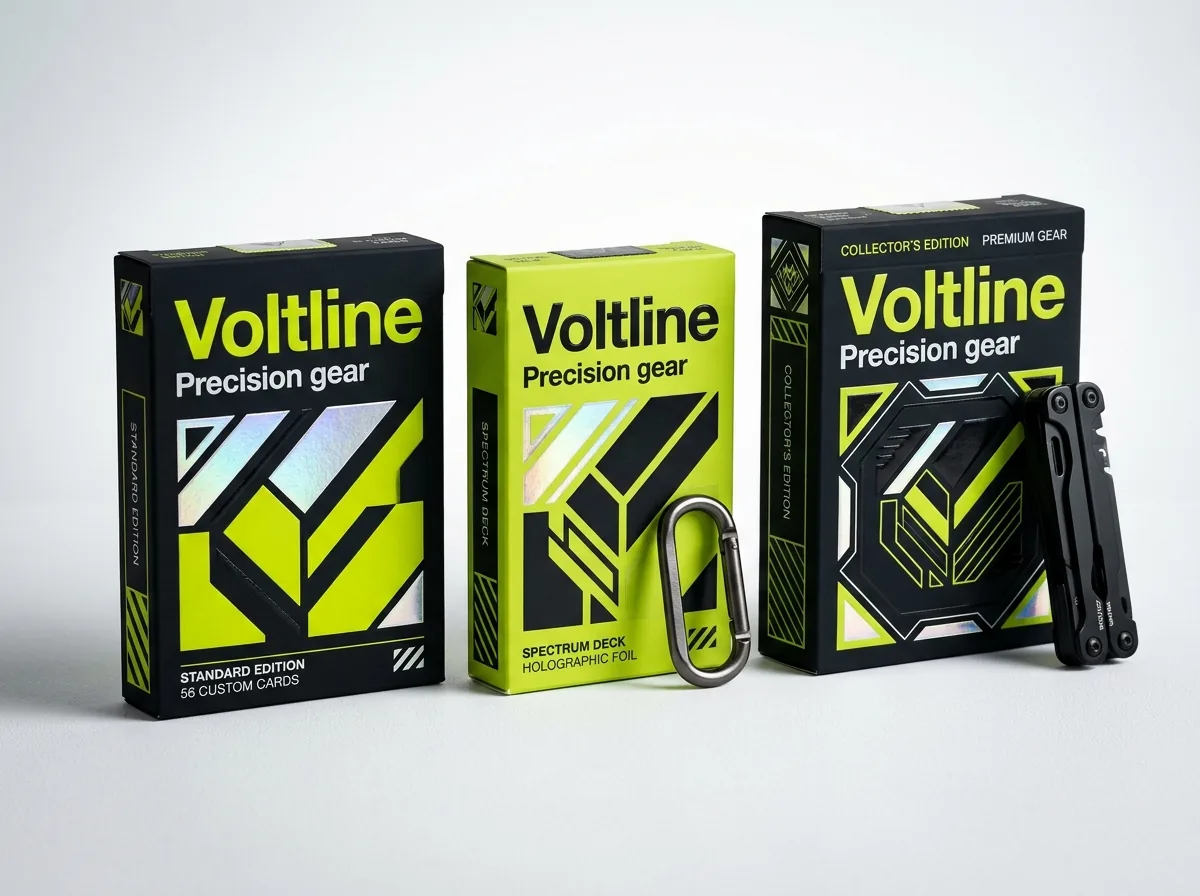



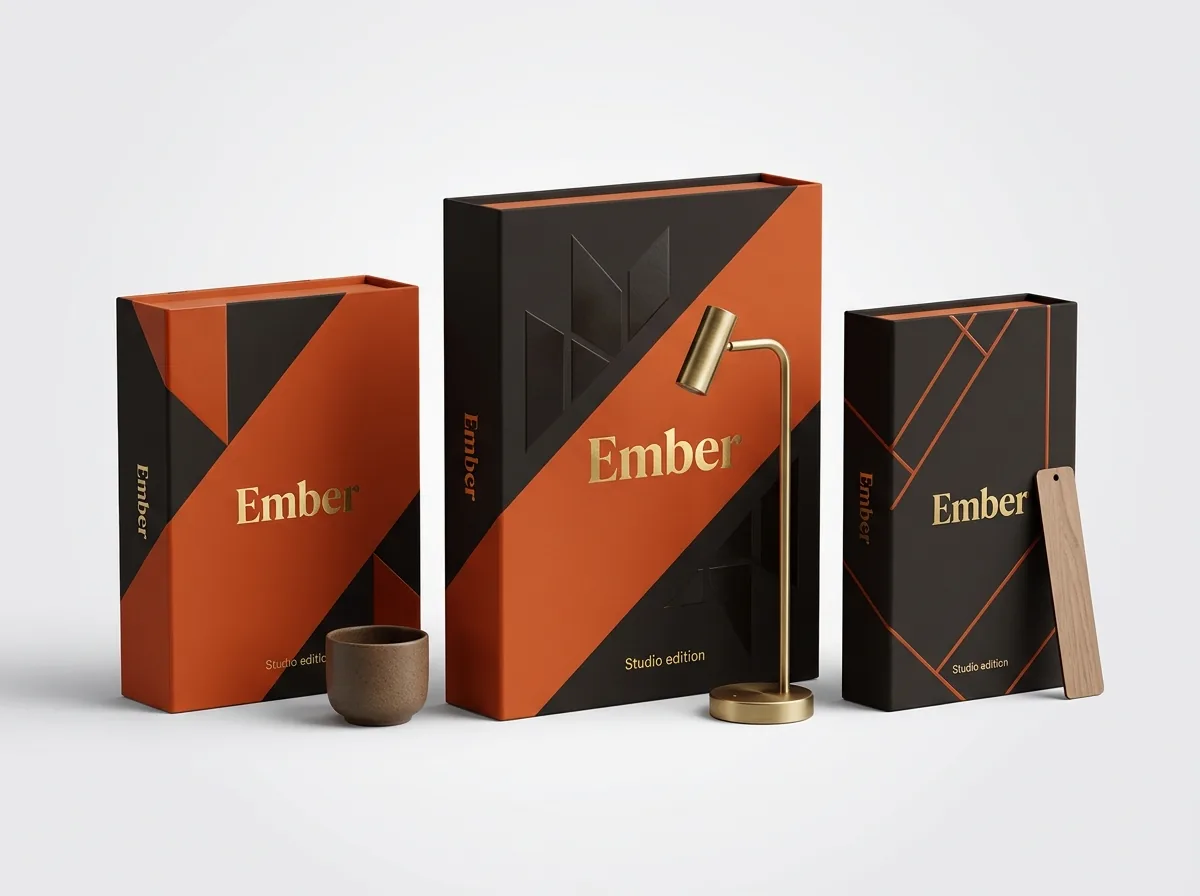
Ready to order playing card boxes? Compare up to 3 quantities with a free 3D mockup.
Request a Quote →Questions about playing card boxes
What is the exact inside size of a standard 54-card poker tuck box in mm and inches?
For 54 standard poker cards (2.5 × 3.5 inches / 63.5 × 88.9 mm) printed on 300 to 310 gsm casino stock, the standard inside tuck box size is 2.56 × 0.70 × 3.56 inches (65.0 × 18.0 × 90.5 mm). If the deck is cello-wrapped inside the box, use 0.75 in (19.0 mm) depth.
How thick is one playing card when calculating stack depth?
A standard 300 to 310 gsm black-core or blue-core playing card is about 0.31 mm (0.0122 inch / 12.2 pt) thick. A heavier 330 gsm card is about 0.33 mm, and a 350 gsm art tarot card is about 0.35 to 0.37 mm (0.014 inch) thick.
What size box do I need for a 78-card tarot deck with a booklet?
Standard tarot cards measure 2.75 × 4.75 inches (70 × 120 mm). A 78-card deck on 350 gsm stock plus a 64-page booklet typically uses an inside box size of 2.85 × 1.35 × 4.85 inches (72.5 × 34.5 × 123.0 mm) in either a heavy tuck carton or a two-piece rigid box.
Can I order a custom tuck box for non-standard square, round or mini cards?
Yes. Because CubitPack never charges die or plate fees, we cut custom tuck boxes and two-piece rigid boxes to any exact millimeter for square affirmation decks, tall oracle cards, mini 1.75 × 2.5 inch board game expansions or hexagonal cards.
How do you size a 12-deck brick box so the tuck boxes fit without rattling?
We calculate the outside dimensions of your finished poker tuck box (including board thickness and any deep embossing), multiply by your grid layout (usually 6 × 2), and add 2.5 mm of total finger clearance so all 12 decks slide in smoothly.
Can I test my printed deck inside a physical tuck box sample before running 1,000 units?
Yes. Every quote includes a free precision vector dieline, digital proof and 3D mockup before payment, and you can request a custom physical prototype to test the slide clearance of your printed card stack and guidebook.
Still have a question? Ask a packaging specialist.
Request a Quote →Request your playing card boxes quote
Tell us your size and quantities, and one dedicated account manager prepares pricing for each tier.
- Free design & AI-to-print studio + 3D mockup
- No die or plate charges · 4–5 day rush available
- Free shipping to all 50 states
- 10% off your first order
The card trim dimensions, gsm-to-millimeter caliper formulas and tuck clearance margins in this guide are based on standard Poker (63.5 × 88.9 mm), Bridge (57 × 88.9 mm), Tarot (70 × 120 mm) and TCG sleeve specifications. A CubitPack packaging specialist checked every calculation. Spot an error? Tell us and we will fix it.
Sources
What changed
- October 22, 2026: First published.
- October 22, 2026: Updated specifications, terminology, and verified source links.
More guides
New packaging guides by email
Sizes, materials and design tips. Unsubscribe anytime.