
What size phone case box do I need for 6.1-inch to 6.9-inch models?
Short answer: Add 0.75 to 1.0 inch to your largest case's width and height for the inner paperboard frame, and match depth to the bumper or folio thickness. Most brands standardize custom phone case boxes at 4.25 × 0.75 × 7.50 inches to fit 6.1-inch through 6.9-inch models.
On this page
- How do I measure a smartphone case to find the inside box dimensions
- What are standard inside sizes for phone case and screen protector boxes
- How does one 4.25 × 0.75 × 7.50 in box fit every phone model
- How much front-to-back depth (W) do slim, rugged and folio cases need
- How do you size cartons for tempered glass screen protectors and alignment trays
- Common mistakes
- FAQs
Request a custom quoteFree dieline & 3D mockup
Unlike single-SKU electronics where the carton hugs one fixed device, mobile accessory brands must package 6.1-inch standard phones, 6.3-inch Pro phones, 6.7-inch Plus models and 6.9-inch Pro Max or Ultra flagships side by side on the same retail wall. Ordering a different outer carton size for every screen diagonal multiplies dieline setup, splits your print run into smaller quantities, and makes retail pegboard rows look uneven. Instead, the smart approach is to size your outer carton around your largest 6.9-inch case plus a 0.375-inch to 0.50-inch perimeter frame border, which lands at a universal 4.25 × 0.75 × 7.50 inch inside dimension. Inside that shared shell, a stepped paperboard frame centers smaller 6.1-inch and 6.3-inch cases behind the front window without rattling. Every order of printed phone case boxes from CubitPack is cut to your exact inside dimensions with zero die fees.
How do I measure a smartphone case to find the inside box dimensions?
Always measure the molded phone case itself rather than copying the bare smartphone dimensions published by Apple, Samsung or Google. A protective case adds 0.12 to 0.30 inch of shock-absorbing TPU or polycarbonate wall thickness around the perimeter, plus an extra 0.08 to 0.18 inch of raised camera bezel height on the back. Set the physical case face-down on a flat table and measure three numbers in inches: overall left-to-right width (which becomes Box Length L), overall front-to-back thickness including the raised camera ring or kickstand (which becomes Box Width W, also called depth), and overall top-to-bottom height (which becomes Box Height H). Once you have those bare case measurements, add the inner frame tolerances below so our structural team can draft your custom phone case boxes and stepped centering tray.
- Case width to Box Length (L): take the widest point of the case (including side grip ridges or action-button guards) and add 0.75 to 0.875 inch total (0.375 to 0.4375 in per side) for the inner paperboard frame.
- Case height to Box Height (H): take the tallest top-to-bottom measurement of the case and add 0.75 to 1.00 inch total so the top and bottom tray ledges stay rigid.
- Case thickness to Box Depth (W): measure from the table surface to the top of the raised camera lip or wallet clasp, then add 0.125 to 0.1875 inch for the inner tray floor and window clearance.
- Universal fleet sizing: if you sell cases for 6.1-in through 6.9-in phones, use the 6.9-in Pro Max or Ultra case as your master outer box benchmark.
- Hang-tab allowance: an integral Euro or J-hook hang tab extends 1.125 to 1.25 inches above the top score line and does not reduce inside box height.
What are standard inside sizes for phone case and screen protector boxes?
While CubitPack cuts every carton and inner frame to your exact sixteenth of an inch with zero die charges, mobile accessory brands and telecom carrier stores rely on eight proven size brackets for consistent shelf presentation. Use the table below to benchmark your product line before measuring your physical cases. Notice how all peg-hook retail cartons stay between 0.50 and 1.00 inch deep front-to-back. Keeping the profile slim lets a standard 10-inch store pegboard hook hold 8 to 12 units in a single row and qualifies single direct-to-consumer orders for low-profile flat parcel rates.
| Mobile accessory product | Typical inside size (L × W × H) | Recommended carton & insert setup |
|---|---|---|
| Camera lens protector rings (individual set) | 3.25 × 0.40 × 4.50 in | Straight tuck end + acrylic/card backing |
| 2-pack tempered glass screen protector + alignment frame | 3.75 × 0.50 × 6.75 in | Straight tuck or hang tab + inner folder |
| Slim TPU, liquid silicone or aramid case (6.1–6.3 in) | 4.00 × 0.625 × 7.00 in | Tray and sleeve or straight tuck |
| Universal retail MagSafe case box (fits 6.1–6.9 in) | 4.25 × 0.75 × 7.50 in | Hang tab window box + stepped frame |
| Rugged drop-tested armor or kickstand case | 4.50 × 0.875 × 7.75 in | Book-style flip cover or window carton |
| Leather card-slot wallet folio case | 4.50 × 1.00 × 7.50 in | Tray and sleeve or two-piece rigid box |
| Case + tempered glass + lens guard 3-in-1 bundle | 4.75 × 1.25 × 7.75 in | Two-level tray box (case top, glass below) |
| Multi-case creator kit (2–3 cases + MagSafe wallet) | 8.50 × 5.00 × 1.50 in | E-flute corrugated mailer + divider grid |
How does one 4.25 × 0.75 × 7.50 in box fit every phone model?
A bare 6.1-inch smartphone case measures roughly 3.00 × 0.48 × 6.00 inches, while a 6.9-inch Pro Max or Ultra case measures roughly 3.30 × 0.55 × 6.65 inches. That is a difference of 0.30 inch in width and 0.65 inch in height. If you put both cases into a plain open box without a fitted tray, the smaller case slides to the bottom corner and looks crooked behind the retail window. Instead of changing the outer carton dimensions, we keep the outer carton fixed at 4.25 × 0.75 × 7.50 inches for your entire catalog and adjust only the interior die-cut window of the folded paperboard insert (or fold up pre-scored sizing tabs at the top and bottom of a single universal insert). The raised center island of the paperboard tray pops into the inside cavity of the phone case, holding a 6.1-inch case and a 6.9-inch case dead-center behind the exact same front window while keeping retail pegboard rows completely uniform.
Know your size? Compare pricing across up to 3 quantities.
Request a Quote →How much front-to-back depth (W) do slim, rugged and folio cases need?
While Length (4.00 to 4.50 in) and Height (7.00 to 7.75 in) stay within a narrow band across almost all smartphones, the front-to-back Depth (Width W) changes substantially depending on the style of protection you sell. Getting depth right is critical: a box that is 0.25 inch too shallow will bow outward on the front face, and a box that is 0.25 inch too deep lets the case fall off its inner tray island during shipping. For ultra-thin aramid fiber, clear polycarbonate and standard liquid silicone MagSafe shells (total thickness 0.45 to 0.55 in), choose a 0.625-inch or 0.75-inch inside depth. For dual-layer rugged armor cases with reinforced air-cushion corners, sliding camera covers or fold-out metal kickstands (total thickness 0.65 to 0.75 in), step up to a 0.875-inch depth. For hinged leather wallet folios with three card slots and a magnetic clasp, or 3-in-1 bundles that stack a tempered glass screen protector underneath the case tray, use a 1.00-inch to 1.25-inch depth.
How do you size cartons for tempered glass screen protectors and alignment trays?
Tempered glass screen protectors are thinner than phone cases, but they almost always ship with a plastic snap-on installation alignment frame, two wet/dry cleaning wipe sachets, a dust-removal sticker sheet and a microfiber cloth. If you size the carton around the bare glass plate alone, the alignment frame will not fit. A snap-on plastic alignment frame adds about 0.35 inch to the width and height of the glass and measures 0.35 to 0.42 inch thick. A 3.75 × 0.50 × 6.75 inch straight-tuck or hang-tab carton fits 6.1-inch to 6.7-inch alignment frames comfortably, while a 4.00 × 0.55 × 7.25 inch carton fits 6.9-inch Max and Ultra installation frames. Inside the carton, we include a two-pocket folded card sleeve that separates the glass sheets from the alignment tray and keeps the cleaning wipes flat so they do not press a lump into the outer box face. Pair your screen protector boxes with custom insert cards and custom QR code stickers linking to a 30-second installation video.
What are the most common phone case box sizing mistakes?
Almost every mobile accessory sizing issue comes from ignoring the raised camera bezel or ordering too many outer dielines. Check these five mistakes before approving your proof
- Measuring the bare smartphone specs instead of the molded case, forgetting the extra 0.25 inch of bumper width and 0.15 inch of camera-ring depth.
- Ordering five different outer carton sizes for 6.1-in, 6.3-in, 6.7-in and 6.9-in phones instead of using one 4.25 × 0.75 × 7.50 in universal box with stepped inserts.
- Making the carton depth 0.25 inch too deep so the phone case pops off the raised center island of the inner tray during parcel transit.
- Sizing a screen protector box for the bare glass sheet and forgetting the extra width and 0.40-inch thickness of the snap-on plastic alignment frame.
- Designing a front window wider than 2.75 inches on a 4.25-inch box, leaving side borders under 0.75 inch that crease easily in shoppers' hands.
Find your size
Suggested inside size: 3.75 × 0.50 × 6.75 in
A starting point. Your account manager confirms the size with you before the proof.
Quote this size →Packaging for this
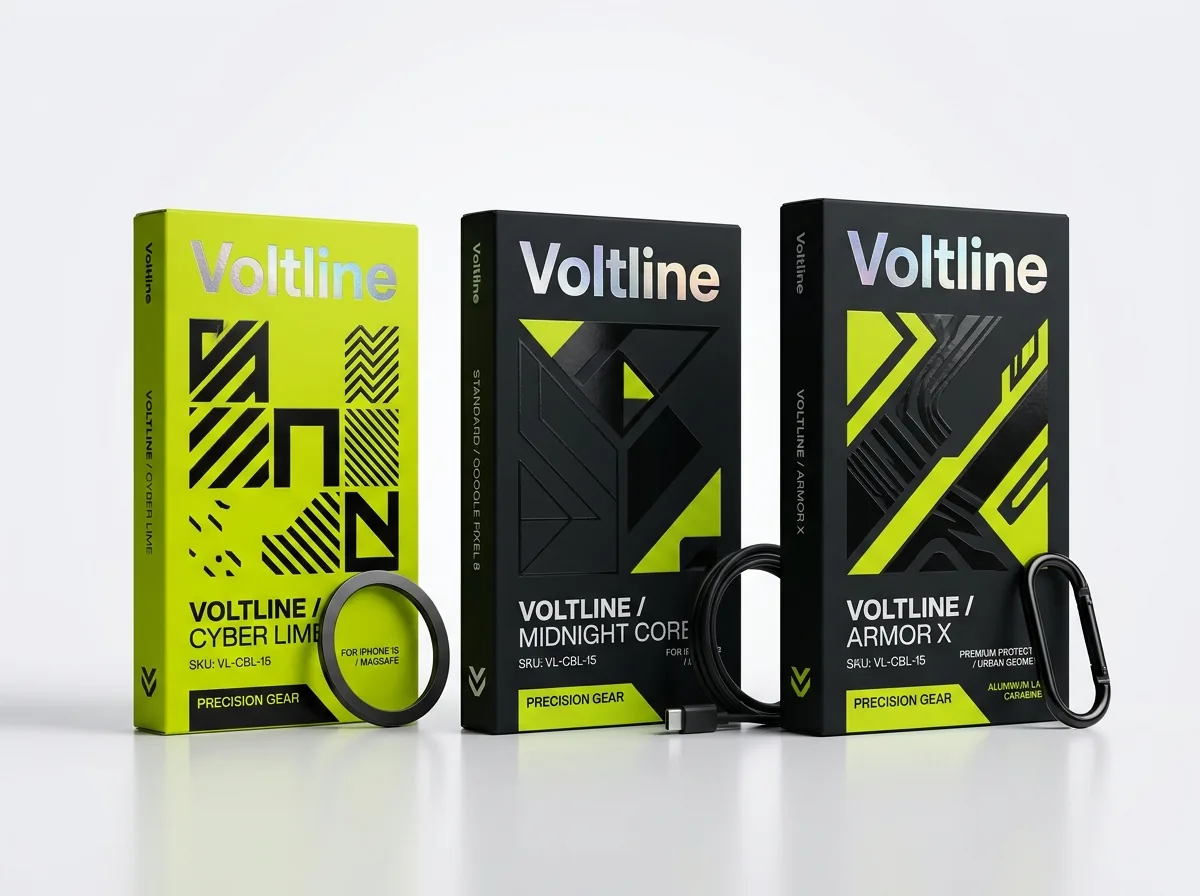


Ready to order phone case boxes? Compare up to 3 quantities with a free 3D mockup.
Request a Quote →Questions about phone case boxes
What is the most popular universal phone case box size for retail stores?
The industry workhorse is 4.25 × 0.75 × 7.50 inches (inside Length × Width × Height). It fits flagship 6.7-inch and 6.9-inch Pro Max and Ultra cases with a clean 0.45-inch frame border, while smaller 6.1-inch cases center neatly inside using a stepped paperboard insert.
How do you write phone case box dimensions (Length × Width × Height)?
Looking straight at the front face of the upright retail box, Length (L) is the horizontal width from left to right (typically 4.0 to 4.5 in), Width (W) is the front-to-back depth (typically 0.5 to 1.0 in), and Height (H) is the vertical height from bottom to top (typically 6.75 to 7.75 in).
Can I pack a phone case and a tempered glass screen protector in the same box?
Yes. Increase the inside depth (W) from 0.75 inch to 1.00 or 1.25 inches. Our structural team engineers a two-level folded paperboard tray that holds the phone case in the top window cradle and tucks the screen protector, alignment frame and cleaning wipes underneath.
Does adding a Euro hang tab change the inside height of my phone case box?
No. An integral folding Euro or J-hook hang tab extends 1.125 to 1.25 inches upward from the back panel above the top score line. Your inside usable height remains unchanged, and the tab can fold flat for online shipping.
How wide should the clear window or open touch cutout be on a 4.25 × 7.50 inch box?
A window measuring 2.50 to 2.75 inches wide by 4.75 to 5.25 inches tall leaves a sturdy 0.75-inch paperboard border on the left and right sides. That shows the case color, MagSafe ring and camera cutout while keeping the front panel flat and rigid.
Can I test my 6.1-inch and 6.9-inch cases inside a prototype before printing 1,000 boxes?
Yes. Every order includes free vector dielines for the outer carton and stepped inner frame, plus a digital proof and 3D mockup before payment. You can also order our $50 sample kit (credited to your order) or a custom physical prototype.
Still have a question? Ask a packaging specialist.
Request a Quote →Request your phone case boxes quote
Tell us your size and quantities, and one dedicated account manager prepares pricing for each tier.
- Free design & AI-to-print studio + 3D mockup
- No die or plate charges · 4–5 day rush available
- Free shipping to all 50 states
- 10% off your first order
The sizing formulas and category benchmarks in this guide are based on current 6.1-inch, 6.3-inch, 6.7-inch and 6.9-inch smartphone case dimensions (slim TPU, MagSafe, rugged armor and leather folios) plus snap-on screen protector alignment trays. A CubitPack packaging specialist checked every row. Spot an error? Tell us and we will fix it.
Sources
What changed
- October 22, 2026: First published.
- October 22, 2026: Updated specifications, terminology, and verified source links.
More guides
New packaging guides by email
Sizes, materials and design tips. Unsubscribe anytime.