
What size power bank box do I need for 5,000 to 27,000 mAh battery packs?
Short answer: Measure your battery pack's length, width and thickness, add 0.25 to 0.375 inch per side for the inner cradle, and add 0.75 to 1.25 inches for an isolated USB-C cable pocket. Most custom power bank boxes measure 3.5 × 1.0 × 5.0 in for 5,000 mAh magnetic packs and 3.75 × 1.375 × 6.25 in for 10,000 mAh banks.
On this page
- How do I measure a portable battery pack and USB-C cable for a custom box
- What are standard inside box dimensions for 5,000 to 27,000 mAh power banks
- How do flat LiPo pouch cells vs 18650 and 21700 cylindrical cells change box depth
- How much space should I add to keep the USB-C cord from scratching the battery
- How does battery weight affect Euro hang-tab placement and front-to-back depth
- Common mistakes
- FAQs
Request a custom quoteFree dieline & 3D mockup
Sizing a portable charger carton depends on two numbers beyond the bare battery shell: the cell architecture inside the housing (flat lithium-polymer pouch cells versus thick 18650 or 21700 cylindrical cells) and the walled compartment that separates the metal USB-C charging cord from the battery finish. If you drop a coiled USB-C cable into the same open cavity as an anodized aluminum or soft-touch battery bank, parcel vibration causes the metal connector shells to scratch the battery casing and digital percentage screen before the customer opens the lid. By adding 0.75 to 1.25 inches to the inside height (for a bottom cord pocket) or width (for a side cord well) plus a 0.25-inch to 0.375-inch perimeter cradle rim, every component rides in its own locked cell. When you order printed power bank boxes from CubitPack, we cut both the outer carton and inner divider to your exact inside dimensions with zero die fees.
How do I measure a portable battery pack and USB-C cable for a custom box?
Always measure a physical production unit alongside the exact charging cord, drawstring mesh pouch and folded instruction sheet that ship inside the retail carton. Two 10,000 mAh power banks can have completely different footprints: a magnetic wireless pack built around a thin lithium-polymer pouch cell might be 0.45 inch thick, whereas a high-output pocket bank built around three cylindrical 21700 cells side by side can be 1.15 inches thick. Next, decide whether the coiled USB-C charging cord sits in a bottom compartment underneath the battery foot (which keeps the carton narrow for peg-hook planograms) or in a false-bottom tray underneath the entire battery back (which keeps the carton shorter). Once you choose the layout, write your target inside dimensions in inches as Length (left to right across the front panel) × Width (front to back depth) × Height (bottom to top) and apply the clearance formulas below when requesting custom power bank boxes.
- Battery housing (L × W × T): measure with digital calipers across the widest body ribs, camera-clearance step or built-in lanyard loop.
- Paperboard cradle rim: add 0.25 in per side (0.50 in total to Length and Height) so the folded tray walls suspend the battery away from outer corners.
- EVA foam perimeter: add 0.375 to 0.50 in per side (0.75 to 1.0 in total) when cradling heavy 20,000 to 27,000 mAh bricks in closed-cell foam.
- Bottom-stacked cord well (+H): add 0.875 to 1.25 in to inside Height for a walled lower pocket holding a coiled 1-foot or 3-foot USB-C cable.
- False-bottom cord basement (+W): add 0.50 in to front-to-back Width if the coiled cord and manual sit flat underneath the battery tray.
What are standard inside box dimensions for 5,000 to 27,000 mAh power banks?
While CubitPack cuts every carton and divider tray to your exact millimeter or sixteenth of an inch with no tooling charges, consumer battery packs cluster into eight standard size brackets based on mAh capacity and cell geometry. Use this benchmark chart to compare your hardware against retail and direct-to-consumer norms. Notice how 5,000 mAh and 10,000 mAh pegboard cartons stay between 1.0 and 1.5 inches deep front-to-back so airport electronics kiosks and big-box stores can hang six to eight units on a single peg hook. Once capacity reaches 20,000 to 27,000 mAh (up to the 99.9 Wh airline carry-on ceiling), the box transitions to a wider auto-lock bottom carton or a two-piece rigid presentation case.
| Power bank capacity & form factor | Typical inside size (L × W × H) | Recommended carton & insert |
|---|---|---|
| 5,000 mAh ultra-slim MagSafe / Qi2 snap-on pack | 3.5 × 1.0 × 5.0 in | Straight tuck + Euro hang tab + card cradle |
| 10,000 mAh magnetic wireless pack with kickstand | 3.625 × 1.25 × 5.5 in | Auto-lock bottom + false-bottom cord well |
| 10,000 mAh pocket bank + short USB-C cord | 3.75 × 1.375 × 6.25 in | Auto-lock bottom + 2-pocket card divider |
| 15,000 mAh travel charger with built-in AC prongs | 4.0 × 1.625 × 6.5 in | Auto-lock carton + reinforced prong guard |
| 20,000 mAh dual-port travel power bank + pouch | 4.0 × 1.75 × 7.0 in | E-flute auto-lock or tray-and-sleeve |
| 24,000-27,000 mAh (99.9 Wh) 140W 3-cell laptop bank | 4.25 × 2.25 × 7.5 in | E-flute auto-lock or two-piece rigid + EVA foam |
| 3-in-1 foldable magnetic travel battery kit + brick | 5.25 × 4.25 × 2.25 in | Tray and sleeve or E-flute mailer + 3-well tray |
| Rugged waterproof solar outdoor power bank + clip | 6.5 × 4.5 × 2.75 in | E-flute corrugated mailer + partitioned divider |
How do flat LiPo pouch cells vs 18650 and 21700 cylindrical cells change box depth?
Two portable chargers with the exact same 10,000 mAh rating often require completely different carton proportions depending on the battery cells inside. Flat lithium-polymer (LiPo) pouch cells stack like credit cards, producing a wide, flat rectangular casing around 0.45 to 0.65 inch thick. Those flat packs fit best in a slim 1.0-to-1.25-inch-deep carton where the coiled USB-C cable sits in a separate compartment below the bottom edge of the battery. In contrast, high-wattage 100W and 140W power banks built with cylindrical 18650 (18 mm diameter) or 21700 (21 mm diameter) cells form a triangular or square prism brick that is 1.25 to 2.0 inches thick on every side. Trying to squeeze a cylindrical-cell brick plus a false-bottom cable well into a front-to-back depth produces a bulky cube that hangs poorly on retail hooks. Instead, orient cylindrical power banks vertically inside an auto-lock bottom carton and place the braided USB-C cord in a side or bottom partitioned column. You can pair these setups with matching custom charger boxes and custom cable boxes across your product line.
Know your size? Compare pricing across up to 3 quantities.
Request a Quote →How much space should I add to keep the USB-C cord from scratching the battery?
One of the most expensive quality-control failures in portable power packaging is transit scuffing: the anodized aluminum body, soft-touch rubberized shell or glossy acrylic OLED screen gets scratched by the sharp nickel-plated tip of the bundled USB-C charging cord. Wrapping the battery in a thin plastic polybag looks cheap during unboxing and still allows metal plug heads to dent the surface during parcel drops. The structural fix is a folded two-compartment cardboard insert or a dual-cavity EVA foam insert with a solid 0.25-inch to 0.375-inch divider wall between the hardware cavity and the accessory pocket. A tightly wound 1-foot USB-C jumper cable needs a pocket of just 2.5 × 0.875 × 0.75 inches, while a 3-foot braided 100W/240W USB-C cord plus a microfiber drawstring travel pouch needs a 3.25 × 1.25 × 1.125 inch compartment.
How does battery weight affect Euro hang-tab placement and front-to-back depth?
When your power bank sells on pegboard hooks in airport travel shops, campus bookstores or electronics chains, the center of gravity of the lithium cells determines whether the box hangs straight or droops forward at a 25-degree angle. Because an integral folding Euro hang tab extends upward from the rear panel, any weight positioned far forward of the back wall pulls the top of the carton downward. To keep peg-hook cartons hanging vertically, keep the front-to-back Width (W) under 1.75 inches for back-panel Euro tabs, and place the heavy battery pack directly against the rear wall of the inner tray while positioning lightweight items (like the instruction manual or mesh pouch) toward the front or bottom. For thicker 20,000 mAh bricks that require a 2.0-inch-deep carton, ask our design team to center a slot-in T-hang tab through the top lid flap directly over the battery's center of mass so the front face hangs completely plumb on store planograms.
What are the most common power bank box sizing mistakes?
Almost every portable charger sizing mistake comes from underestimating battery weight or forgetting to wall off the metal charging cord. Check these five points before locking in your dieline
- Measuring only the bare battery casing and forgetting to add a 0.875 to 1.25 inch walled pocket for the bundled USB-C charging cable.
- Placing a heavy 20,000 mAh battery brick in the front of a deep carton with a rear Euro hang tab, causing the package to tilt forward on peg hooks.
- Using a standard friction tuck bottom on a battery over 8 ounces without an auto-lock base, allowing the weight to push the bottom flap open.
- Cutting the inner tray cavity without left and right 0.6-inch finger notches so customers have to dump the heavy battery out upside down.
- Forgetting to add 0.125 inch of thickness clearance for magnetic snap-on packs that have a raised silicone coil ring on the back face.
Find your size
Suggested inside size: 3.5 × 1.0 × 5.0 in
A starting point. Your account manager confirms the size with you before the proof.
Quote this size →Packaging for this
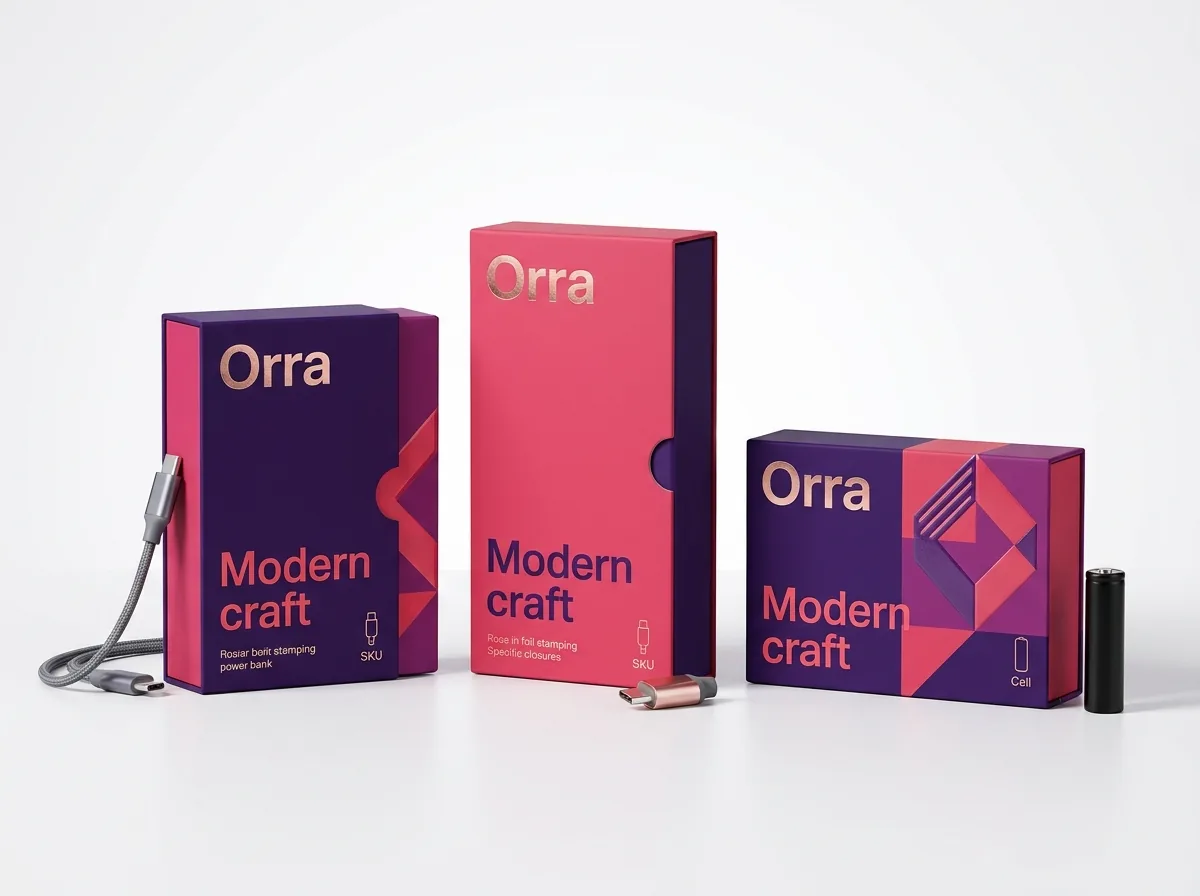


Ready to order power bank boxes? Compare up to 3 quantities with a free 3D mockup.
Request a Quote →Questions about power bank boxes
What size box fits a standard 10,000 mAh portable power bank and charging cord?
Most 10,000 mAh pocket power banks measure around 4.1 × 2.6 × 0.65 inches and fit cleanly inside a 3.75 × 1.375 × 6.25 inch auto-lock folding carton. That leaves room for a contoured paperboard cradle plus a walled lower pocket for a short USB-C charging cable.
How much extra box height do I need for a 3-foot braided USB-C cable?
When coiled into a compact oval bundle with a paper band or twist tie, a 3-foot braided 100W USB-C cable requires a dedicated compartment measuring roughly 3.0 to 3.25 inches wide, 1.0 inch deep and 1.0 to 1.25 inches tall.
Can I use one outer box size for both my 10,000 mAh and 20,000 mAh power banks?
Yes, if you want to standardize outer carton dimensions for retail shelf planograms. We can size the outer carton to fit the larger 20,000 mAh model and engineer a deeper folded paperboard insert cradle that centers the slimmer 10,000 mAh model in the same box.
How much clearance should a paperboard or EVA foam insert leave around a power bank?
We cut folded paperboard cradles 1/32 inch (0.8 mm) larger than your battery's caliper measurements so soft-touch and anodized shells slide in smoothly without scuffing. Die-cut EVA foam cavities are cut 1/64 inch tighter for a snug friction grip.
Do you charge extra die fees for a two-compartment battery and cable insert?
No. CubitPack never charges cutting die or printing plate fees. Your custom outer carton dieline, auto-lock bottom, reinforced Euro hang tab and internal battery-plus-cord divider tray are all engineered with zero tooling charges.
Can I test my actual battery pack and cord in a sample box before running 1,000 units?
Yes. Every order includes a free 2D dieline proof and 3D mockup before payment, and you can order our $50 material sample kit (credited toward your order) or request a custom physical prototype to test-fit your hardware.
Still have a question? Ask a packaging specialist.
Request a Quote →Request your power bank boxes quote
Tell us your size and quantities, and one dedicated account manager prepares pricing for each tier.
- Free design & AI-to-print studio + 3D mockup
- No die or plate charges · 4–5 day rush available
- Free shipping to all 50 states
- 10% off your first order
The sizing formulas and mAh dimension benchmarks in this guide are based on standard consumer portable charger form factors (5,000 mAh MagSafe packs, 10,000 to 20,000 mAh pocket banks and 27,000 mAh 21700-cell laptop banks) and standard paperboard and EVA foam tolerances. A CubitPack packaging specialist checked every row. Spot an error? Tell us and we will fix it.
Sources
What changed
- October 22, 2026: First published.
- October 22, 2026: Updated specifications, terminology, and verified source links.
More guides
New packaging guides by email
Sizes, materials and design tips. Unsubscribe anytime.