
What size custom snack pouch fits chips, granola, nuts and jerky?
Short answer: A 5 × 8 × 3 inch stand-up pouch fits 3 to 4 oz of beef jerky, nuts or cookies (or 1 to 1.5 oz of puffed chips), while a 6 × 9 × 3.5 inch pouch fits 6 to 8 oz of granola or 2 to 3 oz of kettle corn when ordering custom snack pouches.
On this page
- Why does 2 oz of kettle corn or chips need the same pouch size as 8 oz of nuts
- What are the standard custom snack pouch dimensions from 1 oz single-serve to 2 lb club bags
- How do I size flat 3-side-seal and stand-up pouches for beef jerky and meat sticks
- How much top headspace do I need for nitrogen gas flushing, zippers and hang holes
- What size single-serve snack packets fit inside variety boxes and multipacks
- Common mistakes
- FAQs
Request a custom quoteFree dieline & 3D mockup
Picking a snack bag dimension from a generic ounce-weight table is the fastest way to end up with crushed potato crisps or half-empty trail mix bags because snack foods span a 500% range in bulk density. Airy puffed snacks such as kettle corn, extruded cheese curls, lentil puffs and ridged tortilla chips weigh only 0.08 to 0.14 grams per cubic centimeter and need an extra 20% to 25% of nitrogen headspace cushion, meaning just 2.5 ounces fills a 6 × 9 × 3.5 inch stand-up pouch. Medium-density baked goods like oat granola clusters, mini pretzels and biscotti bites sit around 0.30 to 0.38 grams per cubic centimeter, fitting 6 to 8 ounces inside that same 6 × 9 × 3.5 inch bag. Heavy roasted almonds, cashews, sour gummies and dried mango pack at 0.45 to 0.60 grams per cubic centimeter, fitting 8 to 10 ounces in a 6 × 9 × 3.5 inch pouch.
Why does 2 oz of kettle corn or chips need the same pouch size as 8 oz of nuts?
Flexible pouch capacity is governed by cubic volume in milliliters, not scale weight in ounces. When an extruded puff, kettle chip or freeze-dried fruit slice tumbles down a multi-head weigher collar into a pouch, its irregular curved shape bridges against neighboring pieces and traps large pockets of air. Even after vibrating on the filling line, puffed snacks occupy four to five times more volume per ounce than oil-roasted peanuts, pistachios or gummy bears. If your snack brand sells both an airy puffed crisp and a dense nut-and-chocolate trail mix in printed snack food bags, you can still share one master pouch dimension across your catalog to combine print volume. Many CPG founders standardize a 6 × 9 × 3.5 inch stand-up pouch for every grocery SKU and simply print the true net weight on each front panel: 2.5 oz for Sea Salt Veggie Puffs, 7 oz for Maple Oat Granola, and 9 oz for Dark Chocolate Almond Trail Mix.
- Tier 1 · Airy puffed & fried crisps (0.08 to 0.14 g/cm3): kettle corn, potato chips, pork rinds, cheese puffs and veggie straws.
- Tier 2 · Baked clusters, pretzels & jerky strips (0.28 to 0.38 g/cm3): oat granola, mini pretzels, pita chips, cookies and beef jerky.
- Tier 3 · Dense roasted nuts, seeds & dried fruit (0.45 to 0.62 g/cm3): almonds, cashews, pumpkin seeds, mango slices and gummies.
What are the standard custom snack pouch dimensions from 1 oz single-serve to 2 lb club bags?
CubitPack cuts every snack pouch to your exact outer Width × Height × Bottom Gusset in inches with zero die or printing plate fees. Keep in mind that outer height always includes the top 1.25 to 1.75 inch header above the product line where the impulse heat seal, pegboard hang hole, laser tear notches and press-to-close zipper sit. Use the benchmark chart below to compare real-world net weights across puffed crisps versus dense granola, nuts, jerky and gummies.
| Outer size (W × H × G) | Puffed crisps & popcorn capacity | Granola, nuts, jerky & gummy capacity |
|---|---|---|
| 4 × 6 in (flat, no gusset) | 0.5 oz mini puff or crisp taster | 1 to 1.5 oz (28 - 42 g) pocket nuts or gummies |
| 5 × 8 × 3 in | 1 to 1.5 oz single-serve chips or puffs | 3 to 4 oz (85 - 113 g) beef jerky, nuts or cookies |
| 6 × 9 × 3.5 in | 2 to 3 oz kettle corn or veggie straws | 6 to 8 oz (170 - 227 g) retail granola or trail mix |
| 7 × 10 × 3.5 in | 3.5 to 4.5 oz tortilla chips or pretzels | 10 to 12 oz (283 - 340 g) glazed nuts or dried fruit |
| 7.5 × 11.5 × 4 in | 5 to 6 oz family bag of popcorn | 14 to 16 oz (1 lb / 454 g) oat clusters or bites |
| 8.5 × 13 × 4.5 in | 7 to 9 oz shareable party crisps | 24 to 32 oz (1.5 - 2 lb) club-store trail mix |
| 10 × 15 × 5 in | 12 to 16 oz bulk puffed snack bag | 3 to 4 lb foodservice nuts or bakery toppings |
How do I size flat 3-side-seal and stand-up pouches for beef jerky and meat sticks?
Cured beef jerky, turkey jerky, biltong and smoked meat sticks have a unique flat, rigid geometry compared to pourable nuts or granola. Whole-muscle jerky slabs do not flow into a round bottom gusset; instead, they stack like cards against the front and back film walls, alongside a small iron-oxide oxygen absorber packet. For 1 oz to 2.25 oz convenience-store jerky packs and 2-count meat stick packs that hang exclusively on clip strips or wire peg hooks, a flat 3-side-seal pouch (with zero bottom gusset) measuring 4.5 × 7 inches or 5 × 8 inches keeps the meat slices upright facing the shopper. For 3 oz to 4 oz supermarket jerky bags that need to either hang on a sombrero peg hook or stand upright on a shelf tray, use a 5.5 × 8.5 × 2.5 inch or 6 × 9 × 3 inch stand-up custom zipper pouch. If your jerky packs ship to stores inside pop-up shelf trays, pair your bags with custom jerky boxes and custom counter display boxes.
Know your size? Compare pricing across up to 3 quantities.
Request a Quote →How much top headspace do I need for nitrogen gas flushing, zippers and hang holes?
Two different headspace allowances govern the upper third of a snack pouch. First is mechanical seal and zipper clearance: when a rotary premade-pouch filling machine drops granola clusters, pretzel twists or gummy bears through the top mouth of the bag, the product pile must settle at least 0.75 to 1.0 inch below the lower flange of the zipper. If a stray oat cluster or almond bounces into the zipper zone, the heat-seal jaws will crush the nut into the molten polyethylene seal layer and create a micro-leak. Second is gas-flush cushion headspace for fragile fried or baked crisps. When co-packers flush potato chips, plantain chips, pork rinds or puffed curls with inert food-grade nitrogen gas, they intentionally leave 20% to 30% of the internal pouch volume empty so the sealed bag inflates into a taut protective pillow. Adding a sombrero hang hole in the top seal header adds another 0.375 inches to the top seal band. Always factor both clearances into your overall pouch height before ordering custom stand up pouches.
- Top heat-seal + tear-notch + zipper header: occupies the top 1.25 to 1.5 inches of overall pouch height.
- Sombrero (euro) pegboard hang hole header: increases the top header zone to 1.5 to 1.75 inches.
- Filler settling clearance below zipper: leave 0.75 to 1.0 inch of empty film wall above settled nuts or granola.
- Nitrogen-flush pillow cushion for fragile chips: leave 20% to 30% of usable internal volume as gas headspace.
What size single-serve snack packets fit inside variety boxes and multipacks?
School lunchbox packs, airline snack assortments, office pantry caddies and e-commerce sampler bundles rely on compact 0.75 oz to 1.5 oz single-serve packets that have no zipper and open in one tear. A 4 × 5.5 inch or 4 × 6 inch flat 3-side-seal packet holds 1 oz (28 g) of roasted almonds, cashews or fruit gummies, while a 4.5 × 6.5 inch flat packet holds 1 oz of mini cookies, pretzel grid twists or granola bites. When designing a 6-pack, 10-pack or 12-pack retail carton around these single-serve pouches, size the outer folding carton or mailer box around the settled thickness of the filled packets rather than their flat empty dimensions. A 4 × 6 inch packet filled with 1.25 oz of mixed nuts puffs out to roughly 0.65 to 0.75 inches thick at the center belly. We can engineer both your single-serve custom flat pouches and your outer custom snack boxes on one coordinated dieline.
- 3.5 × 5 in flat packet: 0.5 to 0.75 oz (14 to 21 g) trade-show nut, seed or gummy taster.
- 4 × 6 in flat packet: 1 to 1.5 oz (28 to 42 g) standard single-serve trail mix, roasted nuts or fruit chews.
- 4.5 × 7 in or 5 × 7 in flat pillow bag: 0.75 to 1.25 oz single-serve baked crisps, popcorn or mini cookies.
What are the most common custom snack pouch sizing mistakes?
Most snack bag sizing problems happen when brands confuse net weight with cubic volume or forget co-packer filling clearances. Avoid these five mistakes
- Using a nut or coffee weight chart to size a pouch for puffed veggie straws or kettle corn, leaving the bag 60% too small.
- Forgetting that the top 1.5 inches of a stand-up pouch holds the heat seal, hang hole and zipper and cannot hold product.
- Ordering a tall, narrow pouch for 8 oz of cookies or pretzels where adult hands cannot reach through the top zipper mouth.
- Packing flat rigid beef jerky slabs into a deep round-gusset bag where the slices tip sideways instead of facing forward.
- Skimping on top headspace for rotary filler funnels, causing granola clusters or almonds to get crushed in the heat-seal jaws.
Packaging for this
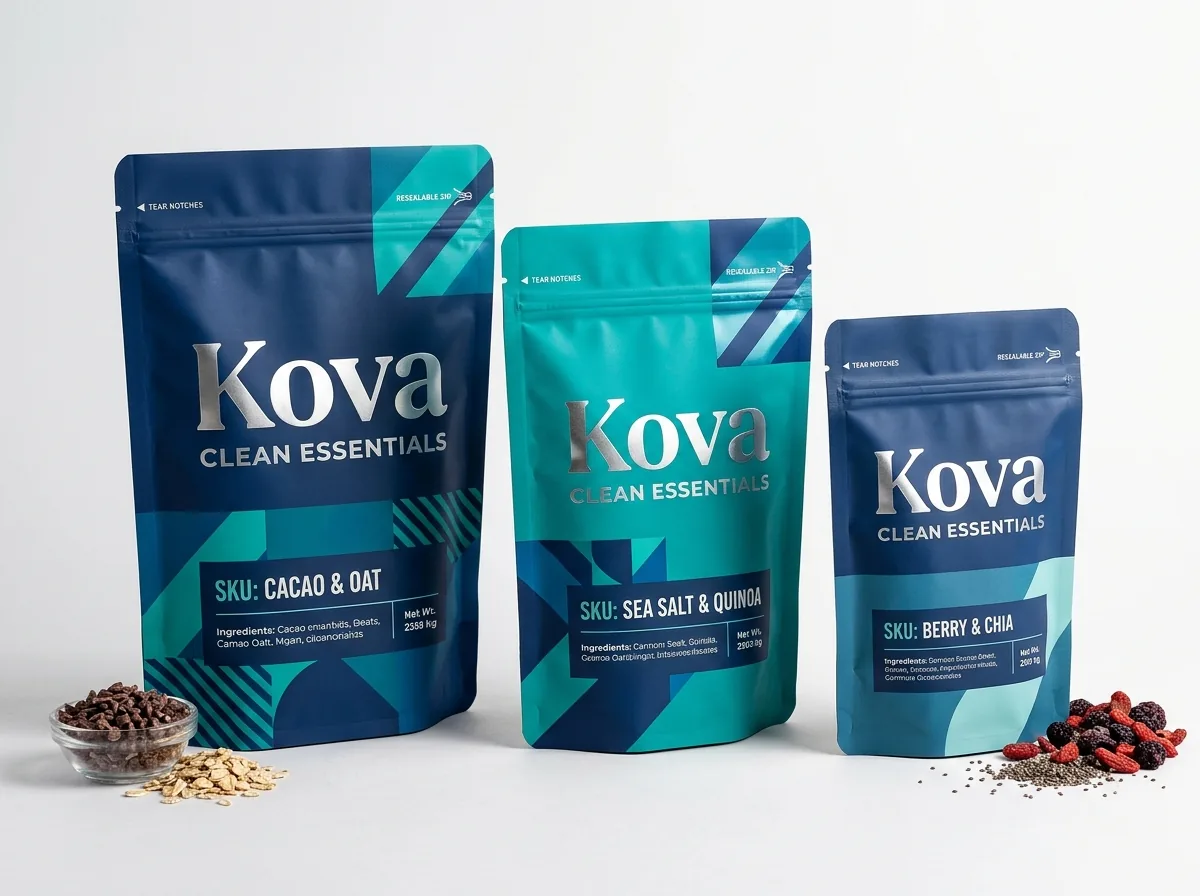
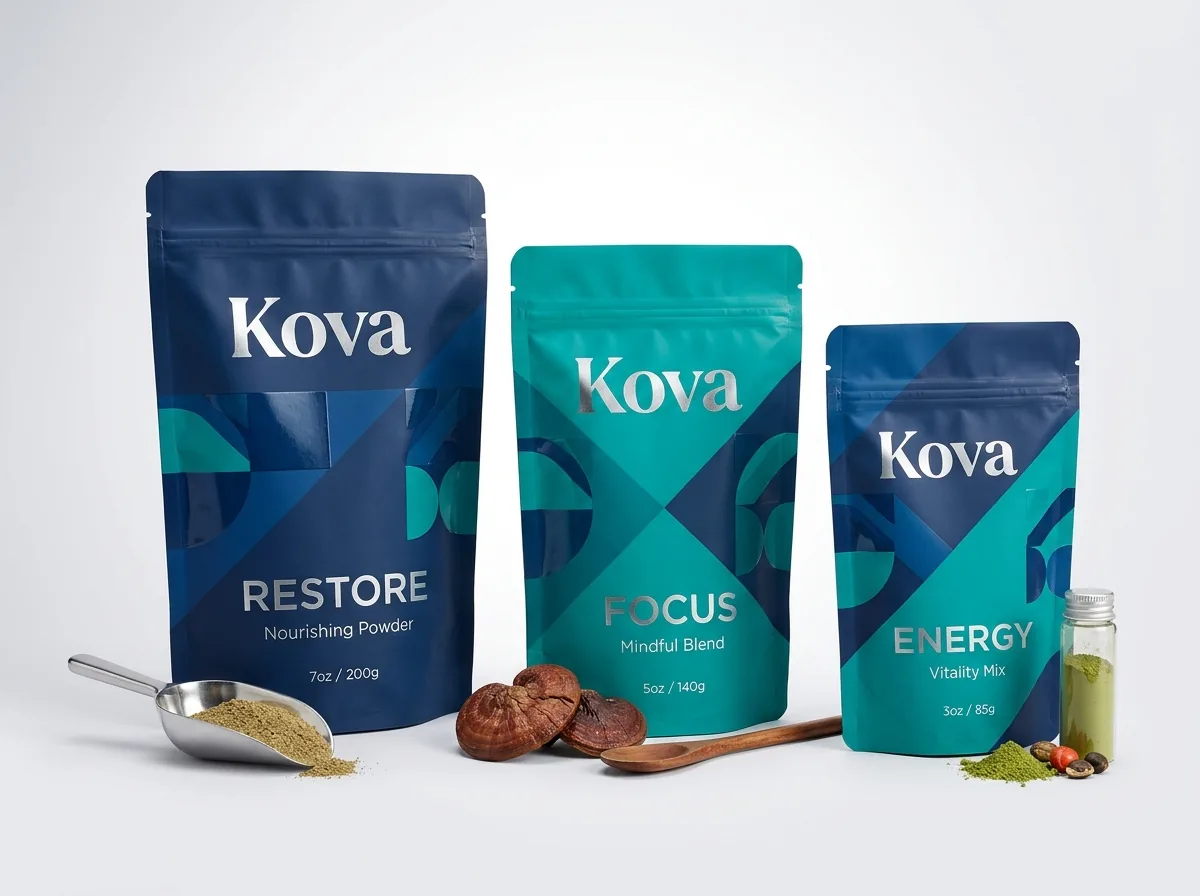
Ready to order snack pouches? Compare up to 3 quantities with a free 3D mockup.
Request a Quote →Questions about snack pouches
Can I use the same snack pouch size for puffed crisps and dense trail mix?
Yes. Many snack companies standardize one 6 × 9 × 3.5 inch stand-up pouch across their entire product line to combine print quantities, labeling the puffed crisp SKU at 2.5 oz net weight and the trail mix or granola SKU at 8 oz net weight.
What size custom snack pouch fits 8 oz of granola or roasted nuts?
A 6 × 9 × 3.5 inch stand-up bottom-gusset pouch is the US grocery retail standard for 6 oz to 8 oz of baked oat granola clusters, spiced pecans, roasted almonds, chocolate-covered pretzels or dried fruit.
What size pouch do I need for 3 oz of beef jerky?
A 3 oz retail beef jerky pack typically uses a 5.5 × 8.5 × 2.5 inch or 6 × 9 × 3 inch stand-up zipper pouch (or a 5.5 × 9 inch flat 3-side-seal bag) with a sombrero pegboard hang hole punched in the top seal header.
How much taller does a snack pouch need to be if I add a zipper and sombrero hang hole?
A standard press-to-close zipper plus tear notches uses 1.25 to 1.5 inches of top header height. Adding a sombrero (euro) pegboard hang hole above the zipper requires 1.5 to 1.75 inches of top header height above your product fill line.
Do I pay custom die charges if I need a specific width for my co-packer's filling line?
No. CubitPack never charges die or printing plate fees. If your co-packer's rotary pouch machine requires a specific 6.25 inch bag width to fit its gripper jaws, we build the exact custom dieline and 3D mockup at no extra cost.
How can I test my snacks inside sample pouches before placing a full print order?
Order our $50 sample kit (credited toward your first order) or request a prototype pouch, then test-fill your actual chips, granola, nuts or jerky to verify settling height, hand opening clearance and shelf stability. Every order includes a free digital proof, 3D mockup, no die or plate charges, and free delivery to all 50 US states.
Still have a question? Ask a packaging specialist.
Request a Quote →Request your snack pouches quote
Tell us your size and quantities, and one dedicated account manager prepares pricing for each tier.
- Free design & AI-to-print studio + 3D mockup
- No die or plate charges · 4–5 day rush available
- Free shipping to all 50 states
- 10% off your first order
The snack capacity benchmarks in this guide are calculated from commercial food bulk densities (0.08 to 0.14 g/cm3 for puffed snacks with 25% nitrogen headspace vs 0.35 to 0.55 g/cm3 for granola, nuts and jerky) and rotary pouch filler clearance rules, verified by a CubitPack packaging specialist. Spot something off? Tell us and we will fix it.
Sources
What changed
- October 22, 2026: First published.
- October 22, 2026: Updated specifications, terminology, and verified source links.
More guides
New packaging guides by email
Sizes, materials and design tips. Unsubscribe anytime.