
What size coffee bag do I need for 8 oz, 12 oz and 5 lb beans?
Short answer: A standard 12 oz whole-bean stand-up pouch measures 6 × 9 × 3.5 inches (or 4.75 × 8.5 × 3.25 inches for a flat-bottom bag), an 8 oz bag measures 5.125 × 8.25 × 3.125 inches, and a 5 lb cafe bag measures 9 × 16 × 5 inches when ordering custom coffee bags.
On this page
- How do I read Width, Height and Bottom Gusset on a coffee pouch
- What are the standard coffee bag dimensions from 2 oz to 5 lb
- How do dark roasts, light roasts and ground coffee change bag size
- How do I size 10 oz, 12 oz and 1 lb retail bags for shelves and mailers
- How should I size 2 oz sample packs and 5 lb wholesale cafe bags
- Common mistakes
- FAQs
Request a custom quoteFree dieline & 3D mockup
Coffee bag sizes are always written as outer Width × Height × Gusset in inches, but the right dimensions depend on both net weight and roast density. During roasting, green coffee beans lose 14% to 20% of their moisture while expanding in cell volume, which means 12 ounces (340 grams) of dark french roast whole beans takes up 10% to 15% more space inside a pouch than 12 ounces of dense light-roast Ethiopian beans or fine espresso grounds. For standard US specialty retail, 6 × 9 × 3.5 inches is the proven 12 oz stand-up pouch size, 4.75 × 8.5 × 3.25 inches fits 12 oz in a five-panel flat-bottom box pouch, 6.75 × 10.5 × 3.75 inches holds 16 oz (1 lb), and 9 × 16 × 5 inches holds 5 lb wholesale cafe hoppers. Always allow 1.5 inches of headspace above the beans for zipper and heat sealing.
How do I read Width, Height and Bottom Gusset on a coffee pouch?
Flexible pouches are measured flat from outer edge to outer edge in inches before the bag is filled, written in the order Width × Height × Gusset (W × H × G). Width is the horizontal distance from the left side heat seal to the right side heat seal. Height is the vertical distance from the very bottom edge of the pouch to the top lip above the zipper and tear notches. Gusset is the total full depth of the folded bottom panel (on a stand-up pouch or flat-bottom bag) or the expandable side panels (on a quad-seal side-gusset bag) when opened out flat. Keep in mind that usable internal room is slightly smaller than those outer dimensions. Side heat seals consume about 0.25 to 0.375 inches on both the left and right edges, and the upper zipper track, tear notches and top heat-seal band occupy the top 1.5 to 1.75 inches of height. When you request a quote for printed coffee bags with valves, sharing both your outer dimensions and your target bean weight lets our structural team verify that your widest filling funnel and heat-sealing bar clear the top opening cleanly.
- Width (W): outer left-to-right measurement across the front face, including side seal flanges.
- Height (H): full top-to-bottom measurement from base edge to top lip above the zipper.
- Gusset (G): total expanded depth at the bottom fold or side pleats when the bag stands open.
- Usable fill height: subtract 1.5 to 1.75 inches from total height for the zipper track and top heat seal.
What are the standard coffee bag dimensions from 2 oz to 5 lb?
Although CubitPack cuts every pouch to your exact millimeter or inch specification with zero die or plate charges, specialty roasters across the United States rely on seven benchmark footprints that fit standard cafe shelves, grocery gondolas and subscription mailers. Notice that the 10 oz to 12 oz retail tier is listed twice in the table below: once as a wide-front stand-up doypack (6 × 9 × 3.5 inches) and once as a narrower, deeper flat-bottom box pouch (4.75 × 8.5 × 3.25 inches) that stands square like a folding carton. All capacities in this reference chart are based on medium-roast whole-bean Arabica coffee at a typical bulk density of 0.36 grams per cubic centimeter. If your roastery focuses on dark espresso roasts or decaf beans that expand heavily during second crack, step up 0.25 to 0.5 inches in height so your staff never have to shake or tamp bags on the packing table just to clear the zipper track.
| Target roast weight | Outer size (W × H × G) | Recommended pouch style & use |
|---|---|---|
| 1.5 - 2.5 oz (42 - 70 g) | 4 × 6 × 2 in (or 4 × 6 in flat) | 3-side-seal flat packet or mini stand-up sample |
| 4 oz (113 g) | 4.5 × 7 × 2.5 in | Stand-up pouch for tasting sets and gift boxes |
| 8 oz / ½ lb (227 g) | 5.125 × 8.25 × 3.125 in | Stand-up pouch for micro-lots and decaf |
| 10 - 12 oz (283 - 340 g) | 6 × 9 × 3.5 in | Stand-up pouch (retail cafe & grocery standard) |
| 10 - 12 oz (283 - 340 g) | 4.75 × 8.5 × 3.25 in | Flat-bottom box pouch (5 flat printable faces) |
| 16 oz / 1 lb (454 g) | 6.75 × 10.5 × 3.75 in | Stand-up or side-gusset full-pound retail bag |
| 32 oz / 2 lb (907 g) | 7.5 × 11.5 × 4 in | Stand-up or flat-bottom family club size |
| 5 lb (2.27 kg) | 9 × 16 × 5 in (or 8 × 19 × 5 in) | Side-gusset or large stand-up cafe bulk bag |
How do dark roasts, light roasts and ground coffee change bag size?
Two bags of coffee that both weigh 12.0 ounces on a legal-for-trade scale can fill a pouch to completely different heights. High-altitude washed Ethiopian or Kenyan beans roasted to a light city profile remain dense and compact, averaging 0.38 to 0.42 g/cm3. By contrast, beans pushed into dark Vienna or French roast lose more mass as water vapor and carbon dioxide while their cellulose walls expand up to 80% over green bean volume, dropping bulk density to 0.30 to 0.33 g/cm3. Grinding coffee changes volume in the opposite direction. Whole beans trap roughly 40% void space between the curved seeds; once ground for drip or espresso, the particles pack tightly together and occupy 15% to 25% less volume for the exact same weight. If your roastery packs whole-bean light roasts, whole-bean dark roasts and pre-ground drip coffee into the same master bag size, always size the pouch around your darkest whole-bean SKU. That way, dark roasts seal cleanly without beans jamming the zipper, while ground coffee simply sits a little lower in the pouch.
Know your size? Compare pricing across up to 3 quantities.
Request a Quote →How do I size 10 oz, 12 oz and 1 lb retail bags for shelves and mailers?
Over the past decade, 12 ounces (340 g) and 10 ounces (283 g) have replaced the traditional 16-ounce pound as the most common specialty retail weights in North America, while 16-ounce bags remain popular for diner blends, grocery club tiers and heavy-drinking households. Remarkably, both 10 oz and 12 oz whole-bean offerings usually run in the exact same 6 × 9 × 3.5 inch stand-up pouch or 4.75 × 8.5 × 3.25 inch flat-bottom pouch; a 10 oz fill simply leaves an extra half inch of headspace below the zipper. If you ship multi-bag coffee subscriptions or sell bag-in-box retail cartons, check how the filled bottom gusset interacts with your outer box. When a 6 × 9 × 3.5 inch stand-up pouch is filled with 12 oz of beans, the bottom oval gusset bellies outward to about 3.25 inches deep while the top tapers to a flat seal. Pairing your pouches with custom coffee boxes or custom mailer boxes sized to that expanded bottom depth keeps the bags from shifting or scuffing matte ink during parcel delivery.
How should I size 2 oz sample packs and 5 lb wholesale cafe bags?
At the two ends of a roaster's catalog sit fractional sample packets and 5-pound wholesale bulk bags, each with specific structural needs. A 2 oz (56 g) or 2.5 oz (70 g) sample pack holds just enough coffee to brew one 10-to-12-cup carafe or four pour-over mugs. A 4 × 6 inch flat 3-side-seal pouch (with no bottom gusset) lies under 0.75 inches thick when filled, allowing four different single-origin sample packs to mail flat inside a shallow subscription box without triggering dimensional weight surcharges. At the wholesale level, a 5 lb (2.27 kg) bag supplies cafe espresso hoppers, restaurant kitchens and office brew stations. You can format a 5 lb bag either as a wide stand-up pouch (around 11 × 16 × 4.5 inches) with a press-to-close zipper or as a deep side-gusset quad-seal bag (around 8 × 19 × 5 inches or 9 × 16 × 5 inches). Make sure the top mouth width matches your bulk weigh-and-fill chute, and leave 2.5 inches of top headspace so heavy 5 lb bags can be folded or heat-sealed without straining the top seam.
- 2 oz sample packets (4 × 6 in): flat 3-side-seal profile mails thin inside tasting flight boxes.
- 4 oz taster pouches (4.5 × 7 × 2.5 in): miniature stand-up gusset stands upright in holiday gift sets.
- 5 lb side-gusset bags (8 × 19 × 5 in): compact footprint stacks tightly inside master shipping cases.
- 5 lb stand-up pouches (11 × 16 × 4.5 in): wide top mouth and built-in zipper for easy cafe counter scooping.
What are the most common coffee bag sizing mistakes?
Sizing errors usually happen when roasters forget how much space zippers, side seals and dark-roast bean expansion consume inside a flexible pouch. Avoid these five mistakes
- Testing pouch capacity with dense light-roast or ground coffee, which leaves puffy dark-roast whole beans overflowing into the zipper track.
- Forgetting that the top 1.5 inches of pouch height sits above the zipper and heat-seal line and cannot hold beans.
- Ordering a top mouth narrower than your roastery's filling funnel or weigher spout, which slows down hand or semi-automatic bagging.
- Assuming an empty flat stand-up pouch keeps the same height once filled; opening the bottom gusset shortens vertical standing height by about 1 inch.
- Placing a front 3 × 4 inch roast label too close to the bottom gusset curve, where the expanding base causes paper label corners to lift.
Packaging for this
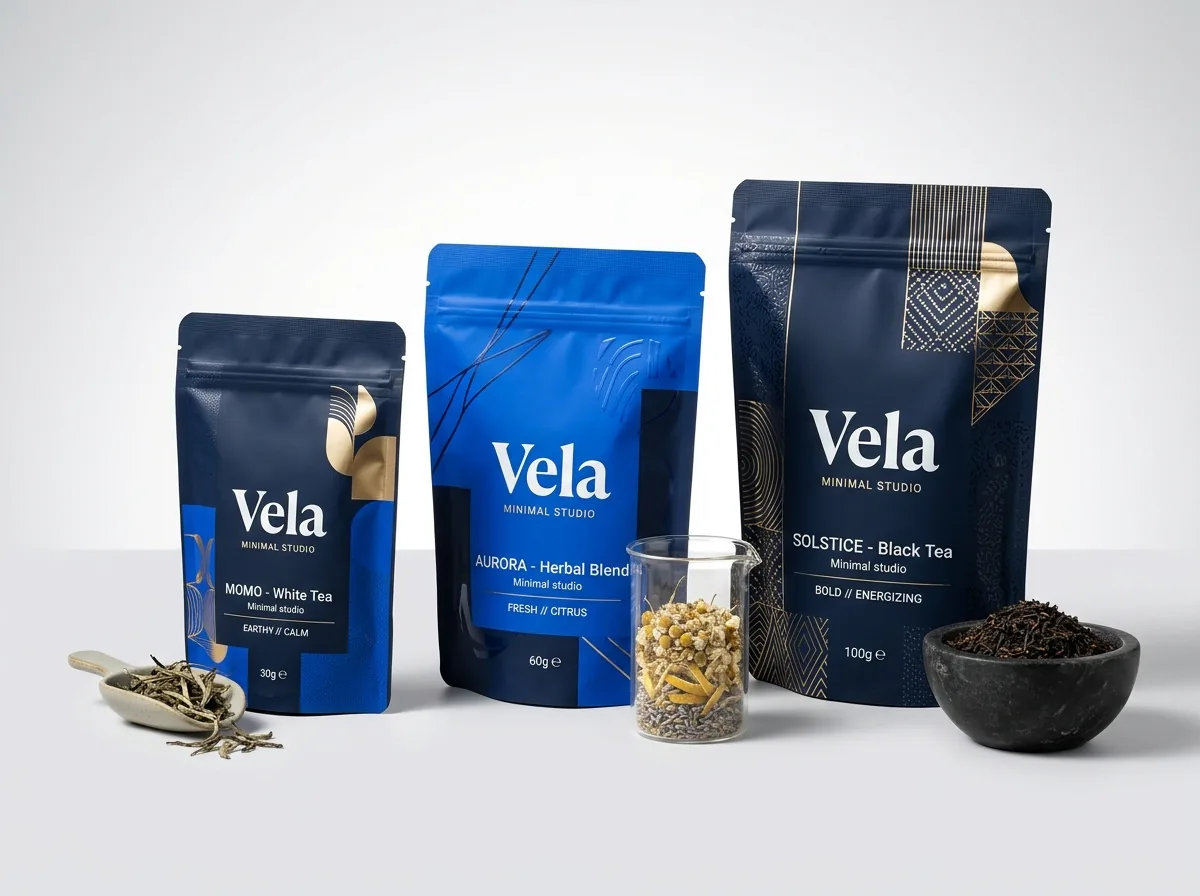
Ready to order coffee bags? Compare up to 3 quantities with a free 3D mockup.
Request a Quote →Questions about coffee bags
Can I use the same coffee bag size for 10 oz and 12 oz roasts?
Yes. Most specialty roasters use the exact same 6 × 9 × 3.5 inch stand-up pouch or 4.75 × 8.5 × 3.25 inch flat-bottom pouch for both 10 oz (283 g) and 12 oz (340 g) whole-bean bags. Sharing one size lets you combine quantities across all SKUs while leaving ample headspace.
How much shorter does a stand-up pouch get when the bottom gusset opens?
When you fill a stand-up pouch and the folded bottom gusset pushes outward into an oval base, the standing vertical height drops by roughly one-third to one-half of the gusset depth (about 0.75 to 1.25 inches on a 12 oz bag). Always check standing height if your cafe shelves have low clearance.
What size label fits on a standard 12 oz coffee bag?
On a 6 × 9 × 3.5 inch stand-up coffee pouch, a 3 × 4 inch or 3.5 × 4 inch vertical rectangle fits cleanly on the flat center panel below the zipper track and above the bottom gusset fold. On a 4.75 × 8.5 inch flat-bottom bag, use a 3 × 4 inch or 3.25 × 4.5 inch label.
Do I pay extra die charges if I need a custom coffee bag dimension?
No. CubitPack never charges die or plate fees. Whether you pick a standard 6 × 9 × 3.5 inch 12 oz pouch or a custom height tailored to your automatic filler and shipping case, we build the exact dieline and 3D mockup for free before payment.
How much headspace do I need above the zipper for heat sealing?
Standard stand-up pouches include about 1.25 to 1.5 inches from the bottom of the zipper track to the top edge of the bag. That upper strip holds the laser-scored tear notches and a 0.25 to 0.375 inch heat-seal zone above the tear line.
How can I test a coffee bag size with my own beans before printing?
Order our $50 sample kit (credited toward your first order) or request a prototype sized to your dimensions, then pour in your darkest whole-bean roast on a gram scale. You will see right away how the beans settle around the zipper and gusset.
Still have a question? Ask a packaging specialist.
Request a Quote →Request your coffee bags quote
Tell us your size and quantities, and one dedicated account manager prepares pricing for each tier.
- Free design & AI-to-print studio + 3D mockup
- No die or plate charges · 4–5 day rush available
- Free shipping to all 50 states
- 10% off your first order
The size benchmarks in this guide are calculated from standard roasted Arabica bulk density (0.32 to 0.40 g/cm3) and verified against US specialty roaster pouch formats from 2 oz fractional packs to 5 lb cafe bags. A CubitPack packaging specialist reviewed every dimension. Spot something off? Tell us and we will fix it.
Sources
What changed
- October 22, 2026: First published.
- October 22, 2026: Updated specifications, terminology, and verified source links.
More guides
New packaging guides by email
Sizes, materials and design tips. Unsubscribe anytime.