
What size box fits 30 ml, 50 ml and 100 ml perfume bottles and discovery sets?
Short answer: A standard 50 ml (1.7 fl oz) standing perfume flacon fits a 2.75 × 1.75 × 4.625 inch carton, a 100 ml bottle fits 3.25 × 2.125 × 5.5 inches, and a 10 ml travel spray fits 1.25 × 1.25 × 4.875 inches. Always add insert margins when sizing custom perfume boxes.
On this page
- How do I measure a glass perfume flacon and cap for a box and insert
- What are the typical perfume box dimensions for 2 ml, 10 ml, 30 ml, 50 ml and 100 ml bottles
- How much clearance do inner corrugated flute liners vs EVA foam inserts need
- How do I size boxes for 2 ml discovery sets and 10 ml travel atomizers
- How do vertical heights work on a standing rigid shoulder-neck perfume box
- Common mistakes
- FAQs
Request a custom quoteFree dieline & 3D mockup
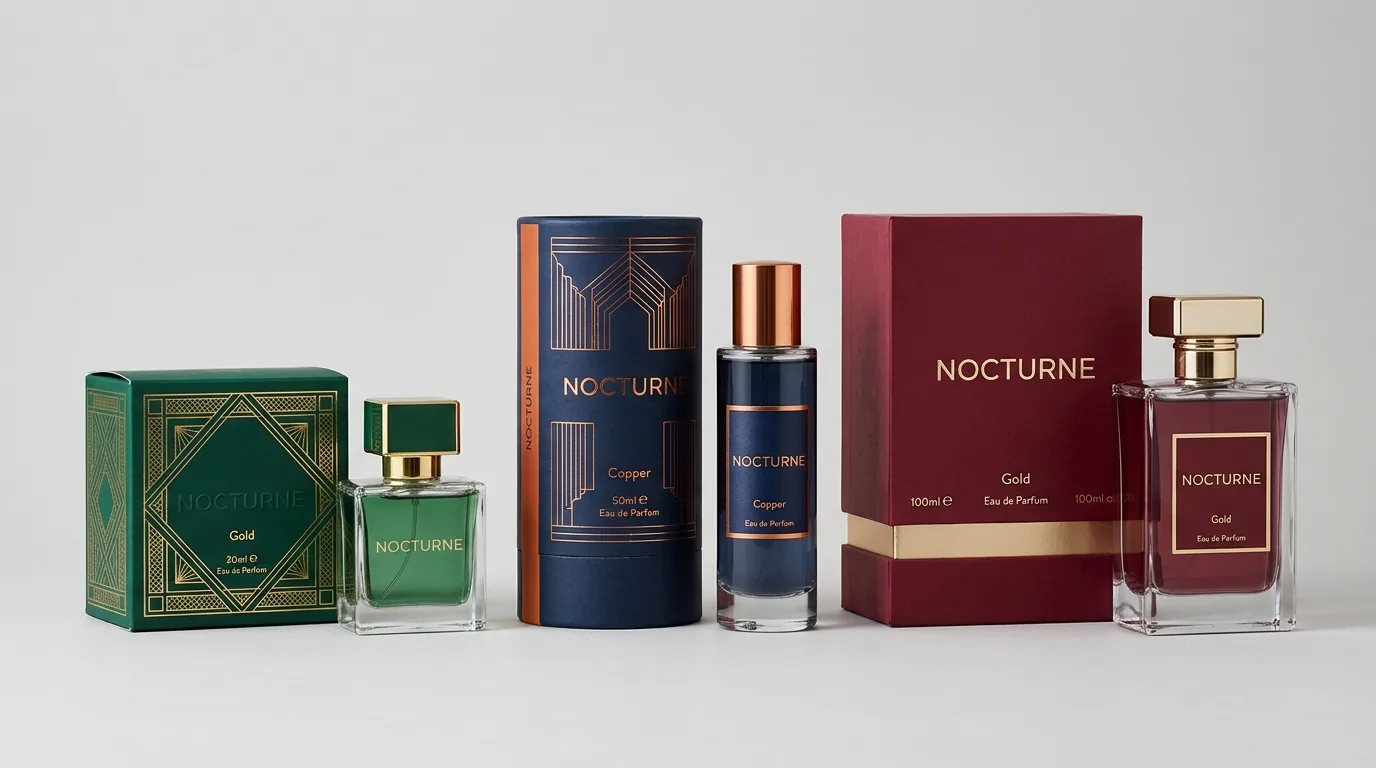
Perfume box dimensions depend on two things beyond the glass bottle itself: whether the flacon stands upright or lies flat, and what kind of shock-absorbing liner or foam cavity surrounds the glass. Heavy flint-glass 30 ml, 50 ml and 100 ml Eau de Parfum flacons rarely touch the outer box wall directly. In a standing folding carton, an internal E-flute or F-flute corrugated sleeve adds 1/8 inch to 3/16 inch around the bottle's width and depth. In a flat-lay rigid magnetic or two-piece coffret, a die-cut EVA foam insert requires at least 1/2 inch to 3/4 inch of foam border on all four sides of the bottle silhouette plus 1/4 inch of foam under the glass base. At CubitPack, our design team sizes both the outer box and internal insert directly from your bottle measurements with zero die charges.
How do I measure a glass perfume flacon and cap for a box and insert?
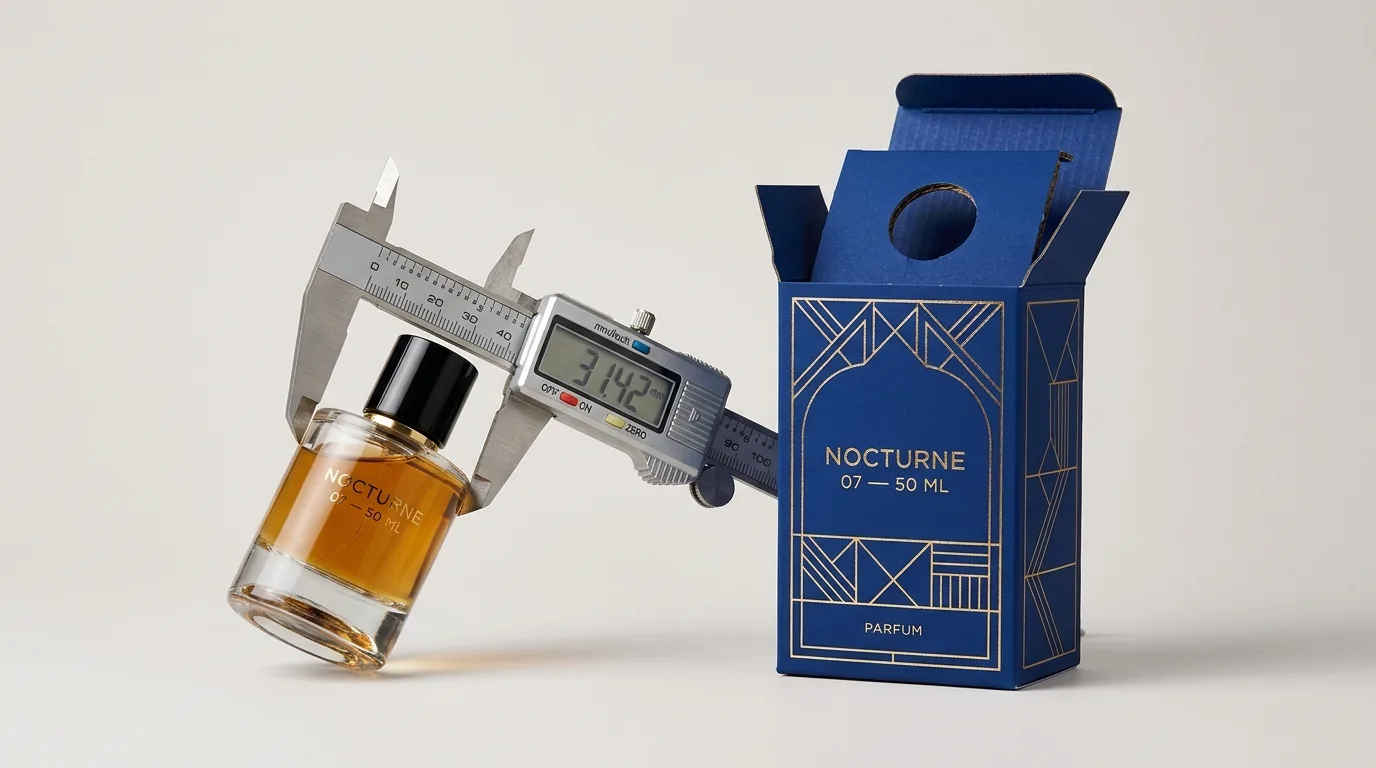
Unlike simple cylindrical dropper bottles, glass fragrance flacons often have thick punt bases, tapered shoulders, crimp-neck atomizer collars and oversized T-shaped, spherical or rectangular caps. Before requesting a quote for custom printed perfume boxes, snap or screw the cap onto your bottle and record five distinct measurements with calipers: total overall height from base to cap top, glass body height from base to shoulder, widest body width, front-to-back body depth, and the width and height of the cap alone. Why measure the bottle body and cap separately? Because in both standing neck-lock cartons and flat-lay EVA foam inserts, the narrow gap at the atomizer collar is where the insert bridges inward to trap the glass shoulder and stop a heavy zamac or magnetic cap from sliding off during shipping.
- Total Capped Height (H): measure from the bottom of the glass punt to the top tip of the seated cap.
- Glass Shoulder Height: measure from the bottom of the glass to the horizontal shoulder where the bottle narrows to the crimp neck.
- Widest Body Width (L) & Depth (W): measure across the widest part of the glass body (and check if the cap is wider than the bottle).
- Cap Width, Depth & Height: record the exact cap dimensions so the foam bridge or top neck collar holds the cap in place.
- Curved or faceted flacons: share your glassworks CAD drawing or mail an empty bottle so we trace the exact contour.
What are the typical perfume box dimensions for 2 ml, 10 ml, 30 ml, 50 ml and 100 ml bottles?
Because flint-glass fragrance bottles come in tall rectangles, compact apothecary cubes, flat oval flasks and cylindrical tubes, every CubitPack box is custom built to your exact flacon. Use the table below as a starting benchmark for 2 ml discovery sets, 10 ml travel atomizers, standing retail cartons (including space for an inner flute liner) and flat-lay rigid coffrets (including a 5/8 inch EVA foam perimeter). Notice how the same 50 ml flacon has two completely different box footprints depending on whether it stands upright inside a retail folding carton (2.75 × 1.75 × 4.625 in) or lies flat on its back inside a velvet-topped EVA foam rigid box (4.75 × 6.25 × 2.25 in).
| Fragrance bottle or kit format | Typical inside box size (L × W × H) | Usual box & insert structure |
|---|---|---|
| 4-to-5 vial discovery set (2 ml glass spray vials) | 4.5 × 3.25 × 0.75 in | Slide drawer or book folder with slotted card |
| 8-to-10 vial discovery coffret (2 ml vials) | 6.5 × 3.5 × 0.875 in | Tray and sleeve or magnetic folder with EVA foam |
| 10 ml (0.33 fl oz) travel spray or rollerball | 1.25 × 1.25 × 4.875 in | Straight tuck carton or rigid cylinder tube |
| 30 ml (1.0 fl oz) standing Eau de Parfum flacon | 2.25 × 1.5 × 4.0 in | Auto lock carton with inner flute sleeve |
| 50 ml (1.7 fl oz) standing rectangular flacon | 2.75 × 1.75 × 4.625 in | Auto lock carton or standing shoulder-neck rigid |
| 50 ml (1.7 fl oz) flat-lay luxury flacon in foam | 4.75 × 6.25 × 2.25 in | Magnetic book box or two-piece rigid + EVA foam |
| 100 ml (3.4 fl oz) standing heavy glass flacon | 3.25 × 2.125 × 5.5 in | Auto lock bottom carton + E-flute inner liner |
| 50 ml bottle + 10 ml travel spray gift coffret | 6.5 × 6.25 × 2.375 in | Two-piece or magnetic rigid box + 2-well EVA foam |
How much clearance do inner corrugated flute liners vs EVA foam inserts need?
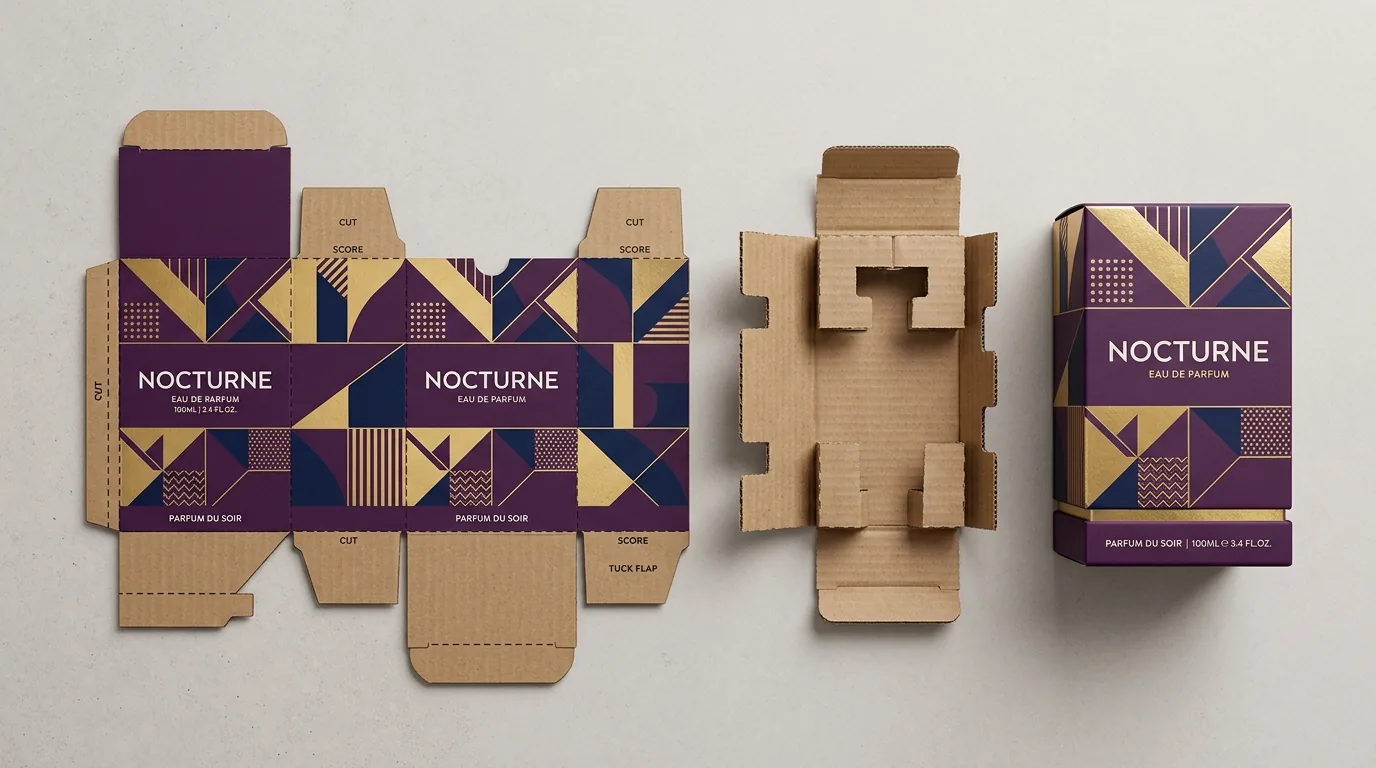
The biggest sizing mistake in fragrance packaging is ordering an outer box to the exact dimensions of the glass bottle and then trying to squeeze a protective liner or foam pad inside afterward. Your insert type directly dictates the outer box footprint. For a standing retail folding carton (such as a custom auto lock bottom box), we slip a die-cut single-face or E-flute corrugated sleeve inside the carton walls to absorb drop shock. That inner corrugated sleeve adds roughly 1/8 inch (0.125 in) to 3/16 inch (0.1875 in) to both the bottle's Length and Width, plus 1/8 inch to the Height for the top neck-lock tab. For a wrapped rigid box (custom shoulder neck boxes or custom magnetic closure boxes) using a die-cut custom EVA foam insert, leave a minimum 1/2 inch to 3/4 inch foam wall around all four sides of the recessed bottle cavity so the foam frame stays rigid and never tears at the edges.
Know your size? Compare pricing across up to 3 quantities.
Request a Quote →How do I size boxes for 2 ml discovery sets and 10 ml travel atomizers?
Online shoppers rarely buy a full 50 ml or 100 ml bottle of a fragrance they have never smelled, which makes 2 ml discovery sets and 10 ml travel atomizers essential SKUs for every DTC fragrance house. Standard 2 ml glass spray vials measure roughly 0.45 inches (11.5 mm) in diameter and 2.25 to 2.5 inches tall. To hold five 2 ml vials in a neat row with 1/4 inch spacing between each vial, a 4.5 × 3.25 × 0.75 inch custom drawer box or folding wallet with die-cut paperboard retaining loops is the industry favorite. Ten-milliliter (0.33 fl oz) travel atomizers and steel-ball rollerballs are much taller and slimmer-typically 0.75 to 0.95 inches in diameter and 4.5 to 4.75 inches tall. Pack them upright in a 1.25 × 1.25 × 4.875 inch straight tuck carton with an internal neck collar, or lay them flat inside a slim ribbon-pull drawer box.
How do vertical heights work on a standing rigid shoulder-neck perfume box?
On a standing custom shoulder neck box, the bottle stands vertically inside a foam-lined base plinth while a tall rigid lid slides down over the bottle and rests on a stepped outer ledge. When sizing a standing shoulder-neck box, the total interior height equals your capped bottle height plus 1/4 inch for the bottom base pad and 1/8 inch of head clearance inside the top cap. We usually proportion the base plinth to cover the bottom 25% to 35% of the bottle's height (for example a 1.5 inch tall base holding an EVA foam well around the bottom of a 4.5 inch tall flacon), with the exposed inner shoulder rising another 0.5 to 0.75 inches to guide the outer lid smoothly into place. That way, lifting the lid immediately reveals 70% of the glass bottle and its front label standing on a stage.
What are the most common perfume box sizing mistakes?
Fragrance bottles have complex curves, heavy caps and thick inserts that leave zero room for guesswork. Avoid these five sizing errors
- Sizing a folding fragrance carton to the bare glass bottle dimensions without adding 1/8 to 3/16 inch for the internal corrugated flute shock liner.
- Leaving less than 1/2 inch of EVA foam border around a heavy 100 ml flacon in a flat-lay rigid box, which causes the thin foam wall to collapse in transit.
- Measuring the glass bottle width while forgetting that a wide T-shaped or spherical cap sticks out 1/4 inch wider on each side.
- Making the EVA foam recess as deep as 100% of the bottle thickness without finger notches or a lifting ribbon, trapping the slick glass bottle inside the well.
- Cutting a single rectangular foam cutout instead of a stepped neck bridge, allowing heavy metal caps to slide off the atomizer during shipping.
Find your size
Suggested inside size: 4.5 × 3.25 × 0.75 in
A starting point. Your account manager confirms the size with you before the proof.
Quote this size →Packaging for this
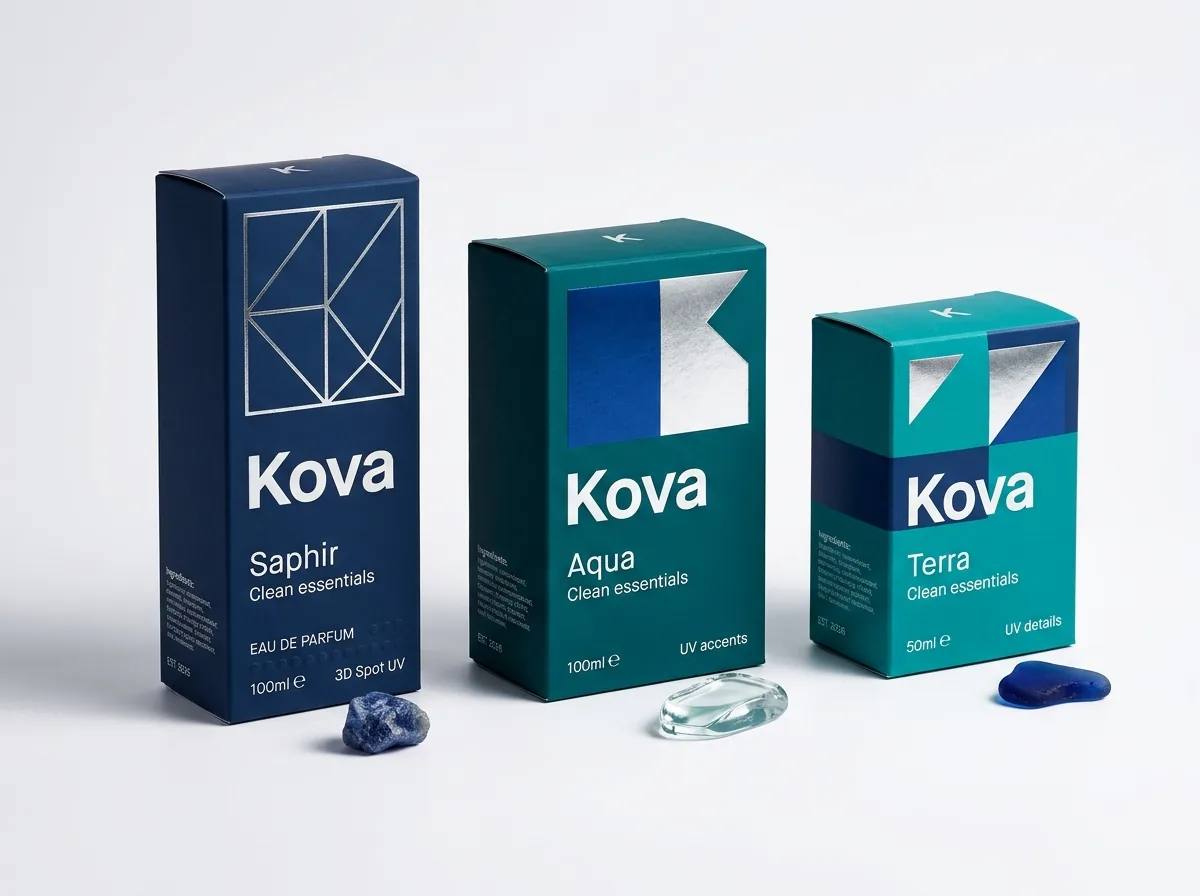
Ready to order perfume boxes? Compare up to 3 quantities with a free 3D mockup.
Request a Quote →Questions about perfume boxes
Should I enter my bottle dimensions or the outer box dimensions in the quote form?
Enter the inside box dimensions (Length × Width × Height in inches) if you already know them, or enter your bottle dimensions and note in Step 2 whether you want a standing carton with a flute liner or a flat-lay rigid box with EVA foam. Our design team calculates the exact outer box size free.
How thick should the EVA foam border be around a perfume bottle in a rigid box?
Leave at least 1/2 inch (0.50 in) to 3/4 inch (0.75 in) of EVA foam between the bottle cutout and the inner walls of the rigid box, plus a 1/4 inch bottom pad underneath the bottle so glass never rests directly against bare board.
Can you cut an EVA foam insert to fit a round, oval or custom-molded glass flacon?
Yes. Because CubitPack never charges die fees, we die-cut EVA and EPE foam wells to match any circular, oval, hexagonal or custom bottle silhouette-including stepped neck bridges for heavy caps-at no extra tooling cost.
What size box do I need for a 5-vial (2 ml) perfume discovery set?
Five standard 2 ml glass spray vials (about 0.45 × 2.375 inches each) fit comfortably inside a 4.5 × 3.25 × 0.75 inch slide-out drawer box or magnetic folder with die-cut paperboard loops or a slim foam tray.
How do you make a snug foam-nestled perfume bottle easy to lift out?
We use two proven details: either we size the foam thickness to 60–70% of the bottle depth with two half-moon finger notches beside the bottle waist, or we anchor a satin ribbon tab under the bottle that lifts the flacon when pulled.
Can I test my perfume bottle fit inside a prototype box before paying for production?
Yes. Before you pay, we send a full engineering dieline proof and 3D mockup of both the box and insert. You can also order a paid physical prototype built to your exact bottle and foam measurements-credited back to your full order.
Still have a question? Ask a packaging specialist.
Request a Quote →Request your perfume boxes quote
Tell us your size and quantities, and one dedicated account manager prepares pricing for each tier.
- Free design & AI-to-print studio + 3D mockup
- No die or plate charges · 4–5 day rush available
- Free shipping to all 50 states
- 10% off your first order
The flacon clearances, corrugated flute liner allowances and EVA foam border rules in this guide were verified against standard 2 ml, 10 ml, 30 ml, 50 ml and 100 ml glass fragrance bottles and reviewed by a CubitPack packaging specialist. Updated. Spot something wrong? Tell us and we will fix it.
Sources
What changed
- October 22, 2026: First published.
- October 22, 2026: Updated specifications, terminology, and verified source links.
More guides
New packaging guides by email
Sizes, materials and design tips. Unsubscribe anytime.