
How do you size custom small mailer boxes for USPS Ground Advantage, 4 × 6 labels, and DIM weight?
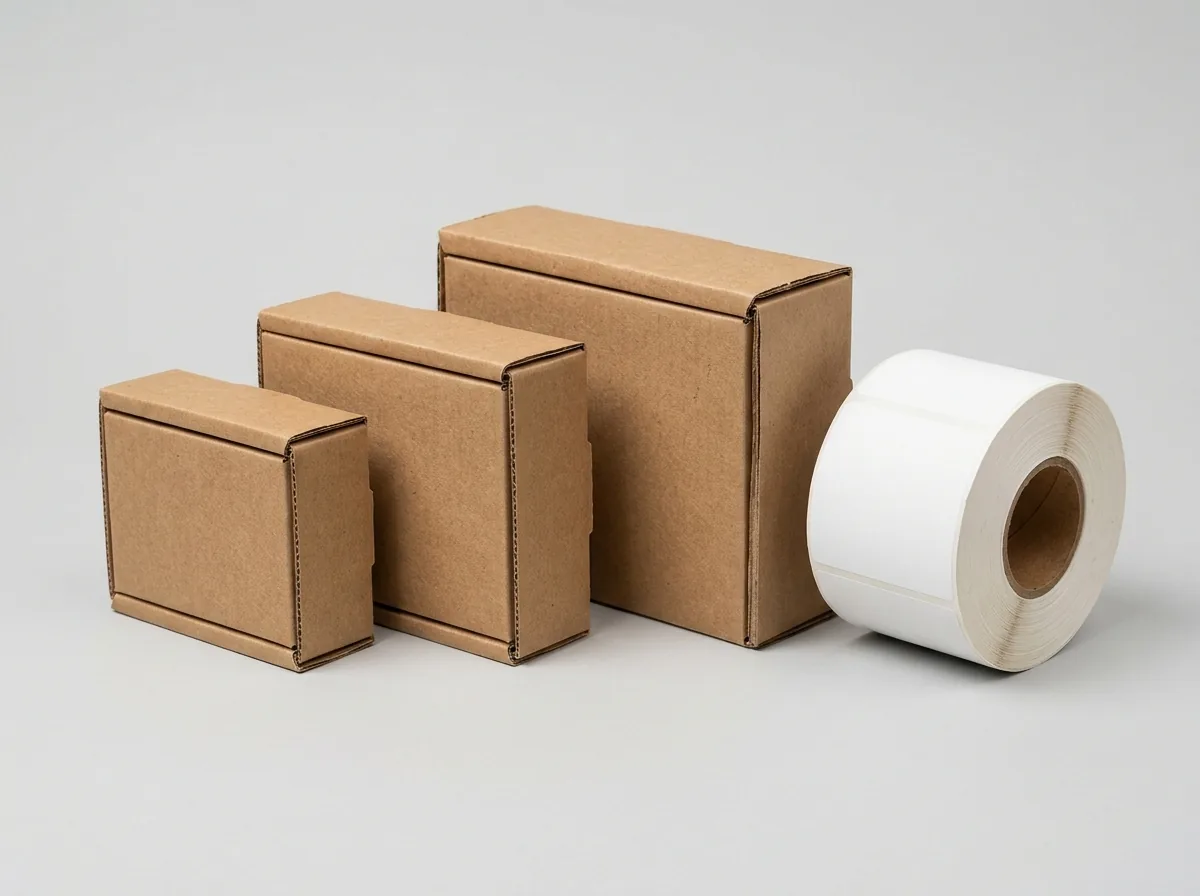
Short answer: Make 6 × 4 × 1.5 in or 6 × 4 × 2 in your baseline small mailer footprint so a standard 4 × 6 in thermal carrier barcode label lays completely flat on the bottom panel, keeping volume under 0.10 cu ft (172.8 cu in) and empty box tare weight around 1.6 to 1.8 oz for the lowest USPS Ground Advantage postage.
On this page
- How do the 6 most popular small mailer box sizes compare on tare weight and USPS tiers
- Why must your shipping barcode label sit flat on one panel of a small mailer box
- How do dimensional weight (DIM) and USPS Cubic Tiers apply to small mailer boxes
- How do you order custom small mailer boxes sized for your SKU and carrier label
- Common mistakes
- FAQs
Request a custom quoteFree dieline & 3D mockup
Right-sizing custom small mailer boxes is the fastest way for jewelry, skincare, supplement, and sample brands to cut outbound parcel postage without sacrificing crush protection. Under USPS Domestic Mail Manual (DMM 201.7.5) machinable parcel standards, a shipping box must measure at least 6 × 3 × 0.25 inches so the carrier's overhead optical scanners can read the entire 4 × 6 inch thermal barcode label on one flat plane without wrapping around a score line. Simultaneously, keeping your outer dimensions at or below 7 × 5 × 2.5 inches holds cubic volume under 87.5 cubic inches (well below the 172.8 cu in / 0.10 cu ft USPS Cubic Tier 1 ceiling) and keeps empty E-flute tare weight between 1.2 and 2.2 ounces so lightweight orders stay inside the 4 oz and 8 oz postage brackets. When you order from 250 boxes, CubitPack engineers your exact millimeter dieline and 3D proof before payment.
How do the 6 most popular small mailer box sizes compare on tare weight and USPS tiers?
When switching from padded plastic poly mailers or oversized stock cartons to compact small mailer boxes, every tenth of an ounce and every cubic inch matters. A 2.1 oz serum bottle packed inside a 1.7 oz E-flute 6 × 4 × 2 in mailer ships at the 4 oz USPS Ground Advantage rate; that same bottle inside a 3.4 oz oversized B-flute carton crosses the 4 oz threshold and bumps every single shipment into the 8 oz rate tier. Use this small mailer sizing and postage table to match your SKU across custom jewelry boxes, custom sample boxes, and custom cosmetic boxes: Notice how the 6 × 4 × 2 in and 6 × 4 × 1.5 in sizes hit every carrier requirement simultaneously: the 6 × 4 in bottom floor matches the exact 4 × 6 in thermal label roll used by Zebra and Rollo fulfillment printers, while the 1.5 to 2.0 in depth glides easily into standard residential mailboxes and apartment parcel slots. When planning fulfillment workflows for high-volume D2C launches or monthly sample subscriptions, standardizing around one or two compact mailer footprints also speeds up packing bench throughput. A warehouse associate can fold a pre-creased 6 x 4 x 2 in E-flute FEFCO 0427 blank in under 8 seconds, drop in a pre-loaded paperboard cradle or tissue-wrapped item, snap the front cherry-lock ears shut without reaching for a tape dispenser, and apply a single 4 x 6 in thermal label flat across the bottom panel. That tape-free, single-label workflow cuts packing labor by 30% to 40% compared to hand-taping small RSC shipping cartons.
- Choose 6 × 4 × 1.5 in or 6 × 4 × 2 in whenever your fulfillment station prints standard 4 × 6 in thermal labels so packers never have to trim labels or wrap barcodes around a corner.
- If you love the square aesthetic of a 4 × 4 × 2 in or 4.5 × 4.5 × 2 in mini cube mailer, configure your shipping software (ShipStation, Pirate Ship, or Shopify Shipping) to output a 4 × 4 in or 2 × 4 in thermal barcode label.
- Keep total packed weight (product + insert + mailer + label) at 3.8 oz or less to lock in the 4 oz USPS Ground Advantage tier, or 7.8 oz or less for the 8 oz tier.
| Inside dimensions (L × W × H) | Cubic volume (cu in / cu ft) | 32 ECT E-flute tare weight | Fits 4 × 6 in label flat? | Best D2C product fit |
|---|---|---|---|---|
| 4.0 × 4.0 × 2.0 in | 32.0 cu in (0.019 cu ft) | ~1.2 oz | No (needs 4×4 or 2×4 label) | Rings, earrings, mini candles, charms |
| 5.0 × 4.0 × 1.5 in | 30.0 cu in (0.017 cu ft) | ~1.4 oz | Needs 5×3.5 or trimmed label | Gift cards, lip balms, enamel pins |
| 6.0 × 4.0 × 1.5 in | 36.0 cu in (0.021 cu ft) | ~1.6 oz | Yes (exact 6 × 4 in base) | Flat jewelry cases, socks, compacts |
| 6.0 × 4.0 × 2.0 in | 48.0 cu in (0.028 cu ft) | ~1.8 oz | Yes (USPS benchmark size) | 30 mL serums, supplement bottles, samples |
| 6.5 × 4.5 × 2.25 in | 65.8 cu in (0.038 cu ft) | ~2.0 oz | Yes (with 0.25 in border) | 2-bottle skincare duos, tech gadgets |
| 7.0 × 5.0 × 2.5 in | 87.5 cu in (0.051 cu ft) | ~2.2 oz | Yes (generous label margin) | Discovery sample kits, candle + match sets |
Why must your shipping barcode label sit flat on one panel of a small mailer box?
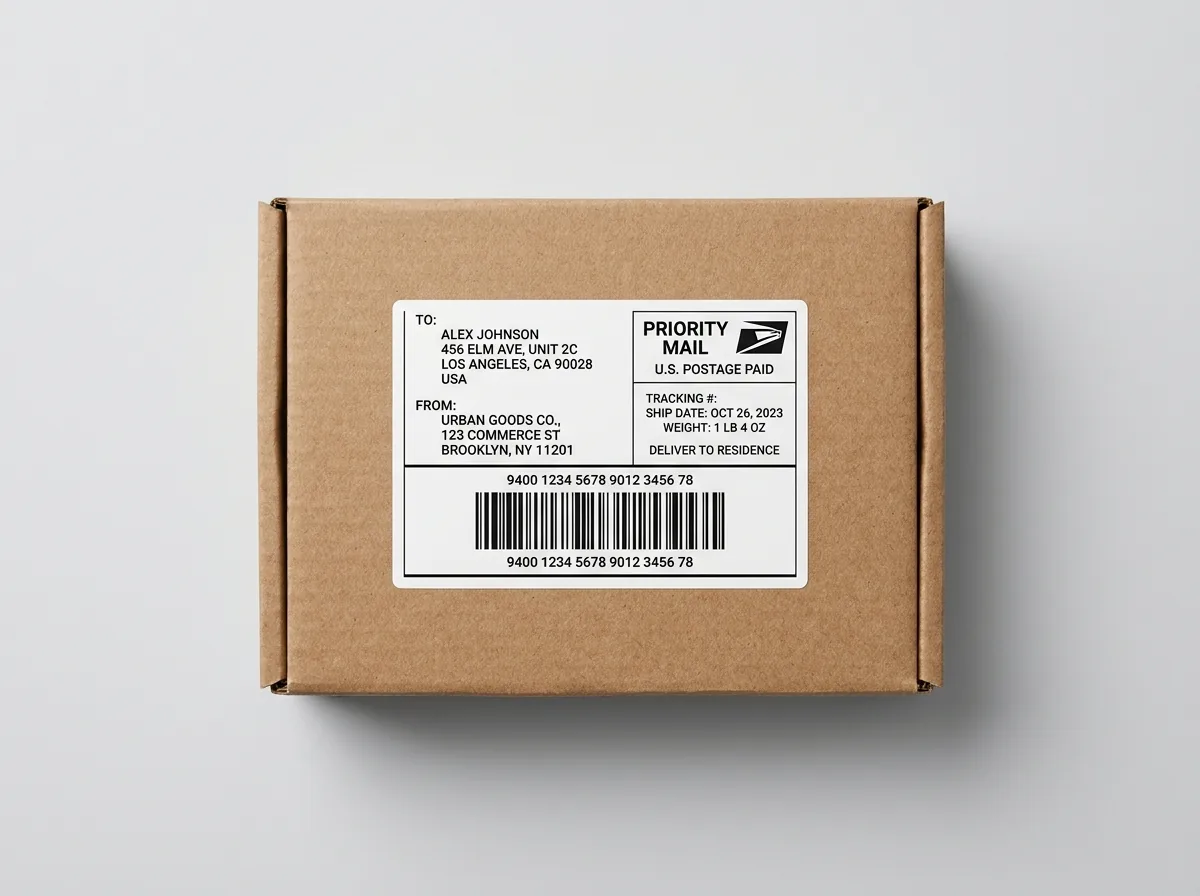
Fulfillment teams ordering miniature boxes under 5 inches long often try to slap a standard 4 × 6 inch thermal label across the bottom panel and fold the remaining 2 inches of the label up the front wall of their custom mailer boxes. In automated USPS, UPS, and FedEx sorting hubs, that folded label creates three costly problems
- Overhead Laser & Camera Read Failure: High-speed tunnel scanners photograph parcels from directly above as they travel at 400 feet per minute. If the 1D tracking barcode or 2D IMpb matrix bends 90 degrees over a box score line, the scanner cannot read the wrapped bars and diverts the parcel to manual hand-sorting.
- Non-Machinable & Dimension-Incompliance Fees: Parcels diverted from automated sorters can trigger manual handling delays and non-machinable surcharges.
- Cherry-Lock & Tuck-Flap Interference: Wrapping a stiff adhesive thermal label over the front wall of a FEFCO 0427 mailer seals the lid shut over the cherry locks, forcing the customer to slice through your branded lid with a box cutter. By sizing the bottom tray floor at 6.0 × 4.0 inches (or printing a scaled 4 × 4 in label for cube boxes), the entire shipping label stays hidden on the bottom base panel while leaving the top lid and front wall 100% clean for your brand unboxing.
How do dimensional weight (DIM) and USPS Cubic Tiers apply to small mailer boxes?
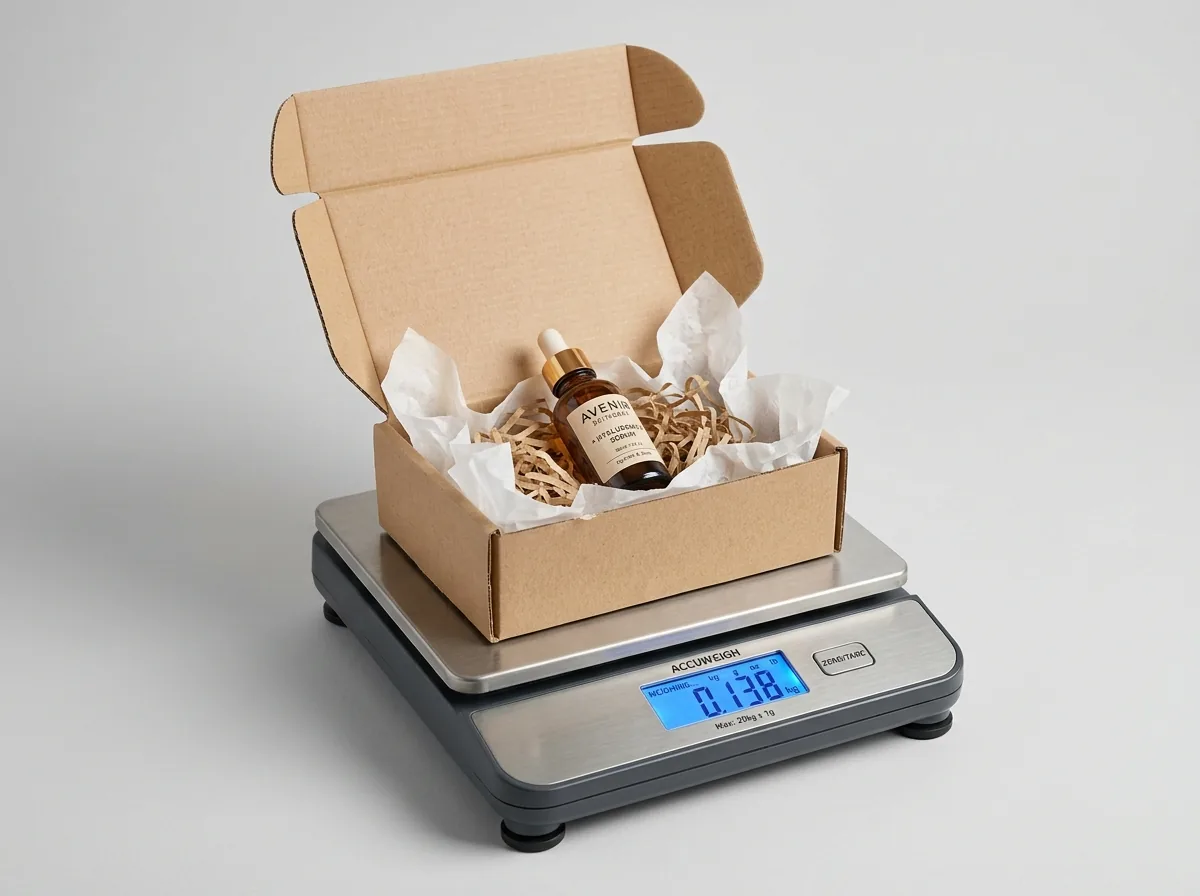
Major carriers calculate shipping costs using the greater of actual scale weight or Dimensional Weight (L × W × H ÷ 166), except when qualifying for USPS Ground Advantage Cubic Pricing (which bills purely by outer volume in 0.10 cu ft steps up to 20 lb): Because every compact mailer size from 4 × 4 × 1.5 in up to 7 × 5 × 2.5 in has a dimensional weight under 1.0 lb and a cubic volume under 0.06 cu ft, small mailer boxes eliminate dimensional weight penalties completely. Whether you ship lightweight 3 oz earrings or a dense 2.5 lb solid brass hardware piece inside a 6 × 4 × 2 in E-flute box, you always qualify for the lowest possible volume tier.
- Test your exact product dimensions in our interactive dimensional weight calculator and box size calculator before locking your dieline.
- Remember that carriers laser-measure the Outside Dimensions (OD) of the folded box: a 6.0 × 4.0 × 2.0 in Inside Dimension E-flute mailer measures roughly 6.38 × 4.25 × 2.13 in on the outside.
- Eliminate heavy crinkle paper by using a 0.3 oz die-cut paperboard cradle or printing your welcome message directly on the inside lid.
| Billing mechanism | Formula / threshold | How a 6 × 4 × 2 in E-flute mailer performs |
|---|---|---|
| USPS Ground Advantage (Under 1 lb) | Billed by actual ounces (4 oz, 8 oz, 12 oz, 15.99 oz) | 1.8 oz empty tare leaves 2.2 oz for SKU in 4 oz tier |
| USPS Ground Advantage Cubic (1–20 lb) | Outer L × W × H ÷ 1,728 (Tier 0.10 = under 172.8 cu in) | 56 cu in outer volume = comfortably inside Tier 0.10 |
| UPS & FedEx Dimensional Weight | Outer L × W × H ÷ 166 (rounded up to next lb) | 56 ÷ 166 = 0.34 lb (never triggers a DIM penalty) |
| Residential Mailbox Clearance | Standard US Postmaster General mailbox slot (5 in H) | 2.0 in box depth fits inside locked mailbox slots |
Know your size? Compare pricing across up to 3 quantities.
Request a Quote →How do you order custom small mailer boxes sized for your SKU and carrier label?
Pair this sizing and postage guide with our comparison of E-flute vs F-flute vs paperboard for small mailer boxes and our engineering walkthrough on small mailer box dieline tolerances and micro-insert design. Follow these four steps to launch from 250 boxes: Every order includes a free prepress audit confirming both your usable interior clearance and your exterior carrier label footprint before production begins.
- Step 1: Enter your usable Inside Dimensions (L × W × H) and quantity (from 250 units) in CubitPack's quote form.
- Step 2: Receive your custom 2D vector CAD dieline showing both Inside Dimensions and outer carrier cubic footprint.
- Step 3: Review your free interactive 3D digital proof before payment.
- Step 4: Approve for 10–14 business day turnaround (4–5 day rush) with zero die fees and free US ground shipping.
What 5 sizing and dieline mistakes happen most often on small mailer boxes?
Our prepress and structural specialists check every compact mailer order before die-cutting, preventing these five common small-box errors
- Ordering a 3.5 × 3.5 × 1.5 in mailer for standalone USPS shipping without realizing a standard 4 × 6 in thermal label will wrap around two sides.
- Letting an empty box plus loose crinkle fill push a 3.5 oz product shipment to 4.2 oz, bumping every parcel from the 4 oz rate to the 8 oz rate.
- Sticking the 4 × 6 in thermal carrier label over the front cherry-lock tuck flap instead of flat on the bottom base panel.
- Using heavy 3.0 mm B-flute instead of lightweight 1.6 mm E-flute on a small parcel, adding unnecessary tare weight and outer volume.
- Forgetting to account for the ~0.38 in outer length increase from the double-rolled side walls when calculating cubic volume.
Packaging for this
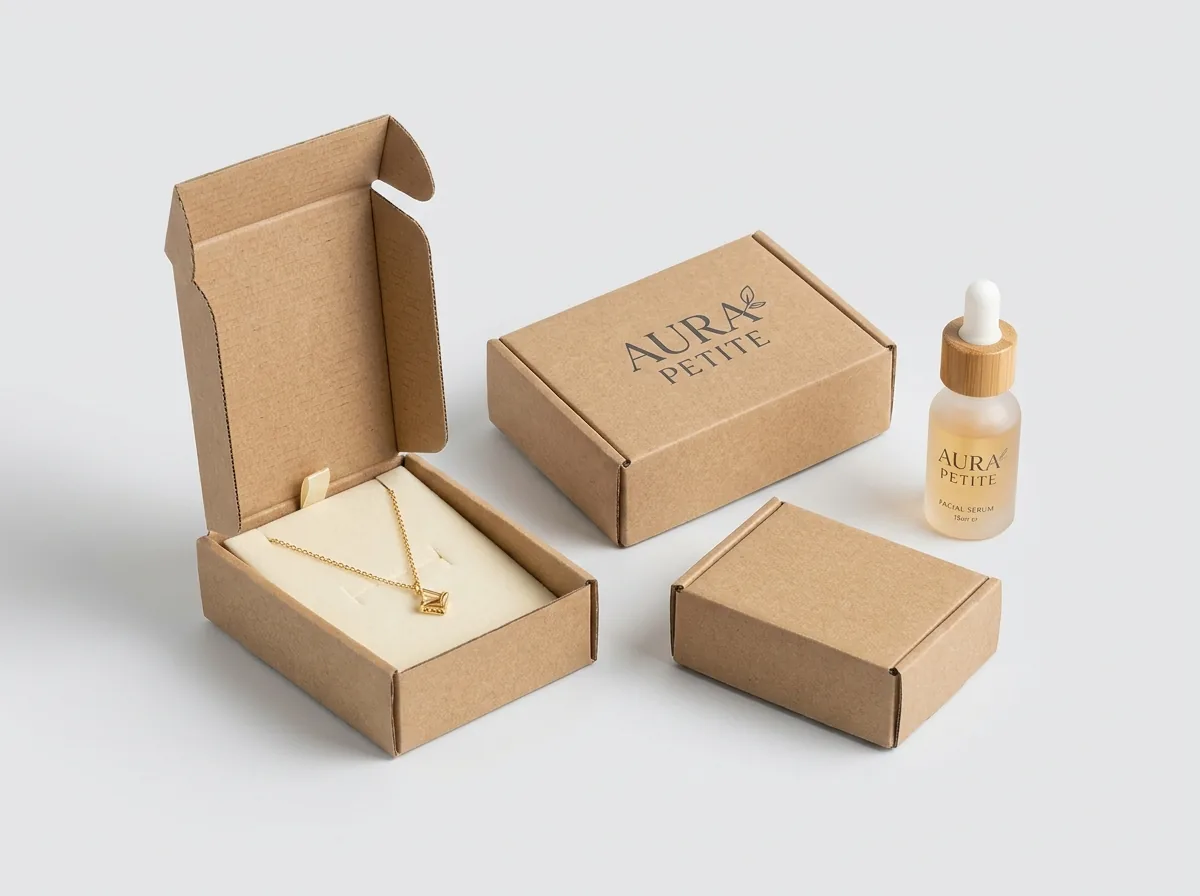


Ready to order small mailer boxes? Compare up to 3 quantities with a free 3D mockup.
Request a Quote →Questions about small mailer boxes
What is the smallest mailer box size that accepts a standard 4 x 6 inch USPS shipping label?
A 6 × 4 × 1.5 in or 6 × 4 × 2 in mailer box is the smallest size that fits a standard 4 × 6 in thermal shipping label completely flat on the bottom panel without folding over an edge. Every order includes a free 2D vector CAD dieline and interactive 3D digital proof before payment.
How do small mailer box dimensions affect USPS Ground Advantage and UPS/FedEx DIM weight?
All compact mailer boxes under 7 × 5 × 2.5 inches measure under 90 cubic inches, which keeps them in the lowest USPS Cubic Tier 0.10 (under 172.8 cu in) and yields a UPS/FedEx dimensional weight under 1 lb. Every order includes a free 2D vector CAD dieline and interactive 3D digital proof before payment.
How much does an empty E-flute small mailer box weigh?
A 32 ECT E-flute small mailer box weighs roughly 1.2 oz (at 4 × 4 × 2 in) to 1.8 oz (at 6 × 4 × 2 in), helping lightweight jewelry and beauty SKUs stay under the 4 oz and 8 oz USPS postage breakpoints. Every order includes a free 2D vector CAD dieline and interactive 3D digital proof before payment.
Why does wrapping a barcode shipping label around a box edge cause carrier surcharges?
Overhead laser and camera scanners in USPS, UPS, and FedEx hubs read parcels from a single flat angle; folding a barcode 90 degrees over a box edge causes read failures and manual sorting delays. Every order includes a free 2D vector CAD dieline and interactive 3D digital proof before payment.
Can I order a custom small mailer box size between stock sizes with zero die fees?
Yes. CubitPack cuts custom millimeter-accurate FEFCO 0427 small mailer dielines from 250 units with zero steel-rule die charges and free US ground shipping. Every order includes a free 2D vector CAD dieline and interactive 3D digital proof before payment.
Still have a question? Ask a packaging specialist.
Request a Quote →Request your small mailer boxes quote
Tell us your size and quantities, and one dedicated account manager prepares pricing for each tier.
- Free design & AI-to-print studio + 3D mockup
- No die or plate charges · 4–5 day rush available
- Free shipping to all 50 states
- 10% off your first order
We verified FEFCO 0427 micro-corrugated side-wall take-up formulas, E-flute and F-flute calipers, and USPS DMM 201.7.5 machinable parcel and 4 x 6 thermal label dimensions against FEFCO Case Code standards, Fibre Box Association (FBA) handbooks, and USPS Postal Explorer guidelines. Spot something wrong? Tell us and we fix it.
Sources
What changed
- November 11, 2026: First published with comparative sizing tables, SVG tolerance diagrams, and USPS label checklist.
More guides
New packaging guides by email
Sizes, materials and design tips. Unsubscribe anytime.