
How Do You Size UPC Barcodes and Position Regulatory Labels on Retail Boxes?
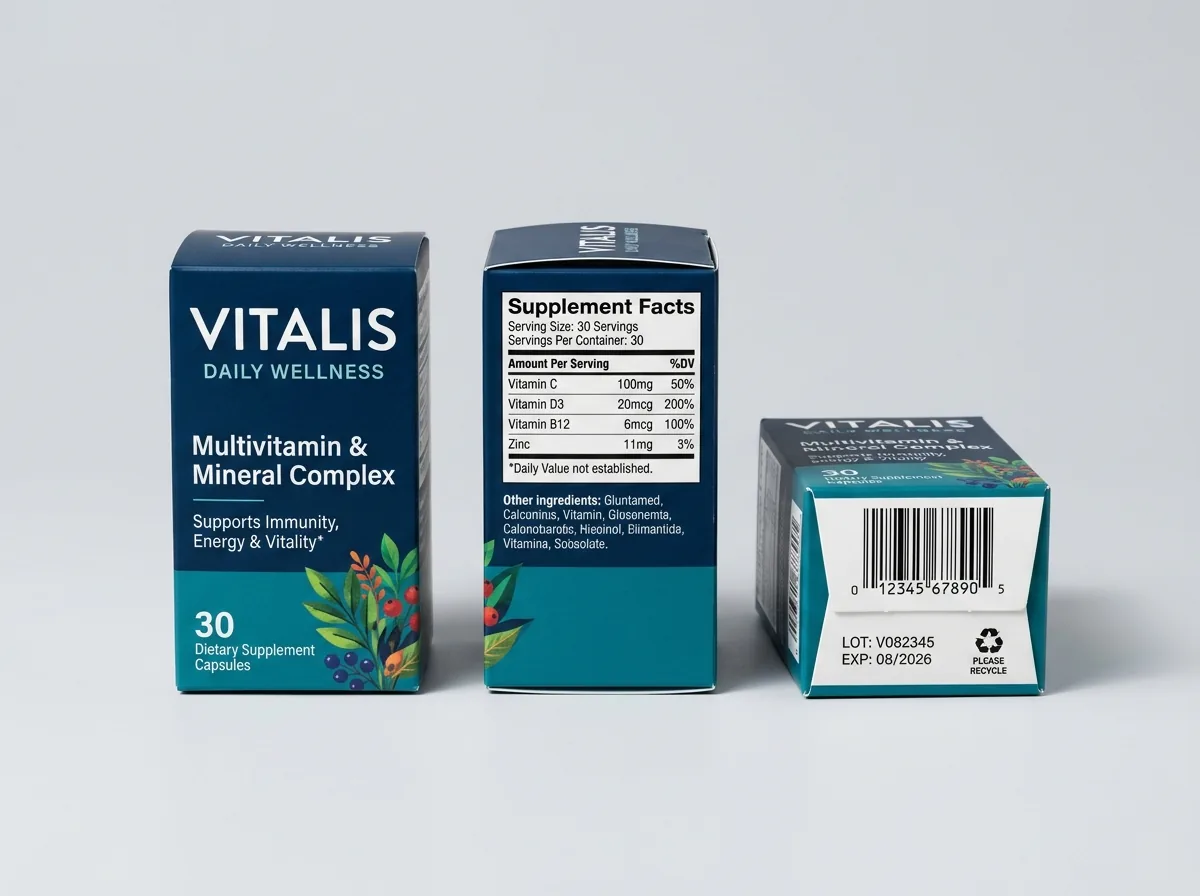
Short answer: Retail boxes require official GS1 UPC-A barcodes scaled between 80% and 120% magnification with at least 0.125 inches of clear white quiet zone margins on both sides. Regulatory labeling including net quantity and manufacturer address must occupy dedicated side panels away from barcode scan paths.
On this page
- What magnification and dimensions are mandatory for GS1 UPC barcodes
- Why are barcode quiet zones critical for optical scanner verification
- Which color combinations scan reliably and which fail instantly
- Where should regulatory net quantity and nutrition panels be placed
- How do prepress file checks prevent barcode plate registration drift
- How does print bar code growth compensation (BWC) protect scan quality
- What are the rules for positioning expiration dates and lot codes
- How does inline optical barcode verification guarantee zero vendor fines
- Common mistakes
- FAQs
Request a custom quoteFree dieline & 3D mockup
Retail distribution requires strict compliance with international GS1 barcode specifications and federal regulatory labeling standards across all consumer product categories. When manufacturing custom retail boxes, failing an automated barcode scan check at retail distribution hubs can result in thousands of dollars in administrative vendor penalties. Standard UPC-A barcodes must maintain an optical magnification between eighty percent and one hundred twenty percent, printed exclusively in dense black or dark ink over pure white backgrounds. Maintaining unobstructed quiet zones of at least 0.125 inches on both the leading and trailing edges prevents laser scanner misreads. In addition, FDA Fair Packaging and Labeling regulations require net contents declarations placed within the bottom thirty percent of the principal display panel. When ordering compliant printed retail cartons, our packaging specialists verify barcode line widths and quiet zone margins on complimentary digital prepress proofs.
What magnification and dimensions are mandatory for GS1 UPC barcodes?
The standard GS1 UPC-A barcode consists of 12 numerical digits mapped to precise vertical dark bars and light spaces. At 100% nominal scale, a UPC-A barcode measures exactly 1.469 inches wide by 1.020 inches high from the top of the bars to the bottom of the human-readable numbers. GS1 specifications permit scaling between 80% minimum magnification (1.175 in wide by 0.816 in high) and 120% maximum magnification (1.763 in wide by 1.224 in high). Truncating barcode vertical bar height below 80% severely restricts multi-directional omnidirectional laser scanning at supermarket checkouts, resulting in manual cashier key-ins and automated retail chargebacks.
Why are barcode quiet zones critical for optical scanner verification?
Optical retail barcode scanners do not merely read dark vertical bars; they measure the contrast ratio between dark bars and surrounding light margins, known as quiet zones. For standard UPC-A symbols, a mandatory blank quiet zone of at least 0.125 inches (or nine times the narrow bar width) must be maintained on both the left and right sides. Printing colored background artwork, borders, graphic lines, or descriptive text within this quiet zone interrupts scanner calibration, causing instant read failure. Prepress specialists always place barcodes within a clean, unprinted white rectangular knockout box.
Which color combinations scan reliably and which fail instantly?
Retail laser scanners operate in the red light spectrum (approximately 660 nanometers), meaning scanners perceive color contrast through red reflection. Dark colors containing high black, cyan, or dark blue pigments absorb red light and read cleanly as solid bars. Conversely, warm colors like red, magenta, orange, and yellow reflect red light completely and appear completely invisible to the scanner. Consequently, printing red barcode bars over white paperboard causes total scan failure, while printing black bars over an orange background produces similar errors. The gold standard remains dense solid black ink over unprinted white paperboard.
Know your size? Compare pricing across up to 3 quantities.
Request a Quote →Where should regulatory net quantity and nutrition panels be placed?
Federal packaging regulations enforced by the FDA, FTC, and USDA mandate strict positioning rules for mandatory consumer disclosures. The Principal Display Panel (PDP) must display the product identity and the net quantity of contents in the lower 30 percent of the panel, aligned parallel to the base. Net quantity must appear in both imperial (ounces, pounds) and metric (grams, milliliters) units with specified minimum type heights based on PDP square inch area. Secondary panels accommodate Information Panels including Nutrition Facts, Supplement Facts, full ingredient declarations in descending order of predominance, and manufacturer distributor address.
How do prepress file checks prevent barcode plate registration drift?
During high-speed offset lithographic printing, microscopic plate stretching and paperboard moisture expansion can cause registration drift across CMYK ink stations. If a barcode is designed using rich black composed of cyan, magenta, yellow, and black plates, even 0.1 mm of plate misregistration blurs vertical bar edges and destroys scanner decodability. Prepress specialists mandate that barcodes be generated as single-color 100% black vector art set to overprint, eliminating registration dependency and ensuring razor-sharp bar edge definition.
How does print bar code growth compensation (BWC) protect scan quality?
During wet ink transfer in offset lithography and flexographic printing, liquid ink naturally spreads outward into porous paperboard fibers before curing, a physical phenomenon known as press gain or ink bleed. If barcode line art is drafted at exact nominal bar widths, ink spread causes dark vertical bars to swell into adjacent white spaces, reducing the width of narrow gaps below optical scanner decode thresholds. Prepress packaging engineers apply Bar Width Reduction (BWR) or Bar Code Growth Compensation during vector artwork preparation. Prepress software mathematically reduces the width of black bars by 0.001 to 0.003 inches, ensuring that after press ink spread occurs, the finished printed bars measure precisely within GS1 specification tolerances.
What are the rules for positioning expiration dates and lot codes?
In addition to static UPC barcodes, consumer packaged goods require dynamic batch lot numbers, Julian production dates, and expiration disclosures. Regulatory bodies require lot codes to be legible without opening the primary packaging. Structural carton designers incorporate dedicated unvarnished knockout windows on bottom or side panels. Omitting aqueous coating or UV varnish over these designated knockout rectangles enables continuous inkjet (CIJ) or thermal transfer coding print heads on high-speed filling lines to deposit fast-drying solvent inks without smudging or flaking off. Positioning lot codes adjacent to barcodes simplifies warehouse tracking during inbound receiving.
How does inline optical barcode verification guarantee zero vendor fines?
Modern commercial folding carton folder-gluers integrate high-speed line-scan cameras and laser verifiers directly above the folding belt. As printed cartons zip past at speeds exceeding twenty miles per hour, optical verification systems inspect every single printed barcode against ANSI and ISO decodability algorithms. The verifier measures minimum reflectance, symbol contrast, modulation, defects, and decodability, grading each symbol from A (4.0) to F (0.0). Any carton that grades below an acceptable B grade triggers an automated air ejector that blasts the defective unit off the line into a reject bin, ensuring that only flawless barcodes enter master shipping cases.
What are common mistakes to avoid in retail box design?
Developing retail packaging requires balancing visual shelf impact with strict store merchandising constraints. Packaging specialists identify four frequent errors
- Truncating vertical barcode bar height below 80% to fit cramped packaging layouts, causing omnidirectional checkout scanner failures.
- Printing colored backgrounds or graphic imagery inside the mandatory 0.125-inch left and right barcode quiet zones.
- Creating barcodes using 4-color rich black (CMYK) rather than single-color 100% vector black, resulting in blurry misregistered edges.
- Placing mandatory FDA net contents declarations in the upper half of the front display panel where federal guidelines strictly prohibit it.
Packaging for this


Ready to order retail boxes? Compare up to 3 quantities with a free 3D mockup.
Request a Quote →Questions about retail boxes
Can I print a barcode on a dark kraft paperboard background?
No. Natural brown kraft board absorbs red scanner light and lacks sufficient contrast against black ink. Barcodes on kraft boxes must be printed inside a solid white ink knockout box to guarantee high-speed optical scannability. High-speed optical verification ensures zero barcode decode errors before your packaging proceeds to full press production.
What is the penalty for unscannable barcodes at retail stores?
Major retailers like Target, Walmart, and national supermarket chains issue severe vendor chargebacks, administrative penalties, and mandatory inventory return fees for unscannable cartons. Ensuring high-contrast barcodes and unprinted quiet zones prevents these expensive compliance rejections.
Can QR codes replace standard UPC barcodes on retail packaging?
No. While QR codes provide excellent interactive consumer engagement and digital storytelling, point-of-sale cash registers still rely primarily on standard 1D UPC-A or EAN-13 barcodes for inventory and price lookup.
Where should the barcode be positioned on a retail box?
The preferred location is on the bottom panel or lower right corner of the rear panel, positioned at least 0.25 inches away from any folded score lines or die-cut edges.
Does CubitPack verify barcode scannability before printing?
Yes. Our prepress specialists review all incoming vector artwork, checking barcode magnification, quiet zone margins, line weight compensation, and color contrast on your free digital proof.
What resolution should raster regulatory graphics use?
All regulatory symbols, recycling badges, and ingredient tables must be supplied as vector art or high-resolution bitmap graphics at a minimum of 600 DPI to avoid pixelated jagged text.
Still have a question? Ask a packaging specialist.
Request a Quote →Request your retail boxes quote
Tell us your size and quantities, and one dedicated account manager prepares pricing for each tier.
- Free design & AI-to-print studio + 3D mockup
- No die or plate charges · 4–5 day rush available
- Free shipping to all 50 states
- 10% off your first order
Researched against GS1 US barcode specifications, Paperboard Packaging Council (PPC) folding carton guidelines, and Idealliance G7 Master Color calibration standards. Verified by CubitPack packaging specialists.
Sources
What changed
- November 11, 2026: Published technical engineering guide for upc-barcode-sizing-and-regulatory-labeling-for-retail-boxes with 5 CAD SVGs and prepress standards.
More guides
New packaging guides by email
Sizes, materials and design tips. Unsubscribe anytime.