
Tuck end vs auto lock bottom shampoo boxes: which holds your bottle?
Short answer: Use a straight or reverse tuck end box for solid shampoo bars and lightweight hair tubes under 5 oz, and switch to a pre-glued auto lock bottom for liquid bottles 8 oz and heavier. When ordering custom shampoo boxes, matching the base lock to bottle weight stops bottom blowouts.
On this page
- How do tuck end and auto lock bottom shampoo cartons compare
- At what bottle weight does a standard tuck bottom fail
- Why do 8 oz to 16 oz liquid shampoo bottles need an auto lock bottom
- Why is straight tuck end the top choice for solid shampoo bars
- How much labor time do auto lock bottoms save during fulfillment
- Common mistakes
- FAQs
Request a custom quoteFree dieline & 3D mockup
The biggest structural difference between a tuck-end carton and an auto lock bottom carton is how the base carries downward force. A straight or reverse tuck end box closes at the bottom with a single friction tab that slides between the side dust flaps. That clean, flat fold is ideal for 3 oz to 4.5 oz solid shampoo bars, scalp serum droppers, and light conditioning tubes, where it keeps unit board usage low and leaves every outer edge smooth. Once you fill an 8 oz, 12 oz, or 16 oz bottle with dense liquid shampoo, however, a friction tuck flap can bow downward or pop open when a shopper lifts the box by its sides. An auto lock bottom (also called a crash-lock base) solves this with overlapping bottom flaps pre-glued at the factory that snap into a locked cross-brace the moment the carton is squeezed open.
How do tuck end and auto lock bottom shampoo cartons compare?
Hair care brands often start with a single box style and quickly discover that a 3.5 oz waterless bar and a 12 oz salon pump bottle put completely different loads on the bottom crease. The comparison table below breaks down weight limits, hand-packing speed, flat storage thickness, and shelf appearance across the four most common bottom closures used on custom printed shampoo cartons. Look closely at two columns: safe container weight and assembly time per box. Even though an auto lock bottom uses slightly more paperboard and includes a factory bottom-gluing step, it erects in about two seconds by hand compared with six to eight seconds for folding a manual 1-2-3 snap-lock base.
| Carton base style | Safe hair care weight | Best container & assembly speed |
|---|---|---|
| Straight tuck end (STE) | Up to 5 oz (140 g) | Solid shampoo bars, travel vials · ~5 sec hand fold |
| Reverse tuck end (RTE) | Up to 5 oz (140 g) | Hair mask tubes, scalp serums · ~5 sec hand fold |
| 1-2-3 snap lock bottom | 5 oz to 10 oz (140–280 g) | Medium jars and 6 oz bottles · ~8 sec 3-step fold |
| Auto lock bottom (crash lock) | 8 oz to 24 oz+ (225–680 g+) | 8 oz to 16 oz pump bottles & duos · ~2 sec pop-open |
| Seal end carton | Up to 32 oz (900 g) | High-speed automated glue lines · tamper-evident |
At what bottle weight does a standard tuck bottom fail?
Water weighs roughly 1.04 ounces per fluid ounce, and thick pearlized shampoos or sulfate-free surfactant blends are slightly denser, adding another 5% to 10% before you even count the PET bottle and lotion pump. A filled 8 oz shampoo bottle typically weighs 9.5 to 10.5 ounces on a scale, and a 16 oz salon bottle exceeds one full pound. On a standard straight tuck end box or reverse tuck end box, the entire weight of the bottle rests on a narrow 5/8 inch friction tab tucked behind two small dust flaps. Worse, most shampoo bottles have a rounded bottom chime (rim) that concentrates downward pressure right in the center of the panel. Over 6 ounces of total product weight, that central push makes a standard tuck panel belly outward so the carton rocks on a flat salon counter, or pops the friction tab loose when a customer picks the box up.
Why do 8 oz to 16 oz liquid shampoo bottles need an auto lock bottom?
An auto lock bottom box has two diagonal glue seams bonded on the folder-gluer machine during production. The boxes still ship completely flat in master cartons, but when your fulfillment crew squeezes the two opposite corners of a flat blank, the four bottom flaps pull each other into a double-layered, overlapping floor that locks mechanically. Because two opposing major flaps overlap across the center of the floor, the heaviest part of a 12 oz or 16 oz shampoo bottle sits directly on two layers of paperboard bonded together. The bottle cannot push the floor open from the inside unless the paperboard itself tears. That makes crash-lock bases the default choice for salon shampoo lines, glass hair oil bottles, and heavy custom lotion boxes.
Know your size? Compare pricing across up to 3 quantities.
Request a Quote →Why is straight tuck end the top choice for solid shampoo bars?
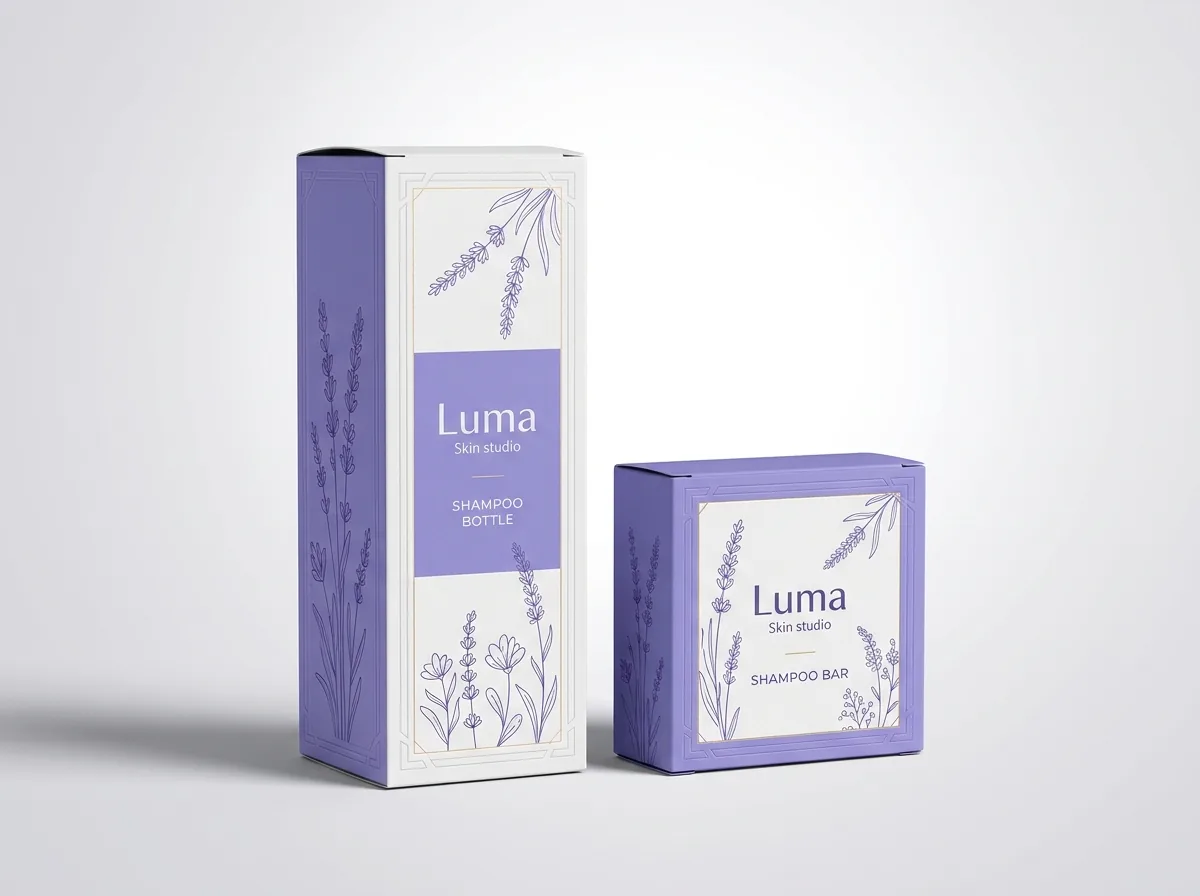
For waterless shampoo and conditioner bars weighing 2.5 oz to 4.5 oz, an auto lock bottom is unnecessary weight and thickness. A solid bar has a flat, wide footprint and low mass, so it distributes its light weight evenly across a simple tuck flap without bowing. Between the two tuck styles, most shampoo bar makers prefer Straight Tuck End (STE) over Reverse Tuck End (RTE). On a straight tuck end carton, both the top and bottom flaps hinge off the back panel and tuck toward the back, leaving the front display panel with two crisp, uninterrupted horizontal fold edges and zero raw cut board showing on the front face. That clean front frame looks sharp around an open die-cut sniff window or botanical artwork.
- Straight tuck end (STE): top and bottom flaps both tuck to the rear, giving the cleanest front frame for shampoo bars.
- Reverse tuck end (RTE): top flap tucks to the back while bottom flap tucks to the front, nesting slightly tighter on the print sheet.
- Slit-lock (cherry lock) tabs: small side notches on the tuck flap that hook into the dust flaps for extra hold on 4.5 oz bars.
- Zero glue along the bottom: allows the box to unfold completely flat if you print hair care instructions on the inside panels.
How much labor time do auto lock bottoms save during fulfillment?
When you are hand-packing 1,000 to 5,000 hair care units for a wholesale order or subscription drop, assembly seconds add up quickly. With a tuck-end or 1-2-3 snap-lock box, an operator has to pre-break the creases, fold in two dust flaps, fold the main bottom panel, and tuck or interlock the tab before turning the box upright to insert the bottle. With an auto lock bottom carton, the operator simply pinches the flat carton open with one hand; the base locks itself in under two seconds, leaving the other hand free to drop in the shampoo bottle and close the top tuck flap. Across a 2,500-box batch, cutting four seconds per carton saves nearly three hours of manual packing labor. For brands that ship two-bottle wash-day sets or include a scalp massager brush alongside a liquid cleanser, the pre-glued floor also keeps the carton square while the packer inserts a folded corrugated partition. Even if you start with manual table packing at 1,000 units and move to a contract filler at 10,000 units later, the same auto lock dieline works smoothly for hand-erecting lines.
- Auto lock bottom: 1.5 to 2 seconds to pop open by hand; pre-glued diagonal seams lock on contact.
- Straight or reverse tuck end: 4 to 6 seconds to pre-break scores, fold dust flaps, and insert the friction tab.
- 1-2-3 snap-lock bottom: 7 to 9 seconds to fold and hook four interlocking bottom panels in sequence.
- Seal-end carton: designed for automated hot-melt glue lines running thousands of bottles per hour.
What mistakes happen when choosing a shampoo box bottom style?
Picking the wrong bottom closure shows up either on the packing table or on the retail shelf. Avoid these five common errors before you approve your final dieline proof
- Putting a 12 oz liquid shampoo bottle in a friction tuck-end box without testing whether the bottom panel bows downward when lifted from a store shelf.
- Over-specifying a thick auto lock bottom on a tiny 3 oz shampoo bar box, where the double-folded base takes up valuable interior height.
- Using a manual 1-2-3 snap lock bottom for a 5,000-unit hand-packed run without factoring in the slower manual folding time for your crew.
- Forgetting that an auto lock bottom adds a diagonal fold crease on the lower back panel, where tiny barcode bars or ingredient text should never sit.
- Ordering reverse tuck end when you want unbroken front fold edges above and below a large front display window.
Find your size
Suggested inside size: 2.75 × 2.75 × 1.25 in
A starting point. Your account manager confirms the size with you before the proof.
Quote this size →Packaging for this
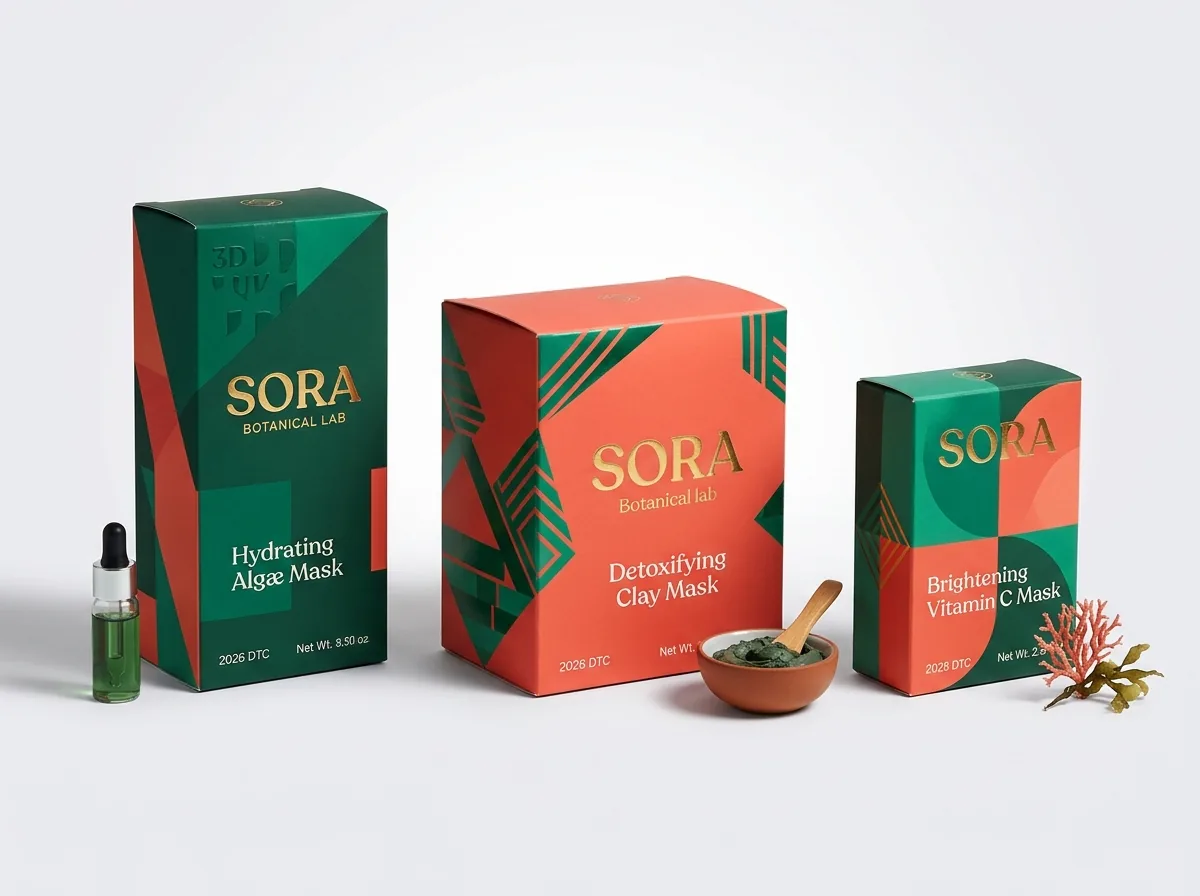
Ready to order shampoo boxes? Compare up to 3 quantities with a free 3D mockup.
Request a Quote →Questions about shampoo boxes
Can an auto lock bottom shampoo box still ship flat to my warehouse?
Yes. Even though the bottom flaps are pre-glued at the factory, the carton folds completely flat along diagonal score lines and ships in compact master cases. It only pops into a 3D box when you squeeze the sides together.
What is the difference between a 1-2-3 bottom and an auto lock bottom?
A 1-2-3 bottom (snap-lock bottom) has no glue on the base; you fold four interlocking flaps together by hand in three steps. An auto lock bottom is pre-glued in production so the base locks automatically in one motion and holds heavier bottles.
Is there a die charge to switch from a tuck bottom to an auto lock bottom?
No. CubitPack charges zero die or plate fees on any custom box style. Our structural team can quote both a tuck-end version and an auto lock bottom version on your order so you can compare the unit cost directly.
Which closure is best for a two-bottle shampoo and conditioner gift set?
Two filled 10 oz or 12 oz bottles weigh over 1.5 pounds together, so an auto lock bottom made from heavy paperboard or E-flute corrugated board - paired with a center divider insert - is the safest choice for retail and shipping.
Does an auto lock bottom have a tuck flap at the top?
Yes. The top of an auto lock bottom box uses a standard tuck flap (with optional slit locks or a hang tab) so customers can open and close the box cleanly while the bottom stays permanently locked under the bottle.
Can I test both bottom styles with my actual shampoo bottle before ordering?
Yes. You can order our $50 sample kit (credited toward your first order) to feel our folding carton styles and board weights in person, or request a custom printed prototype made to your bottle's exact dimensions.
Still have a question? Ask a packaging specialist.
Request a Quote →Request your shampoo boxes quote
Tell us your size and quantities, and one dedicated account manager prepares pricing for each tier.
- Free design & AI-to-print studio + 3D mockup
- No die or plate charges · 4–5 day rush available
- Free shipping to all 50 states
- 10% off your first order
The weight thresholds and assembly times in this comparison come from standard folding carton structural guidelines for liquid bottles and solid cosmetic bars. A CubitPack packaging specialist verified every row. Spot a mistake? Tell us and we will update it.
Sources
What changed
- October 22, 2026: First published.
- October 22, 2026: Updated specifications, terminology, and verified source links.
More guides
New packaging guides by email
Sizes, materials and design tips. Unsubscribe anytime.