
Straight tuck vs gravity dispenser vs auto-lock face mask boxes: which should you choose?
Short answer: Choose straight tuck end cartons for 3-to-5 pack foil sheet masks and squeeze tubes, perforated gravity-feed dispenser boxes for 7-to-14 pack daily mask sets, and pre-glued auto-lock bottom custom face mask boxes for heavy 50 ml and 100 ml glass clay mask jars.
On this page
- How do straight tuck, gravity dispenser, PDQ display and auto-lock mask boxes compare
- Why is the straight tuck end carton the standard for 5-pack sheet masks and tubes
- When should I upgrade to a perforated gravity-feed sheet mask dispenser box
- Why do 50 ml and 100 ml glass clay mask jars require an auto-lock bottom carton
- How do pop-up PDQ counter displays and hang-tab boxes drive single mask trial sales
- Common mistakes
- FAQs
Request a custom quoteFree dieline & 3D mockup
Facial mask packaging splits into four primary carton structures depending on whether you are packing flexible foil serum sachets or heavy glass jars, and how the customer accesses the masks at home or at retail checkout. Standard 5-pack sheet mask sets use a straight tuck end carton because both the top and bottom flaps fold toward the back panel, leaving the front face completely free of raw board edges. Larger 7-pack, 10-pack and 14-pack sheet mask sets add a perforated tear-away slot across the lower front wall so the carton works as a gravity-feed bathroom counter dispenser. Heavy 50 ml and 100 ml glass clay or overnight mask jars require a factory-glued auto-lock bottom carton so the base never gives way. All folding styles start at 1,000 boxes at CubitPack with zero die fees and free US shipping.
How do straight tuck, gravity dispenser, PDQ display and auto-lock mask boxes compare?
When selecting a structure for custom printed face mask boxes, start with two questions: what is the weight and shape of the primary container (flexible foil sachets, a squeeze tube or a thick glass jar), and how many units sit inside one box? A 5-ounce stack of five foil sachets behaves very differently on a retail shelf than a 10-ounce frosted glass clay mask jar or a 20-pouch spa checkout display. Use the side-by-side table below to compare the four core folding carton structures across base strength, customer access, retail merchandising and ideal mask formats. Notice that every folding style ships completely flat in master bundles and starts at 1,000 cartons, so your structural decision is guided purely by how your mask is packed, displayed and opened rather than minimum order constraints.
| Feature | Straight Tuck End (STE) | Gravity-Feed Dispenser Box | Auto-Lock Bottom (ALB) Carton | Pop-Up Counter Display (PDQ) |
|---|---|---|---|---|
| CubitPack minimum | 1,000 boxes | 1,000 boxes | 1,000 boxes | 1,000 boxes |
| Base construction | Rear-tucking bottom flap | Tuck or snap-lock bottom | Pre-glued locking base | Closed tray base |
| How customer opens | Lifts top tuck flap | Zips off lower front tear strip | Lifts top lid; lifts collar | Retailer folds lid into header |
| Weight capacity | Light to medium (under 8 oz) | Medium (7 to 14 foil sachets) | Heavy (8 to 20+ oz glass jars) | 12 to 24 upright sachets |
| Ships & stores | 100% flat | 100% flat | 100% flat (pops open in 1 sec) | 100% flat |
| Best facial mask SKUs | 3-pack & 5-pack sheet masks, tubes | 7-pack, 10-pack & 14-pack routines | 50–100 ml glass clay & eye jars | Single impulse sheet masks |
Why is the straight tuck end carton the standard for 5-pack sheet masks and tubes?
Pick up almost any 5-pack of K-beauty or clinical sheet masks on a beauty shelf and you will find a custom straight tuck end box. Unlike a reverse tuck end carton where one flap hinge cuts across the bottom of the front panel, a straight tuck end (STE) carton hinges both the top lid and the bottom flap from the front panel and tucks them into the rear wall. That geometry gives your front panel two clean folded horizontal edges with zero raw paperboard seams showing on the shelf. Because five 25 ml foil sheet mask sachets (or a 75 ml peel-off mask tube) weigh only 4.5 to 5.5 ounces total, a standard straight tuck bottom with friction slit locks holds the stack securely while keeping board usage and unit cost low. It also runs smoothly on both manual packing tables and high-speed horizontal cartoning machines as your brand scales.
- Clean front billboard: both top and bottom flaps tuck into the rear wall so the front panel is unbroken.
- Upright file access: customers flip open the top lid and fan through the five foil sachets like file folders.
- Fast hand or machine packing: ships flat in pre-glued sleeves ready to squeeze open and load.
- Optional euro hang tab: add a fold-up or integrated hang tab on the back panel for pegboard display.
When should I upgrade to a perforated gravity-feed sheet mask dispenser box?
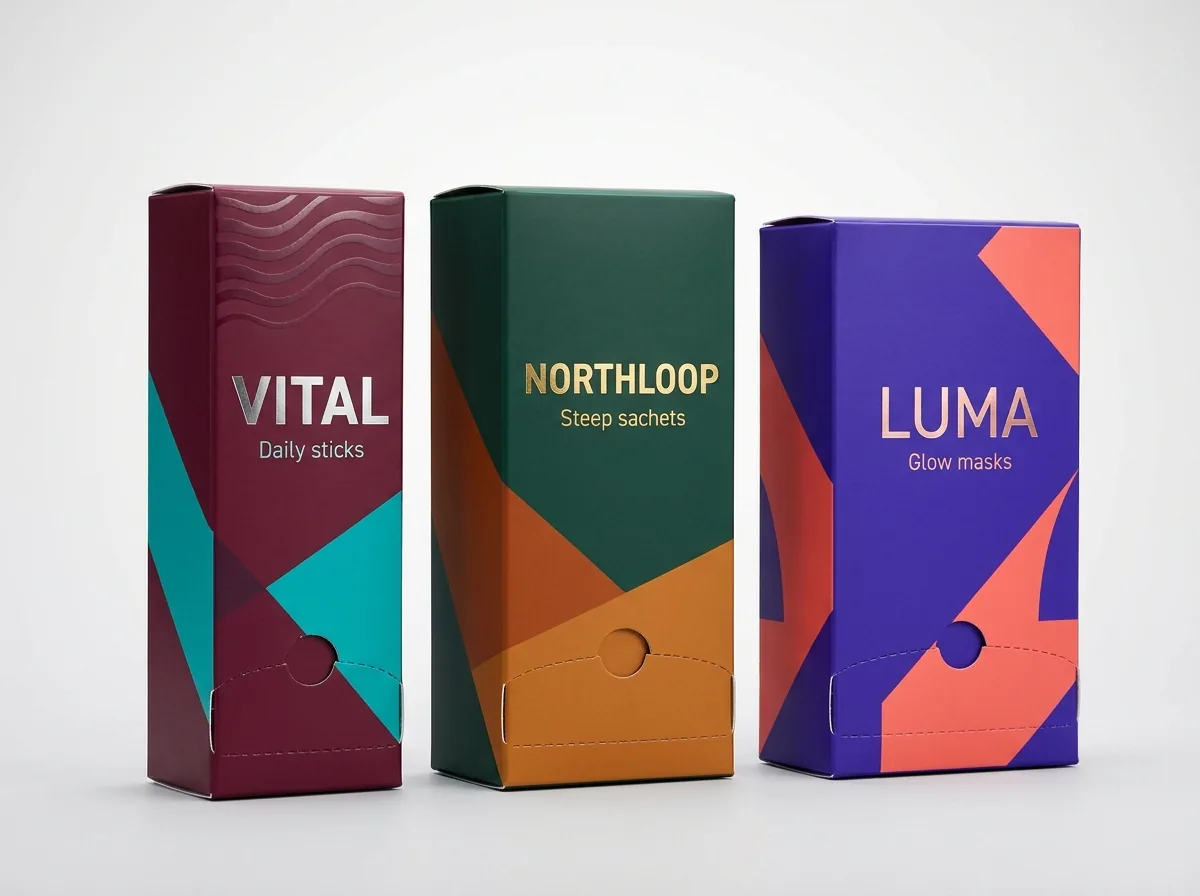
When your brand sells a 7-day weekly glow challenge, a 10-pack hydration bundle or a 14-pack clinic set, a standard top-opening box becomes awkward on a bathroom shelf. Instead of making the customer open the top lid every night, a custom dispenser box builds a perforated zipper strip across the lower front face and 1 inch back into both side panels. When the customer pulls the perforated tab, the lower window opens into a cradled dispensing tray. Each time they slide the bottom foil sachet out, gravity drops the next mask pouch down into the slot. You can also print a numbered countdown gauge along the side edge of the dispenser cutout so the customer can see how many masks remain in their weekly or monthly supply. Because CubitPack includes custom perforation rules on the cutting die at zero extra cost, a 10-pack gravity dispenser costs almost the exact same per unit as a plain 10-pack tuck box.
Know your size? Compare pricing across up to 3 quantities.
Request a Quote →Why do 50 ml and 100 ml glass clay mask jars require an auto-lock bottom carton?
Wash-off kaolin clay masks, dead-sea mud treatments, berry enzyme masks and 60-count hydrogel eye-patch tubs are packed in wide, heavy jars that weigh 7 to 14 ounces filled. If you place a heavy glass jar inside a standard straight tuck end carton, the concentrated circular weight of the jar base pushes straight down on the unglued bottom flap and can pop the bottom open when a shopper picks the box up. Switching to a custom auto lock bottom box solves base failure completely. The bottom flaps are pre-glued at the factory in an interlocking cross pattern that snaps locked the instant your fulfillment team squeezes the flat carton open. Pair that locking base with an internal E-flute corrugated sleeve and a top spatula-slot collar so the glass jar survives both retail handling and e-commerce parcel drops without needing bubble wrap inside the primary carton.
How do pop-up PDQ counter displays and hang-tab boxes drive single mask trial sales?
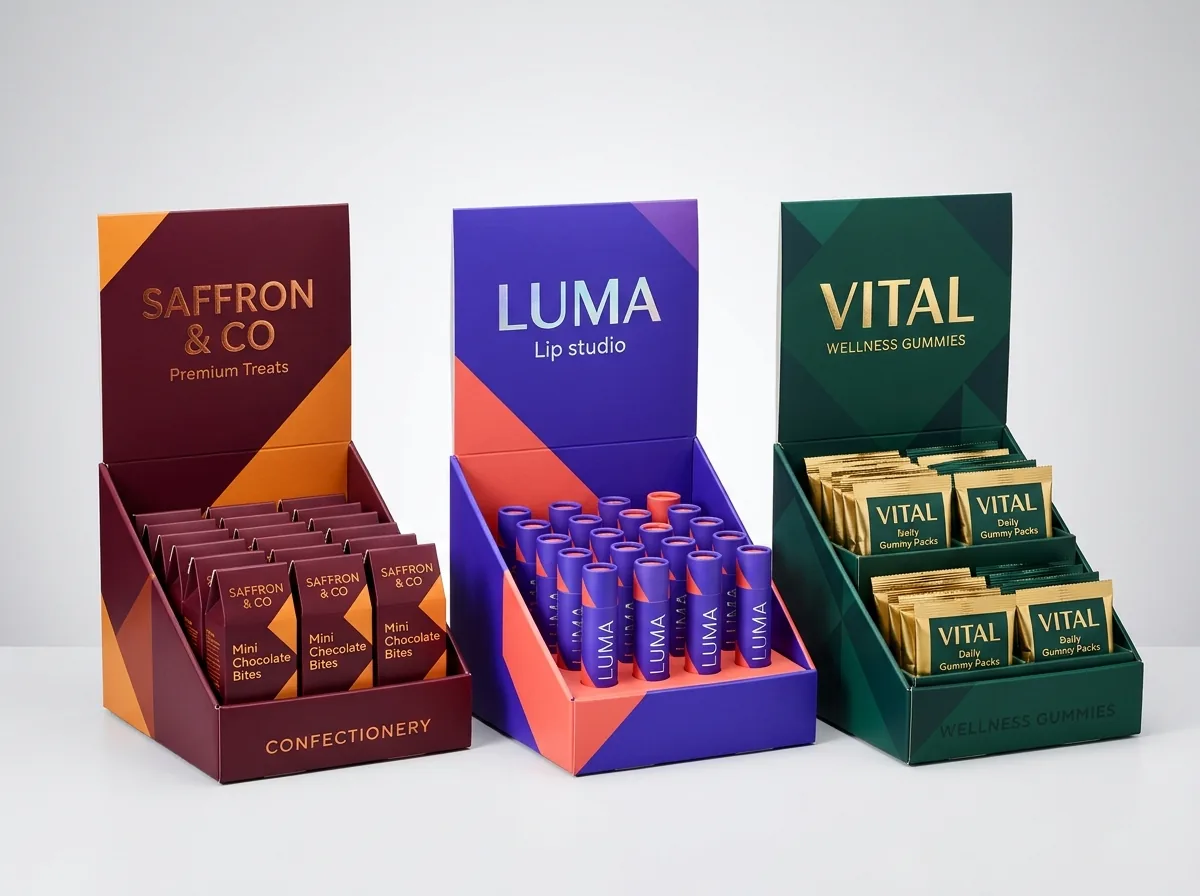
Sheet masks have one of the highest repeat-purchase rates in skincare, provided shoppers can try a single mask first before committing to a 5-pack or 10-pack box. To merchandise single sachets at spas, salons and beauty stores, brands use two retail-ready structures: the custom counter display box (PDQ tray) and the custom hang tab box. A PDQ counter display box holds 12 to 24 individual foil sachets upright inside a compact footprint beside the cash register; the store associate simply tears off the perforated front cover and folds the top flap backward to form a printed billboard header. A slim hang-tab envelope holds 1 to 3 premium bio-cellulose or hydrogel masks on vertical peg hooks in the skincare aisle. Ordering your 5-pack retail cartons, 10-pack bathroom dispensers and 20-count PDQ counter display boxes together in one print schedule guarantees exact Pantone and foil consistency across every retail touchpoint while unlocking higher-tier volume pricing.
What are the most common mistakes when choosing a face mask box style?
Matching the right bottom closure and dispensing method to your facial mask format keeps cartons crisp on retail shelves, inside e-commerce shipping boxes and on humid bathroom vanities. Avoid these five structural mistakes
- Using an unglued straight tuck bottom for a heavy 50 ml or 100 ml glass clay mask jar instead of a pre-glued auto-lock bottom.
- Packing 10 or 14 sheet mask pouches into a plain top-tuck box without a lower perforated dispenser slot for easy daily access.
- Cutting the bottom lip of a gravity-feed sheet mask dispenser slot higher than 1/2 inch, which traps the last two sachets at the bottom.
- Shipping individual foil sheet mask sachets to retail stores in plain brown cartons instead of a pop-up PDQ counter display box.
- Using a reverse tuck end box where the bottom flap seam cuts across the front face of a minimalist skincare design.
Find your size
Suggested inside size: 4.75 × 0.375 × 6.5 in
A starting point. Your account manager confirms the size with you before the proof.
Quote this size →Packaging for this
Ready to order face mask boxes? Compare up to 3 quantities with a free 3D mockup.
Request a Quote →Questions about face mask boxes
Does a perforated gravity-feed sheet mask dispenser box cost more than a straight tuck box?
No. Because the tear-away zipper perforation is built right into the steel cutting die and CubitPack never charges die fees, adding a lower dispenser slot to a 7-pack or 10-pack sheet mask carton does not add tooling cost.
Should I stack sheet mask sachets vertically or horizontally inside a dispenser box?
In a 5-pack straight tuck carton, sachets stand vertically like files. In a 10-pack or 14-pack gravity dispenser box, you can either stand them vertically with a lower front pull slot or stack them flat horizontally so the bottom pouch slides straight out.
When should I switch from a straight tuck end to an auto-lock bottom for face masks?
Switch to a pre-glued auto-lock bottom whenever the contents weigh more than 7 to 8 ounces or concentrate weight in a rigid base, such as 50 ml and 100 ml glass clay mask jars, 60-count hydrogel tubs, or 10-to-14 pack sheet mask bundles.
Do pop-up counter display (PDQ) boxes ship flat with my sheet mask cartons?
Yes. PDQ counter display boxes ship 100% flat just like standard folding cartons. You or your co-packer pop the tray open, load 15 to 20 sheet mask sachets inside, close the top flap for transit, and the retailer zips off the perforated apron at the counter.
Can I order rigid magnetic boxes for a multi-step facial spa kit?
Yes. While single-SKU folding cartons start at 1,000 units, we also make wrapped rigid magnetic closure and drawer boxes starting at just 50 units for spa treatment kits that bundle a clay mask jar, mixing bowl, brush and sheet masks.
Can I test a gravity-feed perforation or auto-lock jar box before paying for my full run?
Yes. Every order includes a free flat dieline proof and a 3D mockup before payment. You can also order our $50 sample kit to inspect boards and finishes, or request a paid custom prototype built to your exact mask dimensions and credited to your order.
Still have a question? Ask a packaging specialist.
Request a Quote →Request your face mask boxes quote
Tell us your size and quantities, and one dedicated account manager prepares pricing for each tier.
- Free design & AI-to-print studio + 3D mockup
- No die or plate charges · 4–5 day rush available
- Free shipping to all 50 states
- 10% off your first order
This comparison draws on CubitPack's decided minimums (1,000 folding cartons, 50 rigid boxes), standard 25–30 ml foil sachet weights, and glass skincare jar retention standards. Reviewed by a CubitPack packaging specialist. Spot something wrong? Tell us and we will fix it.
Sources
What changed
- October 22, 2026: First published.
- October 22, 2026: Updated specifications, terminology, and verified source links.
More guides
New packaging guides by email
Sizes, materials and design tips. Unsubscribe anytime.