
Straight tuck vs reverse tuck vs auto lock cosmetic boxes: which style should you choose?
Short answer: Pick Straight Tuck End (STE) when you want both flaps to tuck toward the back for an unbroken front face on lipsticks, serums and compacts. Pick Reverse Tuck End (RTE) for high-volume tubes that nest tightly on press sheets, or Auto Lock Bottom for heavy glass jars inside custom cosmetic boxes.
On this page
- What is the structural difference between Straight Tuck End and Reverse Tuck End
- How do STE, RTE, 1-2-3 Snap Lock and Auto Lock Bottom compare side by side
- When does a cosmetic bottle or jar need an Auto Lock Bottom or 1-2-3 Snap Lock
- Should cosmetic tuck flaps use friction locks or slit locks
- Common mistakes
- FAQs
Request a custom quoteFree dieline & 3D mockup
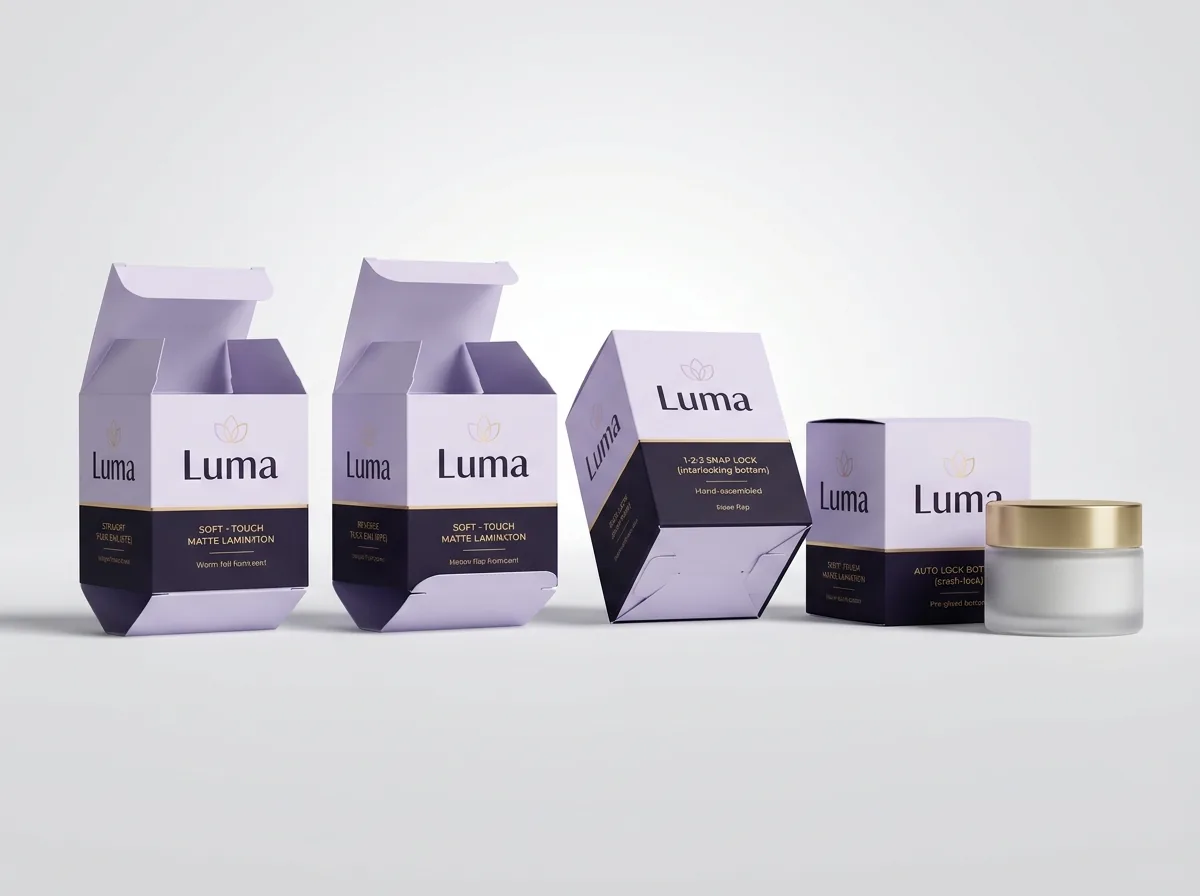
Four folding carton closures handle more than ninety percent of retail makeup and skincare packaging: Straight Tuck End (STE), Reverse Tuck End (RTE), 1-2-3 Snap Lock Bottom and Auto Lock Bottom. For lightweight products under 3 ounces (such as lipstick bullets, lip glosses, mascaras, brow gels and pressed powder compacts), STE and RTE are the standard choices. STE hinges both the top and bottom flaps off the front panel so they tuck into the rear, hiding the bottom cut edge from shoppers looking at the shelf. RTE alternates the top and bottom flaps on opposite panels so flat blanks interlock more tightly on the parent paperboard sheet. Once your container steps up to a heavy 30 ml glass foundation pump or a 50 ml thick-walled glass cream jar, switching to a pre-glued Auto Lock Bottom prevents the jar from pushing through the base and cuts hand-packing time to one second per box.
What is the structural difference between Straight Tuck End and Reverse Tuck End?
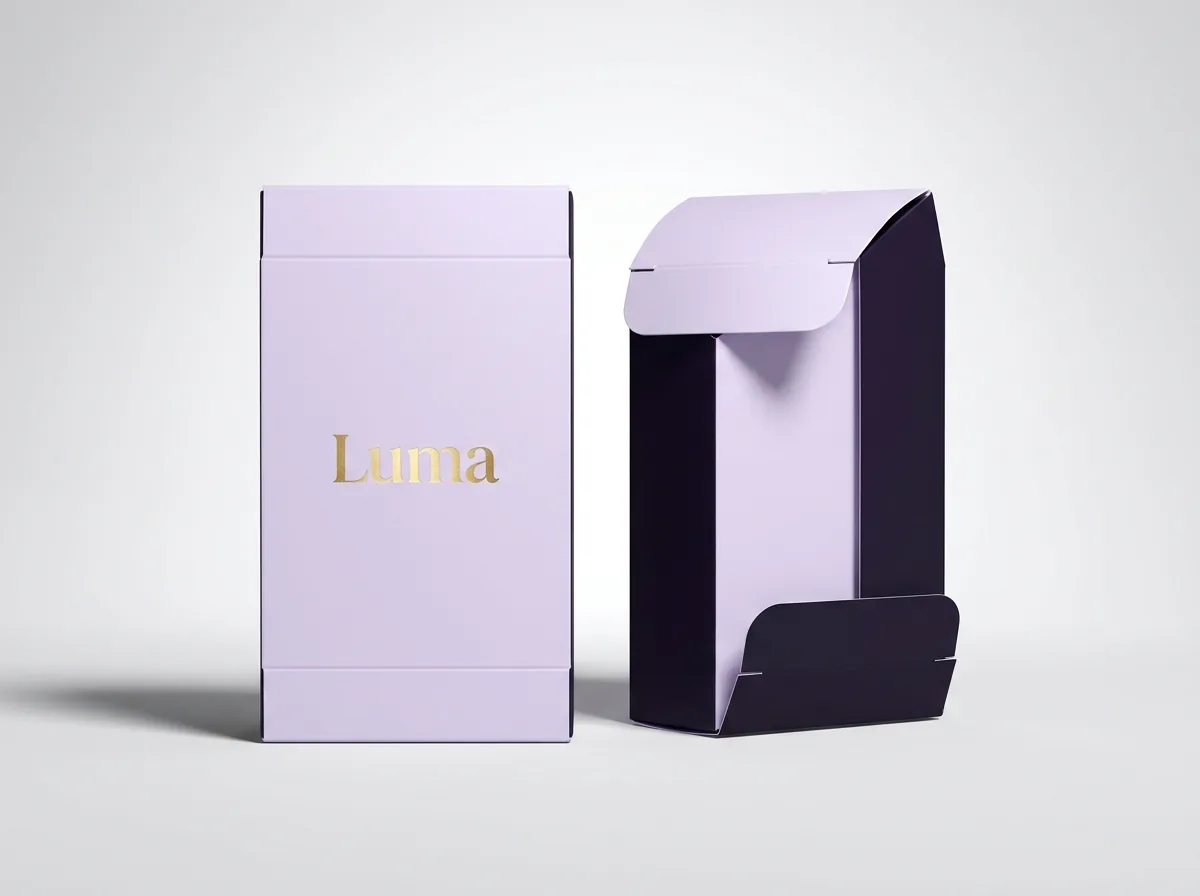
When an assembled Straight Tuck End carton and a Reverse Tuck End carton stand side by side on a retail counter, they share identical inside dimensions, four vertical walls and internal side dust flaps. The difference lies entirely in which panel the top and bottom closure flaps are hinged to on the flat dieline. On custom straight tuck end boxes, both the top lid and the bottom flap hinge directly off the front display panel and fold backward toward the rear panel. Because the bottom flap folds away from the viewer, the bottom front crease is a clean, continuous folded score line with no raw paperboard edge or gap showing on the front face. On custom reverse tuck end boxes, the top flap hinges off the back panel while the bottom flap hinges off the front panel (or vice versa). That alternating layout allows neighbouring flat blanks to rotate and interlock flap-to-flap on the press sheet, reducing board trim on high-volume runs of narrow tubes. When you configure custom printed cosmetic boxes for retail shelves where shoppers inspect the box from twelve inches away, that front bottom fold makes an immediate visual difference. Because Straight Tuck End tucks both flaps toward the back wall, the front panel reads as a clean rectangular canvas from top to bottom with zero interruption.
- Straight Tuck End (STE): both flaps hinge on the front panel and tuck to the back, leaving a clean front bottom crease.
- Reverse Tuck End (RTE): top and bottom flaps hinge on opposite panels so flat blanks nest tightly on the press sheet.
- Identical tooling policy: both ship flat with a pre-glued side seam and carry zero die or plate charges at CubitPack.
- Shelf visual rule: dark or metallic front panels look cleaner on STE because no raw board edge faces the shopper.
How do STE, RTE, 1-2-3 Snap Lock and Auto Lock Bottom compare side by side?
Choosing the right carton style balances four practical factors: how the front bottom edge looks on a lighted retail shelf, how much downward weight the filled container puts on the base, how many glue points are applied on the factory folder-gluer, and how many seconds your fulfillment crew spends assembling each box by hand. Use the comparison table below to match every SKU in your beauty line to its ideal structural closure. If you also need help calculating inside clearance around your bottle or tube, pair this chart with our what size cosmetic box guide.
| Feature | Straight Tuck End (STE) | Reverse Tuck End (RTE) | 1-2-3 Snap Lock Bottom | Auto Lock Bottom |
|---|---|---|---|---|
| Front bottom edge look | Clean folded score; tucks in back | One flap tucks in front, one in back | Clean folded score; interlocking base | Clean folded score; pre-glued base |
| Recommended container weight | Light to medium (under 3 to 4 oz) | Light (under 3 oz) | Medium to heavy (3 to 8 oz) | Medium to heavy glass (4 to 16+ oz) |
| Ideal cosmetic products | Lipsticks, serums, concealers, compacts | Lip balms, mascaras, liners, sample vials | Body scrubs, bath salts, candle jars | 30 ml foundations, 50 ml cream jars, perfumes |
| Factory gluing points | 1 glue seam (vertical side joint) | 1 glue seam (vertical side joint) | 1 glue seam (vertical side joint) | 3 glue points (side seam + crash bottom) |
| Hand-packing assembly time | 4 to 5 seconds (tuck bottom and top) | 4 to 5 seconds (tuck bottom and top) | 8 to 10 seconds (fold 1-2-3 base + top) | 1 to 2 seconds (pop open + tuck top) |
| Compatible with inner neck collar? | Yes (built-in 5th flap or separate insert) | Yes (separate insert recommended) | Yes | Yes (built-in 5th flap or separate insert) |
When does a cosmetic bottle or jar need an Auto Lock Bottom or 1-2-3 Snap Lock?
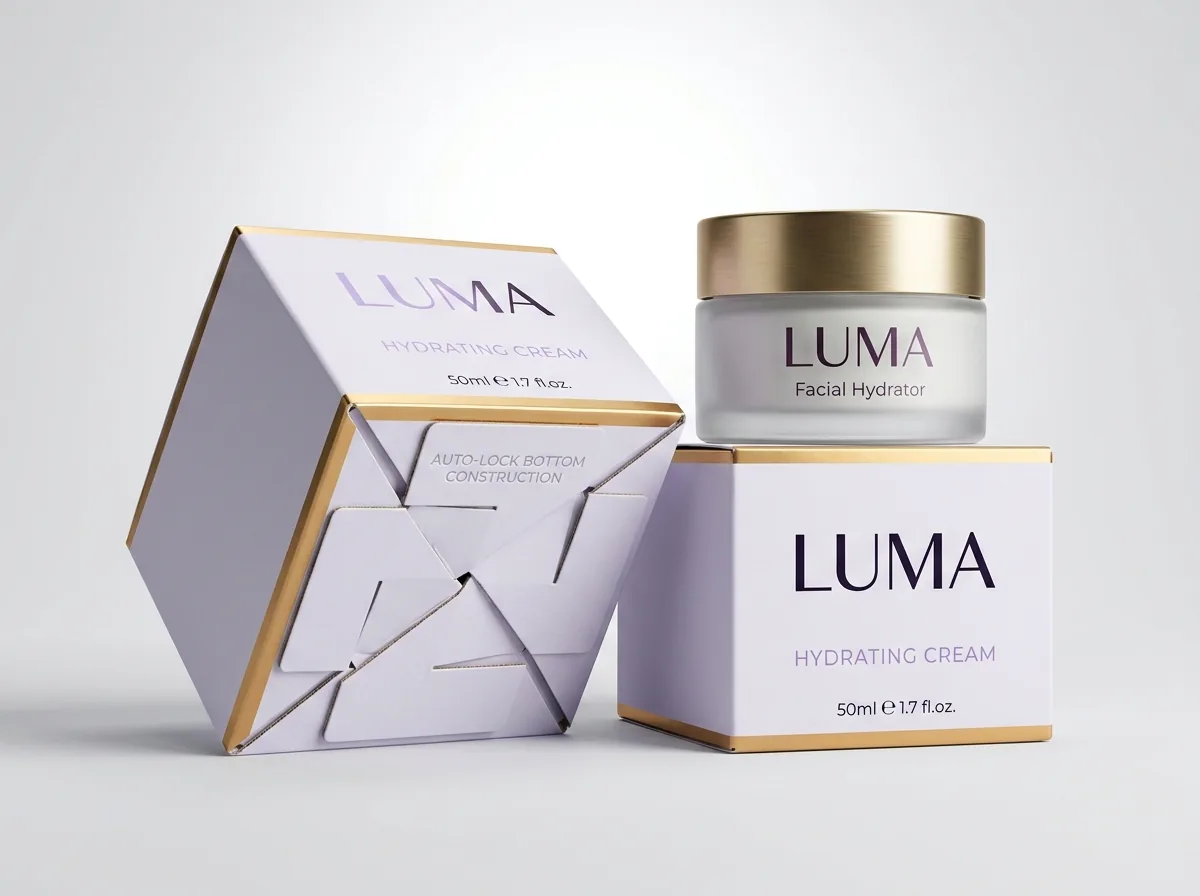
A standard tuck bottom relies on paperboard friction (or small corner slit tabs) to stay closed. That works reliably for a 0.4 oz plastic mascara tube or a lightweight blush compact. However, a thick-walled 50 ml glass moisturizer jar, a 30 ml glass foundation pump or a 100 ml glass perfume bottle concentrates real weight onto a compact square footprint. If a shopper lifts a heavy glass jar off a retail tester shelf and the bottom tuck flap slips, the bottle drops straight through the bottom of the carton. Switching to custom auto lock bottom boxes (also called crash-lock bottom boxes) solves both weight security and fulfillment speed. During conversion during production, the bottom flaps are folded and diagonal-glued before the cartons are packed flat. When your packing crew squeezes the opposite corners of the flat blank, the base snaps and locks shut automatically in about one second. For moderate glass weights where you want a mechanical lock without a second factory glue pass, a 1-2-3 Snap Lock bottom uses four die-cut hooks folded by hand. Many skincare brands use Straight Tuck End cartons for lightweight 10 ml eye rollers and 15 ml lip tubes, then step up to Auto Lock Bottom cartons for 30 ml glass foundation pumps and 50 ml moisturizer jars within the same collection. Since the front and side panels look identical from the outside when standing on a shelf, your product line maintains a unified visual block while each container gets the bottom support its weight requires.
Know your size? Compare pricing across up to 3 quantities.
Request a Quote →Should cosmetic tuck flaps use friction locks or slit locks?
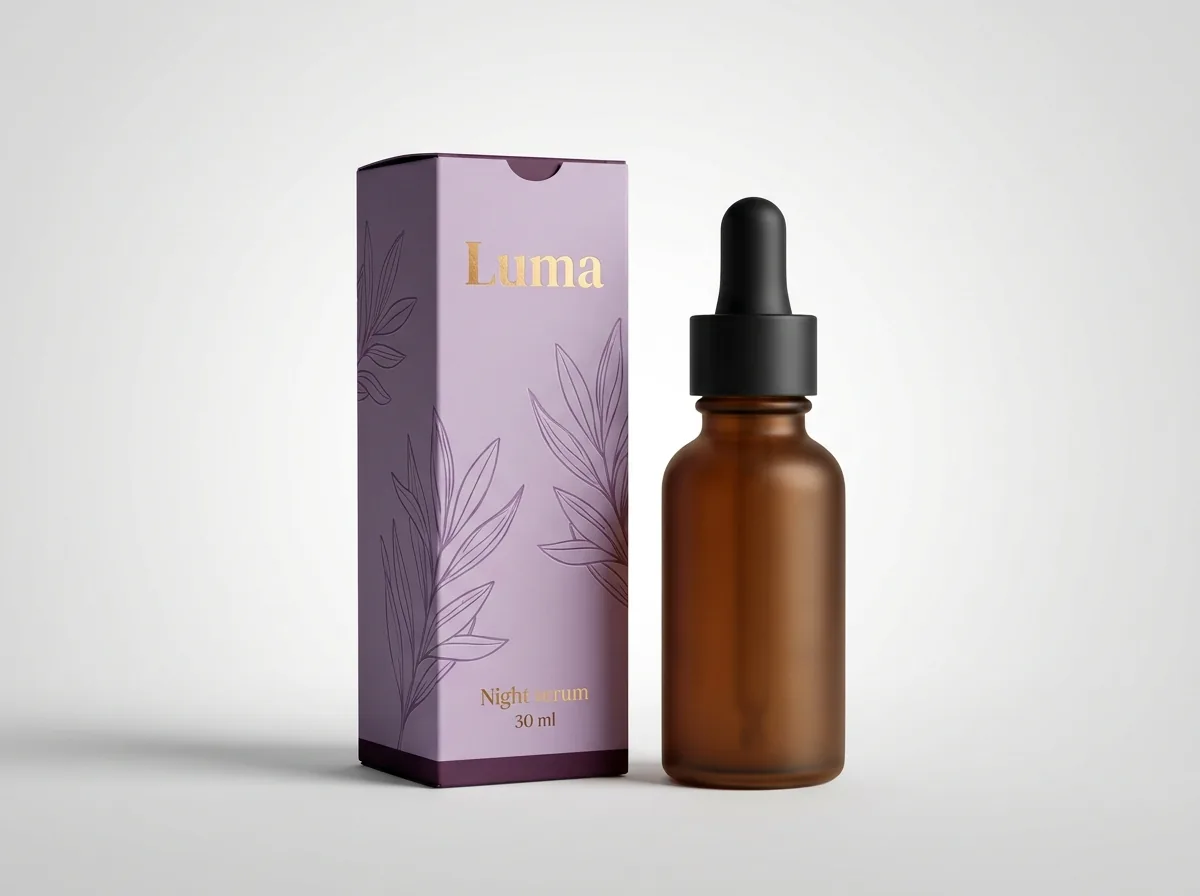
Even when you choose a Straight Tuck End or Reverse Tuck End carton, our design team can customize how the top and bottom tuck tongues lock into the side dust flaps. A Friction Lock uses a smooth curved tongue that stays shut through natural outward paperboard tension. A Slit Lock (also called a Pie Lock or tuck notch) adds two small crescent notches on the shoulders of the tuck tongue that hook positively into matching slits at the base of the dust flaps. For most cosmetic tubes and 15 ml to 30 ml dropper bottles packed in an STE carton, the smartest combination is a Slit Lock on the bottom flap paired with a Friction Lock on the top flap. The bottom slit lock prevents the container from nudging the base open during parcel vibration, while the smooth top friction lock allows your customer to open and close the box repeatedly on their vanity without tearing the corner tabs.
- Bottom Slit Lock: hooks into side dust-flap slits so glass vials and tubes cannot push the bottom open in transit.
- Top Friction Lock: opens smoothly without tearing, ideal for compacts and lipsticks customers re-box on their vanity.
- Thumb notch cutout: optional half-moon finger notch on the front or back rim for easy lid lifting on shallow palettes.
- Tamper-evident wafer seal: pair a friction top flap with a clear or printed security seal sticker for retail shelves.
What are the most common cosmetic box closure mistakes?
Picking the wrong bottom or top flap style usually shows up either on the fulfillment table or on the retail shelf. Watch out for these five structural errors
- Packing a heavy 50 ml glass cream jar or glass foundation bottle inside a plain friction-bottom Reverse Tuck End box.
- Putting aggressive slit-lock tabs on the top opening flap of an eyeshadow palette or compact that customers open daily.
- Placing small front-panel text right along the bottom edge of a Reverse Tuck End box where the front-tucking flap seam sits.
- Ordering 1-2-3 Snap Lock bottoms for a large hand-packed launch without budgeting the extra 6 to 8 seconds of folding time per unit.
- Forgetting to specify an internal fifth-flap neck collar when packing a top-heavy pump or dropper bottle inside an STE or Auto Lock carton.
Find your size
Suggested inside size: 1 × 1 × 3.5 in
A starting point. Your account manager confirms the size with you before the proof.
Quote this size →Packaging for this
Ready to order cosmetic boxes? Compare up to 3 quantities with a free 3D mockup.
Request a Quote →Questions about cosmetic boxes
What is the main difference between Straight Tuck End and Reverse Tuck End cosmetic boxes?
On a Straight Tuck End (STE) box, both the top and bottom flaps hinge off the front panel and tuck into the back panel, leaving an unbroken folded edge along the front bottom face. On a Reverse Tuck End (RTE) box, the top and bottom flaps hinge on opposite panels so flat blanks nest tighter on the press sheet.
When should I upgrade from a tuck bottom to an Auto Lock Bottom cosmetic box?
Upgrade to an Auto Lock Bottom whenever your primary container is a heavy glass bottle or jar weighing more than 3 to 4 ounces (such as a 30 ml glass foundation pump, 50 ml cream jar or perfume flacon), or when your team wants one-second pop-open hand assembly.
Do Straight Tuck End or Auto Lock Bottom boxes require custom die fees?
No. CubitPack never charges die or plate fees on any folding carton style, whether you choose Straight Tuck End, Reverse Tuck End, 1-2-3 Snap Lock or Auto Lock Bottom. Every order starts at 1,000 cartons and includes a free custom dieline and 3D mockup.
Can I combine a slit-lock bottom with a friction-lock top on the same cosmetic carton?
Yes. Mixing a positive Slit Lock on the bottom flap with a smooth Friction Lock on the top flap is standard practice on Straight Tuck End and Reverse Tuck End beauty cartons. Just note your preference when reviewing your free dieline proof.
Which cosmetic box style works best for automated cartoning machines?
Both Reverse Tuck End (RTE) and Straight Tuck End (STE) run smoothly on horizontal and vertical automated cartoning lines. Tell our structural team whether your co-packer uses tuck-in or hot-melt glue closures so we match the dust flap angles to their line.
Can an Auto Lock Bottom box still have a clean tuck top and an inner bottle holder?
Yes. An Auto Lock Bottom carton uses a pre-glued crash-lock base on the bottom and a standard straight-tuck lid on top, and it can include either a built-in fifth-flap neck collar or a separate die-cut card or foam insert inside.
Still have a question? Ask a packaging specialist.
Request a Quote →Request your cosmetic boxes quote
Tell us your size and quantities, and one dedicated account manager prepares pricing for each tier.
- Free design & AI-to-print studio + 3D mockup
- No die or plate charges · 4–5 day rush available
- Free shipping to all 50 states
- 10% off your first order
The structural comparisons and weight thresholds in this guide come from folding carton CAD standards for Straight Tuck End, Reverse Tuck End, 1-2-3 Bottom and Auto Lock Bottom boxes, checked by a CubitPack packaging specialist. Spot something wrong? Tell us and we will fix it.
Sources
What changed
- October 22, 2026:
- October 22, 2026: Updated specifications, terminology, and verified source links.
More guides
New packaging guides by email
Sizes, materials and design tips. Unsubscribe anytime.