
What Size Lip Gloss Box Fits Wand Vials and Squeeze Tubes?
Short answer: A standard 5 ml to 7 ml doe-foot lip gloss wand vial fits a 0.8125 × 0.8125 × 4.5 inch carton, while chubby lip oils use 1.0 × 1.0 × 3.75 inches and crimped 15 ml squeeze tubes need a rectangular 1.25 × 0.875 × 4.25 inch box when ordering custom lip gloss boxes.
On this page
- Why do doe-foot wand vials and plastic squeeze tubes need different footprints
- What lip gloss box sizes fit common wand, lip oil, rollerball and duo formats
- How do you measure a lip gloss vial or squeeze tube step by step
- How do you size a stepped insert for a lip liner and lip gloss duo box
- Common mistakes
- FAQs
Request a custom quoteFree dieline & 3D mockup
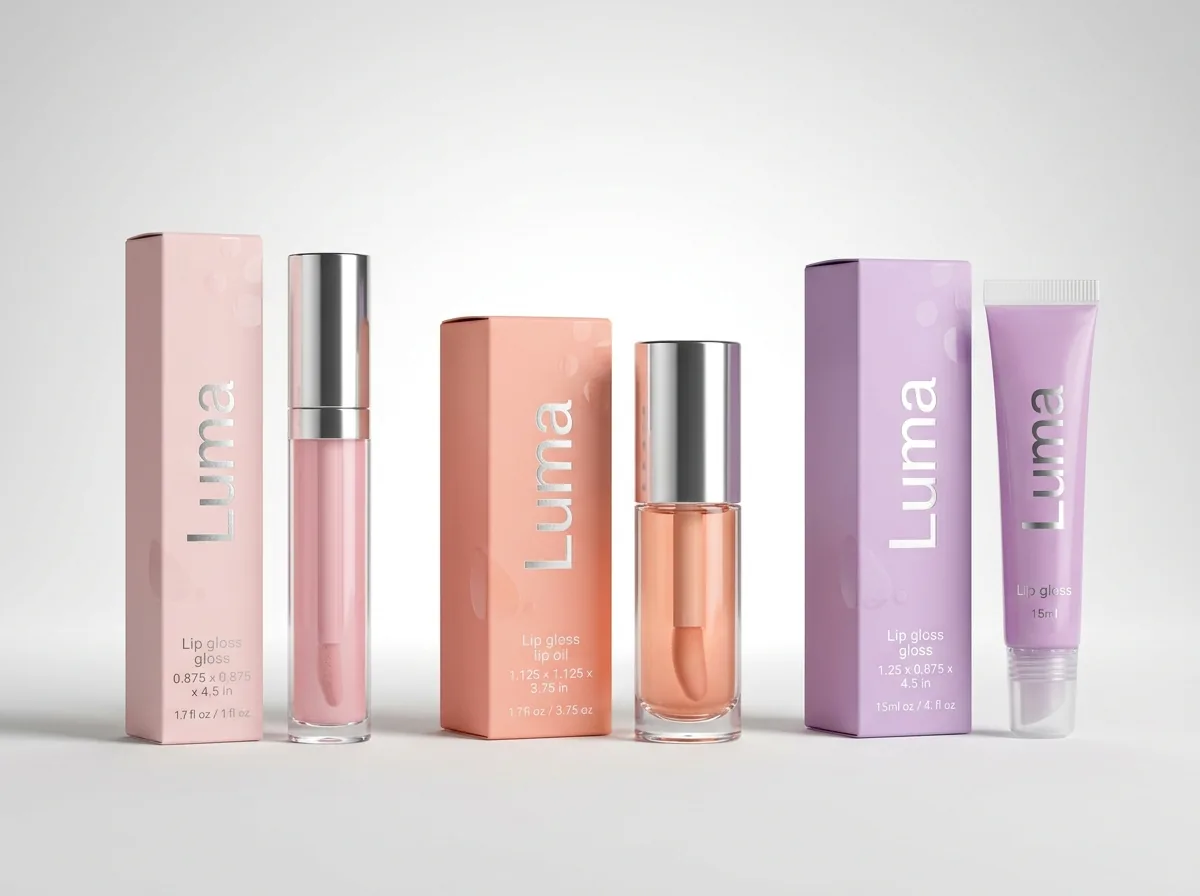
Inside dimensions for lip gloss cartons depend on whether your formula fills a rigid doe-foot wand vial, a chubby cushion barrel, a glass rollerball or a heat-crimped plastic squeeze tube. Standard cylindrical 5 ml to 7 ml doe-foot wand vials measure 0.68 to 0.75 inches in diameter and 4.25 to 4.375 inches tall, matching an inside box size of 0.8125 × 0.8125 × 4.5 inches. Wide chubby lip oil barrels typically require 1.0 × 1.0 × 3.75 inches, and slender 10 ml glass rollerballs fit 0.75 × 0.75 × 3.5 inches. Flexible 10 ml to 15 ml slanted-tip squeeze tubes have a flattened heat seal at the top that spreads wider than the round cap, requiring a rectangular 1.25 × 0.875 × 4.25 inch carton. At CubitPack, every order from 1,000 card boxes includes a free custom dieline, free design help, zero die charges and free US shipping in 10 to 14 business days.
Why do doe-foot wand vials and plastic squeeze tubes need different footprints?
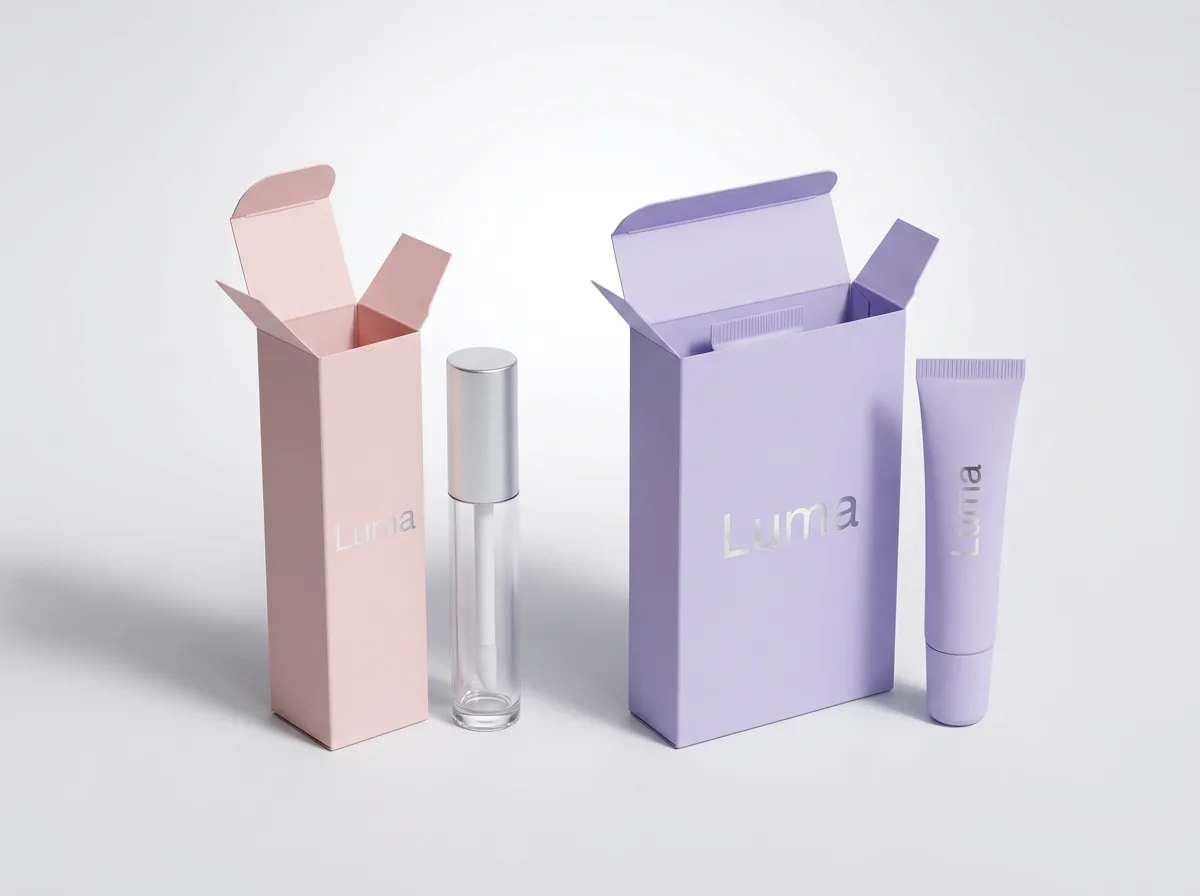
Lip gloss and lip oil formulas are filled into two structurally distinct container families: rigid blown vials (made of transparent PETG, SAN acrylic or heavy glass) and flexible extruded plastic squeeze tubes (usually PE or laminated foil-plastic). Understanding how those two containers behave inside a paperboard folding carton prevents the most common sizing error in lip packaging: forcing a flattened squeeze tube into a narrow square box. A rigid doe-foot wand vial or glass rollerball bottle has a uniform cross-section from its bottom base to its shoulder. Whether the vial is cylindrical or molded with flat square sides, its horizontal width and depth are equal. Adding 1/16 inch (0.0625 inches) of clearance to that diameter gives you a clean square carton footprint (Length equals Width) where the vial slides smoothly through the top tuck opening and stands straight behind a front window cutout. A plastic squeeze tube starts out as a round cylinder at the threaded cap end, but after filling, the open tail end is pinched flat between heated jaws and crimped shut. That flat heat seal flares out roughly 50% wider than the diameter of the cap. For example, a 15 ml slanted-tip lip balm or lip gloss squeeze tube may have a 0.75 inch diameter screw cap at the bottom, while the crimped top tail measures 1.125 inches wide and only 0.125 inches thick. If you try to push that 1.125 inch flat crimp into a 0.8125 inch square box, the corners of the crimp curl backward, creasing the tube and bowing the front and back carton walls outward. Giving the squeeze tube a rectangular footprint (such as 1.25 inches wide across the front Length by 0.875 inches deep from front to back) lets the flat crimp sit parallel to the front panel while the round cap centers neatly at the bottom.
- Cylindrical doe-foot wand vials: Square footprint (L = W = largest diameter + 1/16 in clearance).
- Square-molded PETG or glass gloss vials: Square footprint (L = W = flat side width + 1/16 in clearance) so corners never bind on internal glue seams.
- Crimped plastic squeeze tubes: Rectangular footprint (L = flat top crimp width + 1/8 in; W = cap diameter + 1/16 in).
- Multi-piece lip duos and trios: Rectangular footprint sized to the combined widths of the containers plus internal card divider slots.
What lip gloss box sizes fit common wand, lip oil, rollerball and duo formats?
Use the benchmark chart below to estimate your starting inside carton dimensions (Length × Width × Height in inches) before ordering printed lip gloss cartons. Every CubitPack order is cut to your exact millimeter or fractional-inch measurements with zero die or plate charges, so you never have to settle for an oversized stock box. Notice how the height-to-width ratio varies across categories. Traditional 5 ml to 7 ml doe-foot lip gloss wands are tall and slender (often 4.25 to 4.5 inches tall on a 0.8125 inch square base, a 5.5-to-1 ratio), whereas modern chubby cushion lip oils use a shorter, thicker barrel around 1.0 × 1.0 × 3.75 inches. When a carton is more than five times taller than it is wide, keeping the horizontal clearance tight at 1/16 inch is essential so the slender vial cannot tilt sideways and tip the box over on a flat glass retail shelf.
| Lip gloss or lip oil container | Typical container measurements | Recommended inside box (L × W × H) | Best box style | Clearance & structural note |
|---|---|---|---|---|
| 10 ml glass rollerball lip oil | 0.68 in diameter × 3.375 in tall | 0.75 × 0.75 × 3.5 in | Straight tuck end | +1/16 in on all axes; snug fit prevents heavy glass clinking |
| Standard 5-7 ml doe-foot wand vial | 0.75 in diameter × 4.375 in tall | 0.8125 × 0.8125 × 4.5 in | Window box or straight tuck | +1/16 in clearance keeps slender wand centered in front window |
| Square-molded 6 ml PETG gloss vial | 0.78 in square × 4.25 in tall | 0.875 × 0.875 × 4.375 in | Straight tuck end | Slightly over +1/16 in so sharp acrylic corners clear the glue flap |
| Chubby cushion lip oil / plumping gloss | 0.9375 in diameter × 3.625 in tall | 1.0 × 1.0 × 3.75 in | Window box or straight tuck | Wide 1.0 in face leaves strong 3/16 in side pillars around a window |
| 10-15 ml slanted-tip squeeze tube | 1.125 in top crimp × 0.78 in cap × 4.125 in tall | 1.25 × 0.875 × 4.25 in | Reverse tuck end | Rectangular footprint keeps flat top crimp facing the front wall |
| Lip liner pencil + lip gloss wand duo | 5.0 in pencil + 4.375 in gloss vial | 2.0 × 0.875 × 5.25 in | Window duo or tray & sleeve | Includes a 0.625 in bottom step under the shorter gloss slot |
| 3-piece mini lip gloss holiday trio | Three 0.68 × 3.5 in mini wands | 2.75 × 0.875 × 3.75 in | Tray and sleeve | Slotted card divider leaves 3/16 in printed pillars between vials |
How do you measure a lip gloss vial or squeeze tube step by step?
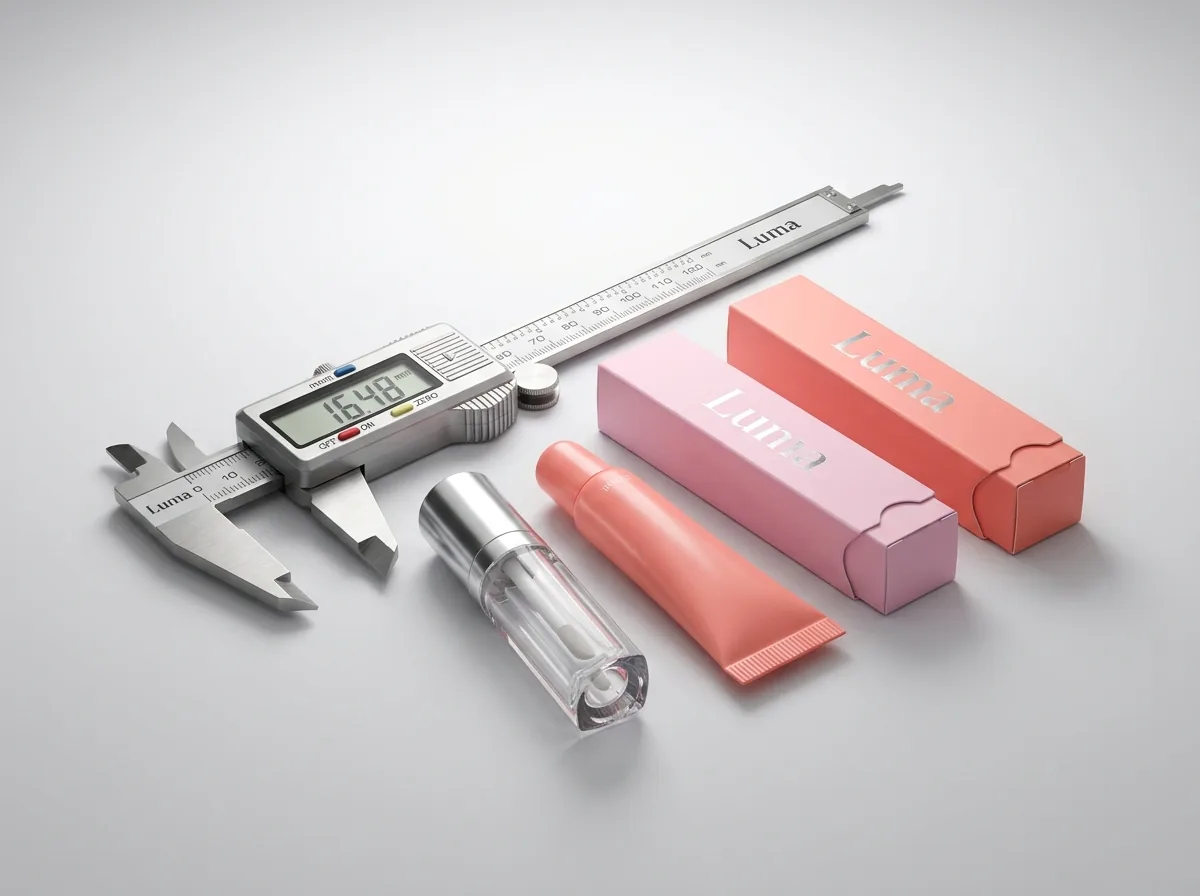
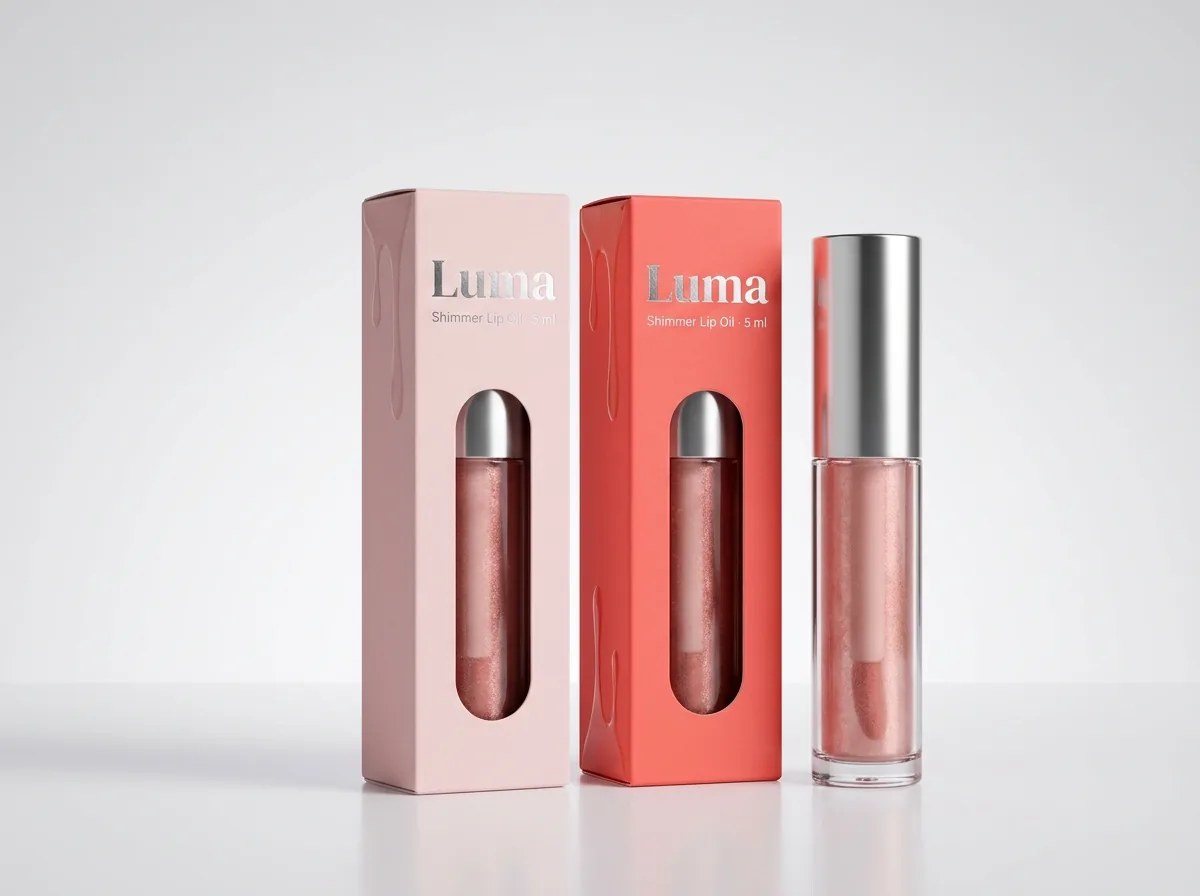
Always measure a filled, capped production sample rather than relying on nominal milliliter capacity. Two 6 ml lip gloss vials from different molders can vary by 3/8 inch in height and 1/8 inch in width depending on whether the base uses a thick heavy-wall cosmetic sham (a solid clear acrylic bottom that makes the vial look taller) and whether the cap has a long metallized wand handle. Follow these four steps and enter your measurements into our Box size finder to get your exact inside carton dimensions: 1. Measure horizontal width at both ends: On a rigid wand vial, check the clear bottom barrel and the screw-on cap with calipers; use whichever is wider and add 1/16 inch (0.0625 inches) for both inside Length (L) and Width (W). On a plastic squeeze tube, measure the flat heat-sealed crimp across the top and add 1/8 inch (0.125 inches) for inside Length (L), then measure the round cap diameter at the bottom and add 1/16 inch for inside Width (W). 2. Measure total closed height: Stand the capped vial or tube upright on a flat table and measure from the table surface to the highest point of the cap or crimp. Add 1/16 inch for standard folding cartons, or 1/8 inch if your squeeze tube has a flexible crimp that curves slightly. 3. Measure the clear barrel zone for window cutouts: If you want a front die-cut window, measure from the bottom base of the vial up to the bottom edge of the screw cap skirt (where the opaque cap stops). Also check where the liquid fill line sits when the vial stands upright. 4. Set window top and bottom margins: Position the bottom edge of your die-cut window at least 3/8 inch above the bottom score line (clearing thick acrylic base shams) and stop the top edge of the window at least 1/4 inch below the cap skirt so the plastic neck threads and air headspace bubble stay hidden behind solid printed paperboard.
- Wand vial inside Length (L) & Width (W): widest barrel or cap diameter + 1/16 in.
- Squeeze tube inside Length (L): flat crimp width + 1/8 in; inside Width (W): round cap diameter + 1/16 in.
- Inside Height (H): total capped height + 1/16 to 1/8 in so top flaps close flat.
- Window cutout zone: keep 3/16 in minimum side pillars on narrow faces and stop 1/4 in below the cap skirt.
Know your size? Compare pricing across up to 3 quantities.
Request a Quote →How do you size a stepped insert for a lip liner and lip gloss duo box?
Lip combo kits that pair a wooden or retractable lip liner pencil with a matching doe-foot lip gloss wand are one of the highest-converting SKUs in beauty, but the two components never share the same dimensions. A standard sharpeable lip liner pencil with its cap measures roughly 0.35 inches in diameter and 5.0 to 5.25 inches tall, while a 6 ml doe-foot lip gloss wand measures 0.75 inches wide and 4.375 inches tall. If you drop both items into an open 2.0 × 0.875 × 5.25 inch carton with no insert, the slender lip liner falls diagonally across the box and the shorter lip gloss vial sinks to the bottom floor, leaving 3/4 inch of empty space above its cap in the front window. To make both products look tailored, our design team builds a single folded paperboard divider insert with two features: a narrow 0.4375 inch cradle column that locks the slender lip liner pencil vertically on the left, and a folded 0.625 inch bottom riser step under the wider 0.8125 inch lip gloss slot on the right. That bottom step boosts the shorter lip gloss vial upward so the top of the lip gloss cap and the top of the lip liner cap sit on the exact same horizontal line inside the carton. You can compare how twin windows or solid color-blocked panels frame these sets in our guide on window lip gloss boxes vs solid shade band cartons, and learn how to lay out the artwork for multi-shade kits in how to prepare custom lip gloss box dielines and shade names. If you also sell solid bullet lipsticks alongside your glosses, see our custom lipstick boxes for compact bullet-tube sizing.
What sizing mistakes cause lip gloss cartons to bulge or rattle?
Avoid these five dimensional errors before approving your custom lip gloss dieline
- Ordering a square carton for a heat-crimped plastic squeeze tube, which crushes the wider flat top seal and bows the front and back carton walls.
- Adding 1/4 inch of extra width around a tall 4.5 inch wand vial, allowing the slender bottle to lean diagonally inside the front window.
- Cutting a front window all the way up to the cap height, exposing ugly plastic neck threads and the air headspace bubble at the top of the liquid fill.
- Forgetting to measure a decorative or flared applicator cap collar when the cap is slightly wider than the clear lower barrel.
- Packing a shorter lip gloss wand and a taller lip liner pencil into a duo box without an internal bottom step to align their top caps.
Find your size
Suggested inside size: 0.75 × 0.75 × 3.5 in
A starting point. Your account manager confirms the size with you before the proof.
Quote this size →Packaging for this
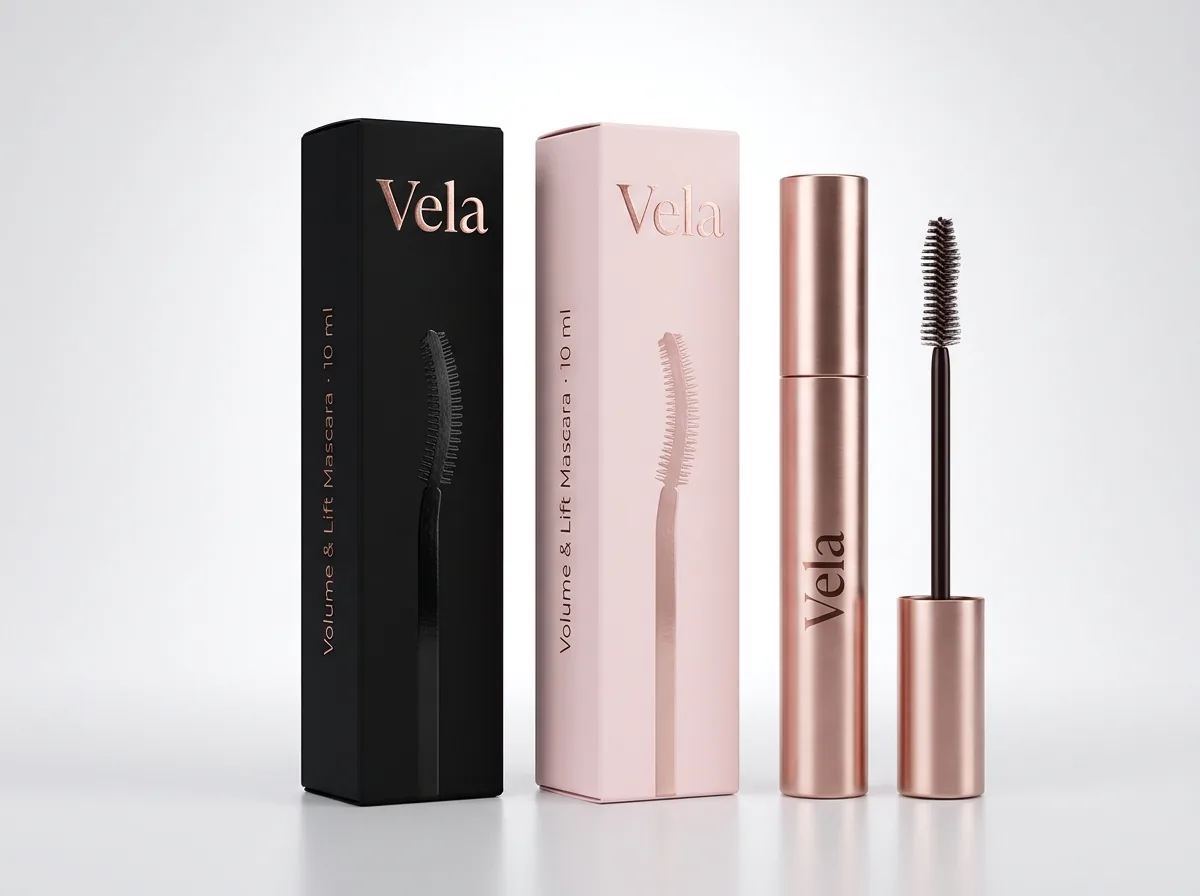
Ready to order lip gloss boxes? Compare up to 3 quantities with a free 3D mockup.
Request a Quote →Questions about lip gloss boxes
What is the standard box size for a 5 ml or 6 ml doe-foot lip gloss wand?
Most cylindrical 5 ml to 7 ml doe-foot lip gloss vials measure 0.68 to 0.75 inches wide and 4.25 to 4.375 inches tall, which fits inside a 0.8125 × 0.8125 × 4.5 inch custom folding carton.
What size box fits a 15 ml slanted-tip plastic lip gloss squeeze tube?
A 10 ml to 15 ml crimped plastic squeeze tube typically fits a rectangular 1.25 × 0.875 × 4.25 inch carton. The 1.25 inch front width accommodates the flat heat-sealed crimp, while the 0.875 inch depth holds the round screw cap.
How much clearance should I add around a glass rollerball or PETG lip gloss vial?
Add 1/16 inch (0.0625 inches) to the widest diameter for inside Length and Width, and 1/16 to 1/8 inch to the total capped height so the vial slides in smoothly without rattling.
Does a hang-tab lip gloss box change the inside carton dimensions?
No. An integrated pegboard hang tab extends upward from the rear outer panel above the top tuck lid, so your inside Length × Width × Height measurements stay identical to a standard tuck carton.
Can you verify my lip gloss vial and squeeze tube fit before printing 1,000 boxes?
Yes. Every order includes a free custom vector dieline, digital proof and 3D mockup before payment, and you can order a $50 sample kit or a paid custom-printed sample (credited toward your full order if you proceed).
Should I give inside or outside measurements when ordering custom lip gloss boxes?
Always give inside dimensions written as Length × Width × Height in inches. Inside measurements reflect the exact usable space for your wand vial, squeeze tube or insert, and our structural team adds the paperboard thickness on the dieline automatically.
Still have a question? Ask a packaging specialist.
Request a Quote →Request your lip gloss boxes quote
Tell us your size and quantities, and one dedicated account manager prepares pricing for each tier.
- Free design & AI-to-print studio + 3D mockup
- No die or plate charges · 4–5 day rush available
- Free shipping to all 50 states
- 10% off your first order
All CubitPack service terms come from our published product specifications and were reviewed by a packaging specialist. Container benchmarks are starting points verified against your physical vials and tubes on your free custom dieline proof. Spot something wrong? Tell us and we will fix it.
What changed
- October 22, 2026: First published.
- October 22, 2026: Updated specifications, terminology, and verified source links.
More guides
New packaging guides by email
Sizes, materials and design tips. Unsubscribe anytime.