
What size eyeshadow box do I need?
Short answer: A standard 36 mm single eyeshadow compact fits a 2.0 × 2.0 × 0.625 inch carton, while a 26 mm magnetic refill pan in a blister shell fits a 1.5 × 1.5 × 0.25 inch sleeve. Four-pan quads use 2.75 × 2.75 × 0.625 inch custom eyeshadow boxes, and 9-pan palettes use 4.5 × 4.5 × 0.625 inches.
On this page
- How do I measure a single eyeshadow compact or palette for a custom box
- What are the standard eyeshadow box dimensions by compact and palette type
- How do I size sleeves for 26 mm and 36 mm magnetic eyeshadow refill pans
- What size box or sleeve fits 4-pan quads, 9-pan squares, and 12-pan palettes
- What size carton fits liquid eyeshadow wands and cream shadow pots
- How much extra box space do I need for a shock-absorbing insert
- Common mistakes
- FAQs
Request a custom quoteFree dieline & 3D mockup
The right eyeshadow box size depends on whether you are packing a bare 26 mm magnetic tin pan, an injection-molded plastic single compact, a cylindrical liquid shadow vial, or a book-style magnetic palette. For low-profile square compacts and quads, always measure the widest outside length, width (across the rear hinge barrel and front thumb clasp), and thickness with digital calipers, then add 1/16 inch (0.0625 in) to each dimension. Keeping clearance tight at 1/16 inch stops the compact from sliding and slamming against the carton walls if dropped, which is the main cause of shattered pressed powder cakes. If you ship fragile baked or multichrome shadows by mail, add 0.5 inches to the length and width to fit a hollow-wall paperboard buffer frame inside your custom printed eyeshadow boxes, and verify every panel on a free 3D mockup before paying.
How do I measure a single eyeshadow compact or palette for a custom box?
Eyeshadow compacts are deceptive to measure with a flat desk ruler because their walls are rarely straight squares. Most injection-molded acrylic or ABS plastic compacts have a cylindrical hinge barrel protruding from the back spine and a raised thumb-release clasp on the front edge. If you size your carton around the main square body and ignore the hinge and clasp, the compact will bow the front and back carton walls outward and pop the tuck flaps open. Use digital calipers to measure the maximum external length (left to right), depth (front clasp to rear hinge), and height (top lid to bottom base) of your closed compact. Add 1/16 inch (0.0625 in) to all three numbers for smooth hand insertion without internal rattle. When you send those measurements to CubitPack, we generate your custom dieline for eyeshadow packaging boxes with zero die or plate charges.
- Step 1 (Length): Measure the closed compact or palette from left edge to right edge and add 1/16 inch (0.0625 in).
- Step 2 (Width across hinge & clasp): Measure from the tip of the front thumb clasp to the back of the rear hinge barrel and add 1/16 inch.
- Step 3 (Depth / Thickness): Measure from the bottom base to the highest point of the top lid (including domed baked shadow lids) and add 1/16 inch.
- Step 4 (Perimeter frame allowance): If adding a hollow-wall paperboard shock frame for mail-order protection, add 0.25 inches per side (0.5 in total to length and width).
- Step 5 (Grain & opening orientation): Set the opening panels on the wider length × depth edges so the compact slides in like a drawer rather than dropping edge-first.
What are the standard eyeshadow box dimensions by compact and palette type?
Although every CubitPack carton is die-cut to your exact inside length × width × depth, color cosmetics suppliers build their tin pans, plastic compacts, and cardboard palettes around a few universal pan diameters (primarily 26 mm, 36 mm, and 59 mm). Use the size chart below to match your hardware format to its standard outer carton or sleeve dimensions. Notice how low-profile compacts list the two large face dimensions first and the narrow thickness last (for example, 2.0 × 2.0 × 0.625 inches), whereas tall liquid eyeshadow wands follow upright bottle sizing with a small square base and a 4.25 inch height.
| Eyeshadow format | Inside box or sleeve size (L × W × D) | Recommended carton style |
|---|---|---|
| 26 mm round or square magnetic refill pan (in blister) | 1.5 × 1.5 × 0.25 in | Thumb-notch card sleeve or flat tuck folder |
| 36 mm single refill pan or mini sample compact | 1.75 × 1.75 × 0.375 in | Straight tuck end or window sleeve |
| Standard 1.5 g – 3 g single eyeshadow compact | 2.0 × 2.0 × 0.625 in | Straight tuck end or die-cut window box |
| Baked dome shadow or glass cream shadow pot | 2.125 × 2.125 × 1.125 in | Cube straight tuck end with insert |
| 4-pan pocket eyeshadow quad compact with mirror | 2.75 × 2.75 × 0.625 in | Straight tuck end or tray and sleeve |
| 4 ml – 6 ml liquid eyeshadow wand or shadow stick | 0.875 × 0.875 × 4.25 in | Tall straight tuck end or hang tab box |
| 9-pan square magnetic eyeshadow palette | 4.5 × 4.5 × 0.625 in | Open-ended slipcase sleeve or straight tuck box |
| 12-pan rectangular artistry palette with mirror | 6.25 × 4.25 × 0.75 in | Straight tuck end or padded corrugated mailer |
How do I size sleeves for 26 mm and 36 mm magnetic eyeshadow refill pans?
Refillable makeup systems let shoppers buy individual tin or aluminum eyeshadow pans and drop them into a reusable magnetic palette. Because a bare 26 mm (1.02 inch) metal pan is only 0.08 inches thick and holds fragile pressed pigment, brands first snap the pan into a small clear PET clamshell blister or recessed paperboard carrier before sliding it into a printed outer sleeve. Always measure the outer perimeter of the closed plastic clamshell blister, not the bare 26 mm tin pan. Most 26 mm single blisters measure 1.375 × 1.375 × 0.20 inches, which fits cleanly inside a 1.5 × 1.5 × 0.25 inch paperboard sleeve or tuck envelope. Adding a half-moon thumb notch on the top edge and a 0.875 inch round window in the center of the front panel lets customers see the shimmer shade and slide the blister out without pinching the pan.
Know your size? Compare pricing across up to 3 quantities.
Request a Quote →What size box or sleeve fits 4-pan quads, 9-pan squares, and 12-pan palettes?
Multi-pan eyeshadow palettes come in two primary constructions: injection-molded plastic compacts (common for 4-pan quads and 6-pan minis) and book-style rigid paperboard cases with magnetic closures (common for 9-pan, 12-pan, and 18-pan palettes). A standard 4-pan quad holding four 26 mm pans measures roughly 2.68 × 2.68 × 0.56 inches and takes a 2.75 × 2.75 × 0.625 inch straight tuck end carton. Book-style 9-pan square palettes typically measure 4.375 × 4.375 × 0.56 inches and take a 4.5 × 4.5 × 0.625 inch outer carton or open-ended slipcase sleeve. Rectangular 12-pan palettes (arranged in three rows of four pans) usually measure 6.125 × 4.125 × 0.68 inches and fit a 6.25 × 4.25 × 0.75 inch box. If your palette ships with a dual-ended eyeshadow brush or an interior mirror, verify whether the lid is thicker at the spine than at the magnetic flap edge.
What size carton fits liquid eyeshadow wands and cream shadow pots?
Not every eyeshadow is a flat pressed powder pan. Liquid glitter and matte fluid shadows use cylindrical PETG or glass vials with a doe-foot applicator wand, while cream-to-powder formulas use twist-up sticks or thick-walled glass pots. Because liquid eyeshadow wands are shorter than mascara tubes, they usually fit a 0.875 × 0.875 × 4.25 inch or 0.75 × 0.75 × 4.0 inch upright carton. You can compare similar tall tube formats on our custom mascara boxes and custom eyeliner boxes pages. Round glass cream shadow pots (typically 4 g to 5 g capacity) have a heavy glass base and a tall screw cap, measuring around 2.0 inches wide by 1.0 to 1.125 inches tall. Those pots need a deeper 2.125 × 2.125 × 1.125 inch carton so the heavy glass jar cannot crush the bottom tuck flap.
How much extra box space do I need for a shock-absorbing insert?
Soft metallic, duochrome, and high-pearl eyeshadow formulas use higher levels of liquid binders and spherical mica, which makes the pressed cake softer and more prone to cracking when a parcel lands on its corner. If you sell direct-to-consumer or ship palettes to retail distribution centers, adding an internal shock-buffer insert inside your unit carton dramatically reduces transit breakage. A folded paperboard perimeter buffer frame wraps around all four narrow edges of your compact or palette, creating a 0.25 inch hollow air cushion between the compact and the outer carton wall. To size your outer box for a perimeter frame, add 0.5 inches to both the length and width of your compact (0.25 inches per side). You can explore custom cradle designs on our custom cardboard inserts page.
What are the most common eyeshadow box sizing mistakes?
Flat compacts and fragile pressed pigments punish even small dimensional errors. Avoid these five sizing mistakes before approving your dieline
- Leaving 1/8 inch to 1/4 inch of empty slack around a pressed powder compact without an insert, allowing the compact to accelerate and crack on impact.
- Measuring the square body of a plastic compact and forgetting the protruding front thumb clasp and rear hinge barrel.
- Sizing a 26 mm magnetic refill pan sleeve to the 1.02 inch metal pan instead of the 1.375 inch clear plastic blister shell that holds it.
- Putting the tuck opening on the large 4.5 × 4.5 inch front face of a flat palette box instead of the 4.5 × 0.625 inch end panel.
- Cutting a front shade window wider than the inner pan rim, which exposes the unprinted plastic hinge or glue well around the pan.
Find your size
Suggested inside size: 1.5 × 1.5 × 0.25 in
A starting point. Your account manager confirms the size with you before the proof.
Quote this size →Packaging for this
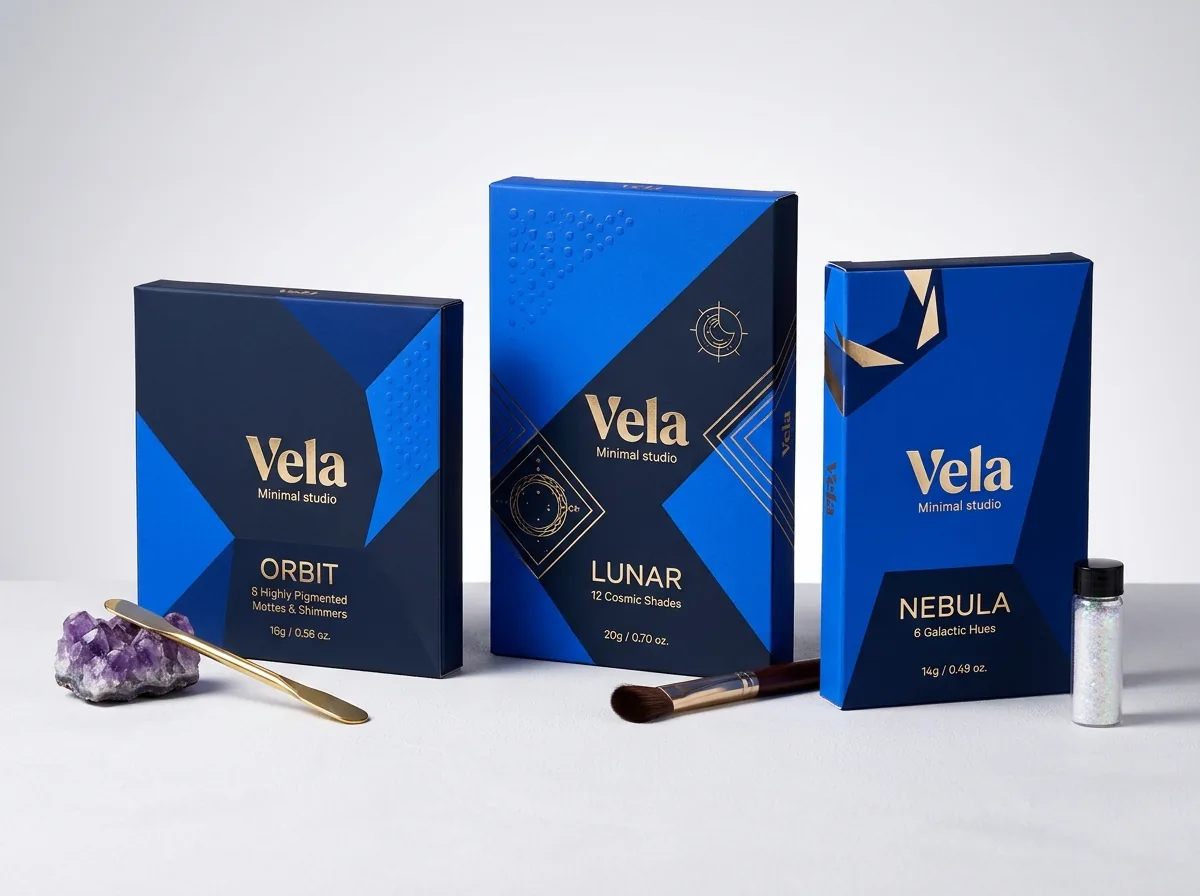
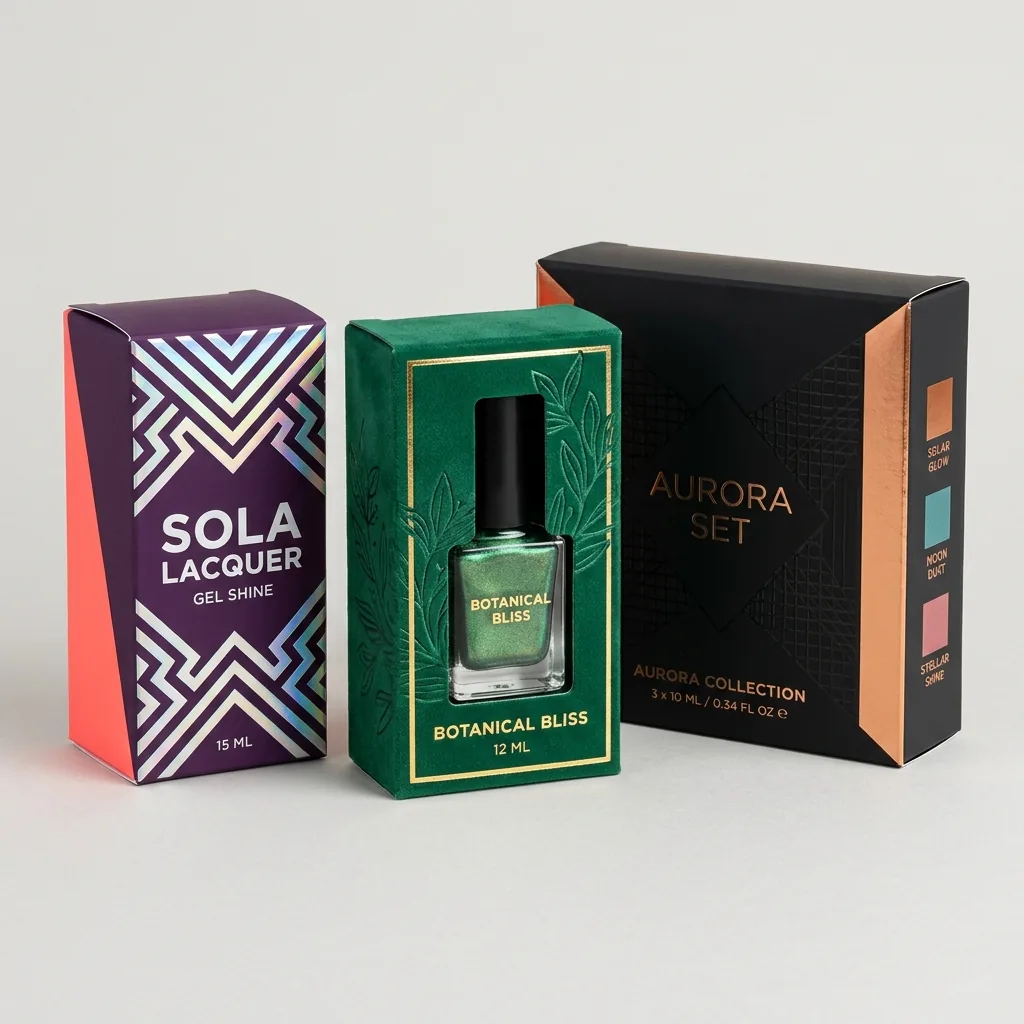
Ready to order eyeshadow boxes? Compare up to 3 quantities with a free 3D mockup.
Request a Quote →Questions about eyeshadow boxes
What is the standard box size for a single eyeshadow compact?
Most standard 1.5 g to 3 g single eyeshadow compacts (built around a 36 mm pan) fit an inside carton size of 2.0 × 2.0 × 0.625 inches. Smaller 26 mm single screw-top compacts usually take 1.75 × 1.75 × 0.5 inches.
What size sleeve fits a 26 mm magnetic eyeshadow refill pan?
When a 26 mm (1.02 inch) magnetic tin pan is seated inside a standard protective PET clamshell blister, the outer sleeve or tuck envelope typically measures 1.5 × 1.5 × 0.25 inches.
How much clearance should I add around an eyeshadow palette for an outer sleeve?
Add 1/16 inch (0.0625 in) to the width and thickness of your closed magnetic palette so the paperboard slipcase sleeve glides on smoothly without scratching the matte lamination, yet holds tightly enough that the palette cannot slip out.
What size box fits a 9-pan square eyeshadow palette?
A standard 9-pan square magnetic palette (three rows of three 26 mm or 30 mm pans) typically fits an inside carton or sleeve size of 4.5 × 4.5 × 0.625 inches. If you include an internal shock-buffer frame, step the outer box up to 5.0 × 5.0 × 0.75 inches.
Do custom eyeshadow box dimensions or window cutouts cost extra?
No. CubitPack never charges die or plate fees. Whether you need a wafer-thin 0.25 inch refill sleeve with a center window or a 12-pan palette box with an insert, custom dielines are included free.
Can I order multiple shade designs in the same eyeshadow box size?
Yes. If you have 8, 12, or 24 single eyeshadow shades that all use the same 2.0 × 2.0 × 0.625 inch box, select 2 designs or 3+ designs in the quote form so we can gang your shades on one shared dieline.
Still have a question? Ask a packaging specialist.
Request a Quote →Request your eyeshadow boxes quote
Tell us your size and quantities, and one dedicated account manager prepares pricing for each tier.
- Free design & AI-to-print studio + 3D mockup
- No die or plate charges · 4–5 day rush available
- Free shipping to all 50 states
- 10% off your first order
The dimensions in this guide were measured across standard 26 mm and 36 mm tin refill pans in PET blisters, injection-molded single and 4-pan quad compacts, 4–6 ml liquid shadow wands, and 9-pan to 12-pan magnetic palettes, with 1/16 inch clearance added. Checked by a CubitPack packaging specialist. Spot something wrong? Tell us and we will fix it.
Sources
What changed
- October 22, 2026: First published.
- October 22, 2026: Updated specifications, terminology, and verified source links.
More guides
New packaging guides by email
Sizes, materials and design tips. Unsubscribe anytime.