
How do you lay out FDA Drug Facts on custom sunscreen boxes?
Short answer: Place the Broad Spectrum SPF rating, water-resistance time, and net contents on the front panel, and reserve the back and side panels for the boxed 21 CFR 201.66 Drug Facts table in 100% black ink. When ordering custom sunscreen boxes, keep Drug Facts inside the 1/8 inch fold safe zones.
On this page
- What belongs on each panel of a US retail sunscreen carton
- How do you format Broad Spectrum SPF and water resistance on the front panel
- What is the exact section order inside an OTC sunscreen Drug Facts box
- How do you fit a full Drug Facts table onto a compact 1.7 oz or stick box
- Where do lot numbers, expiration dates, and barcodes go on the dieline
- Common mistakes
- FAQs
Request a custom quoteFree dieline & 3D mockup
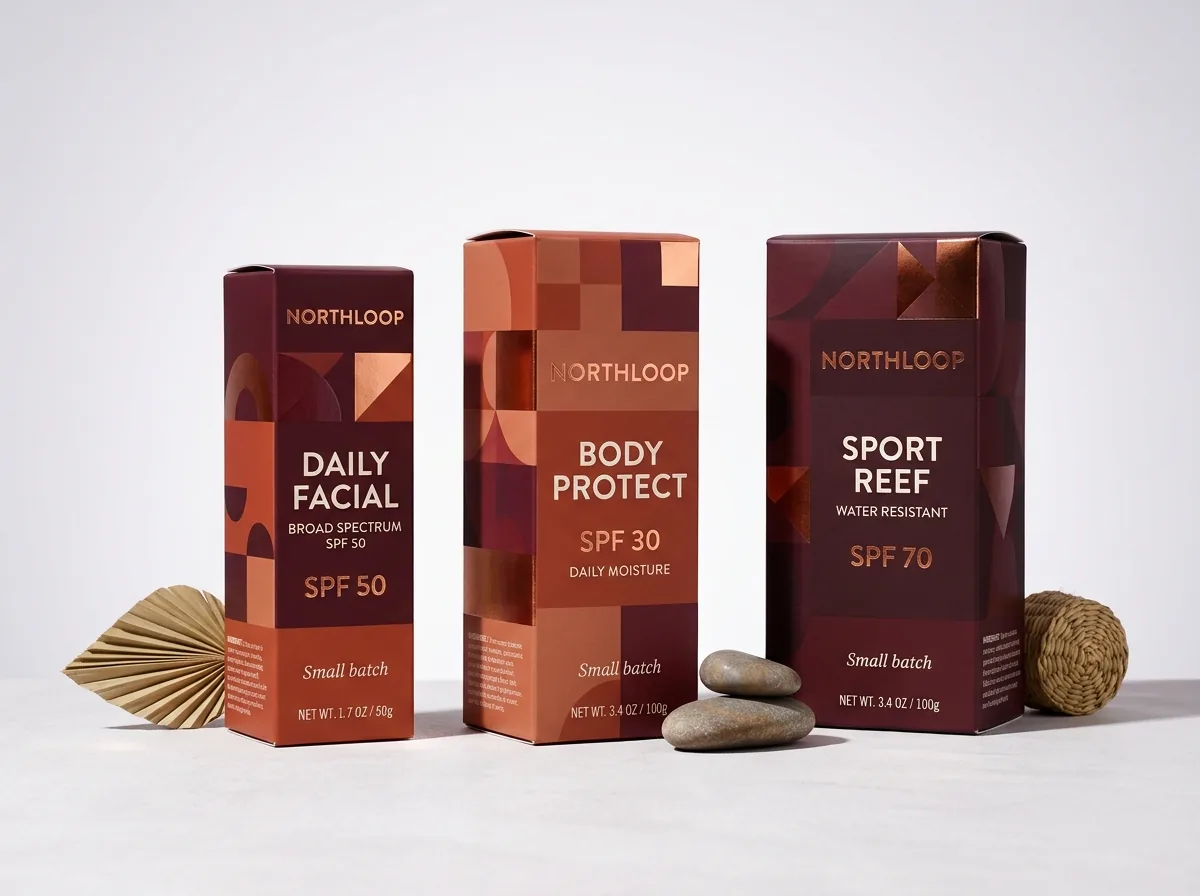
Unlike ordinary facial moisturizers or body lotions, every sunscreen sold in the United States is regulated by the FDA as an over-the-counter (OTC) drug under 21 CFR 201.327 and 21 CFR 201.66. When you package a tube, stick, or airless pump inside a retail box, the outer carton is the container shoppers inspect before buying - so every mandatory OTC element must appear clearly on the outside of the box. The front Principal Display Panel carries the product identity, Broad Spectrum SPF value, water-resistance duration (40 or 80 minutes, if applicable), and net quantity of contents. The rear and side panels hold the standardized Drug Facts box in a strict top-to-bottom sequence: Active Ingredients and Purpose, Uses, Warnings, Directions, Other Information (including the heat and direct-sun storage rule), Inactive Ingredients, and Questions. Our free prepress team checks your dieline layout before printing.
What belongs on each panel of a US retail sunscreen carton?
Trying to squeeze active zinc oxide percentages, sunburn warnings, two-hour reapplication rules, and a 30-item botanical inactive ingredient list onto a curved 1.7 oz tube almost always forces brands into expensive peel-back booklet labels. Moving that required copy onto the four flat walls of custom printed sunscreen cartons gives your artwork room to breathe while keeping the inner tube clean. Use the four-panel layout map below to assign every required disclosure to the right face of your folding carton dieline before exporting your print PDF.
| Carton panel | Mandatory & brand elements | Key prepress & regulatory rule |
|---|---|---|
| Front (Principal Display Panel) | Brand, Broad Spectrum SPF value, Water Resistant (40/80 min), Net Wt / Fl Oz | SPF & Broad Spectrum in equal prominence; net contents in bottom 30% |
| Back panel (Information Panel) | Drug Facts header, Active Ingredients/Purpose, Uses, Warnings, Directions | Enclosed in a continuous box rule; 100% K black ink on light background |
| Right side panel (Continued) | Drug Facts (continued): Other Information, Inactive Ingredients, Questions | Use 'Drug Facts (continued)' header if table spans onto a second panel |
| Left side panel | Skin-type icons, reef/mineral callouts, distributor address, UPC barcode | Keep barcode in a 1.5 × 1.0 in white knockout zone; bars run vertically |
| Top & bottom tuck flaps | Shade name/tint band (top flap) and embossed lot/expiry zone (bottom flap) | Leave an unvarnished window on bottom flap if ink-jetting lot & expiration |
How do you format Broad Spectrum SPF and water resistance on the front panel?
Under 21 CFR 201.327(a), the front Principal Display Panel (PDP) of a sunscreen carton has specific rules that differ from standard cosmetics. If your formula passes Broad Spectrum testing, the words Broad Spectrum SPF [number] must appear together as a continuous statement on the front face, printed in uniform font size and style so Broad Spectrum is just as prominent as SPF 30 or SPF 50. If your formula is water resistant, the front panel must also state either Water Resistant (40 Minutes) or Water Resistant (80 Minutes). Finally, place the statement of identity (such as Mineral Sunscreen Lotion or Sunscreen Stick) and the net quantity of contents in both US customary and metric units (such as 1.7 FL OZ (50 mL)) in the bottom 30% of the front panel, keeping at least 1/8 inch inside the bottom fold score.
What is the exact section order inside an OTC sunscreen Drug Facts box?
The FDA Drug Facts box (21 CFR 201.66) is a standardized medical table: you cannot reorder the headings, rename them, or mix marketing descriptions into the box. Every Drug Facts panel starts with the title Drug Facts at the top left, followed by horizontal barlines separating seven mandatory sections in exact order. First comes Active ingredient (or Active ingredients) on the left with Purpose (Sunscreen) aligned on the right, listing each UV filter alphabetically with its exact percentage (for example, Zinc oxide 18.5%). Second is Uses (helps prevent sunburn, plus skin cancer/early skin aging language if Broad Spectrum SPF 15+). Third is Warnings (For external use only, Do not use on damaged or broken skin, When using this product keep out of eyes, Stop use and ask a doctor if rash occurs, Keep out of reach of children). Fourth is Directions (apply 5-7 minutes before sun exposure; reapply after 40/80 minutes of swimming or sweating and at least every 2 hours; Sun Protection Measures; children under 6 months). Fifth is Other information (protect the product in this container from excessive heat and direct sun). Sixth is Inactive ingredients in alphabetical order, and seventh is Questions or comments? with a domestic phone number.
- 1. Active ingredients / Purpose: alphabetical UV filters (such as Avobenzone, Homosalate, Titanium Dioxide, Zinc Oxide) + 'Sunscreen'.
- 2. Uses: sunburn prevention and Broad Spectrum SPF 15+ protective statements.
- 3. Warnings: external use, broken skin, eye contact, rash stop-use, and child reach warnings.
- 4. Directions: 5-7-minute pre-application, 40/80-minute and 2-hour reapplication, and Sun Protection Measures.
- 5. Other information: mandatory heat and direct-sun storage warning (21 CFR 201.327(e)).
- 6. Inactive ingredients & 7. Questions: alphabetical inactive list and US contact number.
Know your size? Compare pricing across up to 3 quantities.
Request a Quote →How do you fit a full Drug Facts table onto a compact 1.7 oz or stick box?
A full sunscreen Drug Facts panel is long - often 220 to 300 words once you include Sun Protection Measures and 25 inactive ingredients. On a tall 6 oz beach bottle carton (2.75 × 2.75 × 7.5 inches), the entire table fits on the back panel in a single column. On a 1.7 oz facial pump carton (1.75 × 1.75 × 4.75 inches) or a 0.6 oz mineral stick box (1.75 × 1.25 × 3.5 inches), a single back panel is not tall enough. Never wrap a single Drug Facts box across a vertical fold crease onto an adjacent panel; crease lines distort small text and break the table border. Instead, split the table cleanly across the back panel and the right side panel using the official multi-panel format: place a small right-pointing arrow at the bottom right of the first panel, and start the top of the adjacent panel with the heading Drug Facts (continued). Keep both panels at least 1/8 inch inside the vertical fold score lines so neither box border sits on a corner crease. You can apply the same multi-panel layout on compact custom lotion boxes and medicated custom skincare boxes.
Where do lot numbers, expiration dates, and barcodes go on the dieline?
Because OTC sunscreens carry an expiration date (unless stability testing supports exempt status under 21 CFR 211.137) along with a batch lot code, your co-packer needs a dedicated zone on the outer carton to inkjet-code or laser-etch each unit on the filling line. If you laminate your sunscreen carton with gloss, matte, or soft-touch film, standard water-based inkjet ink can smear on top of the slick plastic film, and UV lasers may not contrast cleanly on dark colors. Tell our prepress team how your filler marks lot and expiry dates: we will reserve an unlaminated, unvarnished white rectangle (typically 1.25 × 0.375 inches) on the bottom tuck flap so inkjet printers bond instantly, or position a dark ink patch for laser ablation coding.
- 100% K black ink: always set Drug Facts text, barlines, and UPC barcodes in 100% black (0C 0M 0Y 100K), never 4-color rich black.
- 1/8 inch safe margin: keep the outer Drug Facts box border at least 0.125 in away from every fold score and cut line.
- Unvarnished coding window: leave a glue-free, lamination-free zone on the bottom flap for lot and expiration inkjetting.
- Disclaimer: our team handles prepress layout and typography; always have your regulatory specialist approve final OTC text.
What are the most common sunscreen box Drug Facts prepress mistakes?
Catching these five layout and prepress issues on your digital proof prevents costly reprints and compliance holds
- Wrapping a single Drug Facts box across a vertical fold crease instead of splitting it into two clean panels with a 'Drug Facts (continued)' header.
- Setting 6 pt Drug Facts text in 4-color CMYK rich black or metallic ink, which causes slight plate misregistration to blur fine type.
- Printing 'SPF 50' in giant type while hiding 'Broad Spectrum' in tiny letters, instead of keeping the Broad Spectrum SPF statement in uniform prominence.
- Leaving out the mandatory 'protect the product in this container from excessive heat and direct sun' statement under Other Information.
- Laminating the entire bottom tuck flap without leaving a knockout window where your co-packer inkjets the lot number and expiration date.
Find your size
Suggested inside size: 1.75 × 1.25 × 3.5 in
A starting point. Your account manager confirms the size with you before the proof.
Quote this size →Packaging for this

Ready to order sunscreen boxes? Compare up to 3 quantities with a free 3D mockup.
Request a Quote →Questions about sunscreen boxes
Does the Drug Facts panel have to be on the outer box if it is already printed on the tube?
Yes. Under FDA rules, mandatory OTC labeling must be visible to the shopper at the point of purchase without opening or destroying the outer retail carton. In fact, putting the full Drug Facts table on the outer box lets you simplify the tube's back copy.
What is the minimum font size for an OTC Drug Facts table on a sunscreen carton?
Under 21 CFR 201.66(d), standard Drug Facts body text and bulleted statements must be at least 6 point type (with at least 0.5 point leading), section headings at least 7 point bold (or 8 point), and the main 'Drug Facts' title at least 9 point bold italic.
Can I print the Drug Facts table in navy blue or forest green ink to match my brand?
Yes, 21 CFR 201.66 allows Drug Facts text and rules to be printed in a single dark color (such as 100% black, dark navy, or deep forest green) on a white or contrasting light neutral background. Never use light pastel, metallic foil, or multi-color text inside the box.
What should I do if my mineral sunscreen stick box is too small for the full Drug Facts table?
Split the Drug Facts table across two or three contiguous panels (such as the back panel, right side panel, and left side panel) using the 'Drug Facts (continued)' heading and continuation arrow, or widen the carton profile slightly at zero die cost.
Will CubitPack help set up the Drug Facts table on my sunscreen box dieline?
Yes. Every order includes free prepress design help, a flat digital proof, and a 3D mockup before payment. Send us your approved regulatory copy and we will format the Drug Facts table, barlines, hairpins, and safe margins on your custom dieline.
Where should the expiration date and lot code be placed on a custom sunscreen box?
Most fillers stamp or inkjet the lot number and expiration date on the bottom tuck flap or at the bottom of the back panel. Tell us whether your co-packer uses inkjet, thermal transfer, or laser coding so we reserve the right unvarnished or inked zone.
Still have a question? Ask a packaging specialist.
Request a Quote →Request your sunscreen boxes quote
Tell us your size and quantities, and one dedicated account manager prepares pricing for each tier.
- Free design & AI-to-print studio + 3D mockup
- No die or plate charges · 4–5 day rush available
- Free shipping to all 50 states
- 10% off your first order
The panel layout map and typography rules in this guide reference US FDA OTC labeling regulations 21 CFR 201.327 (sunscreen drug products) and 21 CFR 201.66 (Drug Facts format), combined with offset prepress standards. This guide is for packaging layout; always verify regulatory claims with your compliance counsel. A CubitPack specialist reviewed every section.
Sources
What changed
- October 22, 2026: First published.
- October 22, 2026: Updated specifications, terminology, and verified source links.
More guides
New packaging guides by email
Sizes, materials and design tips. Unsubscribe anytime.