
White card vs kraft sunscreen boxes: which fits your SPF line?
Short answer: Choose coated white card when your suncare line needs bright clinical colors, soft-touch or gloss lamination, metallic foil, and effortless black-on-white Drug Facts contrast. Pick unbleached kraft board for non-nano zinc surf sticks and outdoor mineral lines when ordering custom sunscreen boxes.
On this page
- How do coated white card and unbleached kraft board compare for suncare
- Why do clinical facial sunscreens and tinted SPF drops use coated white card
- When is unbleached kraft board the right choice for mineral zinc suncare
- How do you keep FDA Drug Facts and barcodes readable on brown kraft
- How do both boards handle sunscreen oil smudges and summer humidity
- Common mistakes
- FAQs
Request a custom quoteFree dieline & 3D mockup
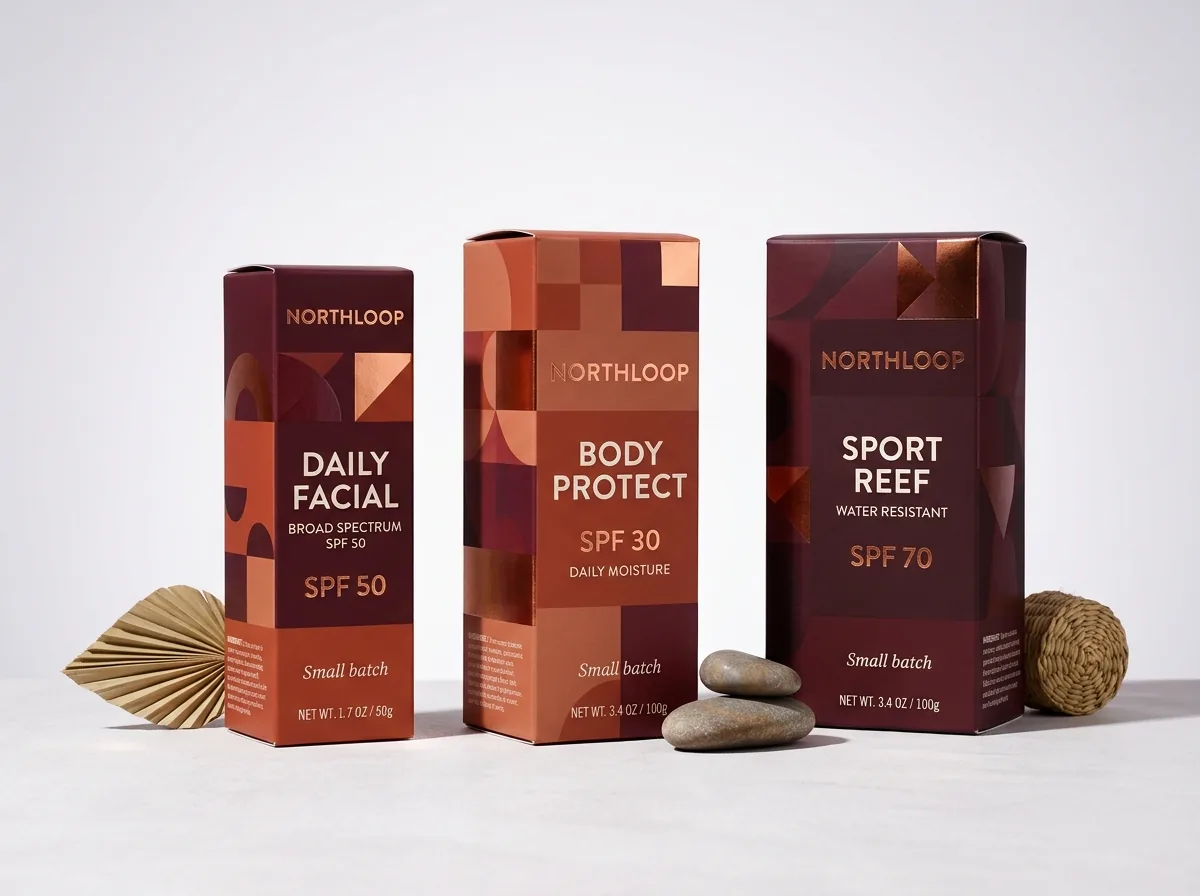
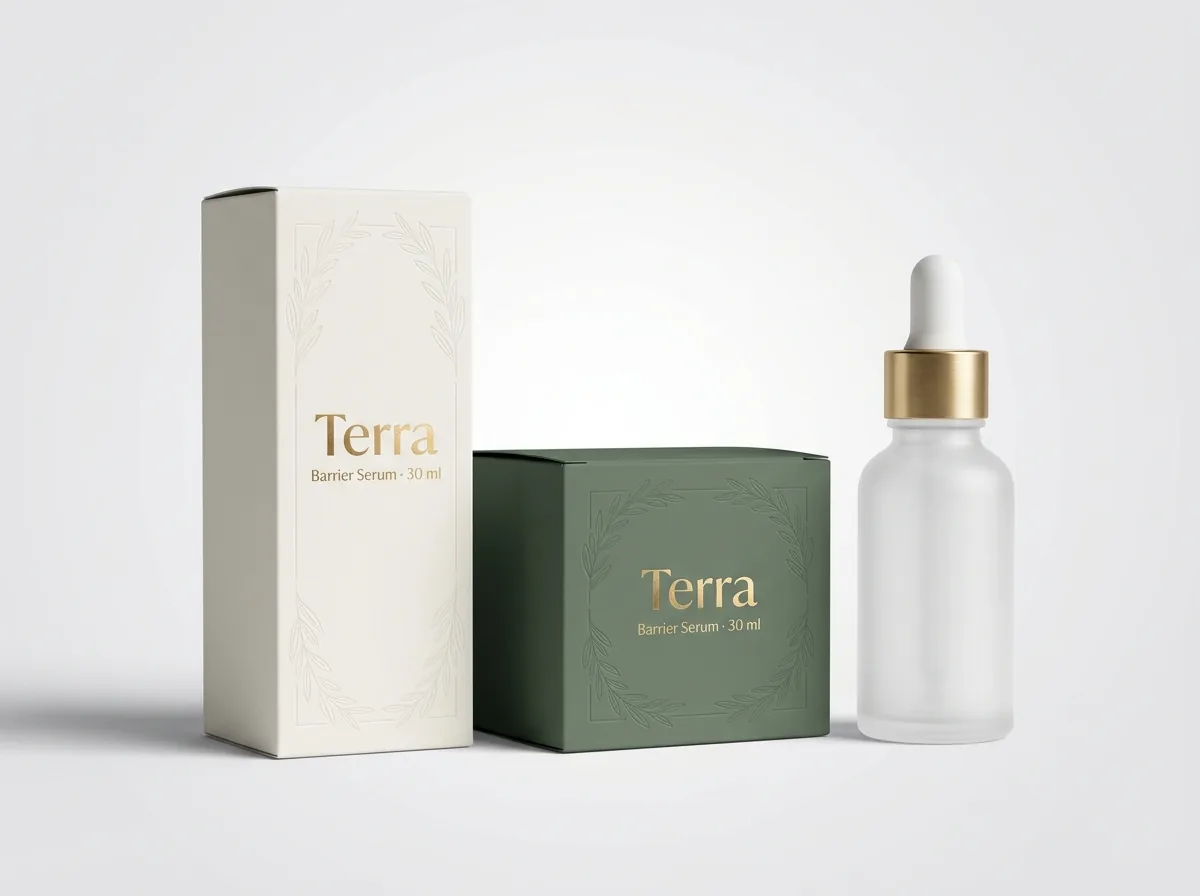
Coated white paperboard and unbleached brown kraft board send two very different signals on the skincare shelf, and they also behave differently during offset printing and humid summer handling. Coated white card has a smooth, clay-coated surface that reflects light evenly, letting solar yellows, coral gradients, skin-tone shade bands, and 6 pt black FDA Drug Facts tables print with razor-sharp contrast. It also bonds cleanly with matte, gloss, or soft-touch film lamination so oily sunscreen fingers and pool splashes wipe right off. Unbleached kraft board exposes natural brown wood fibers for a tactile, coastal look favored by reef-conscious zinc oxide sticks and plastic-free push-up tubes. Because brown kraft absorbs translucent CMYK inks and lowers text contrast, printing a compliant OTC sunscreen carton on kraft requires either dark high-contrast typography or an opaque white ink underbase beneath your Drug Facts panel and barcode.
How do coated white card and unbleached kraft board compare for suncare?
Suncare buyers divide roughly into two camps: clinical or prestige daily SPF shoppers looking for dermatologist-style precision, and outdoor or mineral zinc shoppers looking for rugged, low-impact simplicity. The table below compares coated white card, unbleached kraft, recycled paperboard, and E-flute corrugated across the five factors that matter most on custom printed SPF cartons: color vibrancy, Drug Facts contrast, moisture resistance, decorative finishes, and ideal container match. Pay particular attention to the Drug Facts contrast and moisture columns. Because sunscreens are regulated as OTC drugs in the United States and travel into humid bathrooms and beach totes, your board choice must never compromise 6 pt text readability or allow ink rub-off.
| Carton board stock | Print & Drug Facts contrast | Best SPF formula & finish match |
|---|---|---|
| Coated white card | Maximum black-on-white contrast; true Pantone & CMYK | Daily facial SPF pumps, tinted drops · Matte, gloss, soft-touch, foil |
| Unbleached brown kraft | Warm earthy tone; needs dark ink or white ink knockout box | Non-nano zinc sticks, surf balms · Opaque white ink, blind emboss |
| Recycled paperboard | Crisp print on coated white face or mottled natural back | Clean-beauty SPF tubes & refill cartridges · Matte lamination |
| E-flute corrugated | Strong crush buffer; litho-printed white or kraft liner | 6 oz beach bottles, glass SPF droppers, sun + aloe duo kits |
Why do clinical facial sunscreens and tinted SPF drops use coated white card?
Walk down the suncare aisle of a pharmacy or specialty beauty retailer and you will notice that roughly 80% of daily facial sunscreens, invisible gel primers, and tinted mineral fluids use coated white paperboard. First, white card acts as a neutral reflector underneath translucent CMYK process inks and Pantone spot colors. When you print a warm golden-hour gradient or a precise skin-tone shade band (such as Porcelain, Sand, Caramel, or Espresso for tinted SPF 40 drops), white card reproduces the exact shade inside the bottle without a muddy brown undertone. Second, the smooth clay coating on white card accepts film lamination (matte, gloss, or velvety soft-touch) without microscopic air pockets. Once laminated, the carton resists corner cracking on the folding scores, shrugs off humid summer air, and lets you add raised Spot UV over your SPF 50+ badge or hot foil stamping around your logo. Brands that carry a full facial regimen can match the exact same white card and soft-touch finish across their custom skincare boxes and custom cream boxes.
When is unbleached kraft board the right choice for mineral zinc suncare?
Unbleached brown kraft board is made from long virgin pine fibers that give the sheet high tear resistance and an unmistakable natural texture. For surf brands, outdoor sport sunblocks, baby mineral sticks, and zero-plastic cardboard push-up tubes formulated with non-nano zinc oxide or titanium dioxide, brown kraft communicates outdoor simplicity before the shopper reads a single word. Kraft also pairs well with tactile, low-glare decorative touches. Blind embossing a wave crest or sun icon directly into raw kraft fibers creates a clean sculptural shadow, and printing opaque white ink alongside deep ocean navy, forest green, or burnt sienna produces a crisp coastal look. If you sell a matching zinc lip balm or after-sun salve, you can carry the same unbleached kraft board across your custom lip balm boxes.
- High tear strength: long unbleached wood fibers resist tearing around integrated retail hang tabs.
- Opaque white ink: laying down a white ink hit makes logos, SPF numbers, and wave icons pop against brown fibers.
- Tactile grip: uncoated kraft feels dry and natural in the hand, contrasting nicely with glossy tubes inside.
- Zero-bleach story: aligns naturally with mineral-only reef-conscious and outdoor gear shop merchandising.

Know your size? Compare pricing across up to 3 quantities.
Request a Quote →How do you keep FDA Drug Facts and barcodes readable on brown kraft?
Under FDA OTC sunscreen labeling rules (21 CFR 201.66), the Drug Facts panel must appear on a contrasting background so shoppers can easily read 6 pt active ingredients, warnings, and reapplication instructions. On coated white card, leaving the back panel unprinted gives you maximum black-on-white contrast automatically. On medium-brown unbleached kraft, however, fine 6 pt black serifs or thin 0.5 pt hairpin rules can look softer against the fibrous brown surface. Our prepress team solves this in two ways. For medium-light natural kraft, we print the Drug Facts table in 100% solid black (K) using a clean sans-serif font (like Helvetica or Arial) with slightly heavier barlines so every section divider stands out clearly. For darker kraft stocks or strict retail chain compliance buyers, we print a solid opaque white ink rectangle across the back panel first, then overprint the 100% black Drug Facts table and the UPC barcode right on top of that white ink patch.
How do both boards handle sunscreen oil smudges and summer humidity?
Sunscreen formulas are rich in emollient esters, silicones, plant oils, and oil-soluble UV filters (or oil-dispersed zinc oxide). At a retail tester display, shoppers pump a drop of SPF onto the back of their hand and immediately pick up a boxed unit with oily fingers. Similarly, DTC orders shipped in July sit in hot delivery trucks and humid front porches. Coated white card with exterior matte, gloss, or soft-touch lamination is naturally smudge-proof: oil and water droplets sit on top of the polypropylene or PET film layer without soaking into the paperboard. Raw unbleached kraft, by contrast, is porous so it feels fibrous to the touch. If your kraft mineral stick might leak oil in high heat, wrap the stick or line the inside cavity, and avoid placing pale ink on areas where fingers grip the box. For heavy multi-bottle family beach kits that need extra structural stiffness in humid transit, we can also laminate printed white or kraft liners onto E-flute corrugated board.
- Laminated white card: highest resistance to oily tester thumbprints, pool splashes, and humid transit.
- Raw unbleached kraft: breathable natural feel; best for dry sealed squeeze tubes or capped twist-up mineral zinc sticks stored indoors.
- Laminated kraft: optional matte film over kraft adds moisture and oil protection while keeping the brown kraft tone intact for coastal retail displays.
- E-flute corrugated: best for heavy 6 oz beach bottles and multi-piece suncare gift sets that ship directly to online shoppers across warm summer regions.
What mistakes happen when choosing between white card and kraft for SPF boxes?
Matching your paperboard to your formula and artwork prevents dull colors and compliance headaches. Check these five material pitfalls before ordering
- Printing pastel yellow, peach, or skin-tone tint bands directly onto brown kraft without a white ink underbase, which turns colors muddy.
- Leaving a coated white card sunscreen box unlaminated when printed with dark navy or black ink, leading to scuff marks in shipping cases.
- Printing a UPC barcode directly onto raw brown kraft without a white knockout box, causing checkout scanners to fail.
- Packing an unwrapped oil-heavy zinc balm directly against porous uncoated kraft board where summer heat can cause grease spots.
- Using light 4-color process gray text for the Drug Facts table instead of 100% black ink on a high-contrast white or kraft panel.
Find your size
Suggested inside size: 1.75 × 1.25 × 3.5 in
A starting point. Your account manager confirms the size with you before the proof.
Quote this size →Packaging for this
Ready to order sunscreen boxes? Compare up to 3 quantities with a free 3D mockup.
Request a Quote →Questions about sunscreen boxes
Does unbleached kraft board cost more or less than coated white card for sunscreen boxes?
Both coated white card and unbleached kraft board are standard folding carton stocks at CubitPack, so base board costs are very close. The final unit price depends more on whether you add film lamination, metallic foil stamping, or a white ink underbase. Ask your account manager to quote both side by side.
Can you print bright white text and solar yellow accents on brown kraft sunscreen boxes?
Yes. We print an opaque white ink layer directly onto the unbleached kraft board. You can leave the ink pure white for a crisp coastal look, or print yellow, coral, or ocean blue over a white ink underbase so the colors stay bright against the brown paper.
Is an FDA Drug Facts panel allowed on a brown kraft sunscreen box?
Yes, provided the text and rules have clear visual contrast against the background as required by 21 CFR 201.66. You can either print crisp 100% black type on a light-to-medium kraft stock or print a solid white ink panel on the back of the kraft box for maximum black-on-white contrast.
Can unbleached kraft sunscreen boxes be laminated for moisture resistance?
Yes. Applying a matte lamination over unbleached kraft preserves the warm brown color while sealing the surface against damp hands, sunscreen oil smudges, and summer humidity. Keep in mind that uncoated kraft has a more raw, fibrous feel.
What is the best board option if I want a recycled carton that still prints like white card?
Choose clay-coated recycled paperboard. It has a smooth white printing face on the outside for vibrant CMYK colors, skin-tone shade bands, and high-contrast Drug Facts text, backed by recycled fibers.
Can I feel both white card and kraft board samples before placing my 1,000-box order?
Yes. Order our $50 sample kit (credited toward your first box order) to compare coated white card, unbleached kraft, recycled board, and E-flute corrugated in person along with matte, gloss, and soft-touch laminations.
Still have a question? Ask a packaging specialist.
Request a Quote →Request your sunscreen boxes quote
Tell us your size and quantities, and one dedicated account manager prepares pricing for each tier.
- Free design & AI-to-print studio + 3D mockup
- No die or plate charges · 4–5 day rush available
- Free shipping to all 50 states
- 10% off your first order
The substrate comparisons and prepress contrast rules in this guide come from offset folding carton production standards and FDA OTC Drug Facts legibility requirements (21 CFR 201.66). A CubitPack packaging specialist reviewed every table row. Spot an issue? Email us and we will update it.
Sources
What changed
- October 22, 2026: First published.
- October 22, 2026: Updated specifications, terminology, and verified source links.
More guides
New packaging guides by email
Sizes, materials and design tips. Unsubscribe anytime.