
How do I design custom hot sauce, BBQ and pasta sauce labels for retail?
Short answer: Divide your wrap label into three clear columns: a center brand face scaled to your bottle's diameter (1.75 in wide on a 5 oz woozy), a left wing for your story and heat scale, and a right wing for nutrition facts, allergens and barcode on custom sauce labels.
On this page
- How do I set up a 3-panel wrap grid for a 5 oz woozy or 12 oz BBQ bottle
- How do I design a multi-flavor sauce line with Scoville heat coding
- Should sauce net quantity be in fluid ounces (fl oz) or net weight (oz)
- How do I prepare files, AI illustrations and roll unwind direction
- How do I lower my unit cost when ordering custom sauce labels
- Common mistakes
- FAQs
Request a custom quoteFree dieline & 3D mockup
Designing a retail sauce label that sells from five feet away comes down to respecting the cylinder curve of your bottle. On a narrow 5 oz hot sauce woozy bottle (1.75 in diameter) or a 12 oz BBQ bottle (2.5 in diameter), shoppers looking straight at the shelf only see the middle third of your wrap label before the glass curves away. If your brand logo or flavor name stretches wider than that center zone, the first and last letters disappear around the sides of the bottle. By building your artwork on a strict three-panel grid (center Principal Display Panel, right Information Panel with nutrition facts, ingredients, allergens and barcode, and left Story & Heat Panel) and keeping a shared dieline across every flavor, you get a cohesive shelf block. At CubitPack, our team sets up dielines and 3D mockups on custom printed sauce labels for free.
How do I set up a 3-panel wrap grid for a 5 oz woozy or 12 oz BBQ bottle?
When you unroll a 5 × 3.5 inch hot sauce label flat on your computer screen, it looks like a wide postcard. Once wrapped around a 1.75 inch diameter woozy bottle, however, only the center 1.625 to 1.75 inches faces the customer directly. The same geometry applies to a 7.25 × 3.25 inch wrap on a 12 oz BBQ bottle (where the center 2.5 inches faces forward) and an 8.5 × 3.25 inch wrap on a 24 oz pasta sauce jar (where the center 3.25 inches faces forward). Before placing any artwork, drop two vertical guide lines onto your canvas to divide the total width into three columns: Left Wing, Center Front Panel, and Right Wing, plus a ⅛ inch safe margin inside all four outer edges and a ⅛ inch bleed outside the cut line. Use the layout table below to assign every element to its proper column.
| Wrap panel zone | Width on 5 × 3.5 in woozy | What belongs in this column |
|---|---|---|
| Center Front Panel (PDP) | 1.75 in wide (center) | Brand logo, flavor name, heat badge, Net Contents (5 fl oz / 148 mL) |
| Right Wing (Info Panel) | 1.5 in wide (+ 0.125 in margin) | Nutrition Facts, ingredients, allergens, distributor address |
| Far Right Edge | 0.625 in vertical strip | Ladder-oriented UPC barcode on a solid white rectangle |
| Left Wing (Story & Heat) | 1.5 in wide (+ 0.125 in margin) | Scoville heat meter, pairing suggestions, Shake Well & Refrigerate note |
| Outer Bleed Zone | +0.125 in all around (5.25 × 3.75 in) | Extend background color and art past cut line; zero text here |
| Cap / Neck Seal (optional) | 0.75 in dot or 0.5 × 2 in strip | Heat-level color dot (Mild / Hot) or tamper-evident neck strip |
How do I design a multi-flavor sauce line with Scoville heat coding?
Most hot sauce, wing sauce, salsa and pasta sauce brands launch with three to six flavors: for example, Roasted Garlic (Mild), Smoky Chipotle (Medium), Mango Habanero (Hot) and Carolina Reaper (Extra Hot). If every bottle uses a completely different layout and font hierarchy, retailers struggle to block your brand together on the shelf. Instead, build one master template where your logo, net-contents line, nutrition box and barcode stay locked in the exact same position, and swap only three things per SKU: the primary color band, the flavor title, and the filled chili icons on your heat meter. Because CubitPack guarantees Pantone color matching across all custom roll labels and custom sauce boxes, your Habanero orange and Jalapeno green stay consistent from bottle to 3-pack gift box.
- Lock the dieline: use the exact same width × height across every flavor so they share one cutting setup.
- Color-code the top band or lid dot: shoppers re-buying their favorite heat level look for color first.
- Include a visual heat meter: a 1-to-5 chili icon bar or Scoville scale answers the shopper's first question in one second.
- Add food pairing icons: three small icons (Tacos, Wings, Eggs, Pizza) on the left wing boost impulse purchases.
Should sauce net quantity be in fluid ounces (fl oz) or net weight (oz)?
Under US food labeling rules, liquid sauces that pour freely (such as thin cayenne vinegar hot sauces, soy marinades and liquid salad dressings) declare net quantity by fluid volume: for example, 5 FL OZ (148 mL) or 12 FL OZ (355 mL). Thick, viscous condiments, semi-solid salsas, relishes, tomato pastes and mayo-based aiolis are typically declared by net weight in avoirdupois ounces and grams: for example, NET WT 16 OZ (1 LB) 454 g. Place your net quantity statement in the bottom 30% of the center Principal Display Panel, parallel to the base of the bottle. On the right-hand Information Panel, list ingredients in descending order by weight, call out any major food allergens (such as soy, wheat, sesame, fish or anchovies in Worcestershire and Asian sauces), and include your business name and address.
Know your size? Compare pricing across up to 3 quantities.
Request a Quote →How do I prepare files, AI illustrations and roll unwind direction?
Many independent sauce makers create standout bottle art using illustrated pepper mascots, vintage woodcut flames or AI-generated artwork. If you generate a concept with an AI tool, never print the raw raster text that the AI outputs: small ingredient letters will look soft and uneven on press. Instead, send your AI image through our Print your AI design service or upload it with your quote, and our designers will upscale the illustration, set your nutrition panel and logo in razor-sharp vector type, and add the ⅛ inch bleed for free. If a co-packer or tabletop applicator applies your sauce bottle labels, check which roll unwind direction (position 1 through position 8 on standard roll charts) their machine requires. Most horizontal wrap machines use position 3 (right edge leading, print facing out) or position 4 (left edge leading, print facing out) wound onto a standard 3 inch cardboard core. Sharing those specs in your quote notes prevents hand-rewinding on bottling day.
How do I lower my unit cost when ordering custom sauce labels?
Four factors shape your custom sauce label quote: label dimensions (square inches), total order quantity, material stock (clear or foil vs standard stock), and finishes (foil stamping or spot UV). Because press setup is amortized across the run, ordering 1,000, 2,500 or 5,000 labels across your sauce flavors lowers your price per bottle compared with a single 500-label batch. Use the quote form to enter up to three quantity tiers (such as 500, 1,000 and 2,500) and select 2 designs or 3+ designs so your account manager can price your entire lineup together. Every order includes free design help, zero die or plate charges, a free digital proof and 3D bottle mockup before payment, 10% off your first order, and free shipping to all 50 US states.
- Share one dieline across flavors: Mild, Medium and Hot on one 5 × 3.5 in size saves setup costs.
- Use ladder barcodes on white boxes: guarantees first-scan checkout at grocery stores.
- Approve a 3D mockup first: verify how the 1.75 in front panel wraps before printing.
- Price beat guarantee: we beat any written quote from a US competitor for the same specs.
What are the most common hot sauce and BBQ label design mistakes?
A great-looking flat screen layout can fail on a curved 1.75 inch bottle if the grid or barcode orientation is off. Avoid these five design errors
- Making the main logo 2.5 to 3 inches wide on a 5 oz woozy wrap, so the brand name wraps out of sight around the sides.
- Placing a horizontal picket-fence barcode around a narrow 1.75 in bottle curve where checkout scanners cannot see both ends at once.
- Printing 6 pt ingredient text in four-color rich black or light yellow over a dark red background instead of high-contrast single-color ink.
- Forgetting the ⅛ inch outer bleed or placing text closer than ⅛ inch to the die-cut edge.
- Ordering roll labels for a co-packer without confirming whether their machine needs left-edge or right-edge leading unwind.
Find your label size
Suggested label size: 9⅛ × 2¾ in (width × height)
A typical starting point. Your account manager confirms the size on the proof.
Quote this size →Packaging for this
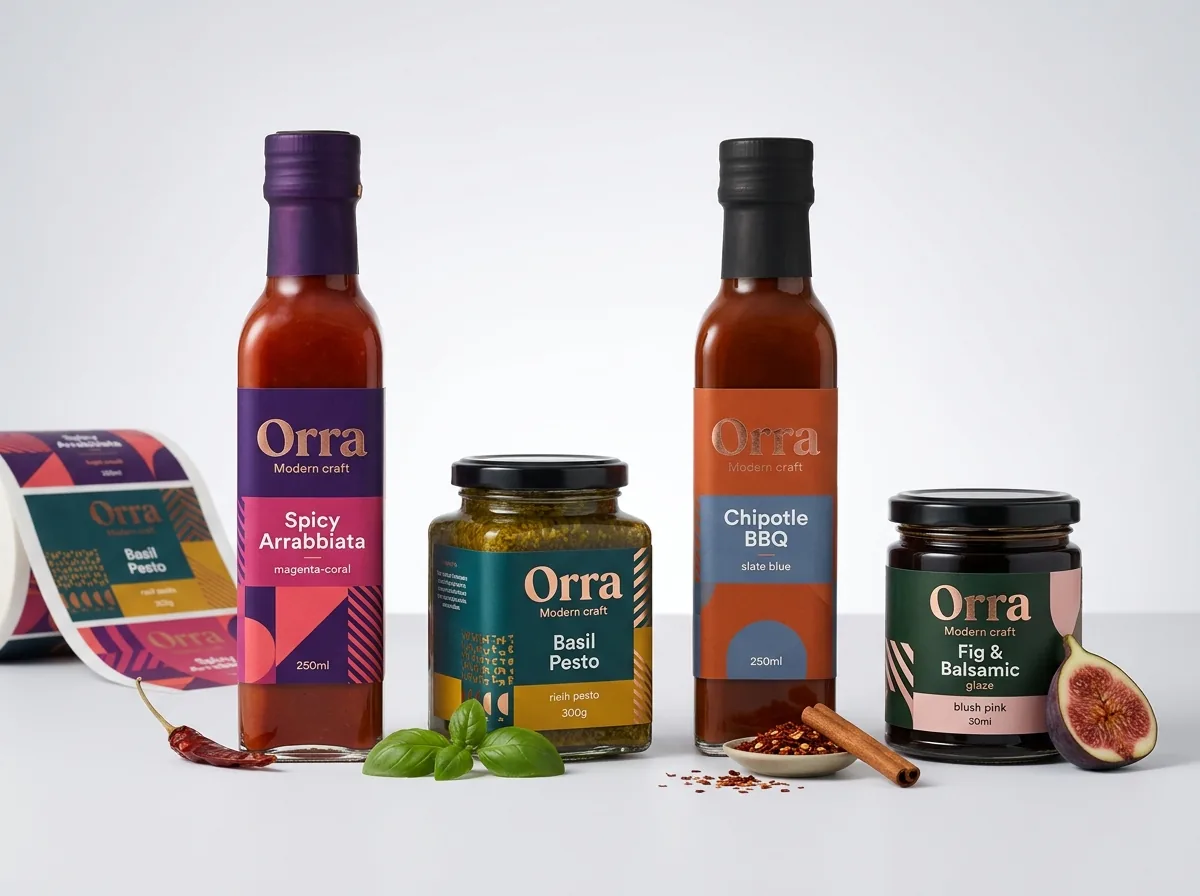
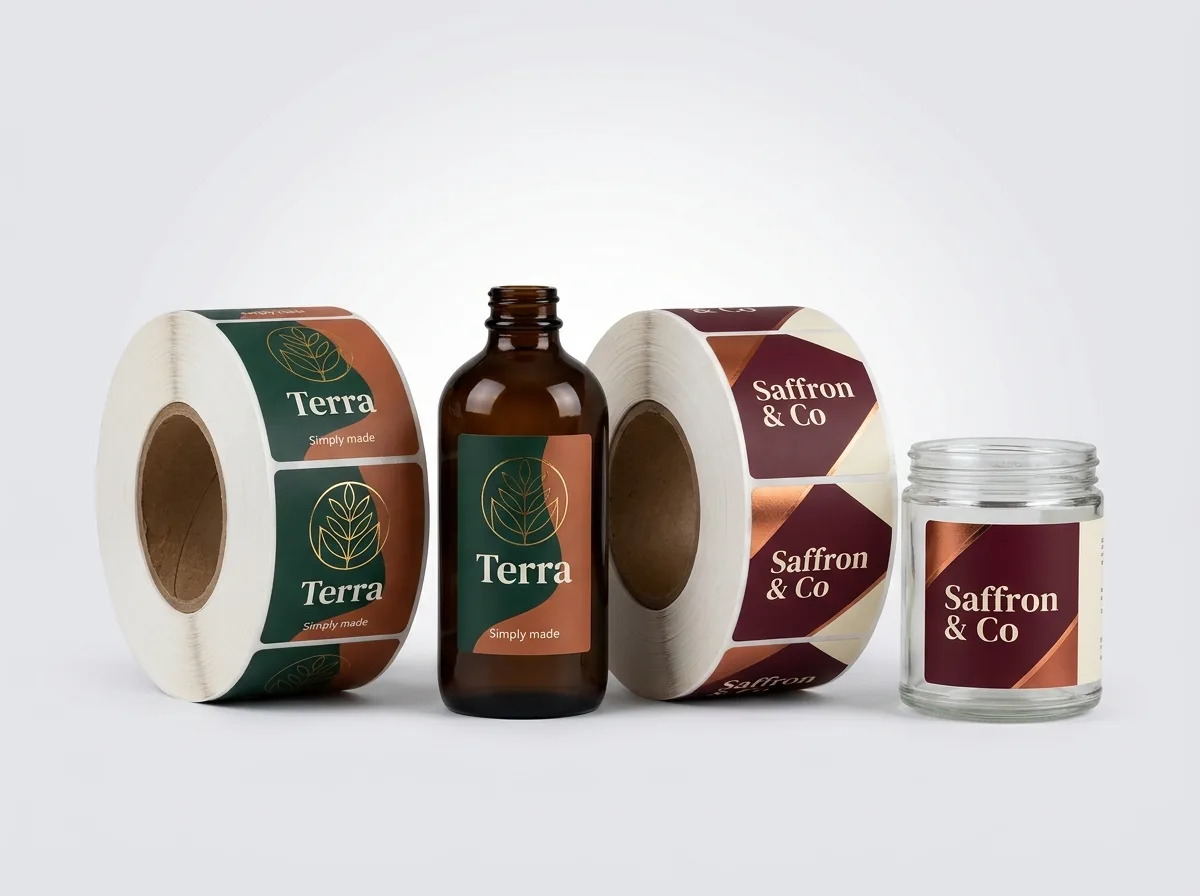
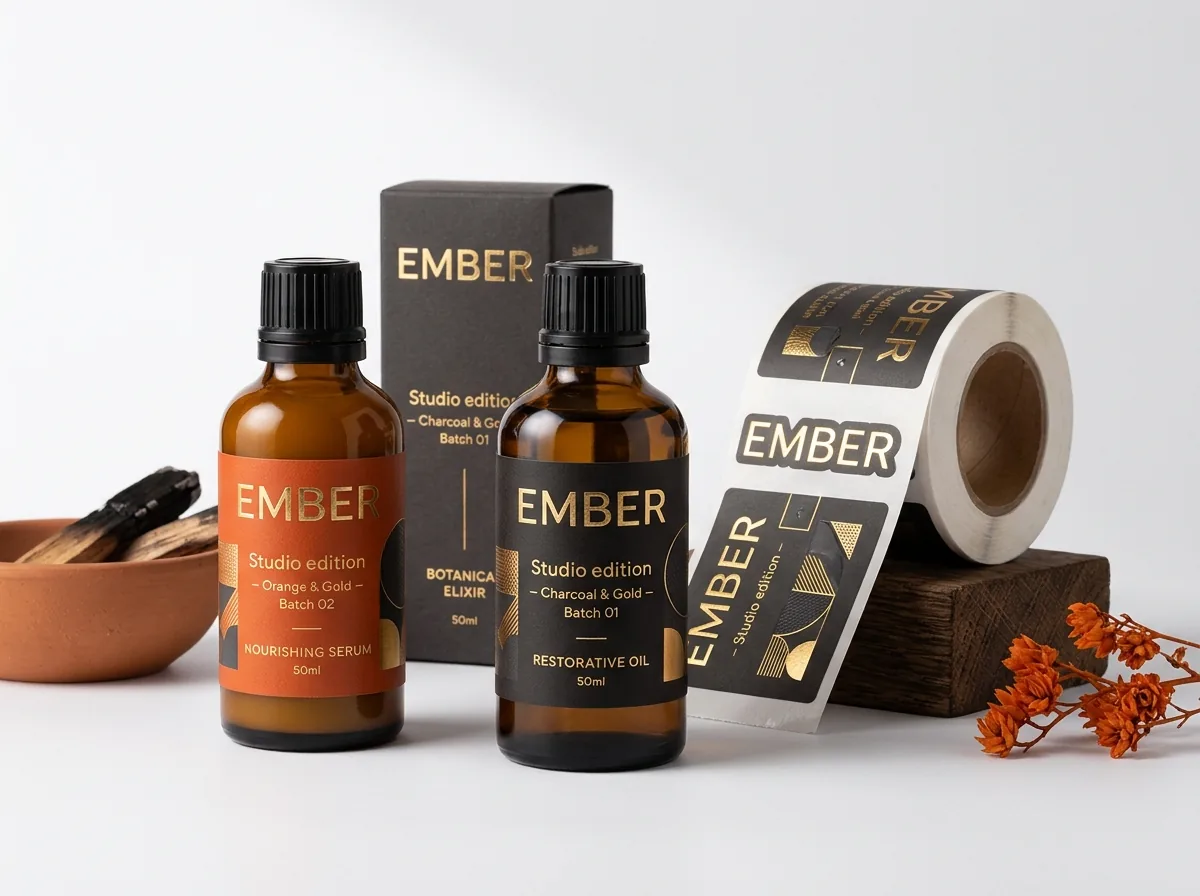
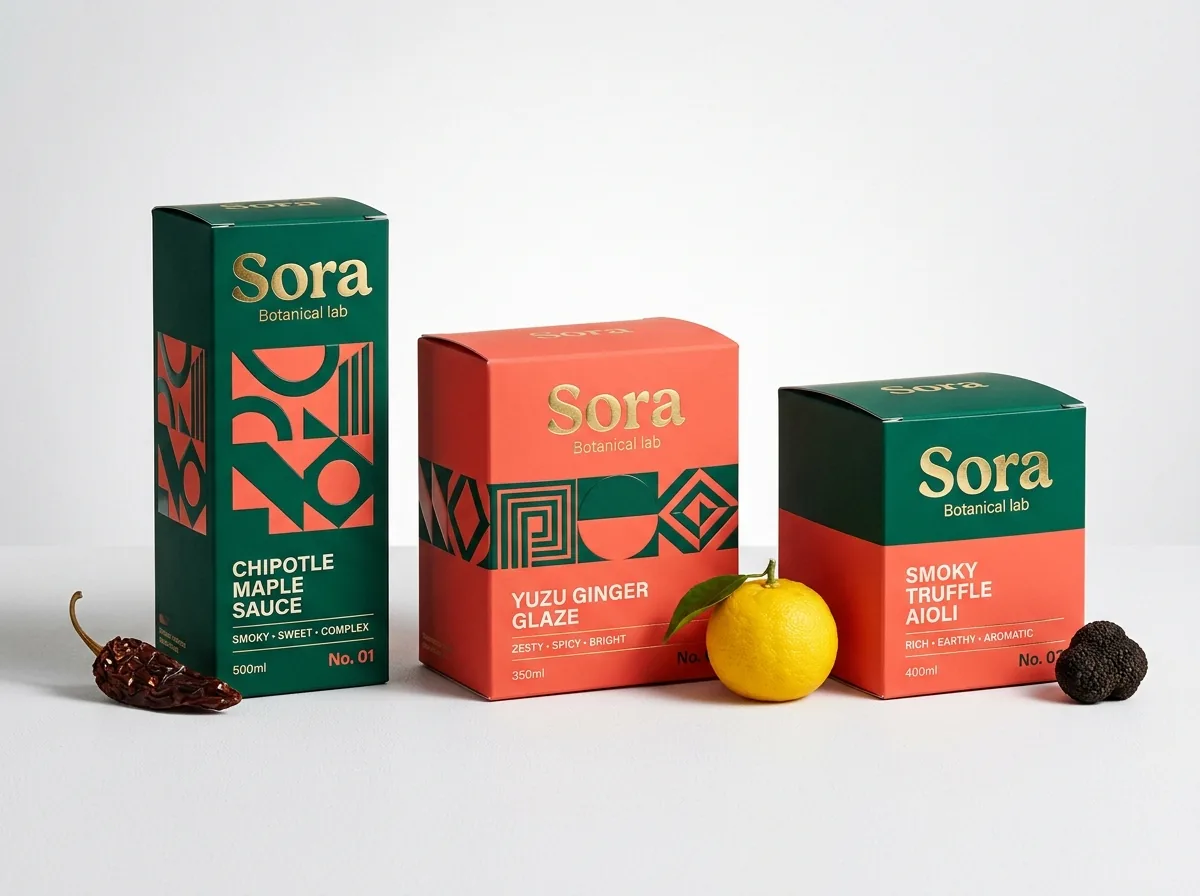
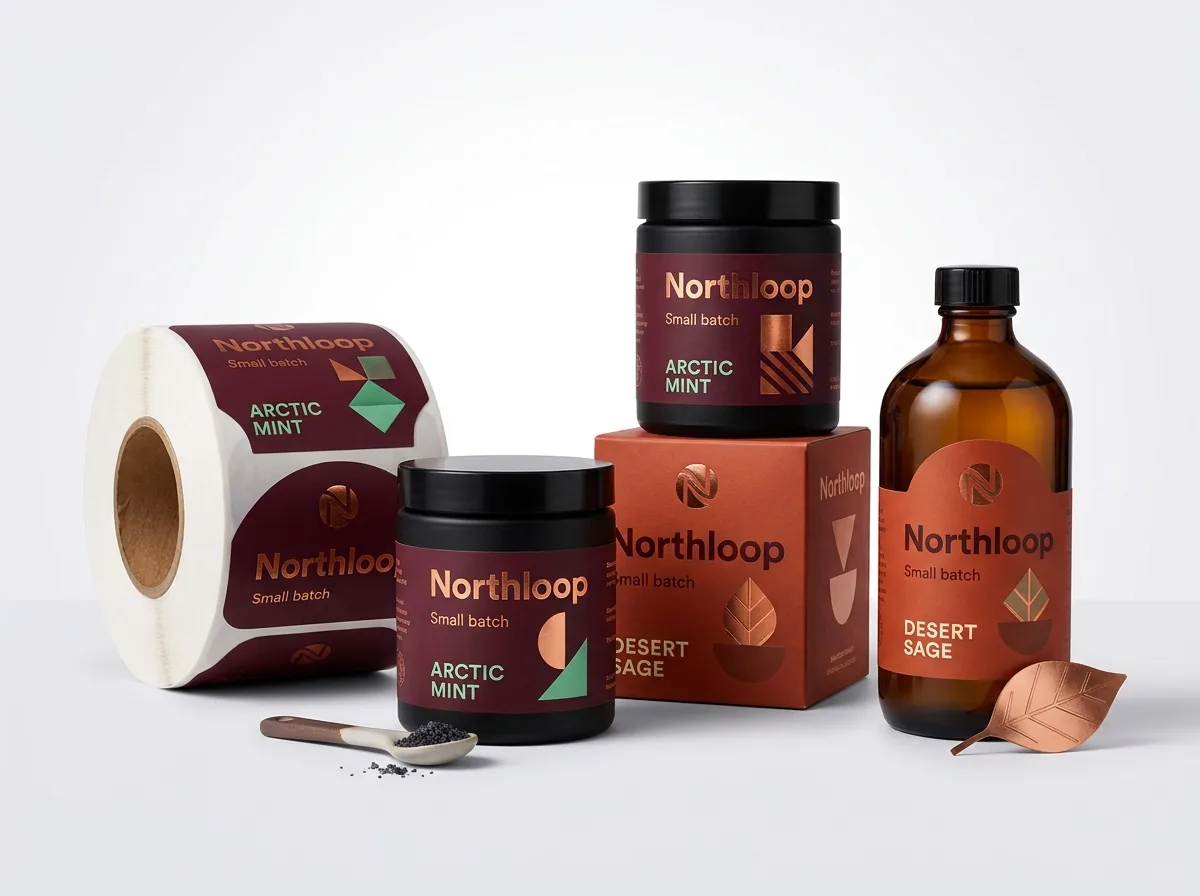
Ready to order sauce labels? Compare up to 3 quantities with a free 3D mockup.
Request a Quote →Questions about sauce labels
Why should I rotate my barcode vertically (ladder style) on a 5 oz woozy bottle?
On a narrow 1.75 inch diameter cylinder like a 5 oz woozy bottle, a horizontal barcode curves away from the scanner beam so the outer guard bars get distorted. Rotating the barcode 90 degrees into a vertical ladder orientation keeps every bar flat along the straight vertical wall.
Can CubitPack set up the 3-panel woozy template for me for free?
Yes. Free design help is included with every order. Send us your logo, flavor names, nutrition facts and barcode number, and our designers will lay out the 3-panel grid, add ⅛ inch bleed, and show you a 3D mockup on your bottle before you pay.
How small can ingredient text be on a 5 oz hot sauce bottle label?
Keep ingredient and address text at least 6 pt (or 1/16 inch tall for lowercase letters as required by FDA legibility rules) with clean contrast between the text and background. Using a condensed sans-serif font in 100% black on a white or cream panel maximizes readability.
Can you print an AI-generated pepper mascot or illustration on my sauce label?
Yes. Upload your AI artwork with your quote and our prepress team will upscale the image to 300 DPI print resolution, extend the background bleed, and replace any fuzzy AI lettering with crisp vector typography on your digital proof.
How do I match the colors on my hot sauce labels to my 3-pack gift boxes?
Because CubitPack prints both custom labels and custom boxes under one roof with Pantone color matching guaranteed, we can run your bottle labels and your 1-pack or 3-pack hot sauce boxes to the exact same Pantone color code.
What is the minimum order and turnaround time for custom sauce labels?
Our standard minimum is 500 labels per order (with smaller trial runs reviewed case by case). Standard production takes 10–14 business days after proof approval and payment, with 4–5 business day rush available and free shipping to all 50 US states.
Still have a question? Ask a packaging specialist.
Request a Quote →Request your sauce labels quote
Tell us your size and quantities, and one dedicated account manager prepares pricing for each tier.
- Free design & AI-to-print studio + 3D mockup
- No die or plate charges · 4–5 day rush available
- Free shipping to all 50 states
- 10% off your first order
This layout guide combines 5 oz woozy cylinder geometry (1.75 in diameter = 1.75 in center front panel), GS1 US ladder barcode orientation rules for narrow cylinders, and FDA 21 CFR 101 panel placement standards. A CubitPack packaging specialist checked every section. Spot something wrong? Tell us and we will fix it.
Sources
What changed
- October 22, 2026: First published.
- October 22, 2026: Updated specifications, terminology, and verified source links.
More guides
New packaging guides by email
Sizes, materials and design tips. Unsubscribe anytime.