
Gloss vs matte sauce labels: which finish holds up to drips and oil?
Short answer: Both protective gloss and matte finishes shield printed ink from vinegar splashes, chili oil drips and refrigerator condensation when paired with the right stock. Pick gloss to make fiery reds and peppers pop, or pick matte for a modern craft look on custom sauce labels.
On this page
- How do gloss, matte, foil stamping and spot UV finishes compare
- How do I keep chili oil, vinegar and BBQ glaze from staining labels
- How do hot-fill pasteurization and cold storage affect sauce labels
- When should I use clear labels or metallic foil on a sauce bottle
- How can I test finishes and order across multiple heat levels
- Common mistakes
- FAQs
Request a custom quoteFree dieline & 3D mockup
Sauce bottles live a much rougher life than dry pantry goods: they go through 185°F hot-fill lines, cool down in water baths, sit in 38°F refrigerators, and get passed around restaurant tables with chili oil or sticky BBQ glaze running down the neck. Choosing between a gloss finish and a matte finish changes how your bottle catches grocery store lighting and how easily kitchen drips wipe away. A gloss finish reflects light like wet glass, deepening bright habanero reds, mango yellows and smoky mahoganies while giving the quickest wipe-down after a messy pour. A matte finish diffuses overhead glare so fine ingredient lists, Scoville heat meters and small allergen text read effortlessly from any angle. When you order custom printed sauce labels from CubitPack, we help you match the finish and stock to your bottling process.
How do gloss, matte, foil stamping and spot UV finishes compare?
Every sauce label needs to do two jobs at once: grab a shopper's eye on a crowded condiment aisle and survive weeks of kitchen handling without scuffing or staining. In addition to our decided Matte and Gloss finishes, CubitPack offers hot Foil stamping and raised Spot UV so you can highlight a smokehouse crest, flame border or reserve batch number. Use the comparison table below to match each finish and decided stock (Clear and Foil, plus additional paper and film stocks ) to your sauce recipe and retail channel. Remember that you can request our $50 sample kit to rub and test these finishes in your own hands before placing a full production run.
| Finish or stock option | Visual effect on bottle | Best sauce & condiment uses |
|---|---|---|
| Gloss finish (decided) | High-shine, wet-look surface that deepens saturated colors | Fiery hot sauces, wing sauces, salsas and foodservice table bottles |
| Matte finish (decided) | Velvety, zero-glare surface with easy-to-read fine text | Small-batch BBQ, truffle marinara, aioli and gourmet gift packs |
| Matte + Spot UV (decided) | Glossy raised sauce drips or flames over a flat matte background | Flagship hot sauce lines, chili crisp jars and limited releases |
| Foil stamping (decided) | Metallic gold, silver or copper pressed onto logo or border | Barrel-aged bourbon BBQ, reserve ghost pepper and holiday sets |
| Clear stock (decided) | Transparent window showing pepper mash, seeds and herbs inside | Herb chimichurri, infused chili oil, vinaigrettes and green sauces |
| Foil base stock (decided) | All-over metallic sheen behind printed CMYK and Pantone inks | High-heat competition sauces and metallic edition 5 oz woozies |
How do I keep chili oil, vinegar and BBQ glaze from staining labels?
Traditional uncoated paper labels act like a sponge when a drop of sesame chili oil, olive oil vinaigrette or molasses BBQ sauce runs down the outside of the bottle: the oil wicks into the paper fibers from the cut edge and leaves a permanent dark translucent blotch. Even water-based cayenne vinegar sauces can soften unprotected paper when wiped repeatedly with a wet dishcloth. When you order hot sauce and BBQ bottle labels for oily or messy condiments, tell your account manager what is inside the bottle on Step 2 of the quote form. Pairing a protective gloss or matte finish with an oil- and moisture-resistant face stock seals the printed ink so customers and restaurant staff can wipe the bottle clean in seconds.
- Chili crisp, garlic oil & vinaigrettes (100% oil phase): specify oil-resistant stock plus gloss or matte lamination.
- Vinegar hot sauces (pH < 4.0, 5 oz woozies): gloss or matte finish prevents acid splashes from dulling dark inks.
- Sticky honey-BBQ & teriyaki glazes (12 oz stout bottles): gloss finish releases dried sugar glaze fastest with a warm cloth.
- Refrigerated salsas, queso & pestos (34°F–40°F): specify cold-case moisture resistance so condensation beads off.
How do hot-fill pasteurization and cold storage affect sauce labels?
Most shelf-stable hot sauces, BBQ sauces and pasta sauces are hot-filled into glass bottles or jars at 180°F to 195°F (82°C to 90°C), capped immediately, inverted for cap sterilization, and then run through a cooling water spray or bath. Applying a pressure-sensitive label at the wrong temperature or onto a damp bottle is the number-one cause of bubbling and edge lift on 5 oz woozy bottles. If you label before filling, the label and adhesive must ride through the 190°F fill and cooling bath without blistering. If you label after the cooling bath, the glass wall must pass through an air knife or drying station so zero moisture film sits between the adhesive and the 1.75 inch woozy curve. Share your exact bottling temperature and storage conditions (ambient shelf vs 38°F refrigerated case) in your quote notes so we specify the right stock and adhesive.
Know your size? Compare pricing across up to 3 quantities.
Request a Quote →When should I use clear labels or metallic foil on a sauce bottle?
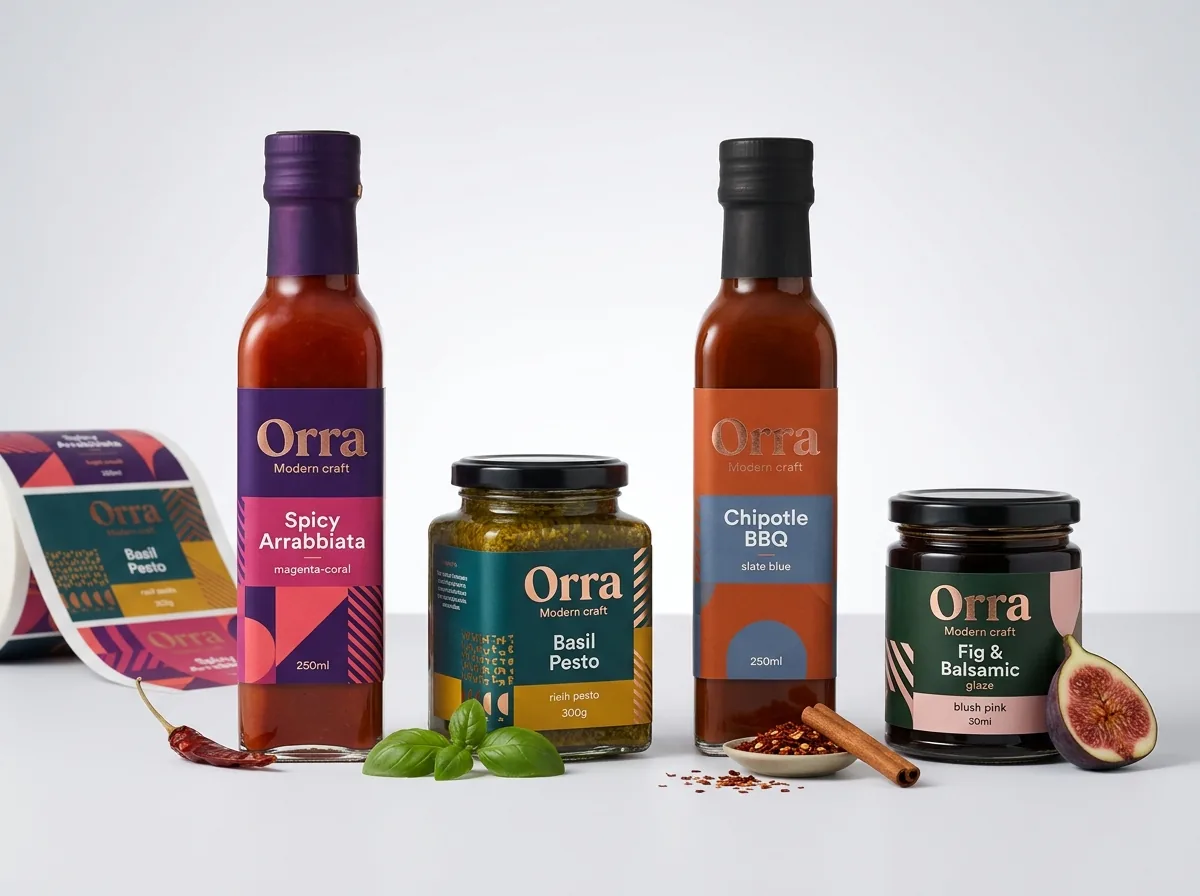
When your sauce has visible texture and vibrant natural color, such as bright orange fermented habanero, emerald green jalapeno-cilantro, or ruby pomegranate vinaigrette, hiding the liquid behind a full opaque wrap misses your strongest selling point. Printing on custom clear labels lets the sauce itself fill the background while your logo and Scoville meter float on top of the glass. We print an opaque white ink underbase behind your colored graphics and UPC barcode so they stay bright against dark red or brown sauces. For flagship reserve sauces, such as whiskey-barrel-aged hot sauce or black truffle marinara, custom foil labels or hot foil stamping on a dark matte background immediately signal a top-shelf recipe. You can also combine matte lamination with raised spot UV glossy flames or sauce droplets that catch the light as shoppers walk down the aisle.
How can I test finishes and order across multiple heat levels?
You never have to guess how a matte, gloss, clear or foil-stamped sauce label will look on your bottle. Every CubitPack order includes a free digital proof and a 3D mockup mapped directly onto your 5 oz woozy, 12 oz BBQ bottle or 16 oz jar before you pay a cent. If you want to compare finishes in person first, you can order our $50 sample kit or request a paid printed sample of your own artwork (which we credit back when you place your full production order). When you are ready to run your full flavor lineup, keep all flavors on the same finish and dieline size (for example, 5 × 3.5 in with matte finish) and select 2 designs or 3+ designs in the quote form so your account manager can bundle your quantities across Mild, Medium, Hot and Extra Hot varieties. If you also sell 3-bottle hot sauce tasting flights or retail gift sets, we can match your exact Pantone label colors to custom sauce boxes under one roof.
- Minimum order: 500 labels per run (smaller pilot runs considered case by case).
- Turnaround: 10–14 business days standard production, 4–5 business days rush.
- Color accuracy: Full CMYK printing plus guaranteed Pantone color matching across rolls and boxes.
- Free US shipping: delivered free to all 50 US states, with worldwide DDP shipping available.
What are the most common sauce label finish and material mistakes?
Kitchen oils, tight 1.75 inch bottle curves and cold condensation punish the wrong label setup. Avoid these five mistakes
- Using unprotected paper on chili oil, vinaigrette or BBQ bottles where a single drip wicks into the edge and leaves a grease stain.
- Applying pressure-sensitive labels to 5 oz woozy bottles while the glass is still damp from a cooling water bath.
- Printing colored logos or barcodes on a clear sauce label without an opaque white ink underbase, making them disappear against dark sauce.
- Using tiny, low-contrast gray text on a high-gloss label where supermarket overhead lights create specular glare.
- Forgetting to tell your account manager whether the sauce sits on an ambient grocery shelf or in a 38°F refrigerated display case.
Find your label size
Suggested label size: 9⅛ × 2¾ in (width × height)
A typical starting point. Your account manager confirms the size on the proof.
Quote this size →Packaging for this
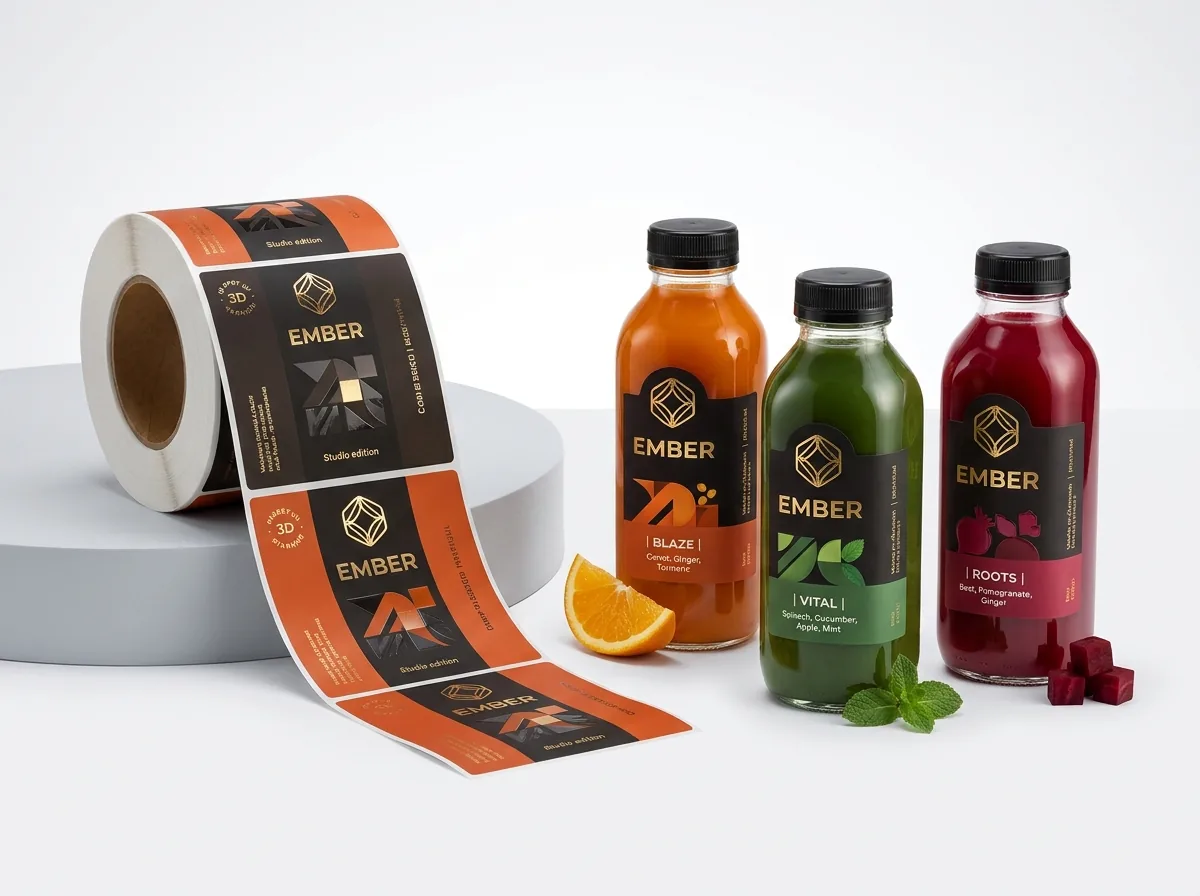
Ready to order sauce labels? Compare up to 3 quantities with a free 3D mockup.
Request a Quote →Questions about sauce labels
Does a matte sauce label wipe clean as easily as a gloss sauce label?
Both gloss and matte finishes protect the printed ink from moisture and sauce splashes when paired with the right stock. Gloss has a slicker surface that releases sticky sugar glazes slightly faster, while matte hides fingerprints and cuts glare under bright store lights.
Can I put both matte and gloss on the same hot sauce label?
Yes. By choosing a matte finish with Spot UV, your main label background stays velvety and non-reflective while the Spot UV areas (such as your logo, pepper illustration or flame border) stand out in raised, high-gloss shine.
Do clear labels work on dark BBQ sauce or soy marinade bottles?
Yes, as long as you print with opaque white ink, light pastel colors or metallic gold/silver foil stamping. Without a white ink backing, dark inks printed on a clear label will blend into the dark brown or black sauce inside the glass.
Why do labels sometimes lift at the edge on 5 oz glass woozy bottles?
A 5 oz woozy bottle has a tight 1.75 inch diameter, which creates outward spring tension if a stiff label stock is used or if the ends overlap. Leaving a ¼ inch gap and pairing a flexible stock with tight-mandrel adhesive keeps the seam flat.
Can I test how a finish holds up to my sauce before ordering thousands of labels?
Yes. You can order our $50 sample kit to test our finishes against your actual sauce, or request a paid printed sample of your own design, which is credited toward your full production order of 500 or more labels.
Does adding foil stamping or spot UV slow down the 10–14 day turnaround?
Standard production for custom sauce labels, including foil stamping and spot UV, is 10–14 business days after you approve your proof and pay. If you have a tight bottling date, ask your account manager about 4–5 business day rush options.
Still have a question? Ask a packaging specialist.
Request a Quote →Request your sauce labels quote
Tell us your size and quantities, and one dedicated account manager prepares pricing for each tier.
- Free design & AI-to-print studio + 3D mockup
- No die or plate charges · 4–5 day rush available
- Free shipping to all 50 states
- 10% off your first order
This comparison is built from CubitPack's decided label finishes (Matte, Gloss, Foil stamping, Spot UV) and stocks (Clear, Foil) alongside standard hot-fill (180°F–195°F) and cold-case bottling practices. A packaging specialist checked every section. Spot something wrong? Tell us and we will fix it.
Sources
What changed
- October 22, 2026: First published.
- October 22, 2026: Updated specifications, terminology, and verified source links.
More guides
New packaging guides by email
Sizes, materials and design tips. Unsubscribe anytime.