
How do you design custom refill spout pouches for soaps, cleaners and pantry oils?
Short answer: Match the inner sealant film to your formula's surfactants, essential oils or food oils, place a clear bottle-count sight window along the back panel, highlight your 75% to 85% plastic reduction badge on the front, and share one dieline across scents on custom refill spout pouches.
On this page
- Which inner barrier films prevent surfactants and essential oils from delaminating
- How do film structures and finishes match different refill formulas
- How do I design a clear bottle-fill sight window and plastic-saved badge
- Where are the heat-seal, spout-weld and gusset distortion zones on the dieline
- What affects the price of custom refill spout pouches and how can I lower unit cost
- Common mistakes
- FAQs
Request a custom quoteFree dieline & 3D mockup
Designing a high-performing custom refill spout pouch goes beyond placing your bottle label artwork onto a flexible bag template. Because a 32 oz or 64 oz refill pouch sits in a damp shower caddy, under a kitchen sink or on a pantry shelf for two to six months while the customer pours out partial refills, the film structure and graphics have to work harder than a single-use sachet. First, the inner sealant layer and laminating adhesive must resist chemical migration from coco-glucoside surfactants, citrus or eucalyptus terpenes, alkaline cleaners or cooking oils. Second, the artwork should add functional refill cues - including a knocked-out vertical sight window marked by bottle fills remaining, a clear plastic-saved comparison badge on the front face, and an unobstructed bottom-gusset zone that keeps barcodes flat. CubitPack provides free custom dielines, prepress checks and 3D mockups on every order.
Which inner barrier films prevent surfactants and essential oils from delaminating?
The number-one technical mistake in personal-care and home-cleaning refill packaging is filling a concentrated soap, essential-oil lotion or high-pH surface cleaner into a general-purpose dry-food pouch. Botanical essential oils - especially d-limonene in citrus oils, pine oil, eucalyptus, peppermint and tea tree - are tiny volatile molecules that penetrate standard polyethylene sealants and dissolve ordinary solvent-less laminating adhesives within weeks, causing the outer printed film to bubble and peel away like a sunburn. Similarly, concentrated dish soaps, laundry detergents and sulfate-free body washes can trigger environmental stress cracking (ESCR) along the folded K-seal gusset creases if the inner linear low-density polyethylene (LLDPE) sealant is not formulated for surfactant contact. When you request a quote for printed liquid refill spout bags, tell us your exact active ingredients, essential-oil percentage and pH so our design team specify chemical-resistant tie layers or food-safe inner liners on request ().
How do film structures and finishes match different refill formulas?
Different liquid categories require different combinations of oxygen barrier, UV light blocking, puncture stiffness and outer surface grip. A vitamin C facial cleanser or cold-pressed extra-virgin olive oil needs total light blocking, whereas an amber hand soap benefits from a vertical clear sight gauge so users can see the liquid color and remaining level. Use the reference table below to match your liquid product to the right multi-layer film stack, spout bore and outer finish ().
| Liquid refill category | Recommended barrier & liner | Best outer finish & spout setup |
|---|---|---|
| Hand soap, shampoo & body wash | Clear high-barrier PET / nylon / surfactant-grade LLDPE | Soft-touch matte finish + 10 mm 45° corner spout + sight window |
| Botanical oils & high-terpene cleaners | Foil or metallized core + chemical-resistant adhesive & sealant | Matte or kraft-look outer + 8.6 to 10 mm corner spout |
| Laundry detergent & dish concentrate | Puncture-resistant nylon-reinforced multi-layer film | Gloss or matte wipe-clean finish + 13 to 16 mm corner spout + handle |
| Extra-virgin olive oil & vinegar | Oxygen & UV foil/metallized barrier + food-safe inner liner | Matte or natural kraft outer + 10 mm drip-cut corner spout |
| Honey, maple syrup & café sauces | High-clarity or metallized food-safe barrier film | Gloss finish + 13 mm corner or center spout for viscous flow |
| Salon back-bar & hospitality (128 oz) | Heavy-gauge nylon/LLDPE with plow-bottom gusset | Scuff-resistant matte + 16 to 22 mm spout + reinforced handle |
How do I design a clear bottle-fill sight window and plastic-saved badge?
When a customer stores an opaque 32 oz or 64 oz refill pouch under the bathroom sink, they cannot tell by looking at the front whether they have enough soap left for one more bottle refill or three. On clear barrier film laminates, we solve this on press at zero extra cost by knocking out a 0.375 to 0.5 inch wide vertical strip in the white ink underbase layer along the back panel or side gusset. Next to that clear viewing strip, print horizontal tick marks calibrated to your primary dispenser bottle - such as '3× 16 oz refills - 2× 16 oz refills - 1× 16 oz refill - Time to reorder' alongside a QR code that links straight to your reorder page. On the front panel, place a crisp geometric badge in the lower corner stating the exact plastic weight saved (for example, 'Uses 80% less plastic than two 16 oz bottles') and link the aesthetic to your primary custom bottle labels or custom jar labels.
Know your size? Compare pricing across up to 3 quantities.
Request a Quote →Where are the heat-seal, spout-weld and gusset distortion zones on the dieline?
A flat pouch dieline transforms into a three-dimensional teardrop cylinder the moment it is filled with 2 to 8 pounds of liquid. As the bottom gusset expands front-to-back, the lower 1.5 to 2.25 inches of the front and back panels curve inward toward the floor seam, and the left and right edges pull slightly inward. If you place your brand name, small ingredient text or a UPC barcode right above the bottom gusset crease, the curve will distort the lettering and stop retail checkout scanners from reading the barcode. Keep all critical text, logos and scannable barcodes in the flat middle band of the pouch - at least 0.375 inches inside the left and right side seals, 1.5 inches above the bottom gusset score, and 0.75 inches clear of the top corner spout weld and die-cut handle patch. Our prepress team checks every artwork file on a 3D mockup before you pay.
- Side seal bleed & safe zone: extend background colors 0.125 in past the outer cut line and keep text 0.375 in inside the heat seals.
- Spout canoe-weld clearance: keep logos and fine rules at least 0.5 to 0.75 in away from the plastic spout flange.
- Barcode placement: orient UPC barcodes vertically (ladder style) on the upper-middle back panel where the film stays flat.
- Starter-kit coordination: pair your pouch with custom mailer boxes with inserts and custom box inserts for glass-bottle + refill bundles.
What affects the price of custom refill spout pouches and how can I lower unit cost?
Four factors drive the unit price of custom printed refill spout pouches: overall film surface area and thickness (a 64 oz handled bag uses roughly twice the barrier laminate of a 16 oz pouch), the inner barrier chemistry (foil or chemical-resistant tie layers vs standard barrier film), the spout and cap hardware (corner weld + die-cut handle vs simple center spout), and your total production run quantity. The easiest way to reduce unit cost across a multi-scent product line - such as Lavender, Cedarwood, Citrus and Unscented hand-soap refills - is to standardize every SKU on the exact same outer Width × Height × Bottom Gusset, film laminate, finish and 45-degree corner spout color. Select '2 designs' or '3+ designs' in Step 2 of the CubitPack quote form so we run all scents together. Remember that we never charge die or plate fees, your first order is 10% off, and we beat any written US competitor quote for the same specs.
- Share one pouch size across scents: running four 32 oz soap fragrances on the same 6.5 × 10.5 × 3.5 in dieline avoids mechanical changeover delays.
- Standardize spout and cap color: pick one neutral white, black or natural cap color across all SKUs and differentiate scents with full-bleed film artwork.
- Use white-ink knockouts for sight windows: a clear vertical strip on a clear high-barrier laminate adds a level gauge with zero window-patching cost.
- Compare three quantity tiers: enter three volume breaks (such as 1,000, 2,500 and 5,000) in Step 1 of the quote form to see how unit price scales.
What are the most common custom refill pouch design and prepress mistakes?
A great refill pouch design protects against both formula delamination and filling-line distortion. Check your dieline against these five common mistakes
- Packing citrus, pine or eucalyptus essential-oil formulas in a standard snack laminate without a chemical-resistant tie layer and inner sealant.
- Placing the UPC barcode horizontally across the lower third of the back panel where the filled bottom gusset curves the film.
- Flooding 100% opaque white ink across the entire back panel of a clear barrier film instead of knocking out a narrow bottle-fill sight window.
- Specifying glossy slippery lamination on a heavy 32 oz or 64 oz shower or sink refill pouch without a handle or soft-touch grip.
- Ordering slightly different pouch heights for each scent in your lineup instead of sharing one dieline and spout across all SKUs.
Packaging for this
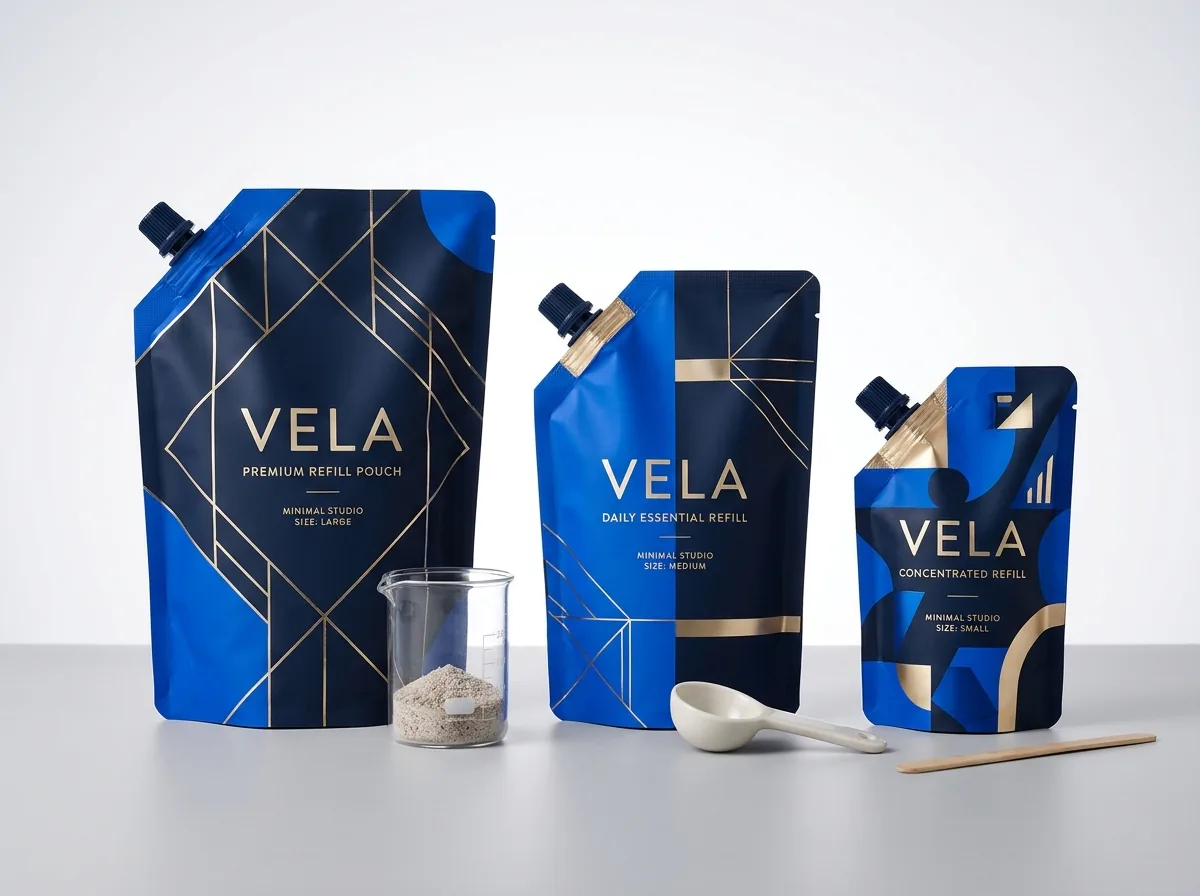
Ready to order refill spout pouches? Compare up to 3 quantities with a free 3D mockup.
Request a Quote →Questions about refill spout pouches
Does adding a clear bottle-fill sight window on the back panel cost extra?
No. When your refill pouch is printed on a clear high-barrier film structure, a clear sight window is simply an area where we knock out the white ink underbase layer in your artwork file. There is no extra window-patching fee.
Can I print a clear sight window if my pouch has an aluminum foil core?
No, because an aluminum foil or metallized film layer is completely opaque across the entire web. If your formula requires a clear fill gauge, we use a transparent high-barrier film (such as EVOH or oxide-coated PET/nylon) instead of foil.
Why is soft-touch matte lamination so popular on bathroom and shower refill pouches?
Soft-touch matte lamination gives the pouch a velvety, higher-friction surface that feels comfortable to hold even when a customer's hands are wet or soapy at the bathroom sink, while matching frosted glass countertop bottles.
Can I combine multiple soap or cleaner scents in one custom refill pouch order?
Yes. As long as every scent uses the same pouch Width × Height × Gusset, barrier film stack and spout fitment, select 2 designs or 3+ designs in Step 2 of the quote form and list the quantity per scent in the notes.
Do I have to pay printing plate fees for each scent or color in my order?
No. CubitPack never charges cutting die or printing plate fees, even when you order multiple scent designs with full-color CMYK, Pantone spot colors or white ink underbases. We also include free design help and 3D mockups.
Can I use your refill spout pouches if I only have a logo or AI concept image?
Yes. Select Free design help or AI image in Step 2 of the quote form. Our packaging designers will lay out your front panel, back-panel bottle-fill gauge, plastic-saved badge and dieline safe zones for free before payment.
Still have a question? Ask a packaging specialist.
Request a Quote →Request your refill spout pouches quote
Tell us your size and quantities, and one dedicated account manager prepares pricing for each tier.
- Free design & AI-to-print studio + 3D mockup
- No die or plate charges · 4–5 day rush available
- Free shipping to all 50 states
- 10% off your first order
The chemical barrier pairings, sight-window prepress rules and barcode safe zones in this guide are based on flexible liquid laminate converting standards and ASTM surfactant resistance practices, checked by a CubitPack packaging specialist. Spot a mistake? Let us know and we will fix it.
Sources
- Environmental stress crack resistance (ESCR) and elevated-temperature compatibility testing for liquid surfactant laminates
- Food-contact inner sealant considerations for olive oil, vinegar and honey refill pouches
- Sight-window white-ink knockout prepress practices and multi-SKU dieline standardization
What changed
- October 22, 2026: First published.
- October 22, 2026: Updated specifications, terminology, and verified source links.
More guides
New packaging guides by email
Sizes, materials and design tips. Unsubscribe anytime.