
45-degree corner spout vs top-center spout refill pouches: which pours cleaner into pump bottles?
Short answer: Choose a 45-degree corner spout for 16 oz to 128 oz pouches that pour into narrow pump bottle necks, because the angled corner acts like a pitcher lip without folding over. Choose a top-center spout for smaller 8 oz to 16 oz squeeze refills on custom refill spout pouches.
On this page
- Why does a 45-degree corner spout pour more cleanly into narrow pump bottles
- How do 45-degree corner spouts and top-center spouts compare side by side
- When is a top-center spout the better choice for a refill pouch
- How does a die-cut two-finger handle work with a 45-degree corner spout
- How does spout position affect your artwork layout and co-packing method
- Common mistakes
- FAQs
Request a custom quoteFree dieline & 3D mockup
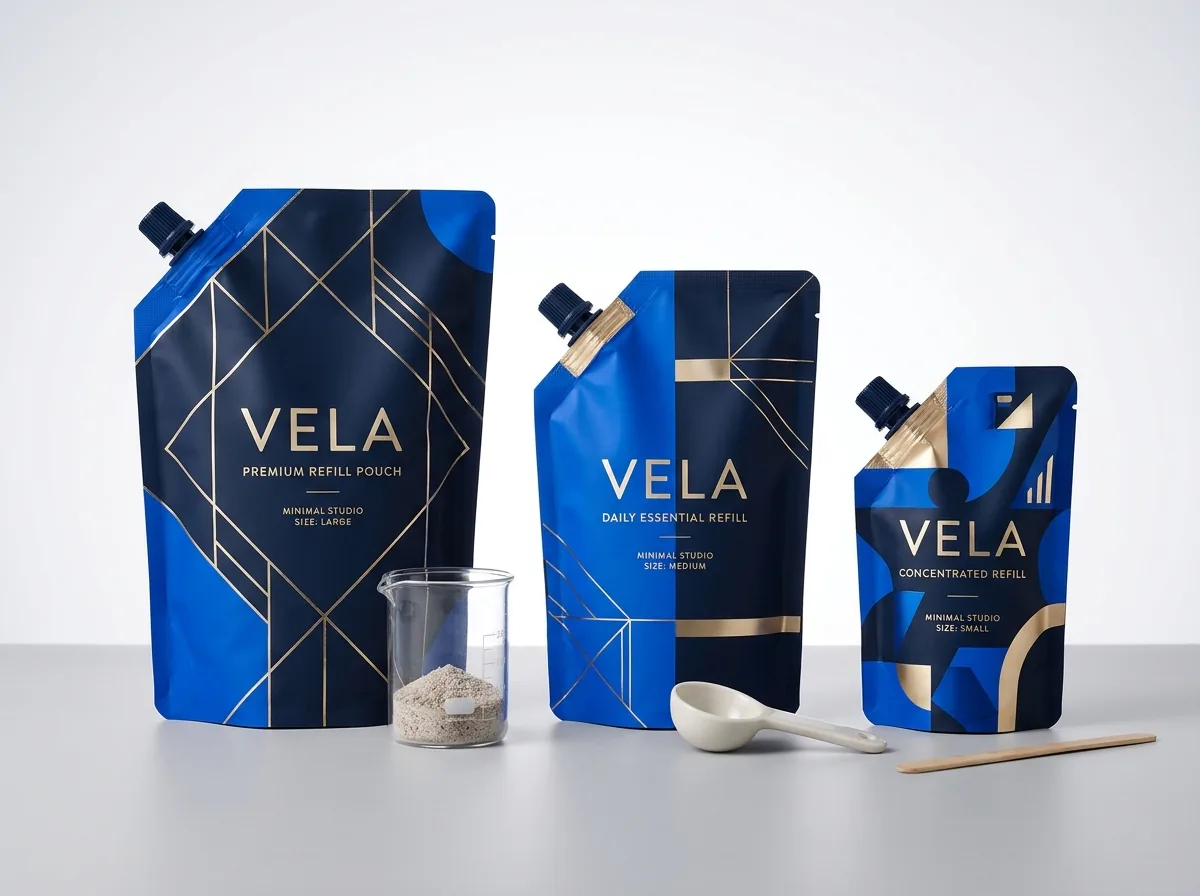
The placement of the dispensing nozzle on a liquid refill pouch determines whether your customer pours hand soap, shampoo, detergent or olive oil smoothly into a narrow dispenser bottle or spills it down the side of the glass. A 45-degree corner spout is heat-welded into a mitered upper corner of the bag, positioning the nozzle at the natural highest and furthest point when the pouch is tilted sideways. That pitcher-style geometry keeps the flexible upper film panels taut and out of the liquid stream, even when the pouch is half empty. A top-center spout sits in the middle of the horizontal top seal; it excels on compact 8 oz to 16 oz pouches that are inverted straight down or squeezed directly, and it leaves the entire upper header open for symmetrical shelf branding. At CubitPack, both corner and center spouts include free structural dielines and 3D mockups.
Why does a 45-degree corner spout pour more cleanly into narrow pump bottles?
Think about how a person refills a permanent 16 oz glass hand-soap pump bottle sitting on a bathroom counter. The bottle stands 7 to 8 inches tall and has a narrow 24-410 neck opening measuring only about 18 mm (under three-quarters of an inch) across the inside throat. If the customer holds a heavy 32 oz or 64 oz pouch with a top-center spout, they have to lift the bag high above the bottle and tilt it past 90 degrees so liquid reaches the center nozzle. As soon as the pouch is half empty, the two flexible upper corners on either side of the center spout sag forward and brush against the wet rim of the bottle. On custom printed refill spout pouches built with a 45-degree corner fitment, the nozzle already points at the exact angle of a pouring pitcher. The user rests the tip of the corner spout inside the bottle neck at a gentle 45-degree tilt while the rest of the pouch body hangs below the rim. Air vents freely out the top of the neck opening, and the last ounce of liquid channels naturally into the corner pocket without squeezing or shaking the bag.
How do 45-degree corner spouts and top-center spouts compare side by side?
Both spout orientations use the same food-safe or chemical-resistant polyethylene/polypropylene canoe weld base and tamper-evident screw caps, and both work across matte, gloss, soft-touch and kraft film structures. The right choice depends on pouch volume, whether the customer pours in multiple partial doses or empties the whole bag at once, and how your co-packer fills the pouches. Use the comparison matrix below to decide which fitment configuration matches your liquid formula and dispenser bottle.
| Feature or use case | 45-degree corner spout | Top-center spout |
|---|---|---|
| Ideal capacity range | 16 fl oz to 128 fl oz (multi-fill bags) | 4 fl oz to 24 fl oz (single or squeeze refills) |
| Pouring into 24-410 pump necks | Excellent - angled tip aims inside the throat like a pitcher | Fair on large bags - upper corners can sag forward when half full |
| Partial multi-dose pouring | Easy to start and stop flow cleanly by tilting back 20 degrees | Best when inverted straight down to empty a full 1x refill |
| Two-finger carry handle pairing | Ideal - handle sits on the opposite upper header for two-hand control | Limited - center spout occupies the middle of the top header |
| Last-drop evacuation | Gravity funnels the final drops directly into the angled corner | Requires squeezing the two top corners inward toward the center |
| Filling line compatibility | Fills through the top web before sealing or via angled spout-fill rails | Universal fit on standard vertical inline and rotary spout fillers |
When is a top-center spout the better choice for a refill pouch?
While 45-degree corner spouts dominate 32 oz to 128 oz household and bath refills, top-center spouts are often the smarter engineering pick in three specific scenarios. First, on compact 8 oz to 16 oz 1-for-1 refills - where the customer uncaps an empty 8 oz facial cleanser or lotion bottle, inverts the entire pouch straight down into the neck, and squeezes the whole bag in one go - a center spout empties symmetrically without tilting. Second, on narrow pouches under 4.75 inches wide, miter-cutting a 45-degree corner removes too much of the top width; a top-center spout preserves full panel width. Third, many contract fillers run automated rotary spout-filling machines calibrated to grip a vertical center spout neck by its flange ribs. If you also package ready-to-use beverages or culinary condiments, compare how center and corner spouts work on our custom drink spout pouches, custom sauce spout pouches and general custom spout pouches pages.
Know your size? Compare pricing across up to 3 quantities.
Request a Quote →How does a die-cut two-finger handle work with a 45-degree corner spout?
A full 32 fl oz refill pouch weighs about 2.1 pounds, a 64 fl oz half-gallon pouch weighs over 4.2 pounds, and a 128 fl oz gallon salon or laundry bag weighs more than 8.5 pounds. When a customer tries to pinch the slick film wall of a 4-pound bag with wet bathroom hands, the heavy bottom gusset swings downward and pulls the spout tip out of the bottle neck. Putting a 45-degree spout on the top left corner leaves the right half of the upper header completely free for a reinforced die-cut oval two-finger carry handle. The user slips two fingers of their dominant hand through the reinforced upper header and cradles the bottom gusset with their other hand - giving effortless pitcher balance from the first ounce to the last.
- 8 oz to 16 oz pouches: light enough to hold with one hand around the middle waist; no handle needed.
- 24 oz to 32 oz pouches: 45-degree corner spout with soft-touch anti-slip matte lamination or optional upper finger hole.
- 48 oz to 64 oz pouches: 45-degree corner spout paired with a reinforced two-finger header handle.
- 128 oz (1 gallon) bags: wide 16 mm to 22 mm corner spout, reinforced header handle and plow-bottom gusset.
How does spout position affect your artwork layout and co-packing method?
From an artwork perspective, a top-center spout creates a symmetrical silhouette where your brand logo sits centered below the cap, while a 45-degree corner spout creates an asymmetrical diagonal cut across one upper corner. On a corner-spout dieline, you actually gain more uninterrupted vertical height on the handle side of the front panel for large typography or a vertical clear bottle-fill gauge on the back. Before finalizing your dieline, ask your co-packer whether they fill through the spout (using a spout-rail filler on pre-made spouts) or fill through an open top web and heat-seal the top after filling. CubitPack can supply either configuration - pre-welded spouts with open top or bottom fill edges, or completely sealed pouches for through-the-spout filling - and we send a free custom dieline and 3D mockup before you pay. Whether you order 16 oz single refills or 64 oz family bags, keeping the same spout fitment and pouch dimensions across all scents lets you combine quantities in one production run with zero cutting die or printing plate charges.
- Through-the-spout filling: pouches arrive fully sealed with the spout welded in place; your filler injects liquid through the nozzle and torques the cap on.
- Open-top web filling: pouches arrive with the corner spout already welded into the corner seam and the remaining horizontal top edge left open for vertical piston filling and heat sealing.
- Artwork safe zone: keep all logos, text and foil stamping at least 0.5 to 0.75 inches away from the mitered corner spout flange and handle reinforcement patch.
- Multi-scent standardization: share the exact same corner spout bore and cap color across all fragrances so your co-packer never has to recalibrate capping heads between batches.
What are the most common mistakes when choosing between corner and center spouts?
Picking the wrong spout orientation can frustrate customers at the sink or slow down your co-packer's filling line. Avoid these five mistakes
- Using a top-center spout on a heavy 64 oz multi-pour refill bag, which forces customers to tilt the flexible top corners into the liquid stream.
- Placing a 45-degree corner spout on a narrow 3.5-inch-wide pouch where the angled miter cut leaves no room for the top seal.
- Ordering corner-spout pouches before checking whether your contract filler's automatic rail only accepts vertical center spouts.
- Skipping a reinforced two-finger handle on 48 oz to 128 oz corner-spout bags, making wet bathroom pouring slippery.
- Placing important text or logos in the upper mitered corner zone where the 45-degree heat weld trims away the film.
Packaging for this
Ready to order refill spout pouches? Compare up to 3 quantities with a free 3D mockup.
Request a Quote →Questions about refill spout pouches
Does a 45-degree corner spout cost more than a top-center spout?
A 45-degree corner spout uses the same plastic fitment and cap as a top-center spout, though welding the spout into a mitered corner can slightly change conversion setup compared with inline center welding. Enter your quantity in the quote form to compare exact pricing.
Which side should the 45-degree corner spout sit on when looking at the front of the pouch?
Either upper corner works equally well for right-handed and left-handed users, because the pouch can simply be turned around. Most US personal-care brands place the corner spout on the top right or top left and put the carry handle on the opposite side.
Can a 45-degree corner spout pouch still stand upright on a retail shelf?
Yes. The standing stability of a refill pouch comes entirely from its bottom gusset (round, K-seal or plow bottom), not from the top spout position. A corner-spout pouch stands just as upright on retail shelves as a center-spout pouch.
How do co-packers fill a 45-degree corner spout pouch?
Co-packers fill corner-spout pouches in one of two ways: either directly through the angled spout nozzle on a semi-automatic or rotary angled spout filler before capping, or through an unsealed top edge that is heat-sealed shut right after filling.
What nozzle bore size is most common on 45-degree corner refill spouts?
For 16 oz to 32 oz hand soap, shampoo, lotion and olive oil refills pouring into 24-410 pump bottles, an 8.6 mm or 10 mm corner spout bore is most popular. For 64 oz to 128 oz laundry detergents and wide jars, 13 mm to 16 mm is common.
Can I test both a corner-spout sample and a center-spout sample before my main run?
Yes. You can order our $50 sample kit to inspect pouch structures and finishes in person, or order a custom printed sample of your exact refill pouch (credited toward your full production order) to test pouring with your bottle.
Still have a question? Ask a packaging specialist.
Request a Quote →Request your refill spout pouches quote
Tell us your size and quantities, and one dedicated account manager prepares pricing for each tier.
- Free design & AI-to-print studio + 3D mockup
- No die or plate charges · 4–5 day rush available
- Free shipping to all 50 states
- 10% off your first order
The pouring angle comparisons, bottle-neck airlock clearances and filling-line methods in this guide come from flexible spout pouch converting standards and dispensing tests on 20-410, 24-410 and 28-410 pump bottles, reviewed by a CubitPack packaging specialist. Spot something off? Tell us and we will fix it.
Sources
What changed
- October 22, 2026: First published.
- October 22, 2026: Updated specifications, terminology, and verified source links.
More guides
New packaging guides by email
Sizes, materials and design tips. Unsubscribe anytime.