
How do you design candle jar labels and bottom warning stickers?
Short answer: Split your candle copy across two coordinated stickers: keep the front vessel label focused on your brand, scent name, three fragrance notes, wax type and net weight (oz and grams), and place fire-safety pictograms, wick care rules and maker contact details on a 2 inch bottom circle when ordering custom candle labels.
On this page
- What belongs on the front candle label vs the bottom warning sticker
- What does ASTM F2058 require on a bottom candle warning label
- Where does the net weight belong on a front candle label
- How do you build one master template for 5 or 10 candle scents
- How much bleed and safe zone do custom candle labels need
- Common mistakes
- FAQs
Request a custom quoteFree dieline & 3D mockup
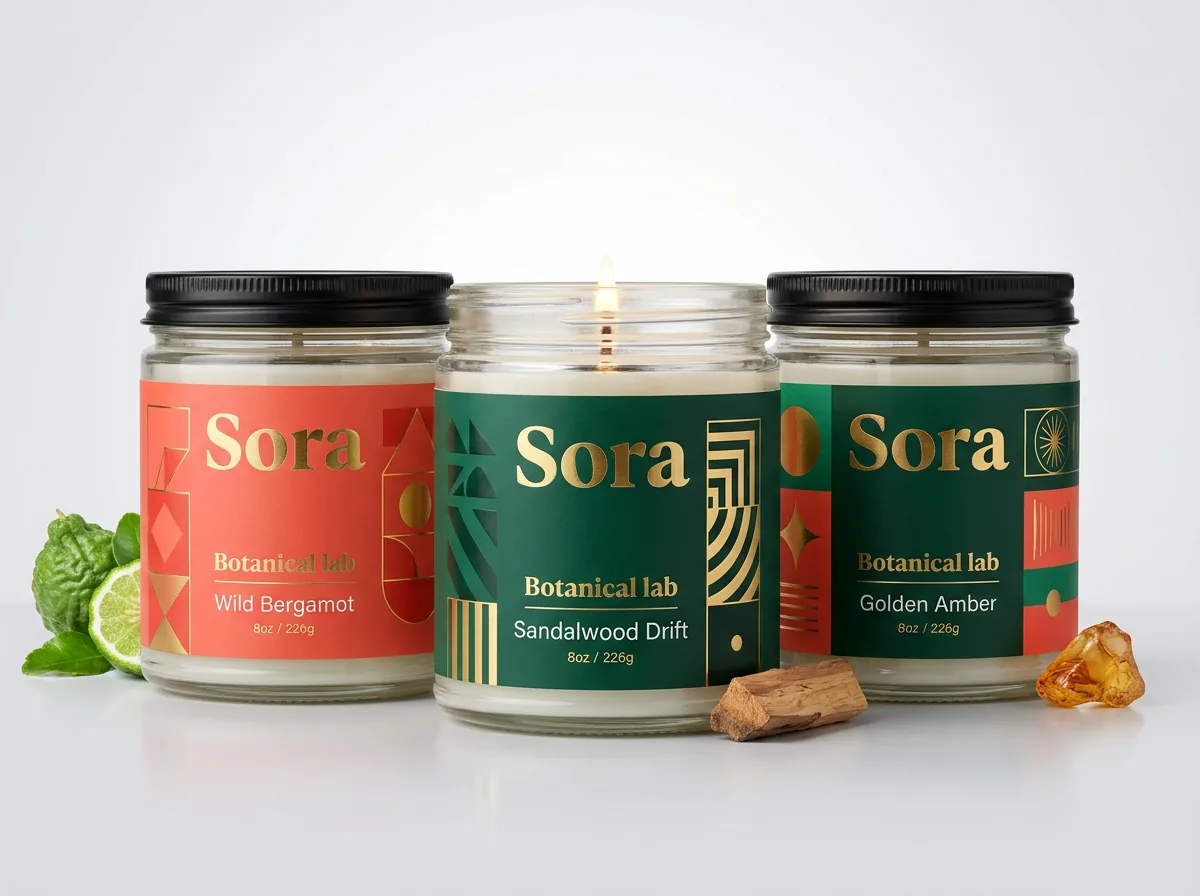
The cleanest retail candle labels never crowd fire-safety triangles and long wick-trimming paragraphs onto the front of the tumbler. Instead, successful candle brands divide the job between a front display panel and a bottom safety sticker. The front panel acts as your silent salesperson on the shelf, pairing a clear hierarchy (scent title first, 2 to 3 fragrance notes second, soy or coconut wax blend and dual net weight at the bottom) with generous visual breathing room. Underneath the jar, a 1.75 inch or 2 inch circular warning sticker carries the ASTM F2058 safety alert symbol, the three mandatory fire pictograms, burn rules and your business address. When you order printed candle labels from CubitPack, our designers check your ⅛ inch bleed, inner safe zone and small-text legibility for free before you pay, starting at 500 labels in 10 to 14 business days.
What belongs on the front candle label vs the bottom warning sticker?
Shoppers picking up a candle in a boutique decide within three seconds whether to lift the jar and smell the cold throw. If your front square is crammed with ten lines of fire warnings, barcode numbers and street addresses, the scent story gets lost. Moving operational and safety copy to the bottom or lid lets your front panel breathe while keeping every regulatory detail attached permanently to the vessel. Use the layout checklist below to assign each piece of copy to its right spot across your front label, bottom warning circle and optional dust cover or lid sticker.
| Label location | What to include | Recommended font & layout rule |
|---|---|---|
| Front label (top & center) | Brand mark, scent name, collection number | Largest type on the jar (14 pt to 24 pt+); high contrast |
| Front label (middle) | 2 to 4 key scent notes (e.g., Cedar · Fig · Vetiver) | 8 pt to 11 pt clean serif or sans-serif with wide tracking |
| Front label (lower third) | Product identity ('Soy Wax Candle') + net weight ('8 oz / 226 g') | Placed in the bottom 30% of the front panel per FPLA rules |
| Bottom warning circle | ASTM F2058 safety triangle, 'WARNING', 3 pictograms, burn rules | 6 pt minimum dark text on white or light background |
| Bottom warning (footer) | Maker/distributor city, state, URL, plus barcode or batch space | Leave a small unvarnished or light box if stamping batch codes |
| Lid circle or dust cover | Scent name or color-coded monogram | Lets shoppers identify scents when jars sit in crate displays |
What does ASTM F2058 require on a bottom candle warning label?
Under the ASTM F2058 standard followed by the National Candle Association and major US retailers, every candle vessel should carry a fire-safety caution label featuring the triangular safety alert symbol (an exclamation mark inside a triangle) followed by the signal word WARNING in bold capital letters. Directly beside or below the header sit three standard safety pictograms: Burn within sight, Keep away from things that catch fire, and Keep away from children and pets. Alongside those three icons, include concise burn instructions covering the three biggest causes of glass overheating and soot: trim the wick to ¼ inch before every lighting, keep the wax pool free of wick trimmings and matches, and do not burn the candle for more than 4 hours at a time. On a 2 inch custom circle label, arranging the three pictograms across the top curve and stacking 4 to 5 bullet lines below keeps the type at a crisp, readable 6 to 7 points.
- Include the triangle exclamation alert icon and the word WARNING at the top of the sticker.
- Show the three standard fire-safety pictograms (burn within sight, keep away from flammables, keep away from children).
- State core burn care: trim wick to ¼ inch, keep wax pool clear of debris, and burn no longer than 4 hours.
- Add your company name, city/state or website at the bottom for distributor traceability.
Where does the net weight belong on a front candle label?
If you sell candles in retail stores or across state lines, the US Fair Packaging and Labeling Act (FPLA) requires two items on the principal display panel (your front label): the statement of identity (such as Soy Wax Candle or Scented Candle) and the net quantity of contents in both US avoirdupois ounces and metric grams (for example, Net Wt 8 oz / 226 g). Measure and state the actual net weight of the wax poured into the jar, not the fluid ounce water capacity of the empty glass tumbler. Place the net weight line in the lower 30 percent of your front label layout, running parallel to the base of the jar, with at least ⅛ inch of safe margin inside the bottom cut line so the numbers never sit too close to the edge.
Know your size? Compare pricing across up to 3 quantities.
Request a Quote →How do you build one master template for 5 or 10 candle scents?
When launching a seasonal line of six fragrances, the smartest way to design is to lock one master width, height, corner radius and cut line across the entire collection. Keep your brand logo, wax blend line and net weight in the exact same spot on every file, and swap only the scent title, the three tasting notes, and the background or accent Pantone color. Sharing one dieline means every jar stands at the exact same visual height on a retail shelf or inside custom candle jar boxes, and it lets you combine multiple scents into one order at CubitPack. If you created your scent illustrations or backgrounds using an AI art tool, you can also use our print your AI design service: our prepress team converts raster artwork into print-ready CMYK or Pantone files with proper bleed at no extra cost.
How much bleed and safe zone do custom candle labels need?
Every printed label file needs three boundary lines: the bleed line, the cut line (your exact finished label size), and the inner safe margin. If your candle label has a colored, black, kraft or photographic background, extend that background color ⅛ inch (0.125 in) past the cut line on all four sides. That extra ⅛ inch bleed guarantees that tiny mechanical tolerances during high-speed kiss-cutting never leave a sliver of unprinted white paper along the edge of a dark tumbler. Inside the cut line, keep all text, thin border frames and logos at least ⅛ inch inward inside the safe zone. Thin rectangular frames placed right on the cut edge will look uneven if the blade shifts by even 1/64 inch; inset any decorative border by at least ⅛ inch so the frame looks balanced on every sticker. Before exporting your final print PDF, convert all fonts to vector outlines (or package the font files) and set your color mode to CMYK or specify your exact Pantone spot color codes. Our prepress specialists review every uploaded file by hand and send you a flat digital proof plus a 3D mockup on your candle vessel before you pay.
- Bleed (+⅛ inch outside cut line): extend background colors, dark fills and patterns all the way to the bleed line.
- Cut line (dieline): set as a 100% magenta vector stroke in a separate layer named Cut or Dieline.
- Safe zone (−⅛ inch inside cut line): keep all scent text, net weight numbers and thin frame borders inside this margin.
- Font size: keep serif scent notes at 7 pt or larger (8 pt+ when printing light ink on dark backgrounds).
- Vector outlines: convert typography and ASTM safety icons to vector paths so every stroke prints razor-sharp.
What are the most common candle label design mistakes?
A few small file errors cause most prepress delays and shelf legibility issues on candle jars. Check these five before sending your files
- Listing the empty jar's water volume (such as '9 oz tumbler') as the net weight instead of the actual weight of the wax inside (often 7 to 7.5 oz / 198 to 212 g).
- Stopping a dark background color right at the cut line with zero bleed, which can leave a white hairline edge on dark glass jars.
- Drawing a thin decorative border less than 1/16 inch from the cut edge instead of giving it a full ⅛ inch inner safe margin.
- Setting small reverse text (white text on a rich black background) in delicate hairline serif fonts under 7 points, where ink spread can fill in thin strokes.
- Crowding fire-safety triangles onto the front scent label instead of placing them on a dedicated 2 inch bottom warning circle.
Find your label size
Suggested label size: 9⅛ × 2¾ in (width × height)
A typical starting point. Your account manager confirms the size on the proof.
Quote this size →Packaging for this
Ready to order candle labels? Compare up to 3 quantities with a free 3D mockup.
Request a Quote →Questions about candle labels
What is the smallest font size that prints clearly on a candle label?
For dark ink on a white or cream background, keep body and warning text at 6 points or larger. For light or white text reversed out of a dark charcoal, navy or forest green background, use at least 7.5 to 8 points with medium letter weight so fine strokes stay open.
Do I need to pay a designer to set up my candle label dieline and bleed?
No. Design help and custom dielines are free at CubitPack. Send us your logo, scent names, font preferences or a rough Canva or AI sketch, and our prepress team will build the cut line, add ⅛ inch bleed and send a digital proof and 3D mockup before payment.
Should I put my barcode on the front candle label or the bottom warning label?
Put your UPC or SKU barcode on the bottom warning circle or on the back of your outer candle box so the front vessel label stays clean and decorative. Leave at least ⅛ inch of quiet white space around the black barcode bars so retail scanners read it instantly.
Why is my wax net weight lower than my candle jar's ounce size?
Glass manufacturers name jars by water volume to the overflow rim (for example, a 9 fl oz tumbler). Because soy and coconut waxes are less dense than water and you leave ½ inch of headspace at the top for the wick, a 9 oz tumbler usually holds about 7 to 7.5 oz (198 to 212 g) of wax by weight.
Can I order 5 different scent designs in one 500-label run?
Yes. Select 3+ designs in Step 2 of the quote form and list your scents in the notes. Keeping the same label size, shape and material across all five scents lets the press run them together efficiently.
Can I print an AI-generated botanical illustration on my candle labels?
Yes. Upload your AI image in the quote form and our prepress specialists will upscale the resolution, extend the ⅛ inch bleed, set crisp vector typography for your scent notes and show you a 3D vessel mockup before you pay.
Still have a question? Ask a packaging specialist.
Request a Quote →Request your candle labels quote
Tell us your size and quantities, and one dedicated account manager prepares pricing for each tier.
- Free design & AI-to-print studio + 3D mockup
- No die or plate charges · 4–5 day rush available
- Free shipping to all 50 states
- 10% off your first order
This design guide combines ASTM F2058 candle fire-safety labeling guidelines, US Fair Packaging and Labeling Act net weight rules, and CubitPack's prepress bleed and dieline standards. Checked by a packaging specialist. Spot something wrong? Tell us and we will fix it.
Sources
What changed
- October 22, 2026: First published.
- October 22, 2026: Updated specifications, terminology, and verified source links.
More guides
New packaging guides by email
Sizes, materials and design tips. Unsubscribe anytime.