
How do you size gravity-feed dispenser box slots, ramp angles, and sachet clearances?
Short answer: Add +3 to +4 mm of interior width and depth clearance around outer sachet heat-seal fins, cut the bottom extraction slot at 1.3 to 1.6 times single-item thickness above a 0.75–1.0 inch stop sill, and seat a 25 to 35 degree uncoated paperboard gravity ramp inside the base.
On this page
- What tower dimensions, slot heights, and ramp angles fit common single-serve products
- How do you match the 25 to 35 degree internal ramp angle to wrapper friction
- Which board caliper stops tall vertical dispenser walls from bowing outward
- How do you run a 3-minute sachet stack test before requesting your CAD dieline
- Common mistakes
- FAQs
Request a custom quoteFree dieline & 3D mockup
Engineering custom dispenser boxes that feed smoothly from the first serving to the very last packet comes down to three exact geometric relationships: chimney slip clearance, bottom mouth aperture height, and interior ramp slope. When any one of those three dimensions is guessed, either crimped foil corners snag halfway down the vertical glue seam, three bars avalanche onto the breakroom counter at once, or the final four sachets lie trapped flat below the opening where fingers have to dig them out. By calibrating interior width and depth around your widest heat-seal fin, pairing a 1.4x extraction window with a rigid bottom stop sill, and matching ramp incline to wrapper friction, every pull advances the next unit automatically. CubitPack builds custom dispenser box and gravity-ramp CAD dielines free starting at 1,000 units, with zero die charges and free shipping across all 50 US states.
What tower dimensions, slot heights, and ramp angles fit common single-serve products?
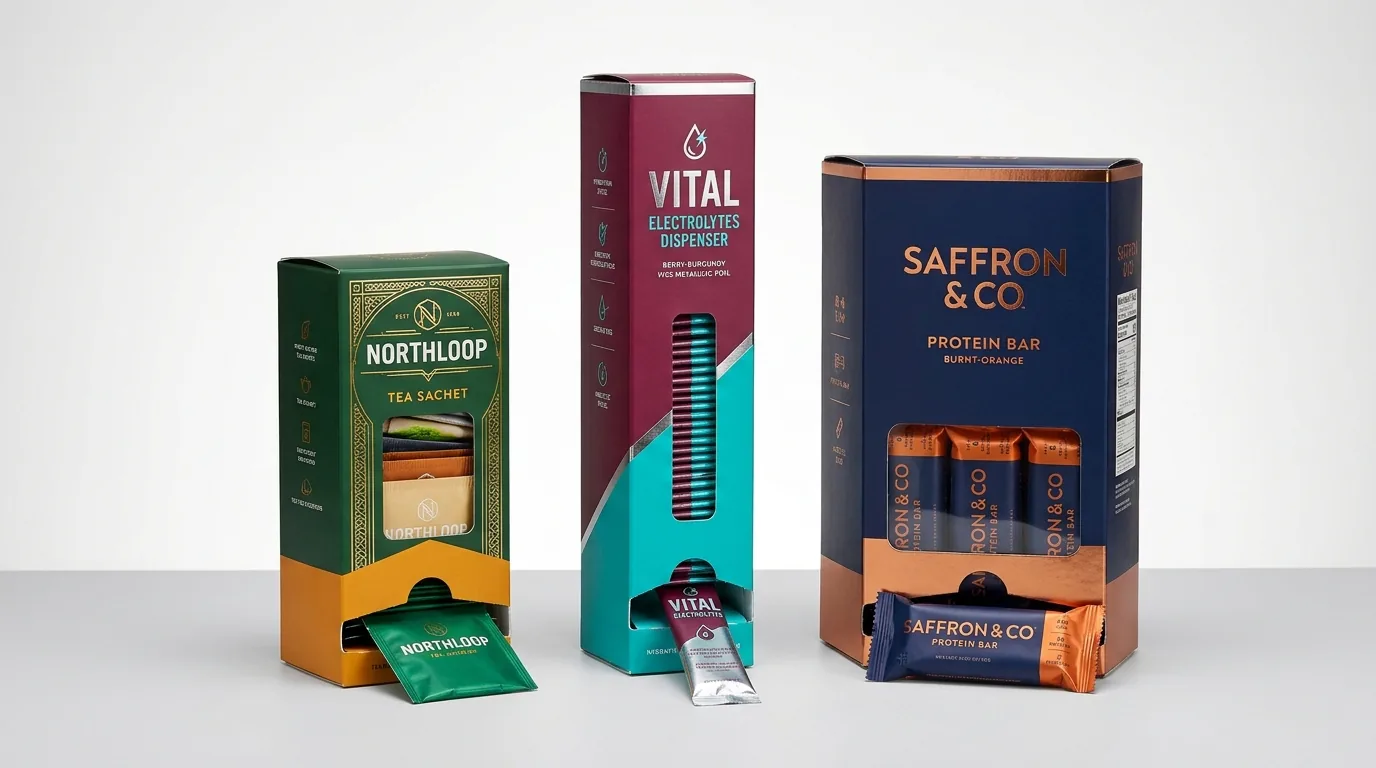
Unlike a standard carton where interior dimensions simply wrap the total bundle volume, a vertical gravity dispenser must account for the triangular height consumed by the sloped bottom ramp plus free breathing room along all four vertical walls. Always measure your packaged item across its rigid outer crimp seals rather than just the filled pillow center, because flexible foil sachets and stick packs fan outward slightly when compressed under a twenty-unit stack. Adding +3.0 to +4.0 mm (+0.12 to +0.16 in) to both interior width and interior depth ensures packets drop straight down without twisting diagonally or catching on the longitudinal side glue lap. Reference the benchmark sizes below when planning your dispenser run
- Calculate total tower height with ramp allowance: Multiply single-packet thickness by unit count, add 12% for air loft in flexible pouches, and add the rear vertical rise of the 30-degree ramp (roughly depth × 0.58).
- Size the slot height at 1.3x to 1.6x single-unit thickness: That sweet spot lets thumb and index finger pinch the front item cleanly while the upper front wall holds item #2 inside the tower.
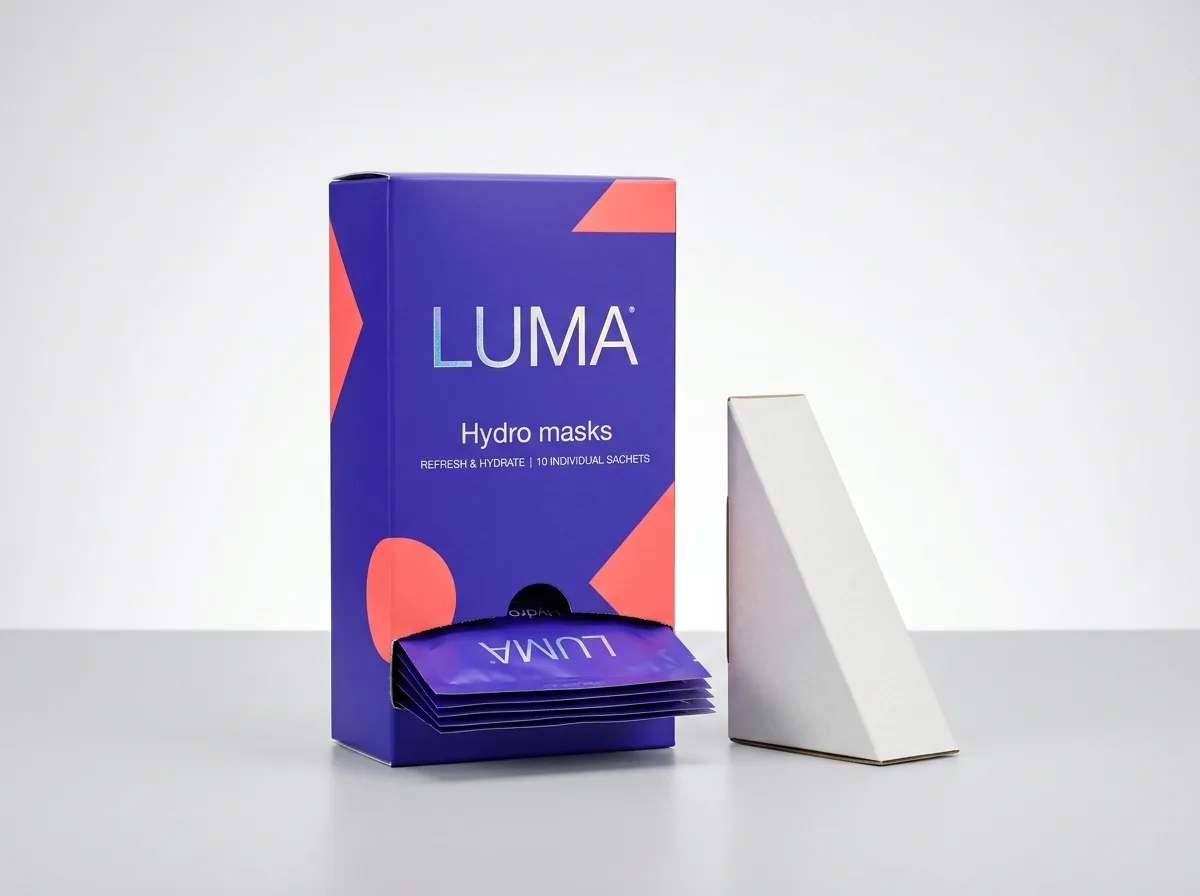
- Keep a 0.75 to 1.0 inch permanent bottom stop sill: Never cut the extraction opening flush with the carton floor when using an angled gravity ramp, or sliding packets shoot right onto the counter.
| Single-serve item | Typical count | Tower W × D × H (in) | Bottom slot × Stop sill | Ramp slope & board |
|---|---|---|---|---|
| Wrapped tea bag sachets | 20–25 envelopes | 3.25 × 2.85 × 6.50 in | 0.65 in slot / 0.75 in sill | 30° ramp · 18–20 pt card |
| Electrolyte & coffee sticks | 24–30 stick packs | 5.25 × 2.50 × 8.50 in | 0.85 in slot / 0.85 in sill | 30° ramp · 20–24 pt card |
| Sheet face mask pouches | 10–14 wide sachets | 5.00 × 4.00 × 7.50 in | 0.90 in slot / 0.90 in sill | 32° ramp · 20–24 pt SBS |
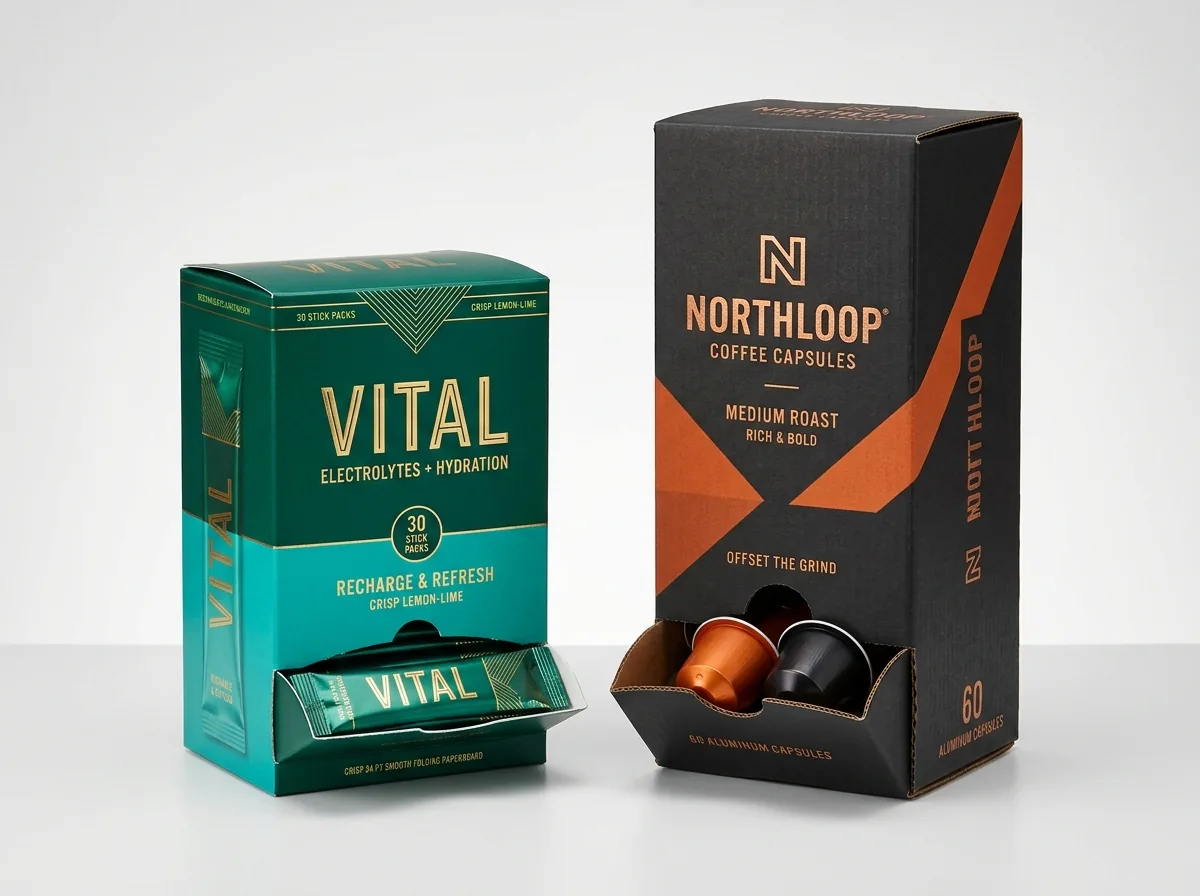
| Espresso capsules (2 lanes) | 20–30 pods | 3.50 × 3.50 × 11.00 in | 1.65 in scoop / 1.00 in tray | 28° chute · 24 pt / E-flute |
| Daily gummy mini packs | 14–21 pouches | 4.50 × 3.75 × 9.00 in | 1.20 in slot / 0.90 in sill | 30° ramp · 24 pt SBS |
| Wrapped protein & oat bars | 12–16 bars | 6.00 × 3.25 × 9.50 in | 1.35 in slot / 1.00 in sill | 25° ramp · 24 pt / E-flute |
How do you match the 25 to 35 degree internal ramp angle to wrapper friction?
Every single-serve wrapper material exhibits a different static coefficient of friction against paperboard, as measured under TAPPI slide-angle standards. Smooth metallized PET foil pouches and rigid aluminum coffee capsules begin sliding at much shallower inclines than textured uncoated paper tea envelopes or soft-touch matte cosmetic mask sachets. If the ramp is too shallow for a paper wrapper, packets stall halfway back once vertical stack weight drops below five units; if the ramp is too steep on heavy protein bars, the bottom bar wedges tightly against the front stop sill. Use the surface-pairing rules below to dial in effortless single-handed pulls
| Wrapper exterior finish | Ideal ramp incline | Ramp board surface | Why this pairing works |
|---|---|---|---|
| Aluminum pods & round tins | 24° to 27° | Uncoated or clay-coated SBS | Gentle roll/slide prevents heavy pods jamming the front lip |
| Gloss BOPP / PET foil sachets | 28° to 31° | Smooth reverse side of SBS | Low foil friction glides forward even when 1 packet remains |
| Matte film pouches & gummies | 30° to 33° | Calendered white SBS deck | Extra 2–3° overcomes satin matte film drag |
| Paper tea envelopes & kraft | 33° to 36° | Aqueous-sealed smooth card | Prevents paper-on-paper fiber grip in humid kitchens |
Which board caliper stops tall vertical dispenser walls from bowing outward?
When twenty-four snack pouches or thirty hydration sticks press downward against an angled bottom wedge, part of that vertical stack force redirects horizontally against the left, right, and front carton walls. If the paperboard caliper is too thin, the lower walls bow outward by 3 to 5 mm, widening the interior chimney enough for flat sachets to slip past one another and jam like shuffled cards. You also want crisp corner crease memory so the rectangular tube stays square throughout weeks of daily countertop pulls in humid kitchens, office breakrooms, or salon washrooms. Across custom tea bag boxes, custom coffee pod boxes, custom face mask boxes, custom gummy boxes, and custom protein bar boxes, choose caliper stiffness around total filled weight and tower height
- 18 pt – 20 pt SBS or Natural Kraft (filled tower under 1.2 lb, height under 7.5 in): Crisp, economical stiffness for 20-count herbal tea bags, cosmetic sample sachets, and single-serve sweetener sticks.
- 24 pt Heavy SBS or Kraft Card (filled tower 1.2 to 3.0 lb, height 7.5 to 10.5 in): Recommended for 30-count electrolyte sticks, 14-pack hydrogel sheet masks, daily gummy pouches, and dual-lane espresso capsules so sidewalls stay arrow-straight.
- 1.5 mm Printed E-Flute Micro-Corrugated (filled tower over 3.0 lb or height above 10.5 in): Ideal for 12-to-24 count dense protein bars, 40-pod office coffee towers, and heavy wholesale club dispensers shipped via parcel carriers.
- Horizontal cross-grain alignment: Orienting board grain horizontally across the front wall maximizes vertical column crush strength while helping horizontal tear-out perforations zip straight.
- Zero extra tooling charges: CubitPack includes custom die-cutting for both the gravity-feed dispenser carton and its folded paperboard ramp starting at 1,000 units.
Know your size? Compare pricing across up to 3 quantities.
Request a Quote →How do you run a 3-minute sachet stack test before requesting your CAD dieline?
Pair this quick physical measurement check on your printed gravity-feed dispenser cartons with our companion guides on bottom gravity dispensers vs top pop-open cartons and counter trays and dispenser perforation cut-tie ratios and reclosable flap dielines, alongside our beverage deep dive on dispenser vs tuck-top tea boxes. Measuring real filled sachets rather than flat empty pouch drawings saves days in prepress because powder, liquid serum, whole-leaf herbs, or gummy pieces puff the center of a pouch much thicker than its flat edge seal. You should also verify whether your pouches are packed cold or warm on the filling line, since trapped nitrogen flush air inside stick packs and pillow pouches adds two to three millimeters of extra springiness per ten-sachet stack that a tight carton chimney must accommodate without bowing outward
- Step 1: Measure one filled sachet's outer width and outer length from crimp edge to crimp edge in millimeters, then add +3.5 mm to each for interior chimney width and depth.
- Step 2: Stack your exact target count (for example, 20 tea bags or 15 protein bars) loosely on a table without pressing down, measure the natural stack height, and note the thickness of a single unit at its thickest center pillow.
- Step 3: Weigh the full stack on a kitchen or postal scale so our structural team pairs the right 18–20 pt, 24 pt, or E-flute stock and ramp angle.
- Step 4: Enter those measurements in CubitPack's quote form (minimum 1,000 boxes); you receive a free vector CAD dieline and 3D digital proof before payment, and you can inspect board weights beforehand with our $50 sample kit (credited to your first order).
What sizing errors cause gravity-feed dispenser boxes to jam or spill?
Double-check your carton brief against these five frequent dispenser sizing mistakes
- Sizing interior width to the filled pouch body while forgetting the 6 mm outer heat-seal fins, causing crimped foil edges to buckle and wedge inside the tower.
- Forgetting to add the vertical height of the 30-degree internal ramp when calculating total carton height, leaving the top two sachets unable to close under the tuck lid.
- Cutting the bottom pull slot taller than twice the thickness of one packet so two or three units tumble out onto the counter together.
- Omitting the 0.75 to 1.0 inch bottom retaining sill beneath a sloped gravity ramp so packets slide straight out the moment the tear strip is removed.
- Using thin 16 pt board on a tall 10-inch stick-pack or bar tower so bowed sidewalls let stacked packets twist sideways and bridge.
Packaging for this
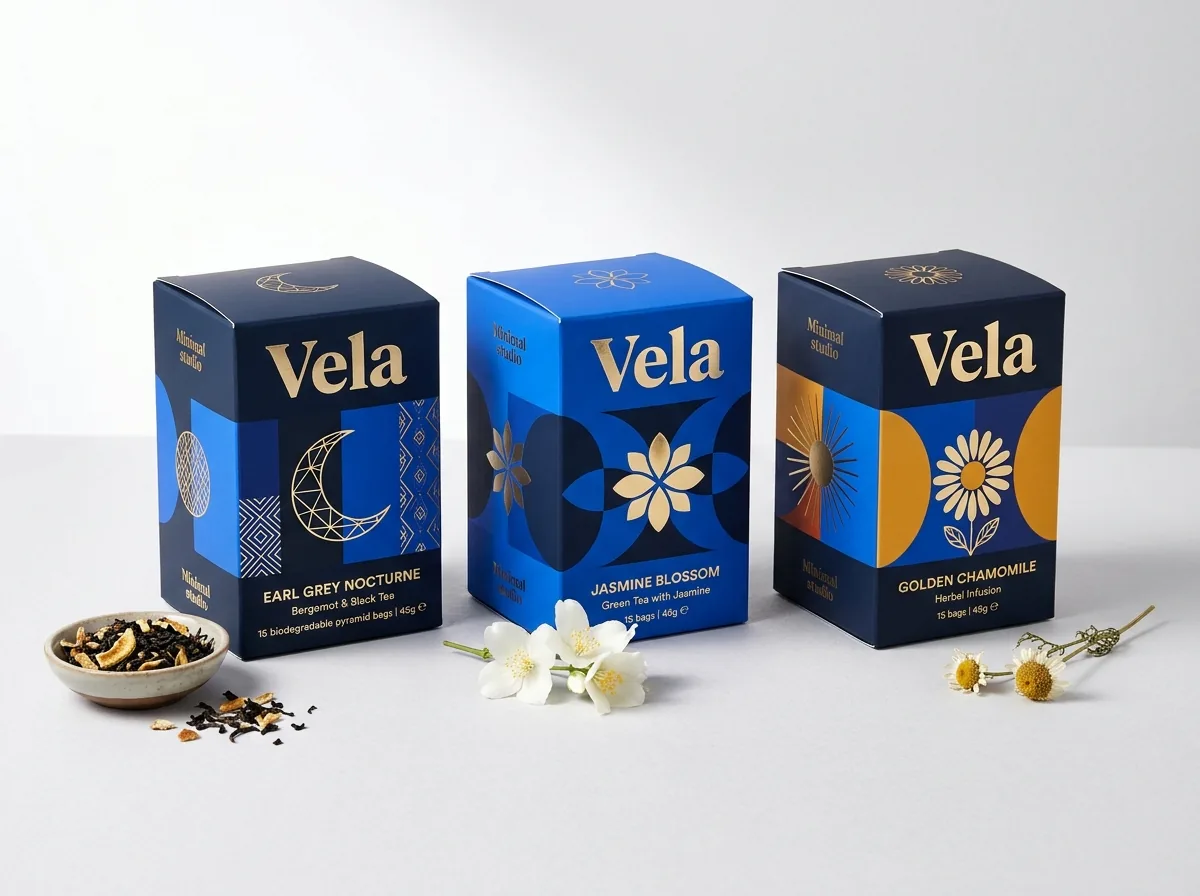
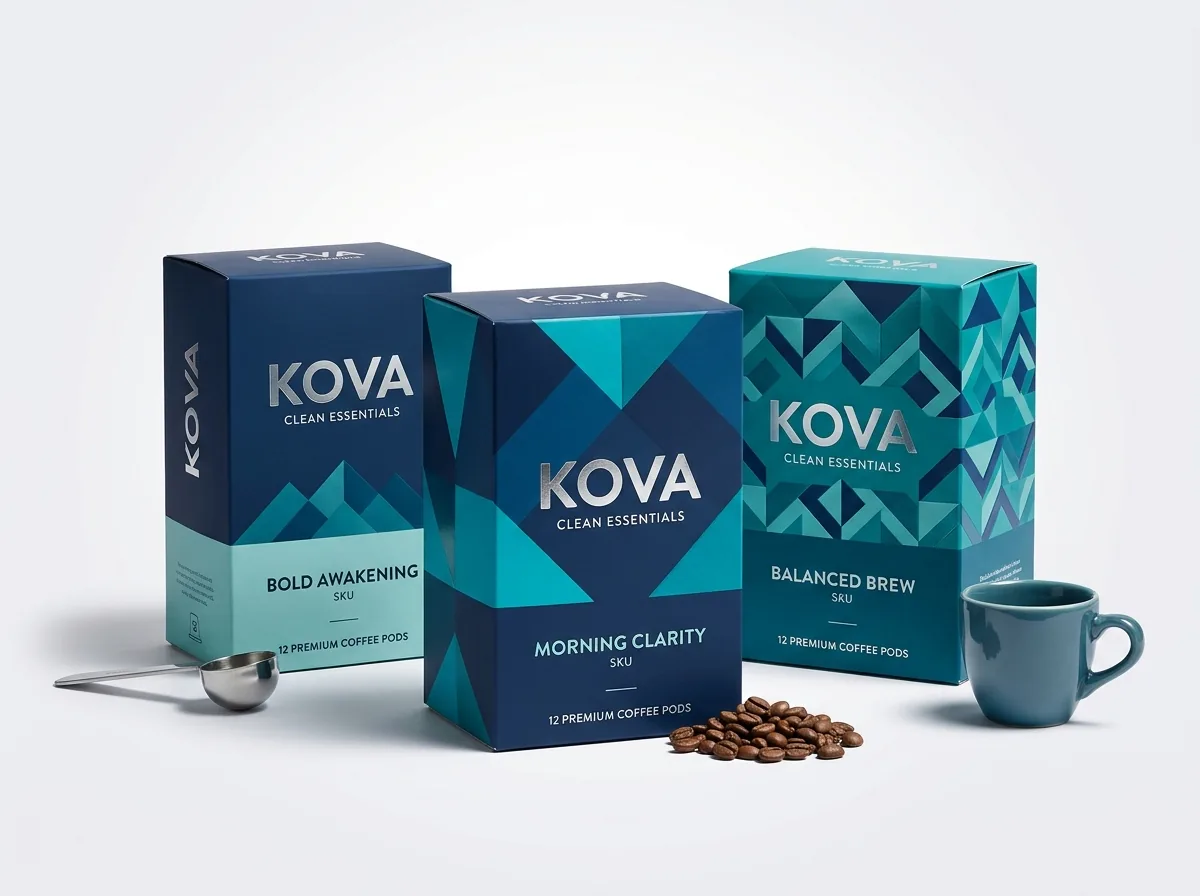


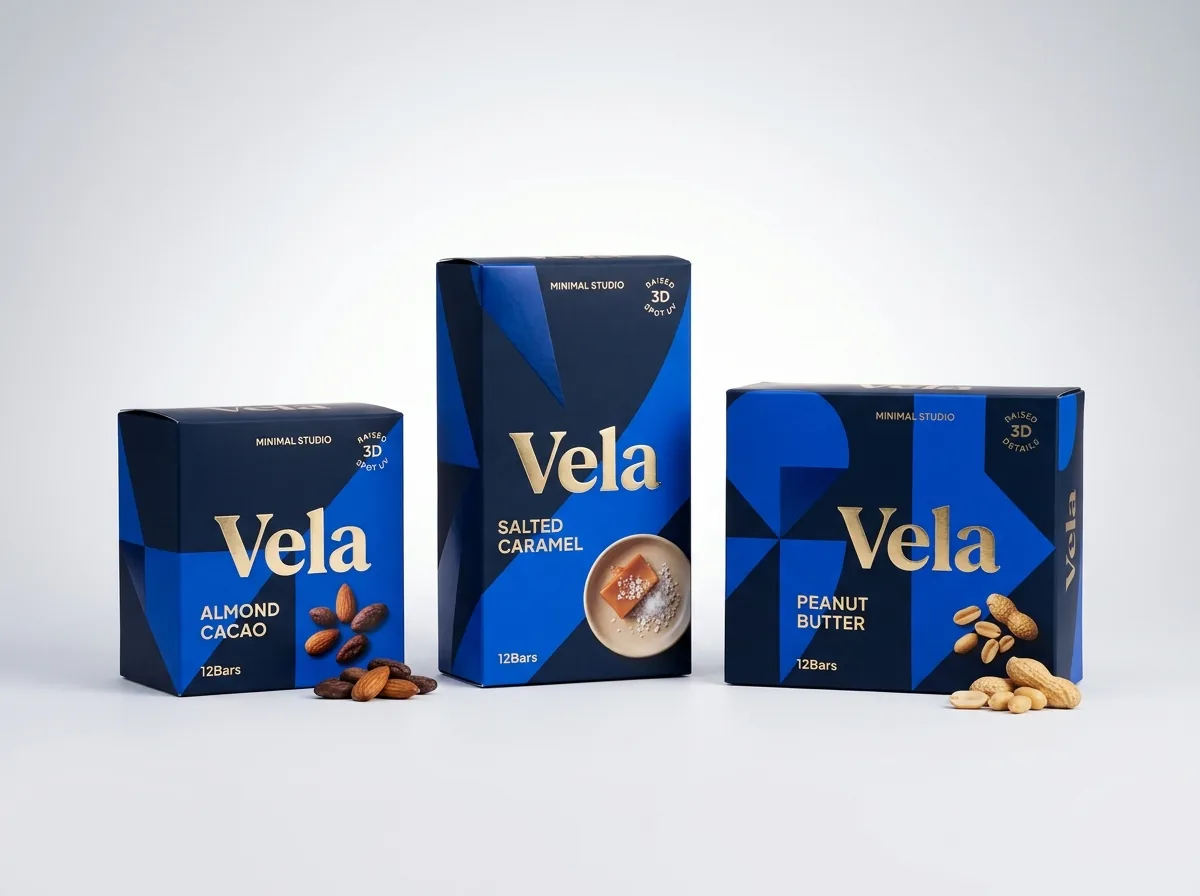
Ready to order dispenser boxes? Compare up to 3 quantities with a free 3D mockup.
Request a Quote →Questions about dispenser boxes
Why do the last few packets get stuck at the bottom of some dispenser boxes?
When a bottom-slot dispenser carton is built with a flat horizontal floor instead of an angled internal ramp, the last two or three flat sachets lie below the lower edge of the opening. Adding a 30-degree folded paperboard wedge raises the back of the floor so even the final sachet slides right up to the front sill.
How much wider should the dispenser box be than my sachet or bar?
Add 3.0 to 4.0 mm (roughly 1/8 inch) over the widest outer heat-seal fin of your sachet, pod, or bar wrapper. That clearance lets the stack drop freely past the interior side glue seam without giving narrow packets enough room to turn crooked.
Does adding an internal 30-degree gravity ramp require extra die fees?
No. CubitPack charges zero die or printing plate setup fees on custom dispenser boxes from 1,000 units, including matched folded paperboard gravity ramps and dual-lane center partitions.
Should vertical sachet packets stand on edge or lie flat inside a gravity tower?
Flat horizontal stacking on an angled 30-degree ramp works most reliably for flexible tea bags, facial sheet masks, gummy mini packs, and protein bars because gravity presses the stack evenly downward toward the front pull slot.
Can CubitPack calculate the exact tower height and ramp geometry from one sample packet?
Yes. Share the length, width, and center thickness of a single filled packet along with your desired count per box in our quote form, and our specialists build the complete carton and ramp CAD dieline free before you pay.
Still have a question? Ask a packaging specialist.
Request a Quote →Request your dispenser boxes quote
Tell us your size and quantities, and one dedicated account manager prepares pricing for each tier.
- Free design & AI-to-print studio + 3D mockup
- No die or plate charges · 4–5 day rush available
- Free shipping to all 50 states
- 10% off your first order
We verified sachet heat-seal chimney clearances, 1.3–1.6x extraction slot ratios, 25–35 degree paperboard ramp inclines, and 18–24 pt caliper stiffness against ECMA Folding Carton Design Codes, Paperboard Packaging Council (PPC) structural guidelines, and TAPPI slide-angle friction standards. Spot something wrong? Tell us and we fix it.
Sources
What changed
- November 6, 2026: First published with 6-product gravity tower sizing table, wrapper-friction ramp incline chart, and 3-minute stack check.
More guides
New packaging guides by email
Sizes, materials and design tips. Unsubscribe anytime.