
What size sauce spout pouch fits 4 oz, 8 oz, 16 oz and 64 oz condiments?
Short answer: Size custom sauce spout pouches by fluid volume plus 10% headspace rather than net weight. Standard outer dimensions are 3.5 × 5.5 × 1.5 in for 4 fl oz, 4.25 × 6.75 × 2.25 in for 8 fl oz, 5.25 × 8.75 × 2.75 in for 16 fl oz, and 8.5 × 12.5 × 4.25 in for 64 fl oz.
On this page
- Why does 16 oz of BBQ sauce take a smaller pouch than 16 oz of oil dressing
- What are standard sauce spout pouch dimensions from 4 oz to 64 oz
- How much headspace and bottom gusset depth do squeeze condiment pouches need
- How do you size 4 oz tasting flights vs 64 oz foodservice back-of-house bags
- How do you verify your sauce pouch size before full production
- Common mistakes
- FAQs
Request a custom quoteFree dieline & 3D mockup
Culinary condiments vary widely in density, which means a pouch sized by net weight in ounces on a grocery scale will often look underfilled or overflow on the filling line. Sugar-heavy molasses BBQ glazes, teriyaki reductions and honey mustards have a high specific gravity (1.15 to 1.25 g/ml), so 16 ounces by weight occupies only about 12.8 to 13.8 fluid ounces of space. By contrast, olive oil vinaigrettes and chili oils are lighter than water (0.91 to 0.93 g/ml), so 16 ounces by weight requires more than 17 fluid ounces of pouch capacity. Always convert your recipe's net weight into milliliters or fluid ounces first, add 10% headspace below the heat-welded spout canoe boss so co-packing nozzles never splash the seal area, and match the bottom gusset depth to keep the filled pouch standing upright on grocery shelves and refrigerator doors.
Why does 16 oz of BBQ sauce take a smaller pouch than 16 oz of oil dressing?
US food labeling rules allow viscous sauces to be declared by net weight (oz / g) or fluid volume (fl oz / ml), depending on category traditions. However, flexible stand-up pouches hold a fixed three-dimensional volume, not a fixed weight. Water has a specific gravity of 1.00 g/ml, where 1 fluid ounce (29.57 ml) weighs roughly 1.04 avoirdupois ounces. When you pack a dense tomato paste reduction, sweet baby back rib glaze or miso tahini dressing with a specific gravity of 1.20 g/ml into a pouch sized for 16 fluid ounces of water, the target 16 oz net weight fills only 80% of the bag, leaving slack film at the shoulders. Conversely, when you pour 16 oz net weight of an herb-infused olive oil marinade (0.92 g/ml) into that same pouch, the liquid rises into the top seal zone. When ordering custom printed sauce spout pouches, share both your net label weight and your fluid volume in milliliters so our design team sizes the flat dieline accurately.
- Oil-based vinaigrettes & chili oils (0.91–0.93 g/ml): 16 oz net weight = ~510 ml (~17.2 fl oz volume needed).
- Thin vinegar hot sauces & soy glazes (1.02–1.06 g/ml): 16 oz net weight = ~455 ml (~15.4 fl oz volume needed).
- Emulsified garlic aioli, mayo & ranch (0.98–1.05 g/ml): 16 oz net weight = ~465 ml (~15.7 fl oz volume needed).
- Tomato pasta sauces & salsas (1.06–1.12 g/ml): 16 oz net weight = ~430 ml (~14.5 fl oz volume needed).
- Molasses BBQ, hoisin & honey glazes (1.18–1.26 g/ml): 16 oz net weight = ~385 ml (~13.0 fl oz volume needed).
What are standard sauce spout pouch dimensions from 4 oz to 64 oz?
Sauce spout pouch dimensions are written as outer Width × Height × Bottom Gusset (W × H × G) in inches, measured from outer edge to outer edge of the heat seals and excluding the plastic spout neck protruding above the top edge. Side heat seals typically consume 0.25 to 0.375 inches per side, and the top spout weld header requires 0.75 to 1.0 inch of headspace. Use the benchmark chart below to pick a starting pouch size for retail squeeze condiments, family simmer sauces or commercial back-of-house restaurant prep bags. Every CubitPack order is cut to your exact millimeter or inch dimensions with no die or plate charges.
| Fluid capacity | Typical net weight (sauce) | Outer pouch size (W × H × G) | Spout placement & bore | Common culinary applications |
|---|---|---|---|---|
| 3 to 4 fl oz (90–120 ml) | 3.2 to 4.5 oz net wt | 3.5 × 5.5 × 1.5 in | Top-center (8.6–10 mm) | Tasting-flight hot sauce, meal-kit glaze, truffle oil |
| 8 fl oz (237 ml) | 8 to 9.5 oz net wt | 4.25 × 6.75 × 2.25 in | Top-center (10–13 mm) | Squeeze garlic aioli, sriracha, chipotle crema, tahini |
| 12 fl oz (355 ml) | 12 to 14 oz net wt | 4.75 × 7.75 × 2.5 in | Top-center (10–16 mm) | Tabletop BBQ sauce, salad dressing, fajita marinade |
| 16 fl oz / 1 pt (473 ml) | 16 to 19 oz net wt | 5.25 × 8.75 × 2.75 in | Center or 45° corner (13–16 mm) | Smokehouse BBQ, buffalo wing sauce, restaurant salsa |
| 24 fl oz (710 ml) | 24 to 26 oz net wt | 6 × 9.5 × 3.25 in | 45° corner or center (16 mm) | Family marinara, vodka pasta sauce, tikka masala base |
| 32 fl oz / 1 qt (946 ml) | 32 to 36 oz net wt | 6.5 × 10.5 × 3.5 in | 45° corner (16 mm) | Multi-meal stir-fry glaze, bulk table condiment refill |
| 64 fl oz / ½ gal (1.89 L) | 64 to 76 oz (4–4.8 lb) | 8.5 × 12.5 × 4.25 in | Corner (16–22 mm) + handle | Foodservice back-of-house dispenser & bottle refill bag |
How much headspace and bottom gusset depth do squeeze condiment pouches need?
Two structural details separate a sauce pouch that stands proudly on a retail shelf from one that tips forward or leaks at the top weld: bottom gusset geometry and top headspace clearance. When a stand-up pouch is filled with viscous sauce, the folded bottom gusset pushes open into a flat oval footprint. Setting the open bottom gusset depth to roughly 45% to 55% of the pouch width gives 8 oz to 24 oz pouches a low center of gravity so they stay upright on refrigerator door racks even when half empty. At the top of the bag, leave at least 10% of the total internal volume as unfilled headspace below the boat-shaped plastic canoe boss of the spout. On hot-fill pasteurization lines (where tomato or BBQ sauce enters the pouch at 185°F to 195°F), steam vapor condenses as the pouch cools in a water bath, pulling the front and back panels inward slightly. Proper headspace prevents hot sauce from contacting the top seal jaws during automated capping.
Know your size? Compare pricing across up to 3 quantities.
Request a Quote →How do you size 4 oz tasting flights vs 64 oz foodservice back-of-house bags?
At the small end of the scale, 3 oz and 4 oz spout pouches (3.5 × 5.5 × 1.5 in) have become a favorite for direct-to-consumer hot sauce tasting flights and subscription meal kits. Three 4 oz pouches fit side by side inside custom mailer boxes or custom sauce boxes at a fraction of the parcel weight and breakage risk of glass woozy bottles. At the large end of the scale, commercial kitchens and restaurant groups use 64 fl oz (half-gallon) and 128 fl oz (one-gallon) spout pouches to replace rigid plastic jugs and number-ten metal cans. For pouches holding 4 to 8 pounds of mayo, ranch or marinara, we widen the side heat seals to 8 mm or 10 mm, switch to a K-seal or plow-bottom gusset that distributes floor weight away from corner welds, and punch a reinforced two-finger carry handle into the upper header beside a 45-degree corner pour spout. You can also explore our general custom spout pouches and custom refill spout pouches for companion formats.
How do you verify your sauce pouch size before full production?
Because viscosity, entrapped air from high-shear blending and filling temperature all affect how high a sauce sits inside a flexible bag, we always recommend verifying your dimensions before ordering a full run. When you request a quote from CubitPack, tell us your target fluid ounces or milliliters, whether your sauce is cold-filled or hot-filled, and whether you fill through the spout or through the open top before heat sealing. Food-contact inner barrier liners for acidic vinegar, cooking oils and hot-fill pasteurization are available on request. Minimums depend on the product; we confirm yours with your quote. Every order includes a free custom dieline, digital proof and 3D mockup before payment, zero die or plate charges, and 10 to 14 business day turnaround (4 to 5 days rush) with free shipping to all 50 US states.
- Confirm whether your co-packer fills through the plastic spout throat or fills through the open top web before welding the spout.
- Keep text and UPC barcodes at least 0.75 inches above the bottom fold crease so the rounded belly never distorts the scanner bars.
- Enter up to three quantity tiers in Step 1 of the quote form to compare unit price breaks across your flavor lineup.
What are the most common sauce spout pouch sizing mistakes?
Avoid these five sizing errors before finalizing your condiment pouch dieline
- Sizing a pouch for 16 oz net weight of dense molasses BBQ sauce using water volume charts, which leaves the top quarter of the bag slack and underfilled.
- Using the same pouch size for 16 oz of light olive oil vinaigrette without checking fluid volume, causing oil to splash into the top heat-seal zone.
- Measuring total pouch height including the plastic spout neck instead of measuring the film bag body from bottom edge to top seal.
- Picking a narrow 1.25-inch bottom gusset on a tall 16 oz pouch, which makes the filled bag top-heavy on refrigerator door shelves.
- Placing the retail barcode across the lower gusset transition curve where the filled sauce belly bends the vertical bars.
Packaging for this
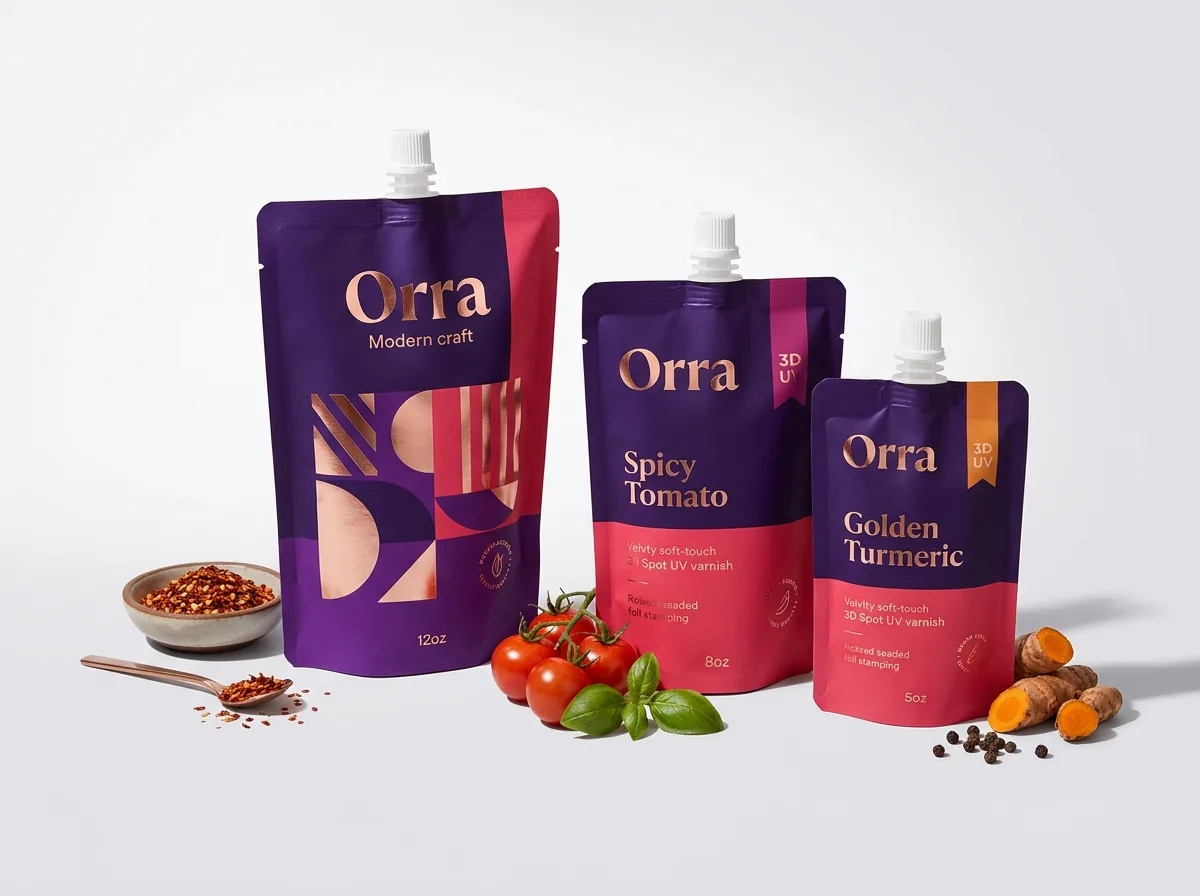
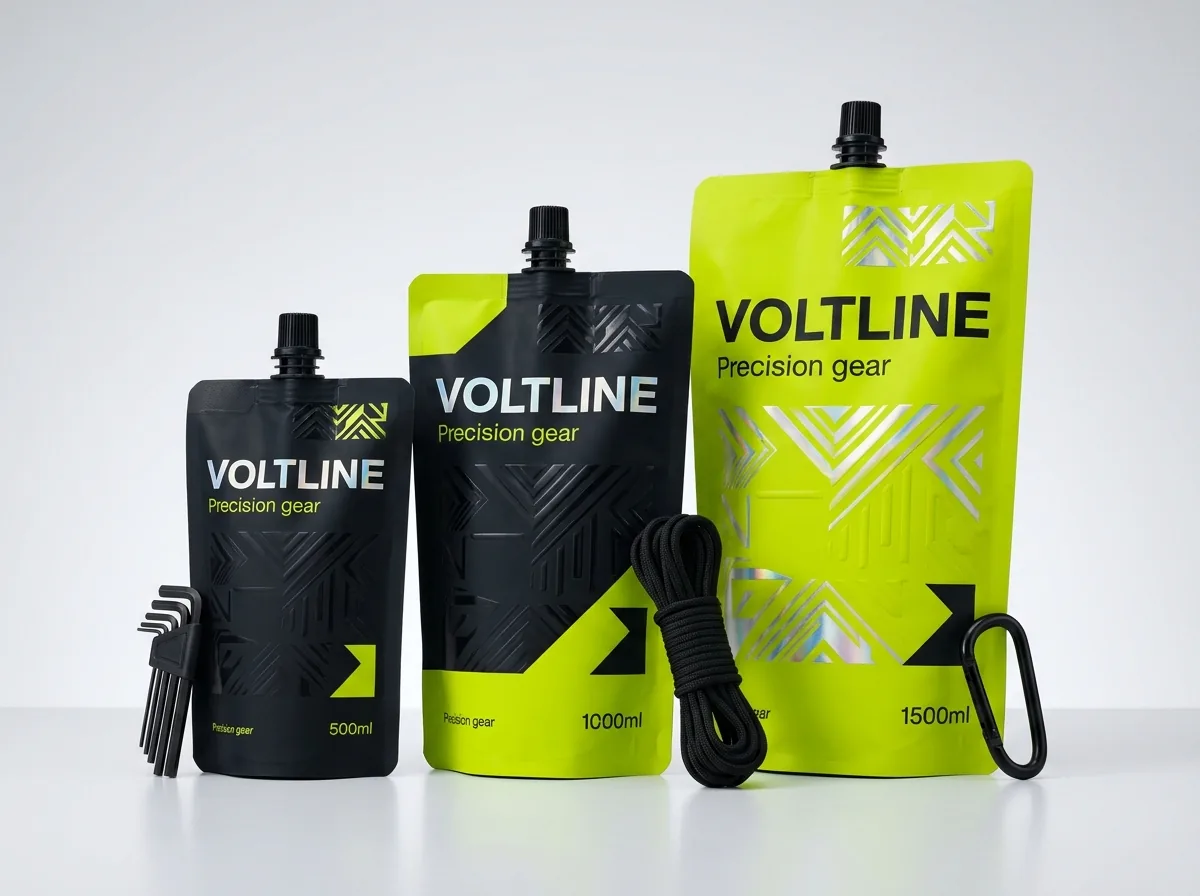
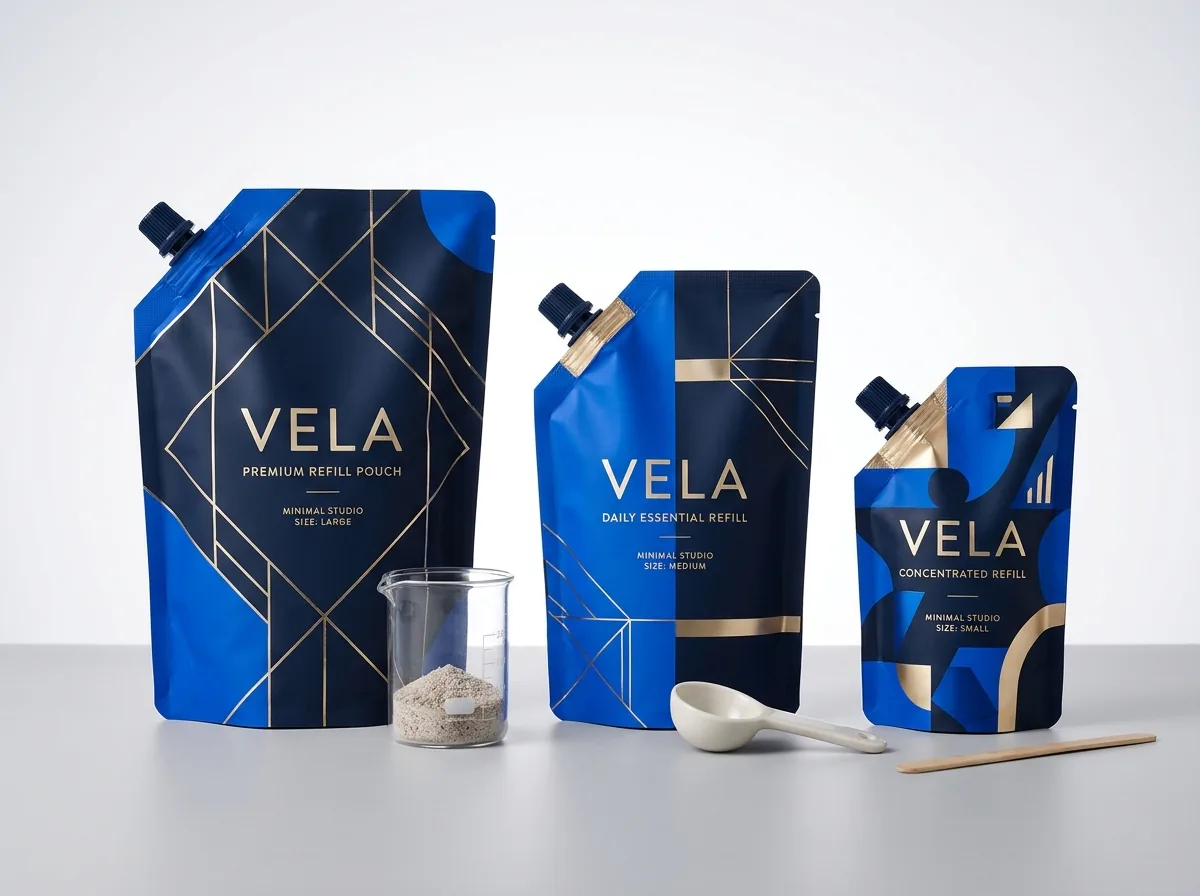
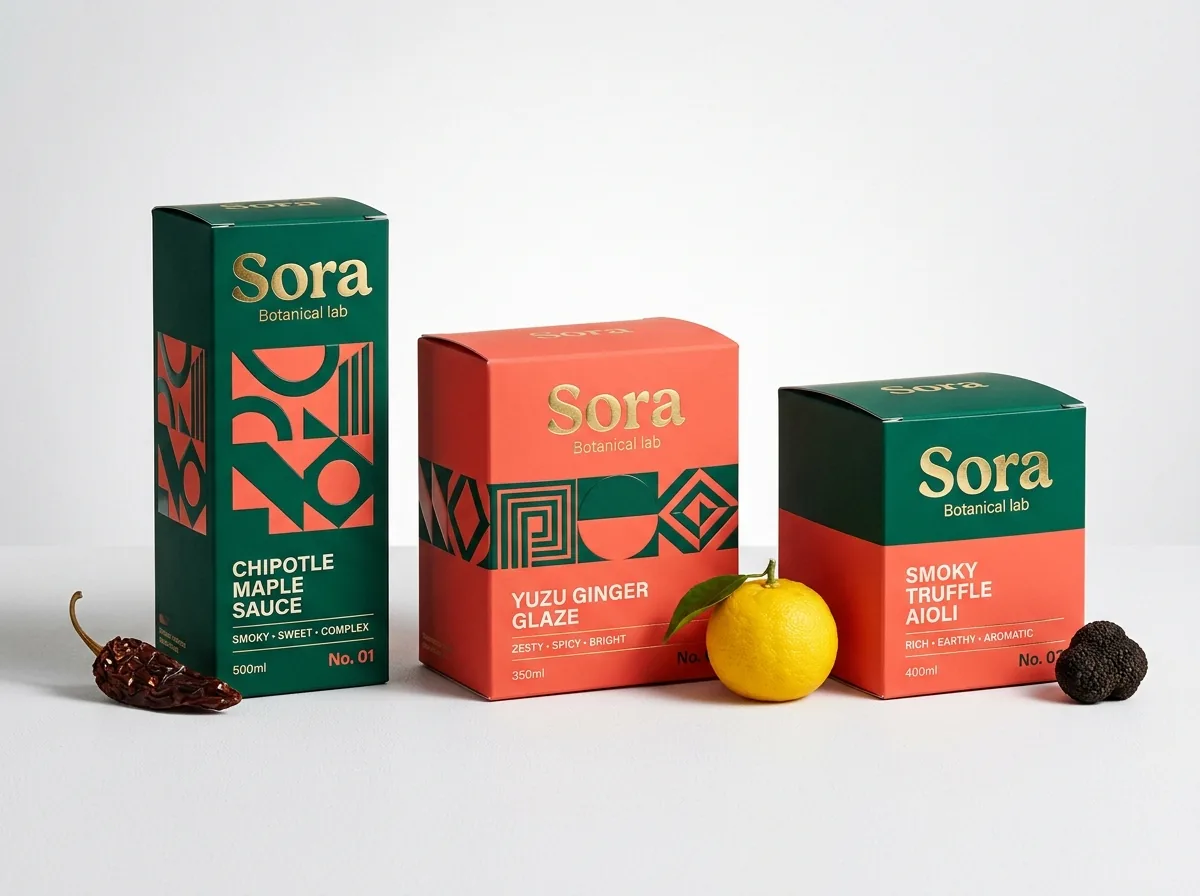

Ready to order sauce spout pouches? Compare up to 3 quantities with a free 3D mockup.
Request a Quote →Questions about sauce spout pouches
Do sauce spout pouch dimensions include the height of the plastic spout and cap?
No. Industry-standard spout pouch dimensions (Width × Height × Bottom Gusset) measure only the flexible film body from outer seal to outer seal. A top-center screw spout and cap typically add 1.0 to 1.375 inches above the top film edge, which matters when sizing master shipping cartons.
What size spout pouch fits a standard 12 fl oz bottle of BBQ or hot sauce?
A 12 fl oz (355 ml) condiment typically fits a 4.75 × 7.75 × 2.5 inch stand-up spout pouch. Because dense BBQ sauce weighs more per milliliter than water, a 4.75 × 7.75 × 2.5 inch pouch holds roughly 13.5 to 14.5 ounces by net weight of sweet BBQ glaze.
How much headspace should I leave at the top of a custom sauce spout pouch?
Leave about 10% of the pouch's internal volume (roughly 0.75 to 1.0 inch below the top spout weld) as unfilled headspace. That clearance accommodates thermal expansion during hot-fill pasteurization and keeps viscous sauce out of the seal area.
Can I use one pouch size for multiple sauce flavors with slightly different weights?
Yes. Many culinary brands standardize on one pouch dimension (such as 4.75 × 7.75 × 2.5 in) across their entire line and adjust the net weight declaration on the front artwork (for example, 11.5 oz for herb vinaigrette, 12 oz for garlic aioli and 13.5 oz for honey BBQ).
What bottom gusset style works best for heavy 24 oz and 64 oz sauce pouches?
For 4 oz to 16 oz pouches, a standard rounded D-seal or K-seal bottom gusset stands cleanly. For 24 oz pasta sauces and 64 oz foodservice bags, a K-seal (with 30-degree angled corner welds) or plow bottom relieves stress on the lower side seals.
Can CubitPack size the retail display box or tasting mailer around my sauce pouches?
Yes. Once we lock the filled thickness of your bottom gusset and the extra height of your spout cap, our design team can build matching counter display cartons or 3-pack tasting flight mailer boxes so everything ships together free.
Still have a question? Ask a packaging specialist.
Request a Quote →Request your sauce spout pouches quote
Tell us your size and quantities, and one dedicated account manager prepares pricing for each tier.
- Free design & AI-to-print studio + 3D mockup
- No die or plate charges · 4–5 day rush available
- Free shipping to all 50 states
- 10% off your first order
The pouch dimensions, specific gravity conversion ratios (0.92 to 1.25 g/ml) and 10% headspace benchmarks in this guide come from flexible packaging engineering standards and co-packing fill tables. A CubitPack packaging specialist verified every row. Spot an error? Tell us and we will fix it.
Sources
What changed
- October 22, 2026: First published.
- October 22, 2026: Updated specifications, terminology, and verified source links.
More guides
New packaging guides by email
Sizes, materials and design tips. Unsubscribe anytime.