
What size mailer box should a small business start with?
Short answer: Most small businesses start with one workhorse inside dimension that fits 80% of their orders: 7 × 5 × 2.5 inches for candles and skincare, 9 × 6 × 3 inches for two-item bundles, or 10 × 8 × 4 inches for apparel. When ordering custom small business packaging, always measure inside length × width × height.
On this page
- Why should a new shop start with just one or two box sizes
- What are the most popular starter mailer sizes by product
- How do I measure my products for a custom mailer box
- How does box size affect USPS Ground Advantage and Priority rates
- How much storage space do 250 or 500 flat mailer boxes need
- Common mistakes
- FAQs
Request a custom quoteFree dieline & 3D mockup
You do not need five or six different box footprints to launch a polished online shop. By auditing your most common single-item and two-item carts, you can pick one or two core corrugated mailer sizes that cover 85% to 90% of your shipments while easily meeting our 250-box minimum. Always state your box dimensions as inside length × width × height in inches, adding ¼ inch of breathing room on each side for tissue paper or ½ inch per wall if you use a cardboard divider. For small items like jewelry, soap bars and wax melts, a 5 × 5 × 2 inch mailer stays well inside the lowest USPS Ground Advantage weight and cubic tiers. For 8 oz candles, serum pairs and mugs, 7 × 5 × 2.5 inches or 9 × 6 × 3 inches are the proven studio standards. Every CubitPack box is cut to your exact size with zero die charges.
Why should a new shop start with just one or two box sizes?
When you run an independent shop from a home studio, a spare bedroom or a small retail backroom, ordering too many box sizes at once creates two headaches: it splits your budget across multiple small runs and fills up your shelf space with slow-moving cartons. Starting with a single workhorse mailer size lets you put your full 250-box or 500-box order into one footprint, unlocking a lower price per box right away. To find that workhorse dimension, look at your last 50 orders on Etsy, Shopify or Faire. In almost every shop, one hero product - or a two-item pair of that hero product - accounts for four out of five shipments. Size your first run of branded small business mailer boxes around that exact two-item footprint. When a customer orders a single item, a sheet of custom printed tissue paper or a folded card insert bridges the extra two inches cleanly without adding billable postage weight.
- Audit your last 50 orders and group them into 1-item, 2-item and 3+ item carts.
- Size your primary box for the 2-item cart so it handles both singles and pairs without an oversized carton.
- Keep a small pack of unprinted shippers or poly mailers on hand for the rare 5-item bulk order until your volume grows.
- Once your store ships 150+ orders a month, add a second box size for larger gift sets.
What are the most popular starter mailer sizes by product?
While CubitPack cuts every order to your exact millimeter or sixteenth of an inch with no die fees, most independent makers, boutiques and artisan food brands build their packaging around six parcel-tested footprints. Every measurement in the chart below refers to the usable interior cavity - length (left to right) × width (front to back) × height (bottom to top) in inches. Notice how the heights stay between 2 inches and 4 inches on almost every row. Keeping your vertical depth shallow prevents products from tumbling on top of each other in USPS sorting bins and keeps the total cubic volume low.
| Inside size (L × W × H) | Best for these small business products | Typical USPS / parcel tier |
|---|---|---|
| 5 × 5 × 2 in | Jewelry boxes, enamel pins, 2 soap bars, wax melts, lip balm trios | Under 8 oz / 0.10 cubic ft |
| 6 × 4 × 2 in | 1-2 dropper bottles, Essential oils, sunglasses, small leather goods | Under 8 oz / 0.10 cubic ft |
| 7 × 5 × 2.5 in | Single 8-9 oz candle jar, skincare duo, stationery cards, coffee mug | Under 1 lb / 0.10 cubic ft |
| 9 × 6 × 3 in | Two candle jars, 12 oz coffee bag + scoop, apothecary gift set | 0.10 to 0.20 cubic ft |
| 10 × 8 × 4 in | Folded t-shirt, baby clothes set, hardcover planner, craft kit | 0.20 cubic ft tier |
| 12 × 10 × 4 in | Boutique sweatshirt, dress, 4-piece bath bundle, bakery sampler | 0.30 cubic ft tier |
| 14 × 10 × 5 in | Chunky knitwear, home decor, wholesale starter pack for Faire | 0.40 to 0.50 cubic ft |
How do I measure my products for a custom mailer box?
Never measure an old shipping box from the outside and type those numbers into a quote form. Corrugated roll-end mailers fold double-thick walls on the left and right sides to lock the lid shut, which means the outside of the box is roughly ⅜ inch to ½ inch wider and longer than the usable space inside. Always measure the products themselves arranged on your table. Place your items in the exact flat layout you want your customer to see when they lift the lid, alongside any thank-you card or instruction booklet. Measure the longest horizontal span as Length (L), the front-to-back depth as Width (W), and the tallest point of the thickest item as Height (H). Then add your cushioning allowance based on how you wrap the goods.
- Tissue paper and sticker wrap only: add ¼ inch (0.25 in) to Length, Width and Height so the tissue folds tuck in smoothly.
- Crinkle paper or honeycomb kraft wrap: add ½ inch (0.50 in) to Length and Width, and ½ inch to Height for a protective bed.
- Custom cardboard divider insert: leave ⅜ inch to ½ inch between glass jars and ½ inch around the outer perimeter.
- Always check that your 4 × 6 inch thermal shipping label fits flat on the top or bottom lid without folding over an edge.
Know your size? Compare pricing across up to 3 quantities.
Request a Quote →How does box size affect USPS Ground Advantage and Priority rates?
For most US small businesses shipping orders under 5 pounds, USPS Ground Advantage and Priority Mail Cubic are the backbone of fulfillment. Both services look at two numbers: scale weight and total cubic volume. You calculate cubic volume in feet by multiplying outside length × width × height in inches and dividing by 1,728. When a parcel stays below 0.10 cubic feet (172.8 cubic inches outside) or 0.20 cubic feet (345.6 cubic inches outside), cubic pricing keeps postage low even if you are shipping heavy soy candles or glass honey jars. Once any package exceeds 1 cubic foot (1,728 cubic inches), carriers apply a dimensional weight divisor (166 for USPS, 139 for UPS and FedEx) that bills you for empty air. Ordering a custom-sized box from CubitPack lets you shave ½ inch off the height or width so your everyday mailer sits safely inside the lower postage bracket, saving money on every single shipment your store sends out.
How much storage space do 250 or 500 flat mailer boxes need?
One of the biggest worries for home-based founders is where to put 250 or 500 boxes when they arrive. Fortunately, corrugated custom mailer boxes and custom kraft mailer boxes are delivered knocked-down flat (KD) with pre-scored fold creases, strapped in neat stacks inside master shipping cartons. Because E-flute corrugated board is only about 1/16 inch thick when flat, 250 medium mailers (such as 9 × 6 × 3 inches) take up roughly the same floor footprint as four or five standard moving boxes. You can slide them under a 6-foot packing bench, stack them in one side of a reach-in closet, or store them on a single heavy-duty wire rack in your garage. Keeping your boxes flat in their master cartons until the day you pack also protects the board from household humidity and dust. If your shop grows into 2,500+ box runs before you move into a commercial warehouse, CubitPack also offers split shipments and optional partner warehousing quoted per order.
What are the most common box sizing mistakes for small businesses?
Sizing errors usually happen when a founder orders boxes before testing how the product, protective wrap and shipping barcode label fit together on the packing bench. Avoid these five mistakes
- Measuring the outside of a stock box instead of the usable inside Length × Width × Height, resulting in a snug cavity that crushes product cartons.
- Ordering a tiny 4 × 4 × 2 inch mailer without realizing a standard 4 × 6 inch thermal shipping label hangs over the edges.
- Picking a box that is 2 inches too tall for the product, which forces you to buy extra crinkle paper and pushes the parcel into a higher cubic rate.
- Ordering five different box sizes in minimum runs on day one instead of one versatile size that covers 85% of carts.
- Forgetting to add ½ inch of clearance when switching from thin tissue paper to honeycomb wrap or a cardboard divider.
Find your size
Suggested inside size: 5 × 5 × 2 in
A starting point. Your account manager confirms the size with you before the proof.
Quote this size →Packaging for this
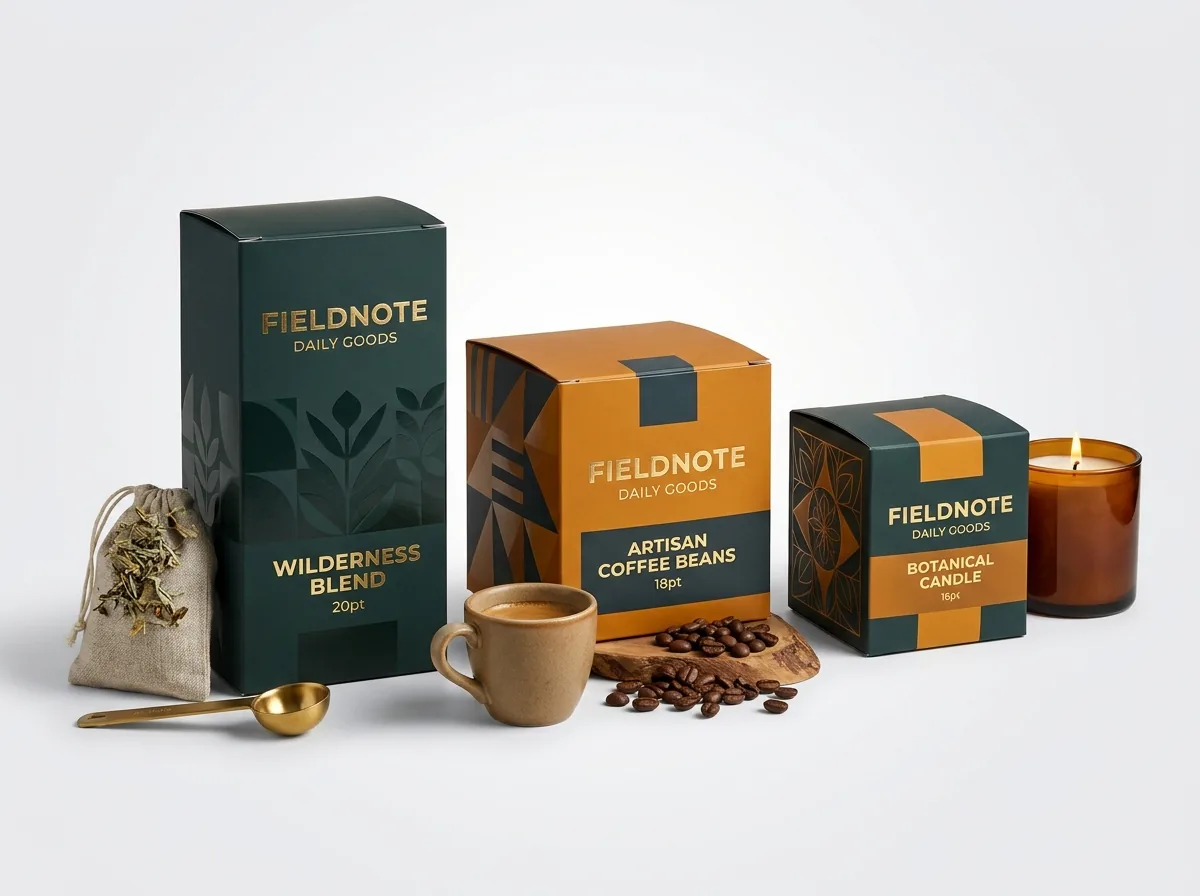
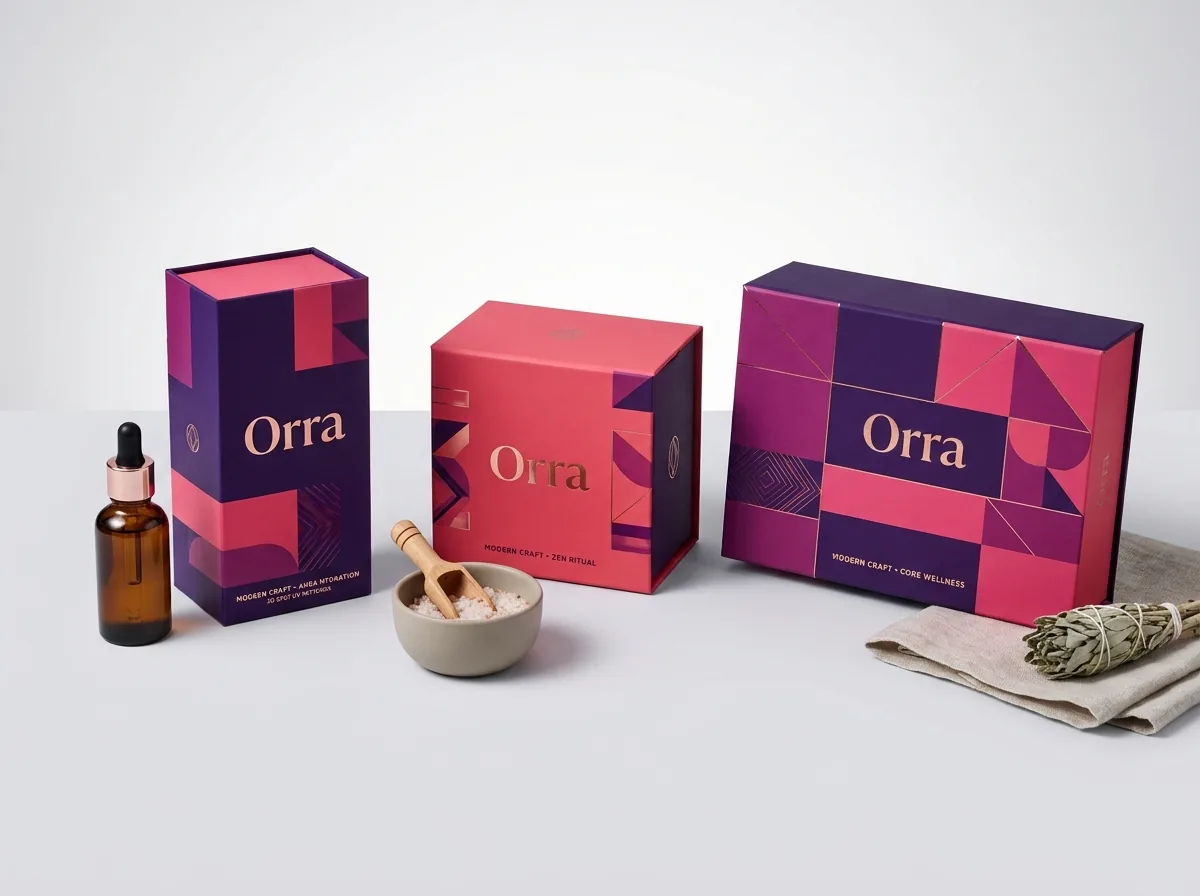
Ready to order small business packaging? Compare up to 3 quantities with a free 3D mockup.
Request a Quote →Questions about small business packaging
What is the single most versatile mailer box size for a small business?
A 9 × 6 × 3 inch or 10 × 8 × 4 inch corrugated mailer is the most versatile starting size for most independent shops. Both footprints hold single items with a little tissue wrap as well as two-to-three item bundles, fit a 4 × 6 inch shipping label flat on the lid, and stay in low USPS postage tiers.
In what order should I write my box dimensions when requesting a quote?
Always write inside dimensions in the order of Length × Width × Height (L × W × H) in inches. Length is the left-to-right opening side as you face the box, Width is the front-to-back depth from the front flap to the back hinge, and Height is the vertical depth from bottom to top.
What is the smallest mailer box size that fits a standard 4 × 6 inch shipping label?
A 6 × 4 × 2 inch mailer is the smallest footprint where a standard 4 × 6 inch thermal carrier label lies completely flat on the top or bottom panel without wrapping over a fold score. Carrier scanners read flat barcodes much more reliably than labels folded around a corner.
How much clearance should I add around glass candle jars or skincare bottles?
If you wrap a single jar in custom tissue paper, add ¼ inch to all three dimensions. If you are shipping glass jars in a rough parcel lane or packing two jars together, add ½ inch around each jar and let our structural team add a die-cut cardboard or foam insert.
Can I test the size of my box before paying for a 250-unit production run?
Yes. Every CubitPack order includes a free 2D dieline proof and an interactive 3D mockup before you pay. You can also print the 2D dieline at 100% scale on paper to test-fit your product on your desk, or order a physical prototype or custom printed sample credited to your order.
Does ordering a custom box size cost extra for cutting dies?
No. Unlike traditional suppliers that charge extra when you step outside their stock catalog sizes, CubitPack charges zero die fees and zero plate fees. A custom 8.5 × 5.5 × 2.75 inch mailer costs no more to set up than a round-number size.
Still have a question? Ask a packaging specialist.
Request a Quote →Request your small business packaging quote
Tell us your size and quantities, and one dedicated account manager prepares pricing for each tier.
- Free design & AI-to-print studio + 3D mockup
- No die or plate charges · 4–5 day rush available
- Free shipping to all 50 states
- 10% off your first order
The starter footprints in this guide are based on USPS Ground Advantage cubic thresholds (0.10 to 0.50 cubic feet), standard 4 × 6 inch thermal label dimensions, and E-flute corrugated wall tolerances. A CubitPack packaging specialist checked every dimension. Spot something wrong? Tell us and we will fix it.
Sources
What changed
- October 22, 2026: First published.
- October 22, 2026: Updated specifications, terminology, and verified source links.
More guides
New packaging guides by email
Sizes, materials and design tips. Unsubscribe anytime.