
What size ecommerce box do I need?
Short answer: Arrange your bundle flat on a table, measure its length, width and height in inches, and add ¼ inch per side for a snug fit or ½ to 1 inch for inserts. Most online stores cover 90% of orders with three custom ecommerce boxes: small (6 × 4 × 2 in), medium (10 × 8 × 4 in) and large (14 × 12 × 6 in).
On this page
- How do I measure single products and multi-item bundles for a box
- What are the most common custom ecommerce box sizes by product
- How many box sizes should an online store stock
- How much extra space do cardboard and foam inserts require
- What is the smallest and largest box size parcel carriers accept
- Common mistakes
- FAQs
Request a custom quoteFree dieline & 3D mockup
To find the right ecommerce box size, always work in inside dimensions: length (left to right across the front) × width (front to back) × height (top to bottom) in inches. Start by grouping your online orders into your most common cart combinations rather than sizing a separate box for every individual SKU. Lay the items on a flat table in the exact orientation they will travel, measure the total footprint with a ruler, and add clearance based on how you protect the contents: add ¼ inch per dimension for non-fragile goods wrapped in tissue paper, or ½ to 1 inch per dimension when adding a corrugated or foam insert. Because every fraction of an inch increases cubic volume and carrier dimensional weight charges, keep the box height just tall enough to clear the highest cap, pump or folded garment. At CubitPack, every box is cut to your exact inside dimensions with no die or plate charges.
How do I measure single products and multi-item bundles for a box?
Custom packaging is always quoted and built using inside dimensions (ID), because the inside cavity determines whether your product fits, whereas the outside dimensions (OD) are roughly ¼ to ⅜ inch larger due to the thickness of the corrugated flute walls. Before you touch a ruler, decide how your customer should see the products the moment the lid lifts. When a customer opens custom printed ecommerce boxes, the widest printed face of your product should look straight up at them rather than lying sideways or buried under crumpled paper. If you ship multi-item kits or average 2.4 items per cart, arrange those items side by side on your workbench with the exact gap needed for a divider wall between them. Measure the longest horizontal side as Length (L), the front-to-back depth as Width (W), and the vertical stack from table to top cap as Height (H). Never guess dimensions from container fluid ounces alone: two 4 oz skincare jars from different glass molds can vary by ½ inch in width and height.
- Length (L): measure the longest horizontal side of your arranged product bundle from left to right.
- Width (W): measure the shorter horizontal side from the front edge to the back hinge.
- Height (H): measure vertically from the base of the tallest item to its highest cap or lid.
- Snug tissue-wrap clearance: add ¼ inch (0.25 in) to L, W and H so items slide in and out without binding.
- Dividers and inserts clearance: add ½ inch to 1 inch to L and W so card folds or foam walls have structural room.
What are the most common custom ecommerce box sizes by product?
Although CubitPack cuts every order to your exact millimeter or sixteenth of an inch with no tooling fees, most direct-to-consumer brands anchor their lineup around six proven footprints. Use the chart below to compare typical inside dimensions against the products they carry and the corrugated box style that suits each weight range. Pay close attention to the third number in each dimension: the vertical height. Keeping a small mailer under 2 to 3 inches tall lets light parcels travel swiftly and keeps total cubic volume low, while stepping up to a 4 inch or 6 inch depth gives round jars, coffee bags and folded hoodies the room they need without bulging the top lid.
| Inside size (L × W × H) | Typical online order contents | Recommended box style |
|---|---|---|
| 6 × 4 × 2 in | 1-2 dropper bottles, jewelry pouches, sunglasses, tech cables | Roll end tuck front mailer |
| 8 × 6 × 3 in | Skincare duo, candle tumbler, supplement bottles, spice duo | Mailer box with card insert |
| 9 × 6 × 4 in | 12 oz coffee bag, mug in protective cradle, gourmet snack trio | Roll end tuck front mailer |
| 10 × 8 × 4 in | Folded t-shirt, hardcover book, 4-piece starter kit, subscription box | Printed inside mailer |
| 12 × 10 × 4 in | Two garments, lightweight footwear, towel set, curated gift bundle | Roll end tuck front mailer |
| 14 × 12 × 6 in | Heavy hoodie, home fragrance set, multi-box replenishment order | Regular slotted shipping carton (RSC) |
| 16 × 12 × 8 in | Small kitchen appliances, bulk wholesale pack, outerwear bundle | Double wall or RSC shipper |
How many box sizes should an online store stock?
Stocking a single box size for an entire catalog forces your fulfillment team to pack single small items inside cavernous cartons stuffed with kraft paper. Conversely, ordering ten different custom box sizes splits your purchasing volume and clutters warehouse shelving. For most growing e-commerce brands, the sweet spot is a three-tier box matrix: a Small 1-item mailer, a Medium 2-to-3-item bundle mailer, and a Large multi-item shipping box. To pick your three sizes, export the last 90 days of order line items from your store platform and sort orders by item count and cubic volume. Design your Small mailer around your top bestselling single SKU so single-item orders ship at the lowest possible postage tier. Design your Medium mailer around your most popular bundle or routine set, and use your Large box for high-cart-value orders. Because our minimum for custom mailer boxes is just 250 units, you can launch a Small and Medium size together or request a quote across three quantities (such as 250, 500 and 1,000) to balance unit cost against storage space.
Know your size? Compare pricing across up to 3 quantities.
Request a Quote →How much extra space do cardboard and foam inserts require?
When you ship fragile glass dropper bottles, ceramic mugs, candle jars or multi-piece starter kits, the insert determines the outer box size, not the bare product alone. A folded custom cardboard insert or corrugated tray needs folded side walls and buffer cells between items so glass never sits directly against the outer parcel wall where a doorstep drop can transfer shock. As a rule of thumb, allow ½ inch of buffer between each item inside the tray and ½ inch around the outer perimeter when using folded corrugated dividers. If you choose die-cut EVA foam inserts or EPE foam for electronics, glass vials or luxury kits, leave at least ½ inch of foam between cavities and ½ inch from the box walls so the foam web stays rigid and does not tear during packing. You never have to calculate insert geometry on your own: give our design team the exact diameter, height and weight of each item, and we will size the insert and the outer box together at no cost.
What is the smallest and largest box size parcel carriers accept?
Even if your product is tiny, like a single lip balm, enamel pin or micro SD card, your outer shipping box must still be large enough to hold a standard 4 × 6 inch thermal carrier barcode label flat on one panel without wrapping around an edge. When a barcode wraps over a box crease, automated sorting scanners at USPS, UPS and FedEx cannot read the tracking number, causing manual-handling surcharges or delayed delivery. For that reason, 6 × 4 × 1.5 inches or 6 × 4 × 2 inches is the practical minimum footprint for a standalone e-commerce mailer. On the upper end, watch the 1 cubic foot (1,728 cubic inches) threshold closely. Once a parcel's outside length × width × height exceeds 1,728 cubic inches (for example, a 14 × 12 × 10.5 inch box), USPS Ground Advantage and Priority Mail apply dimensional weight pricing, and private carriers bill by L × W × H ÷ 139 regardless of how light the contents are. Check your planned size in our dimensional weight calculator before locking your final dieline.
- Minimum practical parcel face: at least 6 × 4 inches on the top or bottom panel so a 4 × 6 in thermal shipping label lies completely flat.
- Sub-1-pound sweet spot: 6 × 4 × 2 in or 7 × 5 × 2 in corrugated mailers keep box weight to a few ounces for low-tier postage.
- USPS 1 cubic foot mark: keep outside L × W × H under 1,728 cubic inches whenever possible to avoid cubic/DIM surcharges.
- Inside-to-outside conversion: add about ⅜ inch to L, W and H on E-flute or B-flute mailers when estimating outside carrier volume.
What are the most common ecommerce box sizing mistakes?
Most expensive fulfillment sizing errors happen when brands copy an old stock carton or forget to account for corrugated wall thickness. Check these five before approving your dieline
- Measuring the outside of a sample box instead of the inside cavity, leaving the finished mailer ⅜ inch too narrow for your product.
- Swapping Length and Width: Length is always the hinge opening from left to right, and Width is the depth from front to back.
- Making the smallest mailer smaller than 6 × 4 inches, which forces warehouse staff to fold the 4 × 6 inch barcode label over a corner.
- Sizing the box to the bare product first and deciding to add a corrugated or foam insert later, when there is no room left for divider walls.
- Leaving 2 inches of empty vertical head space above the product instead of lowering the box height (H) to cut dimensional weight.
Find your size
Suggested inside size: 6 × 4 × 2 in
A starting point. Your account manager confirms the size with you before the proof.
Quote this size →Packaging for this
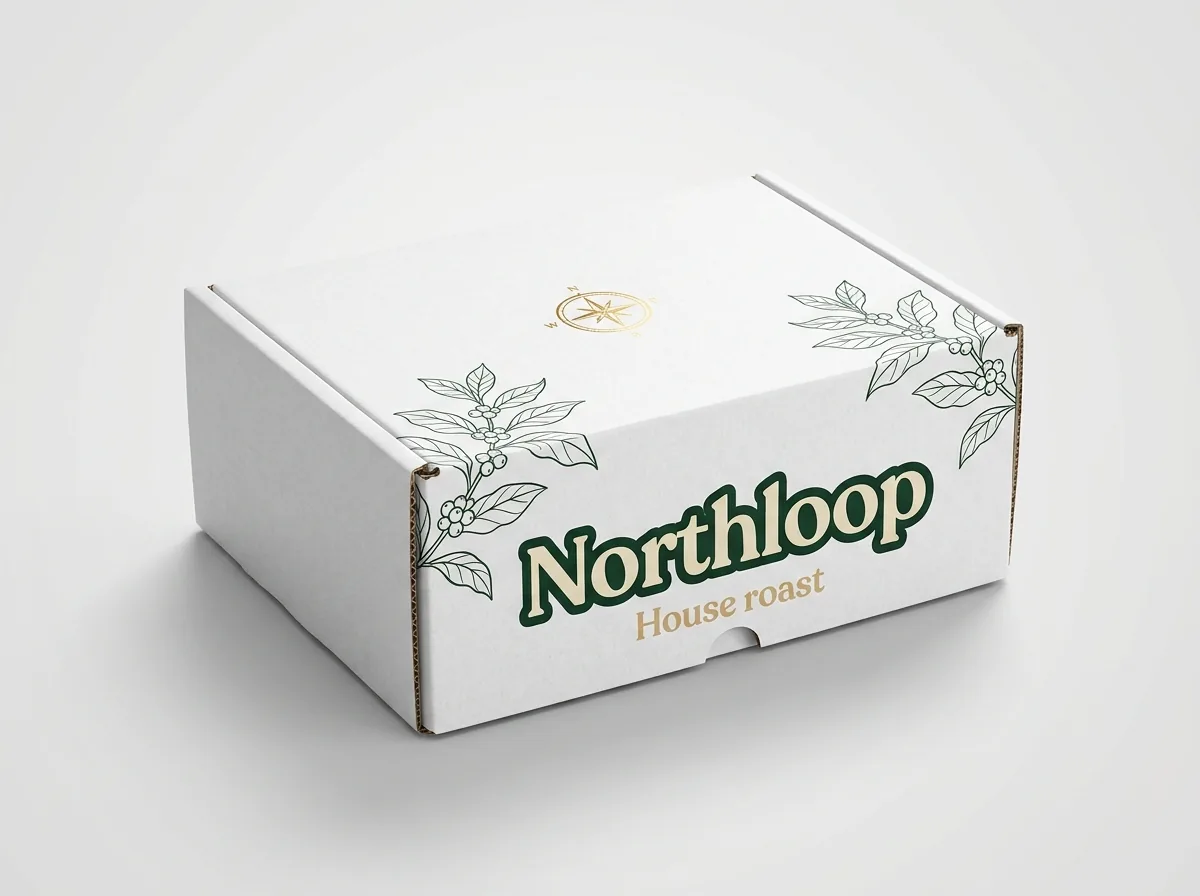
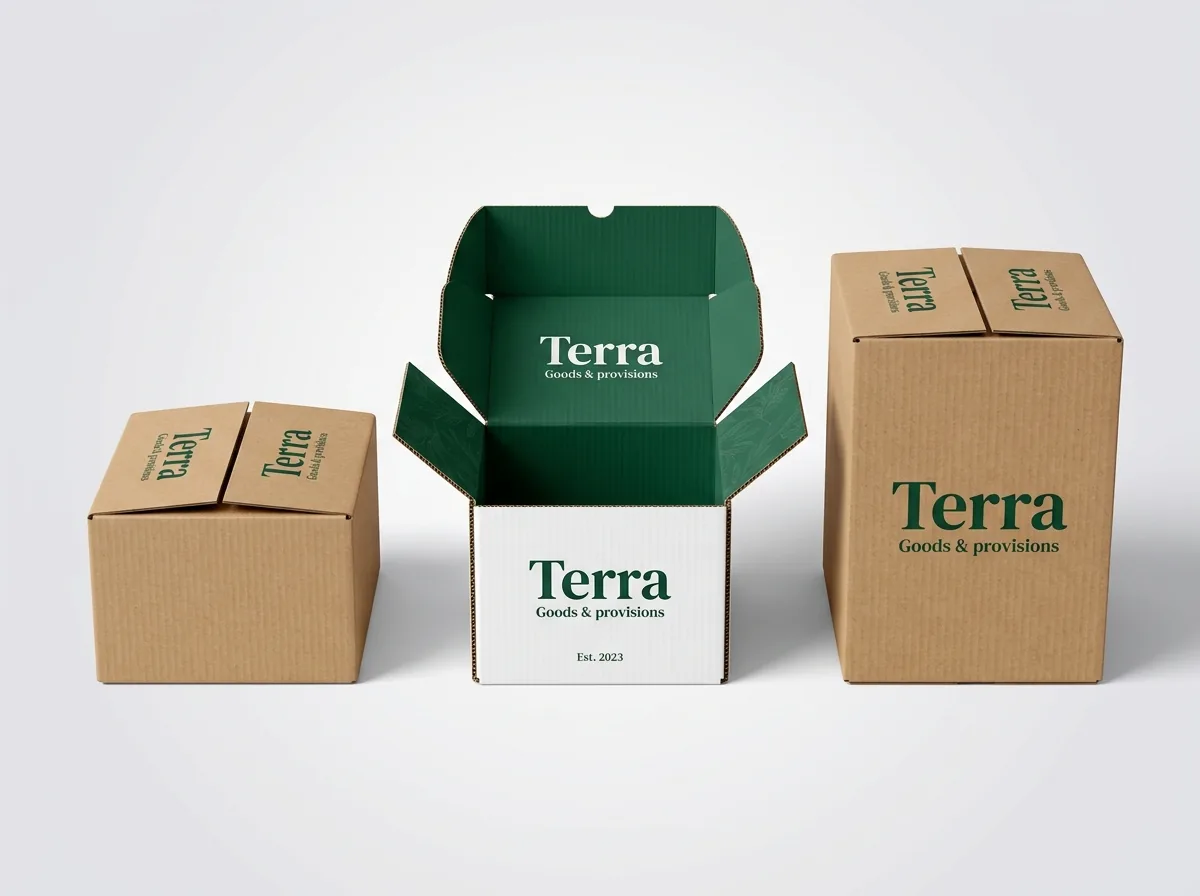
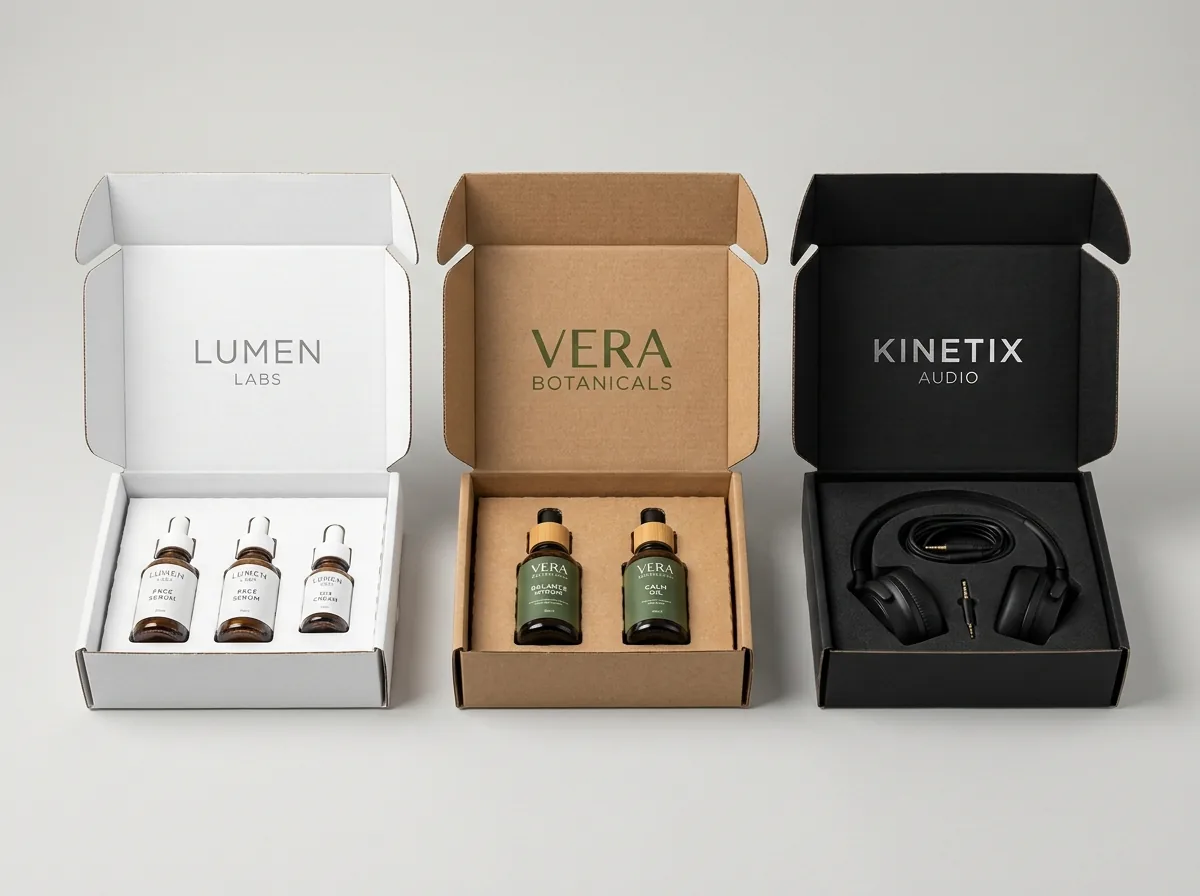
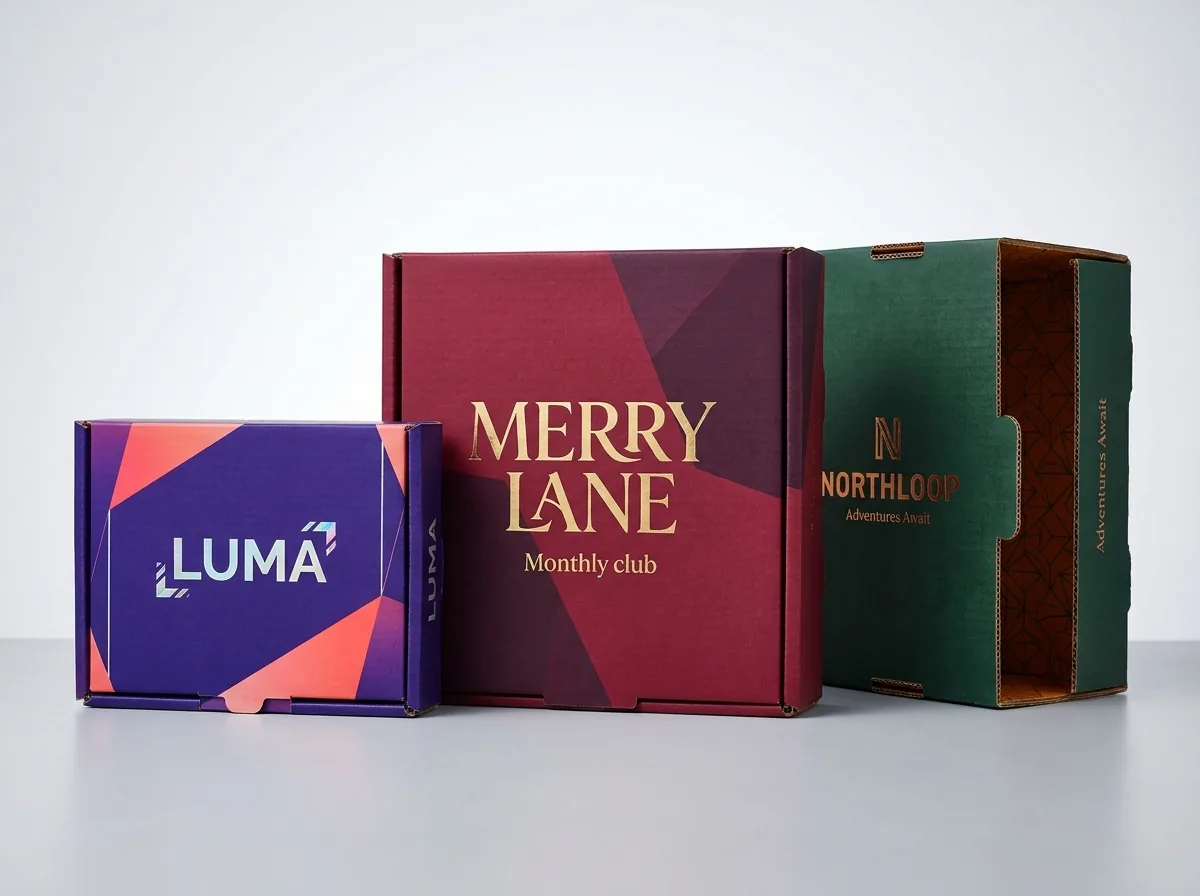
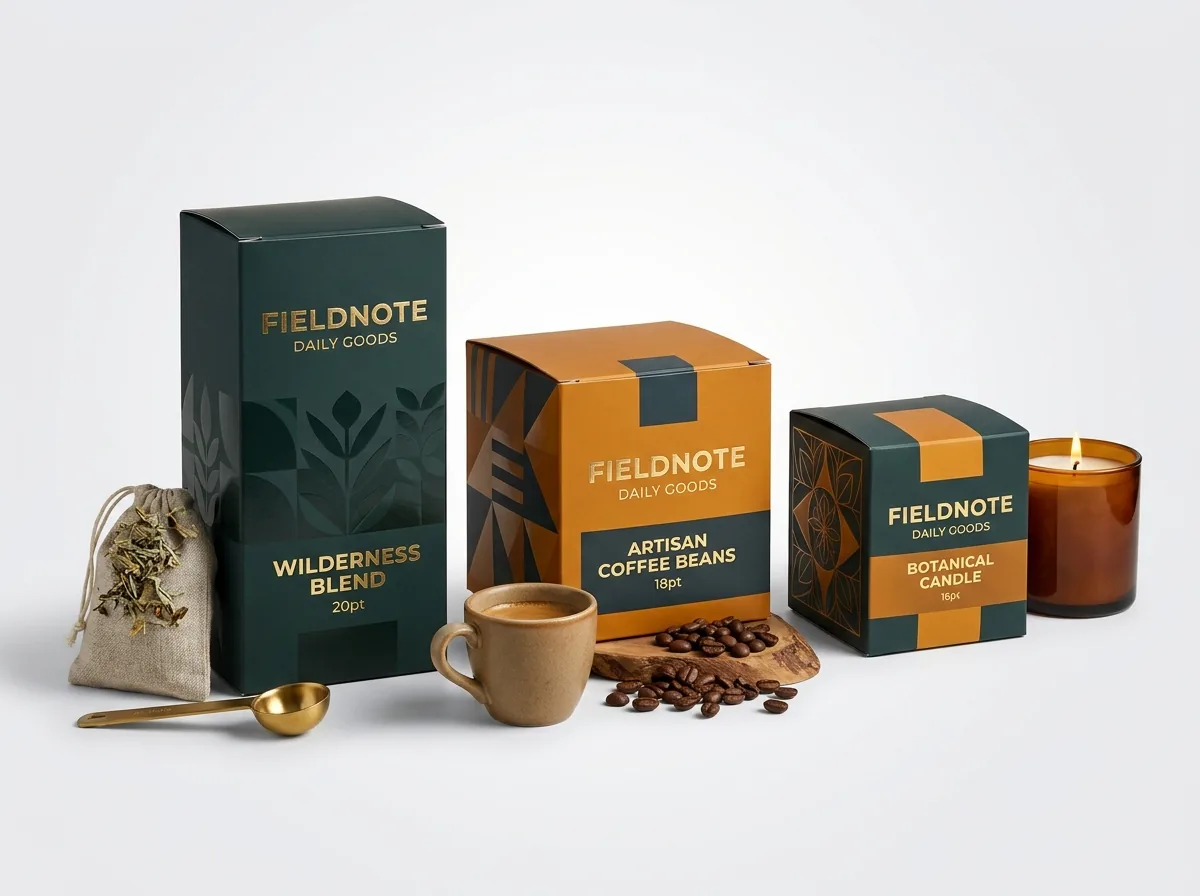
Ready to order ecommerce boxes? Compare up to 3 quantities with a free 3D mockup.
Request a Quote →Questions about ecommerce boxes
In what order do I write length, width and height for a custom box?
Always write box dimensions as Length × Width × Height (L × W × H) in inches, measured on the inside of the box. Facing the front of the box as it opens toward you, Length is left to right, Width is front to back, and Height is top to bottom.
How much bigger are the outside dimensions of a corrugated mailer box?
Because roll-end tuck front mailers fold their side walls over twice to lock into the base, the outside length and width are typically ¼ to ½ inch larger than the inside dimensions, and outside height is about ¼ inch taller. Always use outside dimensions when calculating carrier dimensional weight.
Can I order a custom box size down to a quarter or eighth of an inch?
Yes. Because CubitPack makes every order to your exact dieline and never charges die or plate fees, you can specify fractional inside dimensions like 8.5 × 5.25 × 2.75 inches at no extra tooling cost. You approve the exact 2D dieline and 3D mockup before payment.
How do I size an ecommerce box if my products have irregular shapes?
Place the irregularly shaped item on a flat table in the position it will sit inside the box, then stand two flat books or rulers upright against its widest left/right and front/back points. Measure the distance between the books to get the true bounding rectangle.
Can I order two or three ecommerce box sizes in the same quote?
Yes. In Step 2 of the quote form, select 2 designs or 3+ designs and list your small, medium and large dimensions and quantities in the notes field. Your account manager will return a combined quote within 5-7 minutes so you can compare every size side by side.
How can I test my ecommerce box size before printing 250 or 1,000 units?
Every order includes a free custom dieline PDF that you can print at 100% scale or inspect in our 3D mockup before paying. You can also order a physical prototype or a paid printed sample of your exact box size, with the sample cost credited toward your full order.
Still have a question? Ask a packaging specialist.
Request a Quote →Request your ecommerce boxes quote
Tell us your size and quantities, and one dedicated account manager prepares pricing for each tier.
- Free design & AI-to-print studio + 3D mockup
- No die or plate charges · 4–5 day rush available
- Free shipping to all 50 states
- 10% off your first order
The sizing rules and clearances in this guide follow standard corrugated dieline engineering (Length × Width × Height inside dimensions) and USPS/carrier parcel labeling requirements. A CubitPack packaging specialist reviewed every dimension row. Spot something wrong? Tell us and we will fix it.
Sources
What changed
- October 22, 2026: First published.
- October 22, 2026: Updated specifications, terminology, and verified source links.
More guides
New packaging guides by email
Sizes, materials and design tips. Unsubscribe anytime.