
What size custom pet toy box do I need for plush squeakers, chews and puzzles?
Short answer: Size custom pet toy boxes by measuring the toy's widest rested width, thickest belly depth and standing height, then adding ¼ inch on each axis. Common benchmarks are 3.5 × 1.75 × 5 inches for catnip mice, 4.5 × 3 × 7.5 inches for plush squeakers, and 10 × 10 × 2.75 inches for puzzle games.
On this page
- How do I measure an irregularly shaped plush dog toy or rope tug for a carton
- What are the most common custom pet toy box sizes by category
- How do I size an open-front cradle box for heavy rubber chew toys
- What box dimensions fit catnip mouse multipacks and 18-inch cat teaser wands
- How do I size E-flute boxes for dog puzzle feeders and monthly subscription kits
- Common mistakes
- FAQs
Request a custom quoteFree dieline & 3D mockup
Unlike uniform bottles or cans, pet toys combine soft compressible plush limbs, rigid rubber chew cores, knotted cotton ropes and 18-inch fiberglass cat wands. If you size a carton tightly around a compressed plush dog toy, the polyester stuffing pushes outward against the paperboard walls and pops the tuck flaps open on the pegboard. Conversely, if you size an open-front cradle box too loosely around a heavy natural-rubber chew bone, the bone shifts side to side and tips the box crooked on its retail hook. Always measure your physical toy sitting naturally on a flat table, tuck in any floppy ears or rope tails that fold effortlessly, and add ¼ inch of breathing room to length, width and height. When you order custom printed pet toy boxes from CubitPack, every size is cut to your exact inside dimensions starting at 1,000 units with zero die charges.
How do I measure an irregularly shaped plush dog toy or rope tug for a carton?
Measuring an octopus plush squeaker or a double-knotted cotton rope tug with a loose ruler in the air almost always produces the wrong carton size. Instead, lay the toy on a flat table against two perpendicular straightedges (such as two hardcover books or a carpenter's square) in the exact orientation you want shoppers to see on the retail shelf or pegboard hook. If the toy has soft fabric ears, legs or rope tassels that can fold inward without hiding the character's face or squeaker belly, fold them into that display posture before taking your three measurements. Next, measure the front-to-back belly thickness at the plumpest part of the toy, which is usually right over the internal plastic squeaker bladder or the center knot of a rope tug. Never compress a plush toy by more than 10 percent to force it into a shallower carton, because continuous outward stuffing pressure bows 18 pt paperboard panels into a barrel shape. When you submit your quote for custom dog and cat toy cartons, enter inside dimensions in the order of Length (left to right across the front face) × Width (front to back depth) × Height (bottom to top, excluding any top hang tab).
- Inside Length (L): measure left-to-right across the toy's display silhouette with floppy limbs folded neatly, plus ¼ inch.
- Inside Width / Depth (W): measure front-to-back across the thickest squeaker belly or rubber ring hub without squeezing, plus ¼ inch.
- Inside Height (H): measure from the base of the toy to the top of its head or rope handle, plus ¼ inch (hang tabs add height above the box body).
- Open squeeze cutout: measure the diameter of the internal squeaker bladder and size the front window at least 1.5 inches wide so a shopper's thumb fits easily.
What are the most common custom pet toy box sizes by category?
Although every CubitPack order is cut to custom inside dimensions at no extra tooling cost, most retail pet store pegboard hooks, shelf displays and subscription mailers fall into eight standard size families. Use the benchmark table below to estimate your dimensions before measuring your physical toy samples. Notice how hang-tab pegboard boxes stay under 3.5 inches deep so three to six units can fit on a standard 10-inch or 12-inch retail wire peg hook.
| Pet toy product & format | Typical inside size (L × W × H) | Recommended box style & board |
|---|---|---|
| 2-pack or 3-pack catnip plush mice / crinkle balls | 3.5 × 1.75 × 5 in | Hang-tab box with clear film window (18 pt card) |
| Small / puppy plush squeaker or teething ring | 4 × 2.5 × 6 in | Open-front touch window carton + sombrero tab |
| Medium plush dog squeaker or crinkle character | 4.5 × 3 × 7.5 in | Open-front window box (20–22 pt white or kraft card) |
| Heavy natural-rubber chew bone or treat dispenser | 5 × 2.25 × 8.5 in | Auto-lock tie-back cradle box with twist-tie holes |
| Large power-chewer nylon bone or braided rope tug | 6 × 3 × 10 in | E-flute corrugated open cradle + reinforced hang tab |
| Feather cat teaser wand (16 in to 18 in rod) | 3 × 1.5 × 18.5 in | Tall reverse-tuck sleeve with top window & hang slot |
| Interactive plastic dog puzzle feeder board game | 10 × 10 × 2.75 in or 12 × 12 × 3 in | E-flute corrugated tuck-top or two-piece box |
| Monthly DTC dog toy & treat subscription kit | 11 × 8.5 × 4.5 in | B-flute or E-flute printed corrugated mailer box |
How do I size an open-front cradle box for heavy rubber chew toys?
Solid natural-rubber chew bones, bacon-flavored nylon wishbones and rubber treat-stuffing cones weigh between 6 ounces and 18 ounces and have curved, slippery surfaces. Putting a heavy rubber chew inside a loose four-walled carton lets it bang against the bottom flap, while hanging it on a bare header card lets the bottom swing wildly on the peg hook. The retail standard for heavy chews is a 3-sided tie-back cradle carton built with an auto lock bottom. In a tie-back cradle, the bottom tray supports the base of the chew toy, a full-height double-wall back panel carries your brand graphics and hang tab, and low side wings wrap around the lower third of the toy. Set the inside width and depth of the lower tray ¼ inch wider than the base of the chew bone, and ask our design team to punch two ¼ inch tie-down holes in the back panel directly behind the narrowest waist of the bone. That combination carries the weight on the floor of the carton while the twist tie prevents the top of the bone from tipping forward through the open front.
Know your size? Compare pricing across up to 3 quantities.
Request a Quote →What box dimensions fit catnip mouse multipacks and 18-inch cat teaser wands?
Cat toy packaging splits into two very different shapes: compact pocket-sized cartons for catnip mice, silvervine sticks, springs and mylar crinkle balls, and extra-tall slim sleeves for feather teaser wands. For 2-pack or 3-pack catnip mice, a 3.5 × 1.75 × 5 inch custom window box with a clear film patch keeps loose catnip flakes inside the carton while stacking three units side by side in a 10.5 inch shelf facing. Feather teaser wands and retractable fishing-rod cat toys measure 15 to 18 inches long, and their feathers, bells and elastic cords tangle badly when hung bare on peg hooks. Packing each wand inside a 3 × 1.5 × 18.5 inch vertical tuck-end sleeve keeps the fiberglass rod straight and protects the natural feathers behind a clear upper window so every wand arrives unbent in both retail case packs and Amazon FBA shipments.
- Catnip mice & crinkle balls (2–3 count): 3.5 × 1.75 × 5 in with a glued film window to hold herbal scent.
- Plush cat kickers (9–11 in long): 4 × 2.25 × 11.5 in open-front touch carton so buyers can feel the crinkle fill.
- Feather teaser wands (16–18 in): 3 × 1.5 × 18.5 in narrow sleeve with a cardboard base lock for the wand handle.
- Countertop cat toy bins: 8 × 10 × 4 in PDQ tray holding 24 individual catnip rollers or springs.
How do I size E-flute boxes for dog puzzle feeders and monthly subscription kits?
Interactive dog enrichment puzzles (sliding treat boards, spinning wheel feeders and snuffle mats) and automatic ball launchers are boxed and merchandised like tabletop board games. Because a circular or square plastic puzzle board spans 9.5 to 11.5 inches across and weighs 1.2 to 2.5 pounds, thin folding paperboard will dish inward across the wide front face. Stepping up to E-flute corrugated board in a 10 × 10 × 2.75 inch or 12 × 12 × 3 inch footprint gives you flat, crush-resistant front and back billboards for step-by-step puzzle photos and mental-stimulation difficulty ratings. If you run a monthly direct-to-consumer dog or cat box that bundles two plush squeaker toys, a chew bone and two bags of treats, a 11 × 8.5 × 4.5 inch custom mailer box is the industry workhorse. That footprint fits two medium plush toys side by side without crushing their squeakers while staying compact enough to avoid carrier dimensional-weight surcharges.
What are the most common pet toy box sizing mistakes?
Most pet toy packaging failures come from squeezing plush stuffing too tightly or misjudging how a heavy toy hangs on a retail hook. Avoid these five sizing errors
- Compressing a plush squeaker toy to fit a shallow box depth, which causes the stuffing to bow the front panel and pop the top tuck flap open.
- Including the 1.5-inch top pegboard hang tab inside the box's vertical height measurement, leaving the actual carton body 1.5 inches too short for the toy.
- Making an open-front window wider than the toy's shoulders without adding back-panel twist-tie holes, allowing the toy to fall out during shipping.
- Designing a pegboard hang-tab box deeper than 4 inches front-to-back, which cuts the number of units that fit on a standard retail peg hook in half.
- Using thin uncorrugated paperboard on 10 × 10 inch dog puzzle feeder boxes, causing the wide front face to warp and crush on shelves.
Find your size
Suggested inside size: 3.5 × 1.75 × 5 in
A starting point. Your account manager confirms the size with you before the proof.
Quote this size →Packaging for this
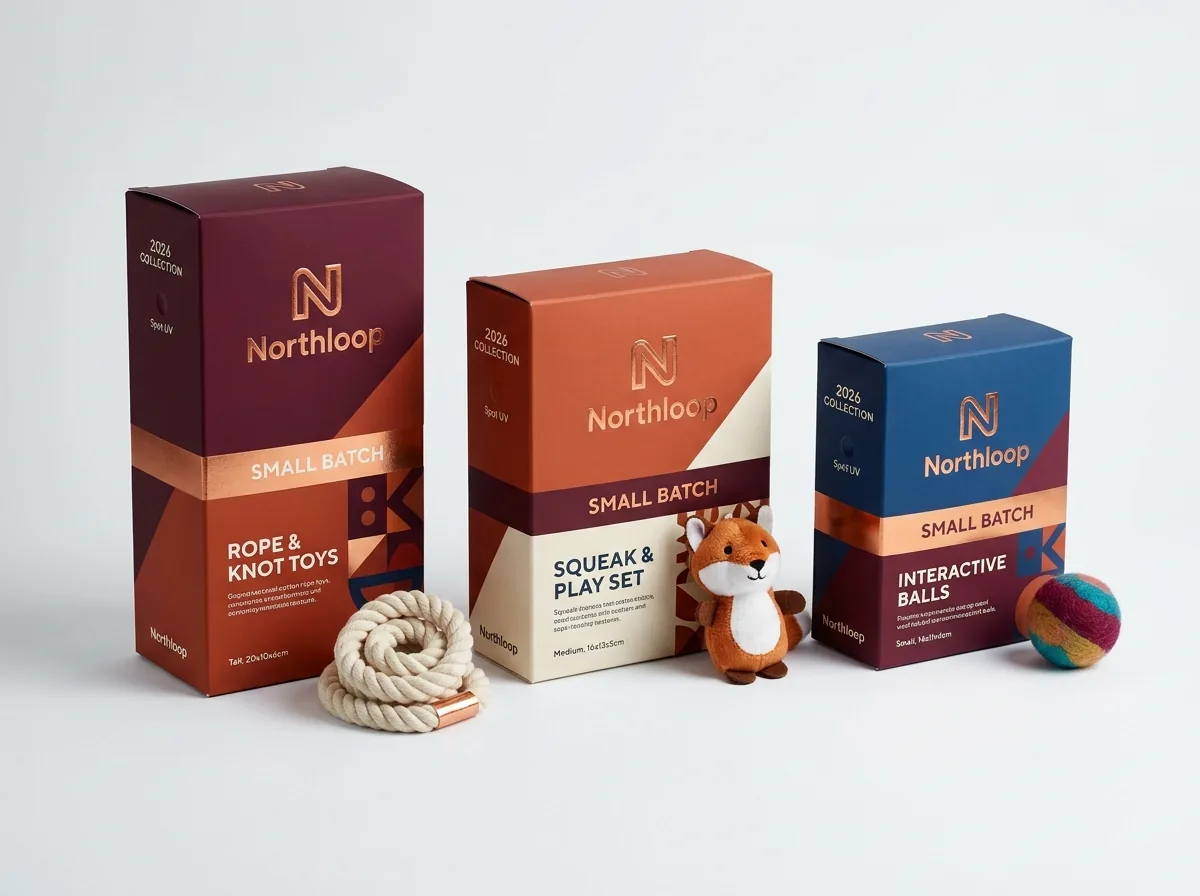
Ready to order pet toy boxes? Compare up to 3 quantities with a free 3D mockup.
Request a Quote →Questions about pet toy boxes
Does the height of a hang-tab pet toy box include the top hang tab?
No. Box dimensions (Length × Width × Height) always refer to the usable inside cavity of the carton body. If your plush toy is 7 inches tall, order a 7.25 or 7.5 inch box height, and our structural team adds the 1.25 to 1.5 inch sombrero hang tab above the top crease.
How much clearance should I leave around a plush dog toy?
Add ¼ inch to the toy's natural un-squeezed length, width and height. Soft plush toys vary slightly in stuffing loft from piece to piece, and ¼ inch of clearance keeps the carton walls flat and square.
How big should the open squeeze cutout be on a dog squeaker toy box?
Size the open front window at least 1.5 to 2.5 inches across and center it directly over the toy's internal squeaker bladder so shoppers can press the squeaker with a thumb without bending the paperboard frame.
Can I use one box size for small, medium and large dog chew toys?
A tiny puppy chew rattles and looks lost inside a large-dog carton, so most brands use two box sizes (one for S/M and one for L/XL) or use a shared outer box size with different die-cut internal cardboard neck collars to center each chew size.
Is there an extra die fee for bone-shaped windows or back-panel tie holes?
No. CubitPack charges zero die or plate fees. We die-cut custom bone or paw viewing windows, sombrero pegboard hang slots and back-panel twist-tie anchor holes into your box template at no extra cost.
Can I test my actual plush or rubber toys inside a sample box before printing 1,000 units?
Yes. Every order includes a free digital proof and 3D mockup before payment, and you can also request a paid physical sample cut to your exact dieline to test-fit your toy and tie-downs, with the sample fee credited to your order.
Still have a question? Ask a packaging specialist.
Request a Quote →Request your pet toy boxes quote
Tell us your size and quantities, and one dedicated account manager prepares pricing for each tier.
- Free design & AI-to-print studio + 3D mockup
- No die or plate charges · 4–5 day rush available
- Free shipping to all 50 states
- 10% off your first order
The dimensions in this guide were compiled from standard US pet-specialty pegboard hook depths (8 to 12 inches), common plush squeaker and rubber chew footprints, and 10 to 12 inch interactive puzzle board diameters, and verified by a CubitPack packaging specialist against our published product specifications. Spot something wrong? Tell us and we will fix it.
Sources
What changed
- October 22, 2026: First published.
- October 22, 2026: Updated specifications, terminology, and verified source links.
More guides
New packaging guides by email
Sizes, materials and design tips. Unsubscribe anytime.