
Open 6-pack beer carriers vs enclosed can cartons and mailers: which fits your brew?
Short answer: Choose open-top wet-strength CUK basket carriers for 12 oz amber glass bottles sold in taprooms and liquor stores where neck labels help sell the beer. Choose fully enclosed paperboard custom beer boxes for 4-, 6-, and 12-pack cans to replace plastic rings, keep rims clean, and maximize cooler graphics.
On this page
- How do open 6-pack bottle carriers, enclosed can cartons and corrugated mailers compare
- When should a brewery use an open-top 6-pack bottle basket carrier
- Why are craft breweries switching from plastic rings to enclosed 4- and 6-pack can cartons
- How can a taproom use one enclosed 4-pack master carton across 15 seasonal beer releases
- When should you upgrade to E-flute or B-flute corrugated beer mailers
- Common mistakes
- FAQs
Request a custom quoteFree dieline & 3D mockup
Open 6-pack bottle basket carriers, enclosed paperboard can cartons, and corrugated beer mailers serve three distinct distribution channels. Open-top 20 pt to 24 pt wet-strength CUK basket carriers feature a glued multi-ply center handle and integrated cell dividers that stop 12 oz glass longneck bottles from clinking while leaving neck labels and custom crown caps visible. Enclosed 18 pt to 22 pt CUK or 20 pt SBS cartons surround 4-pack 16 oz tallboys, 6-pack 12 oz cans, or 12-pack fridge dispensers on all six sides, replacing hard-to-recycle HDPE snap-on plastic rings while shielding aluminum drinking rims from warehouse dust and giving your artwork 360-degree visibility in the cooler. For direct-to-consumer beer clubs, taproom tasting flights, and influencer mailers, neither retail folding carton passes parcel drop tests on its own; upgrade to an E-flute or B-flute corrugated mailer with full-height interlocking cell dividers.
How do open 6-pack bottle carriers, enclosed can cartons and corrugated mailers compare?
Craft breweries and cideries often mix package formats across their lineup: 12 oz glass longnecks for core lagers, 16 oz aluminum tallboy 4-packs for hazy IPAs and pastry stouts, 12-pack sleek or standard can boxes for grocery endcaps, and mixed tasting-flight boxes for online club members. When you spec custom printed beer boxes and carriers, each vessel and sales channel places different mechanical demands on the paperboard. Glass bottles require internal cell separation so sharp impacts on distribution trucks do not chip or crack adjacent bottles. Aluminum cans do not shatter on contact, so they can sit side by side in a snug matrix without internal partitions, provided the outer carton walls and bottom flaps are locked tightly enough to prevent chime override. Meanwhile, direct-to-consumer parcel shipments require flute cushioning around the perimeter and between every vessel. Use the table below to compare all three beer packaging structures across vessel fit, board stock, UV and dust protection, and sales channel.
| Feature | Open-Top 6-Pack Bottle Carrier | Enclosed 4-/6-/12-Pack Can Carton | Corrugated Beer Flight Mailer |
|---|---|---|---|
| Typical vessel | Six 12 oz longneck, heritage, or stubby glass bottles | Four 16 oz tallboys, six 12 oz cans, or twelve 12 oz cans | Four to twelve cans, 22 oz bombers, or mixed flights |
| Recommended board | 20 pt to 24 pt wet-strength CUK or 20 pt kraft | 18 pt to 22 pt wet-strength CUK or 18 pt to 20 pt SBS | E-flute or B-flute corrugated (white or kraft) |
| Internal dividers | Built-in pop-open 6-cell paperboard partitions | None needed; tight matrix locks cans together | Die-cut corrugated cell dividers or molded cradles |
| Light & dust protection | Low on top; shields lower bottle body only | 100% enclosed; keeps can drinking rims clean | 100% enclosed during shipping and unboxing |
| Billboard print area | Side and end walls below bottle shoulder | All four vertical walls plus top and bottom panels | Full exterior plus full interior lid and tray |
| Primary sales channel | Taproom coolers, bottle shops, grocery shelves | Grocery cold boxes, C-stores, distributor pallets | Direct-to-consumer beer clubs, corporate gifts |
| CubitPack minimum | 500 carriers | 500 cartons | 500 mailers |
When should a brewery use an open-top 6-pack bottle basket carrier?
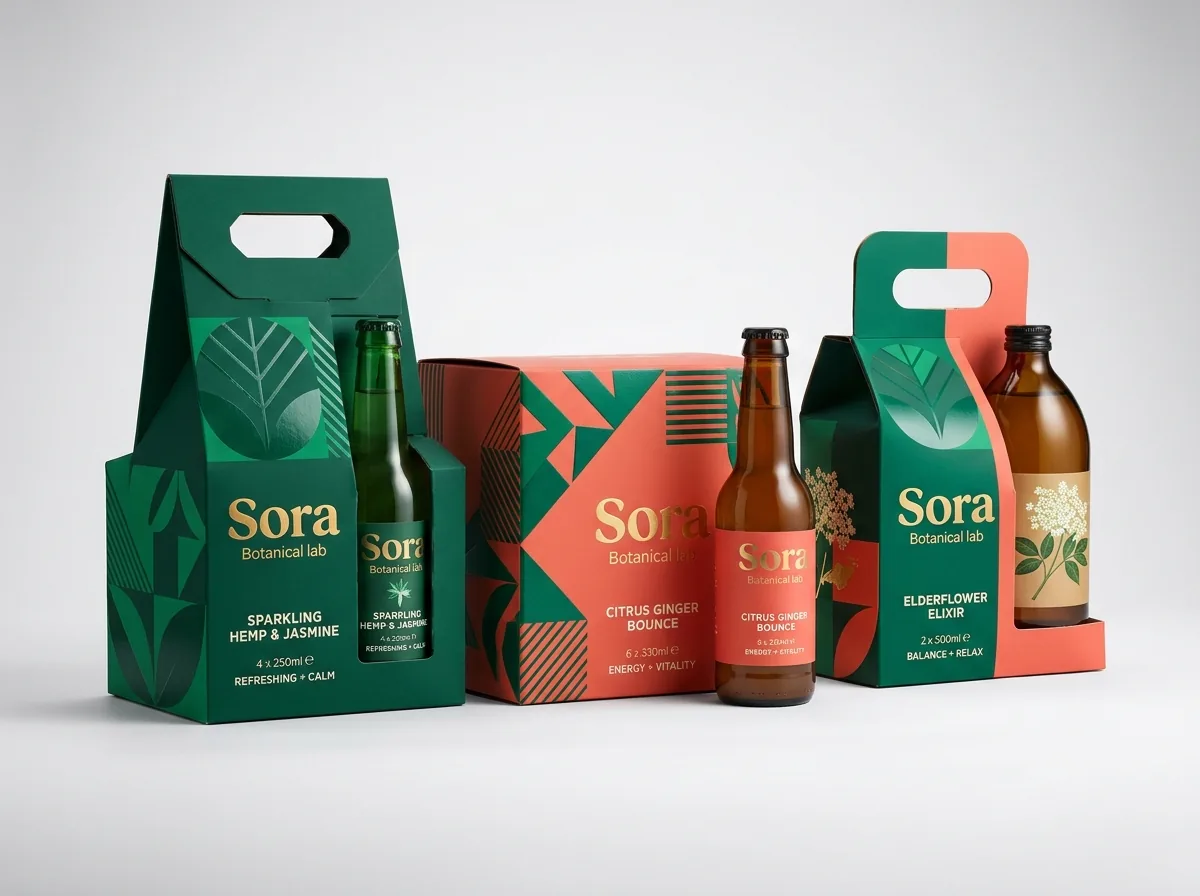
Open-top custom drink carrier boxes and custom auto-lock bottom boxes remain the industry benchmark for 12 oz glass beer, cider, and craft soda bottles. Because the side walls stop just below the bottle shoulder, typically 4.50 to 5.00 inches above the base, shoppers can see the glass color, neck foil or neck label, and custom-printed crown cap while browsing the shelf. That visual cue also makes open basket carriers ideal for mix-and-match 6-pack racks in bottle shops and grocery stores. Structurally, a commercial 6-pack basket carrier relies on three load-bearing zones: a multi-ply glued center riser handle, fold-out cell partition straps that separate all six bottles, and an auto-lock bottom that snaps into place when the flat carrier is popped open. Because six filled 12 oz glass bottles weigh roughly 7.2 lb, standard dry-grade folding carton board softens and tears at the handle slot after sitting in a humid 38 °F walk-in cooler. Specifying 20 pt to 24 pt wet-strength Coated Unbleached Kraft (CUK) beverage board ensures the long virgin pine fibers retain their tensile strength even when condensation beads on cold glass.
- Pop-open auto-lock setup: Ships flat in master cases and pops open by hand in under two seconds for fast taproom or bottling-line loading.
- Built-in glass separation: Die-cut partition wings swing out automatically as the carrier opens, creating six individual cells so glass bottles never clink directly against each other.
- Multi-ply center handle: Two or three laminated layers of wet-strength CUK at the top grip bar prevent finger-slot tearing when customers carry 7.2 lb of cold bottles.
- Amber vs clear glass rule: Open carriers work well for amber bottles, which block UV wavelengths; clear or green bottles need enclosed cartons to prevent lightstruck off-flavors.
Why are craft breweries switching from plastic rings to enclosed 4- and 6-pack can cartons?
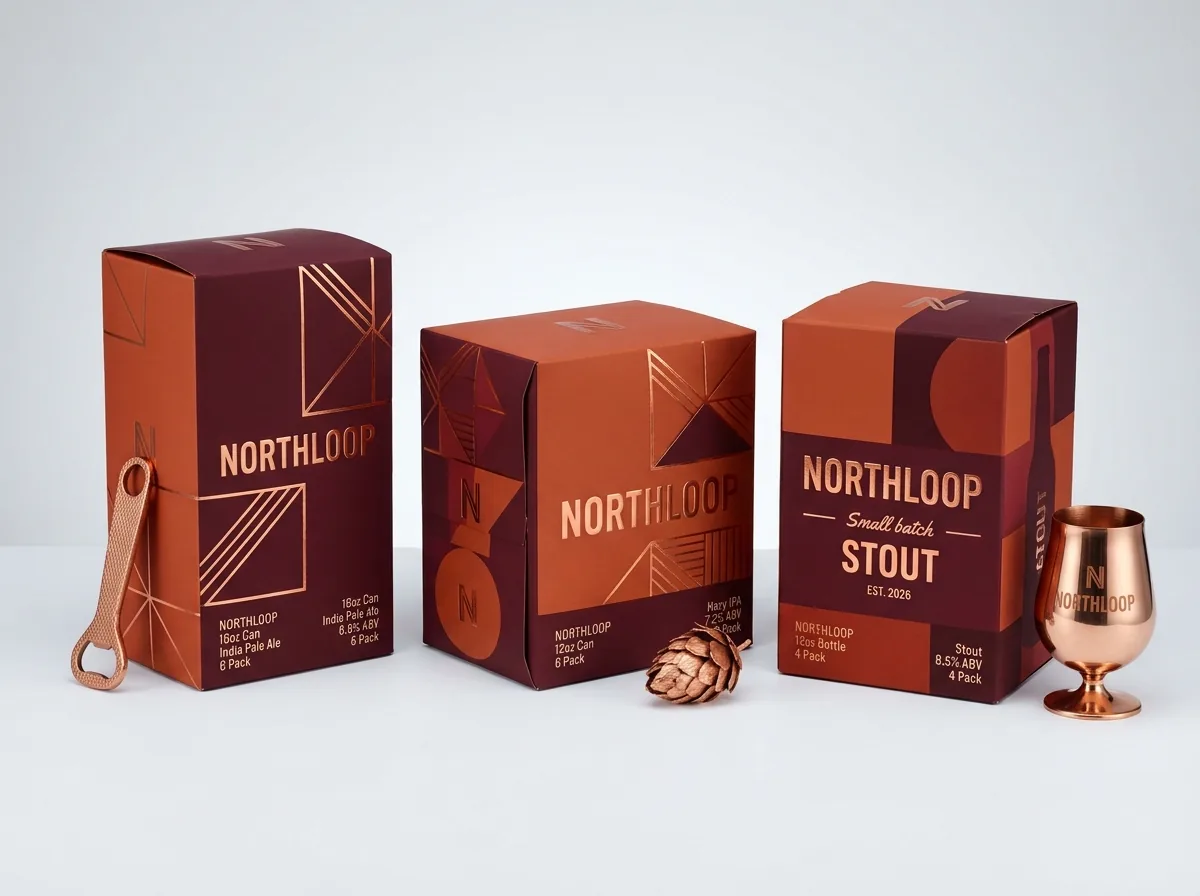
For 12 oz and 16 oz aluminum cans, craft breweries are moving away from snap-on HDPE plastic rings toward fully enclosed paperboard cartons. While plastic top clips hold four or six cans together cheaply, they leave the top drinking rims completely exposed to warehouse dust, forklift exhaust, and sticky cooler condensation during distribution. Many municipal curbside recycling programs also reject small rigid plastic can carriers, whereas paperboard cartons fold flat into standard household paper recycling streams. From a merchandising standpoint, an enclosed 4-pack tallboy or 6-pack can carton turns curved aluminum cylinders, which only display about 35% of their curved label face toward the shopper at any angle, into a flat, continuous rectangular billboard. You can print edge-to-edge brand art on the front and back panels, tasting notes and hop varieties on the side panels, and barcode plus TTB disclosures on the base using custom seal end boxes or top-finger-hole tuck cartons.
- Sanitary top coverage: Enclosed top flaps shield aluminum can lids and pull tabs from dust, grime, and handling between the canning line and the customer's glass.
- Curbside recyclability: 100% paperboard CUK and SBS cartons fold flat into household recycling bins without plastic clips or rings.
- Stacking and pallet stability: Flat top and bottom carton surfaces stack cleanly on retail shelves and distributor pallets without plastic-clip wobble.
- 12-pack fridge dispenser convenience: For 12-can packs, perforated zip-strip ends let customers slide the entire carton onto a refrigerator shelf and pull out cold cans one at a time.
Know your size? Compare pricing across up to 3 quantities.
Request a Quote →How can a taproom use one enclosed 4-pack master carton across 15 seasonal beer releases?
Small and mid-sized craft breweries often release a new hazy IPA, fruited sour, or barrel-aged stout every two weeks in 16 oz tallboy 4-packs. Ordering separate custom-printed 4-pack cartons for every 20-case taproom batch drives up per-unit costs and fills warehouse racks with leftover packaging. The smarter structural strategy is an enclosed 4-pack 16 oz tallboy master carton with a die-cut side window. You print your core brewery logo, taproom story, and handling icons on the exterior carton, while a 2.0 × 4.5 inch open window on the front or side panel frames the pressure-sensitive label applied to the cans inside. Every time you release a new seasonal brew, the inner can label displays the specific beer name, artwork, ABV, and mandatory TTB text right through the window.
When should you upgrade to E-flute or B-flute corrugated beer mailers?
Paperboard folding cartons (18 pt to 24 pt CUK or SBS) are engineered for retail shelves, cold cases, and palletized distributor cases, not for individual parcel shipping through UPS or FedEx. If your brewery runs a direct-to-consumer beer club, ships taproom tasting flights, or sends influencer press kits, you need the structural crush resistance of corrugated board. For 4-can or 6-can tasting flights and single 22 oz bomber gift boxes placed inside an outer shipping case, 1/16-inch E-flute corrugated board gives you crisp litho-laminated or digital graphics on both the exterior and interior lid while adding double-wall corner rigidity. For heavy 8-can or 12-can direct-to-consumer boxes, step up to 1/8-inch B-flute corrugated board paired with full-height interlocking custom cardboard inserts. Keep at least 0.25 inches of corrugated air cell or divider material between every can or bottle and the outer shipping wall so corner drops on concrete do not dent aluminum chimes or fracture glass bases. Need exact inside dimensions for 4-pack tallboys, 6-pack carriers, and 12-pack fridge cartons? Check our beer box size chart for 12 oz cans, 16 oz tallboys and 6-packs, and review TTB outer-carton rules in our guide on how to design custom beer boxes for cold coolers and TTB labeling.
What are the five most common mistakes when choosing between beer carrier styles?
Avoid these five structural mismatches when pairing a beer box style with your vessel and sales channel
- Packing clear or green glass bottles in open-top basket carriers under bright grocery LEDs, allowing hop compounds to turn lightstruck within hours on a display endcap.
- Using dry-grade 18 pt SBS for heavy 6-pack bottles or 4-pack 16 oz tallboys stored in wet 38 °F walk-in coolers instead of moisture-resistant 20 pt to 24 pt wet-strength CUK beverage board.
- Shipping 18 pt to 22 pt folding cartons directly through parcel couriers without an outer corrugated shipper and internal cell dividers, leading to punctured walls and dented can chimes.
- Ordering separate fully printed cartons for small 20-case taproom releases instead of building one master enclosed 4-pack carton with a die-cut side window that reveals each seasonal can label.
- Using snap-on plastic rings for premium grocery cold-box placements where enclosed paperboard 4-pack cartons provide four times the visual brand area and keep can lids sanitary.
Find your size
Suggested inside size: 3.125 × 3.125 × 11.25 in
A starting point. Your account manager confirms the size with you before the proof.
Quote this size →Packaging for this

Ready to order beer boxes? Compare up to 3 quantities with a free 3D mockup.
Request a Quote →Questions about beer boxes
Should I use an open basket carrier or an enclosed carton for 12 oz glass beer bottles?
Use an open-top 6-pack basket carrier if you package in amber glass and want shoppers to see your neck label and crown cap on taproom or liquor-store shelves. Choose a fully enclosed 6-pack or 12-pack bottle carton if you use clear or green glass that needs UV protection, or if you want larger continuous graphic panels.
Are paperboard 4-pack and 6-pack can cartons better than plastic can rings?
Paperboard 4-pack and 6-pack can cartons offer three major advantages over plastic snap rings: they cover the top drinking rims to keep dust and cooler grime off the lids, they provide four full sides for bold cooler graphics, and they are accepted in standard household curbside paper recycling streams.
Why is wet-strength CUK board preferred over standard SBS for beer carriers?
Wet-strength Coated Unbleached Kraft (CUK) is made with long virgin kraft fibers and wet-strength resins that keep their tear resistance when cold cans and bottles sweat in humid 38 °F walk-in coolers. Standard SBS provides a bright white print face for dry shelves, but CUK handles heavy wet loads far better.
Do enclosed 6-pack and 12-pack can cartons need internal cell dividers?
No. Aluminum cans do not break when touching one another, so enclosed 4-, 6-, and 12-pack can cartons rely on a snug internal dimension matrix, plus 1/16 inch per row, to lock the cans tightly together. Internal paperboard dividers are only required for glass bottles or direct-to-consumer parcel shipping mailers.
Can I use one enclosed 4-pack carton across multiple craft beer flavors?
Yes. Many craft breweries print their brewery logo and core story on a single master 4-pack 16 oz tallboy carton with a die-cut side window. The window lets the specific beer name, artwork, and mandatory TTB information on the individual can label show through, saving plates and storage space.
Can I ship a 6-pack carrier or 12-pack can box through UPS or FedEx as-is?
No. Retail 20 pt to 24 pt paperboard carriers and can cartons are built for cold cases and palletized distributor cases, not individual parcel drop impacts. For parcel shipping, place cans or bottles inside a B-flute or E-flute corrugated mailer with full-height cell dividers between every vessel.
Still have a question? Ask a packaging specialist.
Request a Quote →Request your beer boxes quote
Tell us your size and quantities, and one dedicated account manager prepares pricing for each tier.
- Free design & AI-to-print studio + 3D mockup
- No die or plate charges · 4–5 day rush available
- Free shipping to all 50 states
- 10% off your first order
This comparison is built on wet-strength CUK beverage board specifications, UV lightstruck protection principles, and parcel drop-testing standards. Checked by a CubitPack packaging specialist. Spot an error? Tell us and we will fix it.
Sources
What changed
- October 22, 2026: First published.
- October 22, 2026: Updated specifications, terminology, and verified source links.
More guides
New packaging guides by email
Sizes, materials and design tips. Unsubscribe anytime.