
How do custom mailer boxes with fitted inserts compare to interlocking partition dividers and loose void fill?
Short answer: Fitted die-cut inserts lock mixed-shape products along all three axes (X, Y, and Z) with labels facing straight up and cut kitting time to 25–35 seconds. Interlocking corrugated grid partitions suit 4, 6, or 12 identical upright jars, while loose crinkle paper settles 30%–40% in transit and only suits non-fragile goods.
On this page
- How do fitted die-cut inserts, interlocking grid partitions, and loose void fill compare across 6 metrics
- Why do glass bottles and jars packed in loose crinkle paper break during parcel sorting
- When is an interlocking corrugated grid partition the smartest choice for your mailer box
- How do you transition your packing line from loose void fill to a fitted mailer insert
- Common mistakes
- FAQs
Request a custom quoteFree dieline & 3D mockup
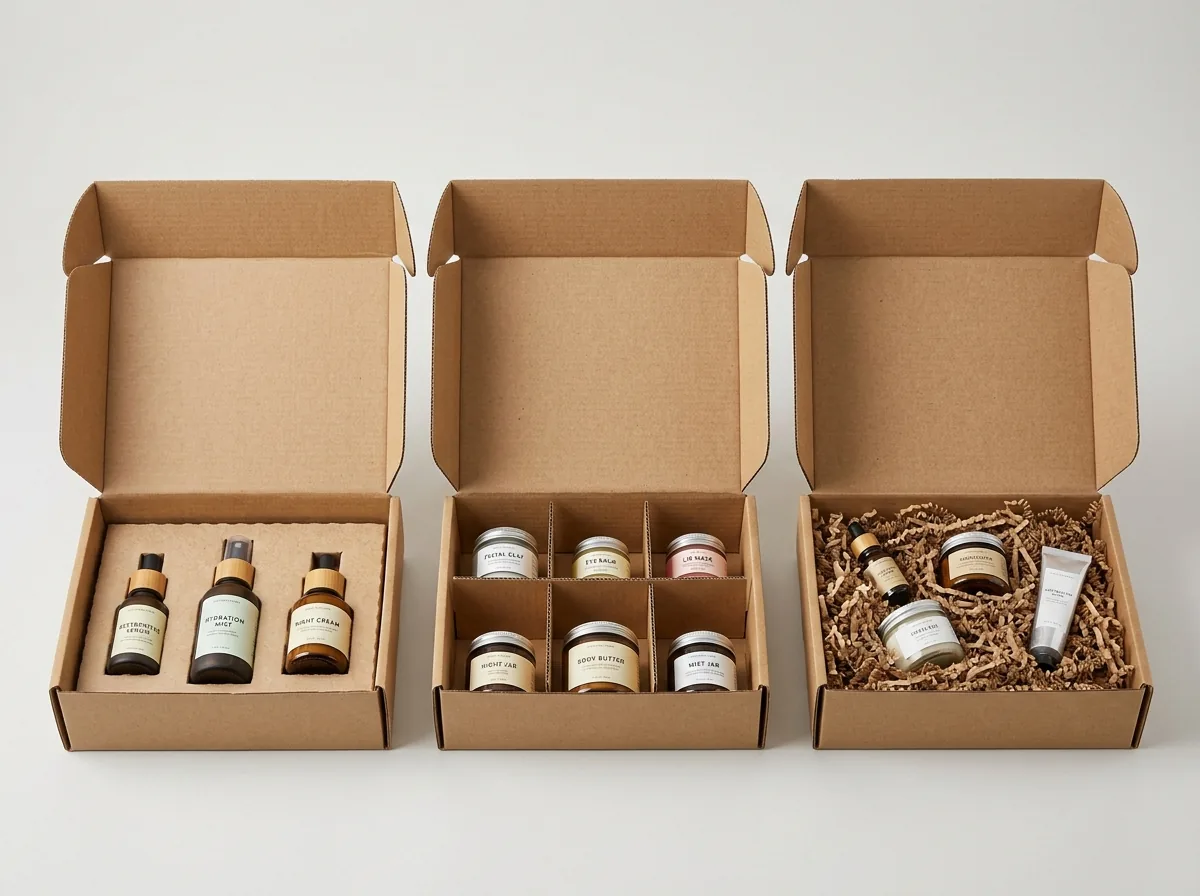
Brands shipping multi-item kits or fragile containers inside FEFCO 0427 mailers choose between three internal protection systems: custom mailer boxes with fitted die-cut inserts, interlocking slotted corrugated partition dividers (FEFCO 0930–0934), and loose void fill such as shredded crinkle paper or honeycomb wrap. Under ISTA 3A parcel truck vibration (3–6 Hz continuous bounce), loose crinkle paper compresses and settles by 30% to 40%, allowing heavy glass jars to migrate through the paper shreds and collide edge-to-edge. Fitted die-cut paperboard, E-flute corrugated, and EVA/EPE foam inserts eliminate product migration by locking each SKU inside a contoured pocket separated by 12–15 mm rigid bridges, while cutting warehouse packing time from 65–95 seconds down to 25–35 seconds per box. Order co-engineered mailers with fitted inserts or grid dividers from 250 sets with free US shipping.
How do fitted die-cut inserts, interlocking grid partitions, and loose void fill compare across 6 metrics?
Choosing the right interior architecture for co-engineered mailer boxes with inserts, custom subscription boxes, custom candle boxes, and custom gift basket boxes affects your breakage rate, fulfillment labor cost, billable dimensional weight, and customer unboxing impression: While loose crinkle paper requires zero upfront CAD planning, it forces you to buy an outer mailer box 18% to 28% larger in cubic volume to accommodate 1.5 to 2 inches of paper fluff around every item, which frequently pushes your parcel into a higher USPS, UPS, or FedEx dimensional weight tier. Beyond transit protection and dimensional weight savings, fitted die-cut inserts also standardize quality control on high-volume fulfillment lines. When temporary warehouse staff pack multi-item kits using loose crinkle paper, one packer may use two handfuls of shred while another uses five, resulting in inconsistent lid closure tension and uneven product spacing. A die-cut paperboard, E-flute, or foam insert acts as a physical poka-yoke template: if a packer forgets to load one of the three items in a skincare regimen, the empty die-cut pocket is immediately visible before the lid is closed.
- Choose a fitted die-cut cradle or foam insert when shipping mixed SKU shapes (e.g., a cleanser tube + dropper bottle + cream jar) or when front-facing unboxing presentation is critical.
- Choose an interlocking corrugated grid partition when shipping multiples of the exact same jar or bottle (such as a 4-pack of 8 oz soy candles or a 6-pack of gourmet jam jars).
- Reserve loose crinkle paper for lightweight, non-fragile soft goods, apparel accessories, or single tins that cannot shatter if they shift.
| Comparison factor | Fitted Die-Cut Insert (Card / Flute / Foam) | Interlocking Grid Partition (FEFCO 0930) | Loose Crinkle Paper + Bubble Wrap |
|---|---|---|---|
| Axes of immobilization | Locks X, Y, and Z axes (contoured to each SKU) | Locks X and Y in uniform rectangular cells | None (settles 30%–40% under parcel vibration) |
| Mixed-shape SKU capability | Excellent (holds tubes, droppers, jars & cards together) | Low (best for 4, 6, or 12 identical round/square jars) | Moderate (requires hand-wrapping each fragile item) |
| Customer unboxing sightline | 100% front-label facing, dust-free gallery reveal | Top caps visible (upright cell orientation) | Products buried under loose paper shreds & dust |
| Surface printing & onboarding | Full CMYK, Pantone, foil & Step 1-2-3 numbering | Unprinted kraft or white slotted corrugated strips | No printable structure |
| Average kitting time (3-SKU kit) | 25–35 seconds per box | 20–30 seconds per box | 65–95 seconds (weigh fill, bubble-wrap, fluff, pack) |
| Outer box DIM volume impact | Most compact (15–18 mm perimeter buffer) | Compact vertical footprint | 18%–28% larger box required for loose fill loft |
Why do glass bottles and jars packed in loose crinkle paper break during parcel sorting?
On the packing bench, two glass skincare jars or candle tumblers nestled in 2 inches of hand-fluffed crinkle paper look cushioned. However, parcel delivery trucks subject packages to continuous low-frequency bounce (3 Hz to 6 Hz) for hundreds of miles, combined with 8 to 10 automated conveyor drops from 18 to 36 inches. Within the first 30 minutes of truck vibration, heavy glass or ceramic items compress the loose paper fibers underneath them and sink toward the floor of the custom mailer box, while the displaced crinkle shreds migrate upward into the empty top corners of the cavity. With zero structural barrier left between the vessels, the glass shoulders clink directly against each other on the next chute drop. A fitted die-cut 32 ECT E-flute cradle or closed-cell EVA foam insert solves this permanently by placing a rigid 12 mm to 15 mm physical bridge and a 10 mm to 18 mm bottom suspension riser between every item.
- Zero fiber settling: Corrugated flutes and closed-cell EVA/EPE foams maintain their exact millimeter geometry from your packing table to the customer's porch.
- Zero paper dust on matte or frosted bottles: Shredded kraft and dyed crinkle paper shed fine cellulose dust that clings statically to frosted glass jars, glossy labels, and dark outer boxes.
- Eliminates single-use bubble wrap sleeves: Because the die-cut pocket and perimeter crush zone isolate the glass, your packers no longer need to wrap individual bottles in plastic bubble pouches.
When is an interlocking corrugated grid partition the smartest choice for your mailer box?
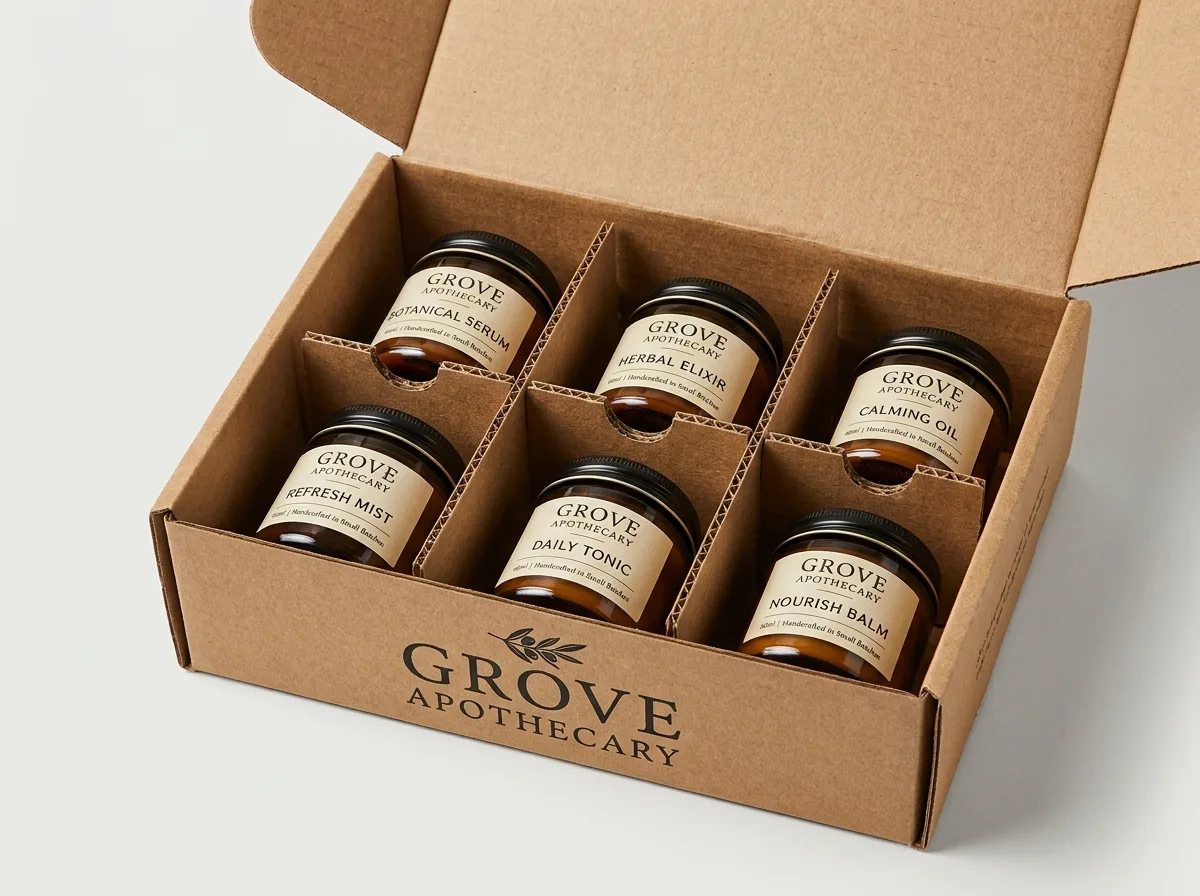
Interlocking partition dividers (FEFCO 0930–0934) are made from flat-cut longitudinal and transverse E-flute or B-flute corrugated strips with half-depth slots that slide together like an egg crate inside custom mailer boxes with inserts and custom gift basket boxes: Because the vertical partition walls run the full interior Height (H) of the mailer box from floor to lid ceiling, an interlocking grid adds enormous vertical top-to-bottom stacking compression strength, making it ideal when shipping 4, 6, 9, or 12 uniform cylindrical jars or beverage cans.
- Full-height glass separation: Every jar is surrounded on all four sides by full-height corrugated walls from base to cap.
- Perimeter air-cell option: By extending the slotted strips 15 mm past the outer row of cells, an interlocking partition creates a 12-cell perimeter buffer around 4 or 6 central jars.
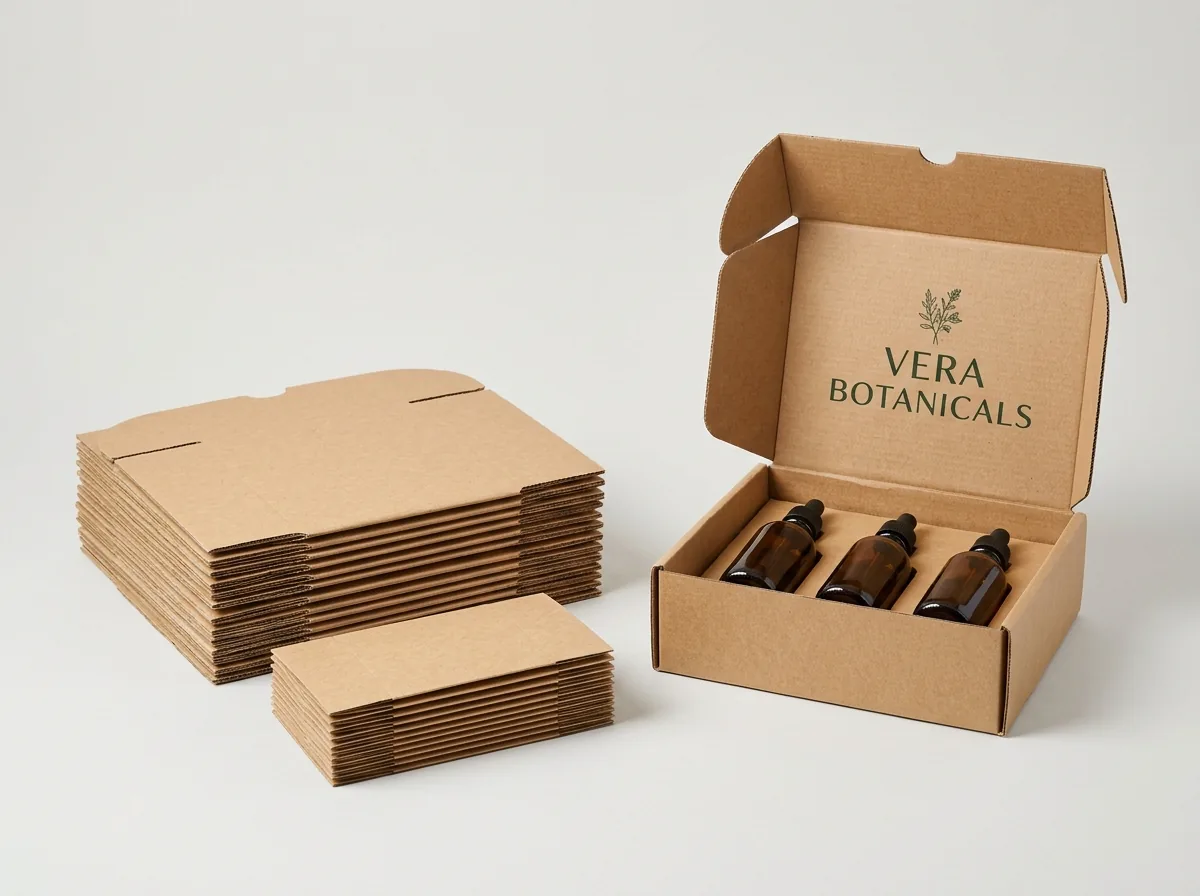
- Ships 100% flat in banded sets: Both contoured die-cut trays and slotted grid partitions ship flat alongside your flat outer mailers.
| Design parameter | Contoured Die-Cut Tray Insert | Interlocking Slotted Grid Partition |
|---|---|---|
| Product orientation | Flat/horizontal (front label faces up) or angled | Upright/vertical (lid or cap faces up) |
| Top-load stacking reinforcement | Moderate (supports perimeter & riser walls) | Very high (full-height vertical cross-walls support lid) |
| Custom die tooling | Flatbed rotary or platen steel-rule cavity die | Simple straight-cut slotted strips (zero complex contours) |
| Best product match | Skincare regimens, PR boxes, starter kits, electronics | 4-pack candles, 6-pack hot sauce/honey jars, beverage samplers |
Know your size? Compare pricing across up to 3 quantities.
Request a Quote →How do you transition your packing line from loose void fill to a fitted mailer insert?
Pair this comparison with our mailer box insert materials guide and our tutorial on how to measure products for custom mailer boxes with inserts. You can also check how shrinking your outer box footprint lowers carrier rates in our dimensional weight calculator and box size calculator. Follow these four steps to upgrade your kit to a co-engineered mailer and insert from 250 sets
- Step 1: Audit your current packing line, time how long packers spend wrapping bubble sleeves and fluffing crinkle paper, and measure your current outer box volume.
- Step 2: Choose between a contoured die-cut tray (for mixed SKUs laid face-up) or an interlocking grid partition (for 4 to 12 uniform upright jars).
- Step 3: Enter your product dimensions in CubitPack's quote form (from 250 sets) to receive a combined quote, two-piece 2D vector CAD dieline, and 3D proof before payment.
- Step 4: Test your new 25–35 second kitting workflow and enjoy 10–14 business day production (4–5 day rush) with free US ground shipping.
What mistakes do brands make when choosing between inserts, dividers, and void fill?
Prevent transit breakage, bloated shipping bills, and slow fulfillment by avoiding these five mistakes
- Packing two or more naked glass jars or dropper bottles in loose crinkle paper without a rigid bridge between them, leading to glass-on-glass breakage after parcel vibration settles the paper.
- Oversizing the outer mailer box by 2 inches on every side just to fit loose void fill, which inflates carrier dimensional weight charges on every shipment.
- Using an upright interlocking grid partition for products whose primary branding is on the side barrel when you want a camera-ready influencer PR reveal (use a horizontal contoured die-cut tray instead so front labels face straight up).
- Ordering slotted partition dividers shorter than the full height of the glass jars, allowing the top rims of tall bottles to clink together when the box tilts.
- Spending 75+ seconds per order hand-wrapping bubble bags around individual skincare bottles instead of dropping a pre-scored die-cut cradle into the mailer in 10 seconds.
Packaging for this

Ready to order mailer boxes with inserts? Compare up to 3 quantities with a free 3D mockup.
Request a Quote →Questions about mailer boxes with inserts
Why is a fitted die-cut insert safer than loose crinkle paper for glass jars and dropper bottles?
Loose crinkle paper compresses and settles by 30% to 40% under continuous parcel truck vibration, allowing heavy glass jars to shift and collide. A fitted die-cut insert physically locks each item inside its own pocket separated by 12–15 mm rigid bridges and 15–18 mm perimeter crush buffers.
When should I use an interlocking corrugated grid partition instead of a die-cut tray insert?
Use an interlocking slotted corrugated grid partition (FEFCO 0930) when shipping 4, 6, 9, or 12 uniform upright jars, candles, or bottles where maximum vertical stacking strength and simple rectangular cell separation are the top priorities.
Does switching from loose void fill to a fitted insert reduce shipping costs?
Often yes. Loose void fill requires 1.5 to 2 inches of extra space around products, inflating the outer box volume by 18% to 28%. A fitted insert needs only a 15–18 mm perimeter buffer, keeping the outer mailer compact and lowering billable carrier dimensional weight.
How much warehouse packing time does a fitted mailer box insert save?
A pre-scored paperboard, E-flute corrugated, or pre-laminated foam insert cuts 3-SKU kitting time to roughly 25–35 seconds per box, compared to 65–95 seconds when workers must weigh crinkle fill, wrap individual items in bubble sleeves, and arrange them by hand.
Can CubitPack manufacture both contoured die-cut inserts and interlocking grid partitions?
Yes. We engineer and manufacture contoured paperboard trays, die-cut E-flute cradles, interlocking corrugated grid partitions, and closed-cell EVA/EPE foam inserts co-designed with your FEFCO 0427 outer mailer from 250 sets, with zero die fees and free US shipping.
Still have a question? Ask a packaging specialist.
Request a Quote →Request your mailer boxes with inserts quote
Tell us your size and quantities, and one dedicated account manager prepares pricing for each tier.
- Free design & AI-to-print studio + 3D mockup
- No die or plate charges · 4–5 day rush available
- Free shipping to all 50 states
- 10% off your first order
We verified FEFCO 0900 die-cut fitment and 0930 interlocking partition standards, loose void-fill vibration settling behavior, and dimensional weight volume formulas against FEFCO Case Code standards, Fibre Box Association (FBA) handbooks, and ISTA Procedure 3A testing protocols. Spot something wrong? Tell us and we fix it.
Sources
What changed
- November 11, 2026: First published with 3-system comparison table, ISTA 3A vibration settling diagram, and kitting speed / DIM weight breakdown.
More guides
New packaging guides by email
Sizes, materials and design tips. Unsubscribe anytime.