
How do you measure and choose paperboard thickness for custom pillow boxes?
Short answer: Measure custom pillow boxes by three numbers: Usable Center Length (between the inner peaks of both curved end creases, never outer tip-to-tip), Flat Width across the un-popped sleeve, and Center Belly Depth when arched open. Pair compact sizes with 14–16 pt paperboard and medium or elongated boxes with 18–20 pt card.
On this page
- What are the 3 pillow box dimensions and standard sizes by product
- How do 14–16 pt, 18 pt, and 20 pt paperboard calipers affect curved spring lock
- When should you choose coated white SBS vs natural brown kraft or slide-in inserts
- What is the 4-step bench check before ordering 1,000 custom pillow boxes
- Common mistakes
- FAQs
Request a custom quoteFree dieline & 3D mockup
Sizing custom pillow boxes works differently from sizing square folding cartons because four concave score lines curve inward into the interior cavity to lock the ends shut. When a buyer measures only from outer corner tip to outer corner tip, a rigid item like a 3.375 × 2.125 inch CR80 gift card or cold-process soap bar collides with the inward-arching end creases and prevents the flaps from snapping closed. At the same time, because curved end flaps rely on natural fiber spring tension rather than tuck slits or glue, choosing the right paperboard caliper (typically 14 pt to 20 pt SBS or unbleached kraft) with longitudinal grain ensures effortless three-second assembly. CubitPack engineers your exact curved CAD dieline free of charge starting at 1,000 boxes, charges zero die or plate setup fees, and ships flat bundles free across all 50 US states.
What are the 3 pillow box dimensions and standard sizes by product?
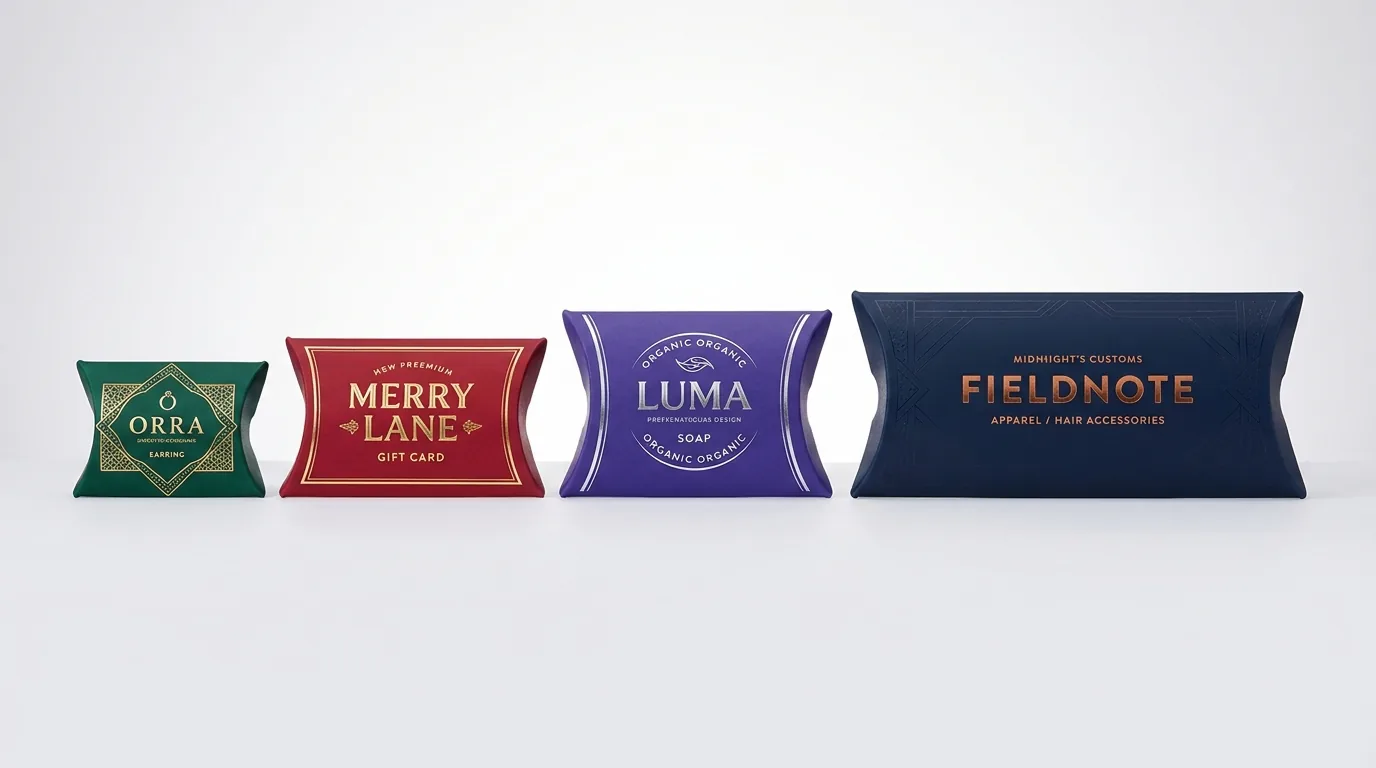
Every elliptical tubular carton has two distinct length measurements on a flat dieline: Tip-to-Tip Outer Length (from outer corner point to outer corner point) and Usable Center Length (between the innermost apexes of the left and right concave score arcs). Depending on box width and arc curvature, those two end curves inset 0.375 to 0.75 inches on each side, consuming 0.75 to 1.5 inches of total length. Meanwhile, Flat Width narrows slightly across the chord when the front and back panels bow outward to create Center Belly Depth. Use the size reference chart below to match common gifts, favors, soaps, and salon products to proven pillow box dimensions
- Add +6 to +10 mm (+0.25 to +0.375 in) to Usable Center Length for rigid items: Rectangular items like gift cards, earring backing cards, and soap bars cannot tuck into the pointed corner pockets at the ends; they must clear the innermost peak of both curved scores with room to spare.
- Account for Flat Width contraction when arching open: When a 3.5-inch-wide flat sleeve pops open to a 1.5-inch center belly depth, horizontal chord clearance narrows toward the straight side creases. Add at least +0.5 inches (+12 mm) over a rigid bar's width so the side folds never pinch.
- Keep Center Belly Depth between 35% and 48% of Flat Width: Over-inflating depth past half the flat width creates steep score angles that crease sharply at the corners instead of forming a sleek pillow arch.
| Product category | Typical item size | Usable Center L × Flat W × Depth | Approx. Tip-to-Tip L | Recommended caliper |
|---|---|---|---|---|
| Stud earrings & rings | 1.75 × 1.75 in card | 2.75 × 2.5 × 0.85 in | 3.5 in | 14–16 pt SBS / kraft |
| CR80 gift cards & vouchers | 3.375 × 2.125 in card | 4.25 × 3.0 × 0.85 in | 5.1 in | 16 pt SBS / kraft |
| Wedding & party favors | 4–6 wrapped truffles | 4.5 × 3.5 × 1.35 in | 5.5 in | 16–18 pt SBS / kraft |
| Artisan bar soap | 3.5 × 2.25 × 1.0 in bar | 4.75 × 3.5 × 1.50 in | 5.8 in | 18 pt SBS / kraft |
| Bracelets, watches & socks | Rolled pair or pouch | 6.0 × 4.0 × 1.75 in | 7.2 in | 18–20 pt SBS / kraft |
| Hair extension bundles | 10–26 in folded wefts | 11.5 × 4.5 × 1.85 in | 12.8 in | 18–20 pt laminated SBS |
How do 14–16 pt, 18 pt, and 20 pt paperboard calipers affect curved spring lock?
Unlike straight tuck cartons that hold shut with friction tabs or ankle slit locks, a pillow box stays closed because its concave score arcs act like miniature leaf springs. When you press a crescent end flap past dead-center, paperboard stiffness pushes outward against the curved crease channel and holds the flap flat against its mate. If the board is too thin on a long salon box, the middle belly sags under thumb pressure; if the board is overly thick on a tiny 2.75-inch earring pod, dense cellulose fibers fight the tight curve radius and spring back open on the counter. Matching paperboard point thickness directly to box span ensures every single unit pops open smoothly and stays shut in gift bags. Compare standard caliper tiers below
| Paperboard caliper | Metric thickness | Spring-snap feel | Ideal box span & payload |
|---|---|---|---|
| 14 pt – 16 pt SBS or Kraft | 0.35 – 0.41 mm | Nimble, effortless snap on tight curves | Mini 2.5–5 in jewelry, earring & CR80 gift card pods (under 3 oz) |
| 18 pt SBS or Kraft | 0.46 mm | Crisp tactile click; balanced arch rigidity | All-around 4.5–8 in favor, candy, cosmetic & soap boxes (3–6 oz) |
| 20 pt Laminated SBS / Kraft | 0.51 mm | Firm, structured boutique arch | Long 9–14 in hair extension, scarf, tie & apparel boxes (up to 8 oz) |
| 24 pt+ Heavy Card | 0.60 mm+ | Too stiff for small arcs; reserved for jumbo sleeves | Oversized apparel pillows only with wide channel creasing |
When should you choose coated white SBS vs natural brown kraft or slide-in inserts?
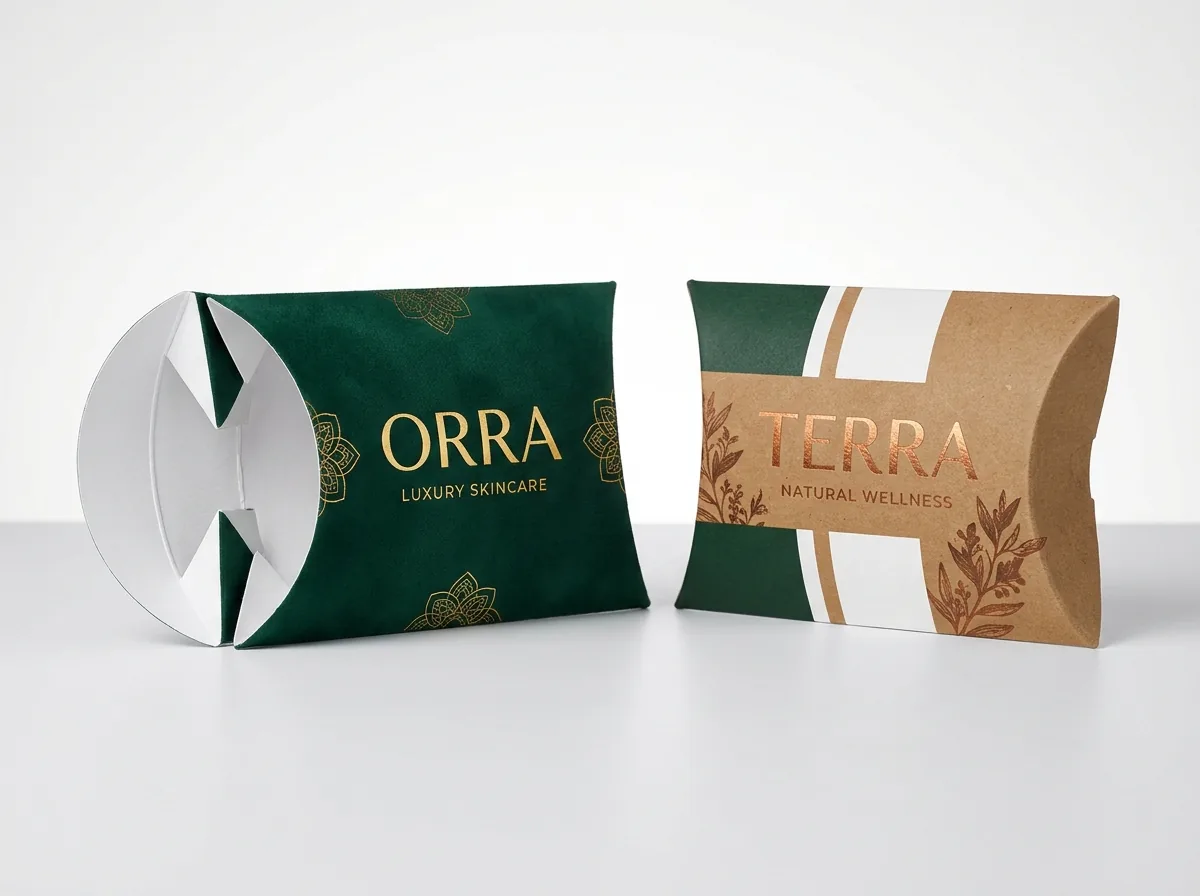
Once your cavity dimensions and caliper are set, board finish and interior card carriers determine how printed paperboard pillow boxes look on a counter and hold delicate contents steady. Because the front and back faces bow into a smooth convex arch when popped open, thin items without an internal card rest loosely along the bottom side fold rather than staying centered behind a window. Across custom jewelry boxes, custom earring boxes, custom gift card boxes, custom soap boxes, and custom hair extension boxes, match substrate and insert choices to your product's surface chemistry and weight distribution
- Bleached White SBS (C1S / C2S) for saturated color and foil precision: Clay-coated white sulfate board delivers razor-sharp Pantone color-blocking, smooth gradients, raised Spot UV, and mirror-clean gold, silver, rose-gold, or holographic foil stamping.
- Unbleached Natural Kraft for tear strength and botanical warmth: Virgin brown kraft fibers have exceptional tensile tear resistance along curved creases and pair naturally with artisan cold-process soaps, rustic wedding favors, and opaque white + deep forest or burgundy inks.
- Add matte or soft-touch lamination on dark full-bleed designs: Deep emerald, plum, midnight navy, or matte black ink coverage flexes sharply at the four corner junctions where curved scores meet straight side folds; a thin film laminate eliminates white fiber cracking.
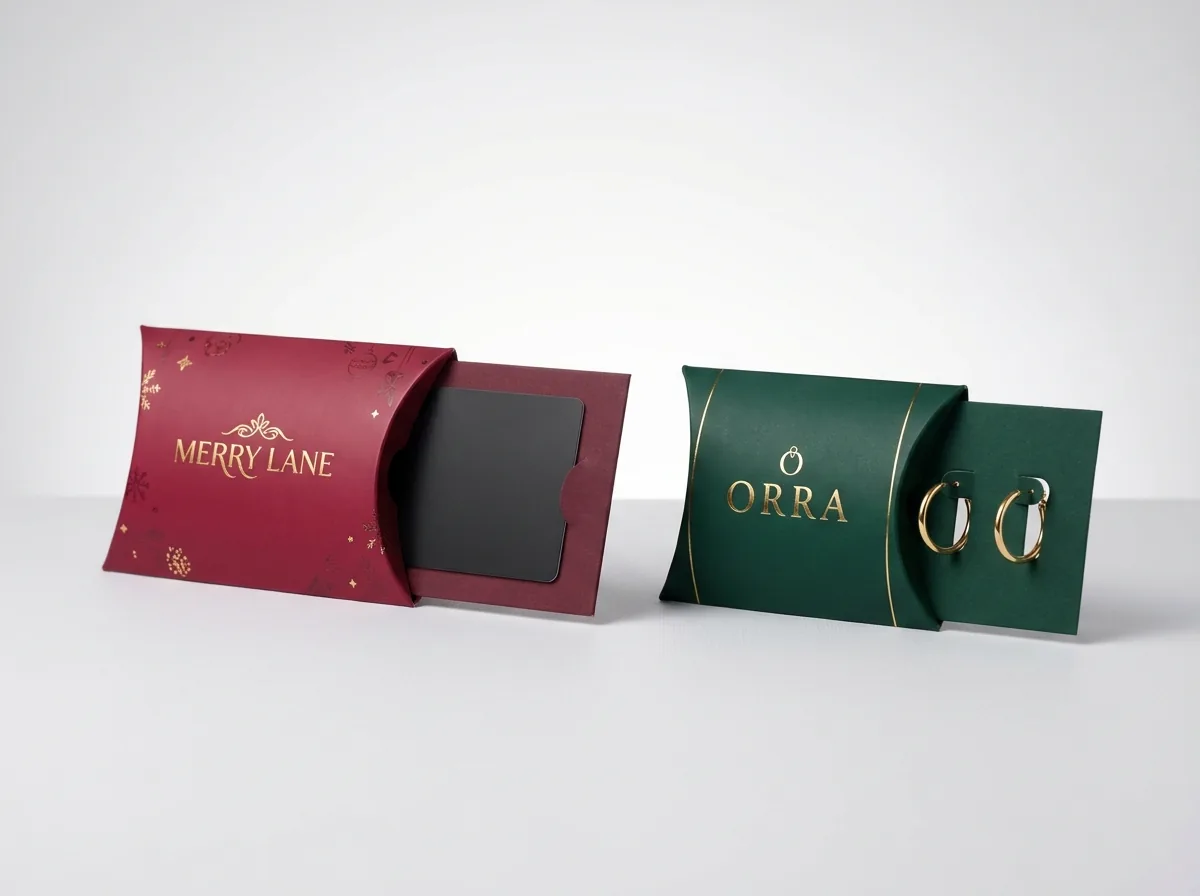
- Pair tiny or thin items with a slide-in backing card: A loose pair of stud earrings or a bare plastic CR80 gift card slides back and forth inside an empty cavity. Adding a die-cut 18 pt card carrier (sized 3 mm narrower than flat width and 4 mm shorter than usable center length) centers the item right behind a window or thumb notch.
- Use grease-resistant liners or wraps for oiled goods: Essential-oil bath bars and cocoa-butter truffles can leave translucent spots on unlaminated board; request an aqueous inner barrier or wrap confections in glassine or foil.
Know your size? Compare pricing across up to 3 quantities.
Request a Quote →What is the 4-step bench check before ordering 1,000 custom pillow boxes?
Follow this four-step verification routine alongside our companion guides on comparing pillow boxes vs gable boxes and tuck-end cartons and pillow box dielines, curved scores, windows, and ribbons explained, as well as our specialized walkthrough on rigid drawer vs folding pillow gift card boxes. Taking five minutes to fold a 100%-scale paper printout around your actual jewelry card, soap bar, or silk weft bundle eliminates guesswork before press
- Step 1: Measure your item (plus any pouch, wrapper, or backing card) at its longest rigid edge, widest point, and thickest center profile on a flat ruler.
- Step 2: Add +0.375 in (+9 mm) to rigid length for Usable Center Length, +0.5 in (+12 mm) to rigid width for Flat Width, and +0.25 in (+6 mm) to thickness for Center Belly Depth, keeping total packed payload under 8 ounces.
- Step 3: Select 14–16 pt card for mini gift-card and jewelry pods, 18 pt for medium favor and soap boxes, or 18–20 pt laminated SBS for long hair-extension and apparel packs.
- Step 4: Submit your target inside dimensions in CubitPack's shared quote form (from 1,000 boxes); prepress generates your free 2D vector CAD dieline and interactive 3D mockup before payment with zero die or plate setup fees, plus an optional $50 sample kit credited toward your first order.
What sizing and board mistakes ruin custom pillow boxes?
Check your draft specs against these five frequent pillow box sizing errors before approving your dieline
- Measuring tip-to-tip outer corner length instead of usable center length between the curved end creases, leaving a gift card or soap bar 0.75 inches too long to close.
- Forgetting that flat width narrows slightly when the front and back faces arch outward into a 3D belly, pinching wide rectangular backing cards along the side creases.
- Specifying stiff 24–28 pt board on a compact 3-inch jewelry pillow box so the tight curved flaps resist snapping past dead-center.
- Printing dark solid ink across unlaminated card without testing curved-crease flex, causing faint white lines along the four corner junctions.
- Overloading a friction-snap pillow box with 16+ ounces of dense glass jars instead of switching to an auto-lock bottom or gable carton.
Packaging for this
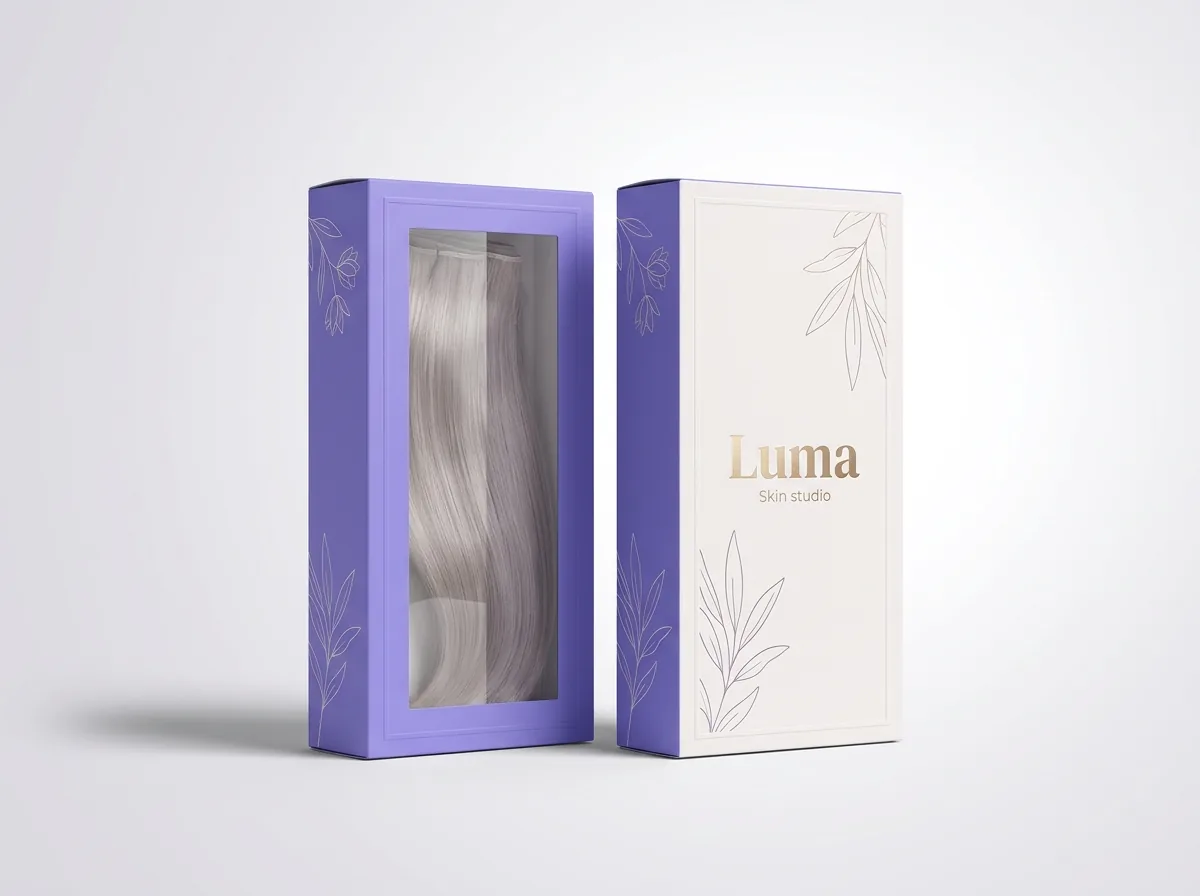
Ready to order pillow boxes? Compare up to 3 quantities with a free 3D mockup.
Request a Quote →Questions about pillow boxes
Do I enter usable center length or tip-to-tip length in the CubitPack quote form?
Enter your usable interior Length × Width × Height (Depth) around your product, meaning the clear center length your item needs between the curved end creases. Our structural specialists automatically calculate the extra crescent flap arc and tip-to-tip length on your free CAD dieline.
What size custom pillow box fits a standard CR80 plastic gift card?
A standard CR80 gift card measures 3.375 × 2.125 inches. Ordering a pillow box with roughly 4.25 × 3.0 × 0.85 inches of usable center space (about 5.1 inches tip-to-tip) lets the card and a thin paper carrier slide in smoothly while both curved ends snap shut cleanly.
How much weight can a paperboard pillow box safely hold?
Standard 16 pt to 20 pt paperboard pillow boxes hold lightweight items up to 6 to 8 ounces comfortably through natural curved-score spring tension, including jewelry, favors, soaps, candies, scarves, socks, and hair bundles.
Can I feel 16 pt, 18 pt, and 20 pt paperboards before placing a 1,000-box order?
Yes. Order CubitPack's $50 material & finish sample kit (credited toward your first production order) to compare paperboard weights, kraft vs white SBS, soft-touch lamination, Spot UV, and metallic foils in hand.
How flat do 1,000 custom pillow boxes ship and store?
Because pillow boxes are pre-glued along a single longitudinal seam and lie completely two-ply flat without bulky bottom folds, 1,000 un-popped 18 pt pillow blanks stack roughly 14 to 18 inches tall inside one compact master shipping carton, delivered free across all 50 US states.
Still have a question? Ask a packaging specialist.
Request a Quote →Request your pillow boxes quote
Tell us your size and quantities, and one dedicated account manager prepares pricing for each tier.
- Free design & AI-to-print studio + 3D mockup
- No die or plate charges · 4–5 day rush available
- Free shipping to all 50 states
- 10% off your first order
We verified usable center length vs tip-to-tip arc allowances, chord-to-depth contraction, 14–20 pt SBS and kraft spring-tension calipers, and longitudinal grain alignment against ECMA Folding Carton Design Codes, Paperboard Packaging Council (PPC) guidelines, and TAPPI creasing standards. Spot something wrong? Tell us and we fix it.
Sources
What changed
- November 6, 2026: First published with 6-product pillow box dimension chart, 14–20 pt caliper spring-tension table, and slide-in carrier sizing rules.
More guides
New packaging guides by email
Sizes, materials and design tips. Unsubscribe anytime.