
How do I measure a two-piece box and calculate lid-to-base clearance?
Short answer: Always measure a two-piece box from the usable inside dimensions of the bottom base tray, Inside Length (L) × Inside Width (W) × Total Assembled Height (D), then add twice the base wall buildup plus +1.5 to +3.0 mm of telescope clearance to establish the inner span of the top lid.
On this page
- What is the 3-step formula for measuring Base Inside L × W × D and calculating Lid Inner Span
- How much lid-to-base clearance do folding simplex, rigid setup, and corrugated two-piece boxes need
- How do vertical insert stack-up and paperboard grain orientation affect two-piece box performance
- What are standard custom two-piece box sizes across jewelry, chocolates, apparel, candles, and cards
- How do I verify my two-piece box lid-to-base clearance before full production
- Common mistakes
- FAQs
Request a custom quoteFree dieline & 3D mockup
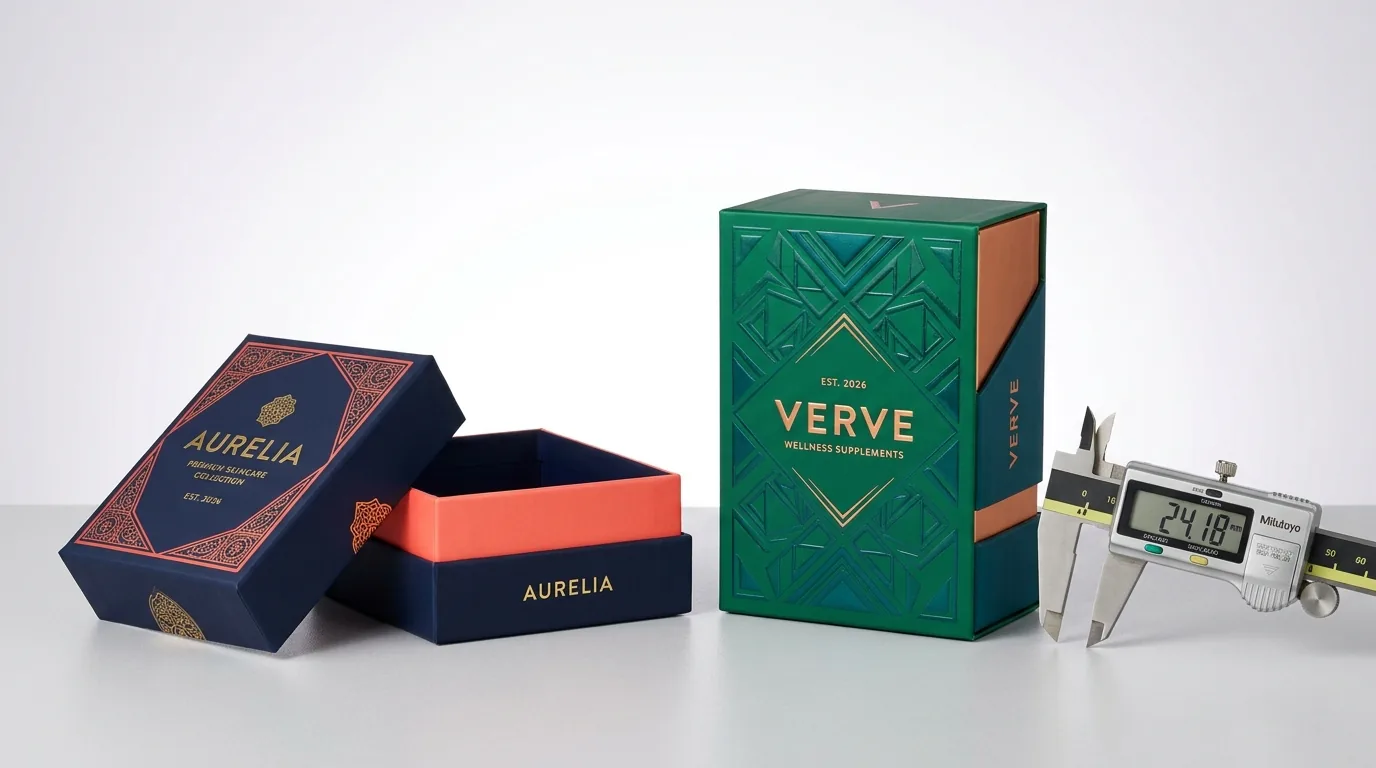
When ordering custom two-piece boxes (FEFCO 0300 / 0320 and ECMA simplex lid-and-base cartons), every structural calculation starts from the interior cavity of the bottom base tray in the sequence Length (L) × Width (W) × Height (D). Because the detachable top lid must slide vertically over all four outside walls of the base without jamming on corner crease knuckles or trapping excessive air, the lid dieline is never identical to the base dieline. On a 24 pt double-wall rollover folding simplex box, each base wall consists of two folded board plies plus an internal corner dust flap (~1.4 mm per wall, or +2.8 mm across two opposite walls), requiring an additional +2.0 to +3.0 mm of telescope clearance. On wrapped rigid setup boxes, a +1.5 to +2.0 mm gap delivers a smooth 3-second pneumatic slow-descent drop during unboxing.
What is the 3-step formula for measuring Base Inside L × W × D and calculating Lid Inner Span?
Whether you are packing a 12-piece artisan chocolate ballotin, a folded merino sweater, or a velvet-cushioned pendant necklace, a two-piece box is built from the inside out. You specify the usable interior space of the bottom tray, and our CAD team calculates the exact outer expansion for the matching top lid
- Step 1: Measure the Usable Inside Length (L) and Inside Width (W) of the bottom base tray. Place your product, thermoformed candy tray, or EVA foam insert flat on a table and measure its longest horizontal side (L) and shorter front-to-back side (W) with digital calipers. Add +0.0625 in (+1.5 mm) of finger-access breathing room around rigid items or trays so packers can load the base without scraping the side walls.
- Step 2: Calculate the Base Outer Span by adding twice the assembled wall thickness (2 × W_wall). On a double-wall rollover folding simplex tray, each side wall folds 180 degrees over an internal corner lock flap, making each wall roughly 2.2× to 2.4× the raw paperboard caliper (about 1.4 mm per wall on 24 pt board, or +2.8 mm total across opposite walls). On a wrapped rigid setup box, each wall equals the solid grayboard thickness (1.5 to 2.5 mm) plus two layers of turned 157 gsm art wrap paper and glue (~0.3 mm per wall).
- Step 3: Add substrate-specific Lid-to-Base Clearance (+1.5 to +4.8 mm total) to establish the Lid Inner Length (L_lid) and Lid Inner Width (W_lid). The complete formula is: Lid Inner Span = Base Inside Span + (2 × Assembled Base Wall Thickness) + Total Lid Clearance. Finally, set your Total Assembled Height (D) by summing your product height, any bottom insert floor thickness (+1.5 mm), and top cushion pad or headspace (+3.0 to +5.0 mm).
How much lid-to-base clearance do folding simplex, rigid setup, and corrugated two-piece boxes need?
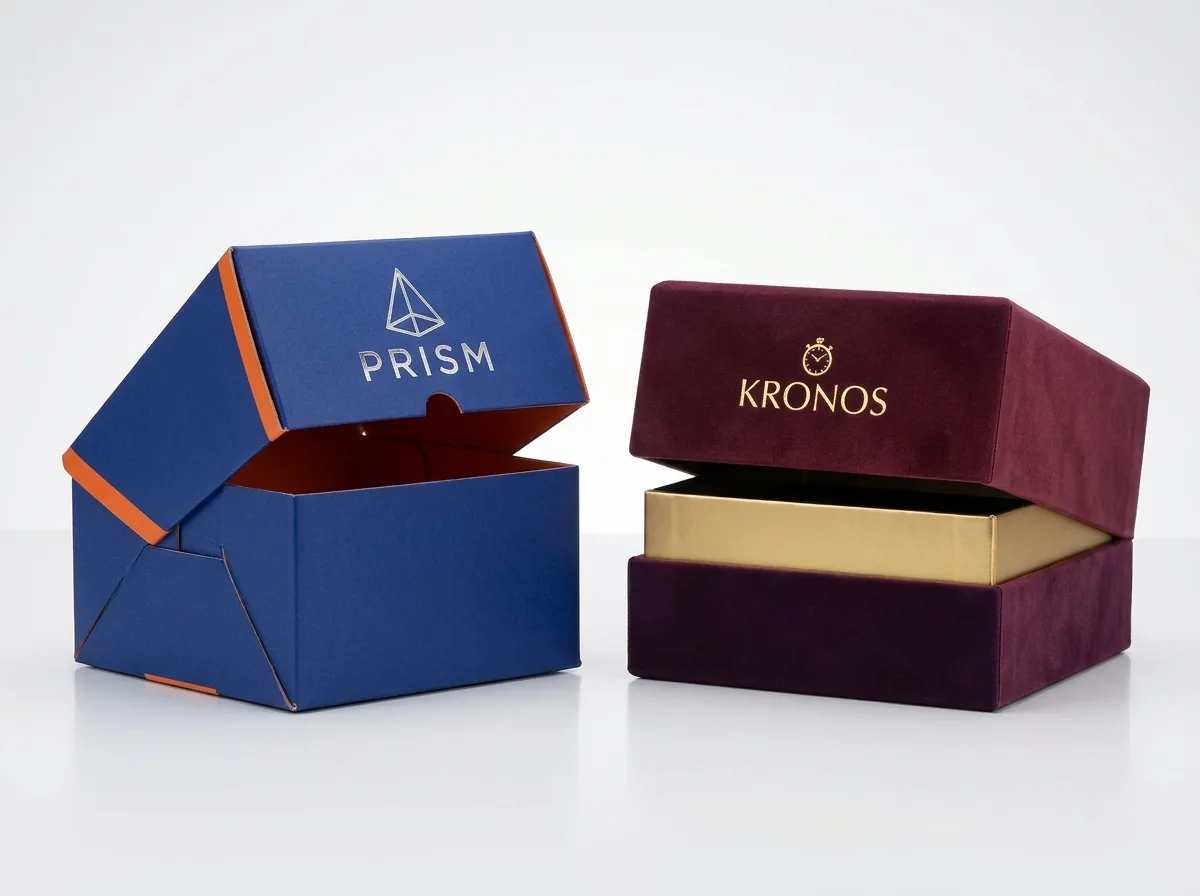
The feeling of a two-piece box when a customer lifts the lid is governed by less than a millimeter of air gap. If a rigid jewelry or watch box lid has +3.5 mm of clearance, the lid rattles loosely and drops instantly; if it is calibrated to +1.5 to +2.0 mm, trapped air escapes slowly around the perimeter to create a luxury 3-second pneumatic descent. Conversely, a folding paperboard simplex box has folded corner crease knuckles that require slightly more clearance (+1.5 to +3.0 mm) so the lid corners never catch or flare outward
| Two-piece box construction | Assembled base wall buildup (2 walls) | Total lid-to-base clearance added | Resulting unboxing motion & feel |
|---|---|---|---|
| 18–20 pt Folding Simplex (Double-Wall) | +2.0 to +2.3 mm (+0.080 to +0.090 in) | +1.5 to +2.0 mm (+0.060 to +0.080 in) | Crisp, snag-free lift-off over corner folds |
| 24 pt Heavy Folding Simplex (Double-Wall) | +2.6 to +3.0 mm (+0.102 to +0.118 in) | +2.0 to +3.0 mm (+0.080 to +0.118 in) | Clears thick 24 pt corner knuckles cleanly |
| Rigid Setup Box (Slow-Descent Vacuum Fit) | +3.6 to +5.6 mm (2× board + 4× wrap) | +1.5 to +2.0 mm (+0.060 to +0.080 in) | 2.5 to 4.0 sec air-cushioned luxury drop |
| Rigid Setup Box (Easy Slip-Off Fit) | +3.6 to +5.6 mm (2× board + 4× wrap) | +2.2 to +2.8 mm (+0.086 to +0.110 in) | Effortless one-hand lift for bakery & gifts |
| Rigid Shoulder-Neck Box (Over Inner Collar) | Measured over inner neck outer span | +1.2 to +1.8 mm (+0.047 to +0.070 in) | Snug friction seat against stepped shoulder |
| E-Flute Corrugated Telescope (FEFCO 0320) | +6.4 to +7.0 mm (4× E-flute plies) | +3.0 to +4.8 mm (+0.118 to +0.189 in) | Prevents flute-to-flute friction jamming |
How do vertical insert stack-up and paperboard grain orientation affect two-piece box performance?
Two structural details separate a retail-ready two-piece carton from one that bulges in the middle: vertical height budgeting (D) and long-wall grain orientation. In chocolate ballotins, skincare sets, and stationery boxes, the base depth (D) must accommodate more than just the bare product height. It must also fit the bottom cavity tray lip (+1.5 mm), a 3-ply or 5-ply candy cushion pad (+3.0 mm), and +2.0 mm of top headspace so the descending lid ceiling never crushes delicate chocolate swirls or serum droppers. At the same time, paperboard grain must run parallel to the longest side wall (L) so the long rollover walls fold smoothly with the grain without cracking or bowing outward during retail display
| Board caliper & substrate | Single-ply vs double-wall thickness | Maximum unsupported span (L) | Best two-piece box applications |
|---|---|---|---|
| 18 pt – 20 pt SBS or Natural Kraft | 0.45–0.50 mm raw · 1.0–1.1 mm rollover wall | Up to 7.0 in (178 mm) | 9–16 pc chocolate ballotins, A7 greeting card sets, small gifts |
| 24 pt Heavy SBS or Kraft | 0.60 mm raw · 1.3–1.4 mm rollover wall | 7.0 to 12.0 in (178–305 mm) | Folded knitwear & dress shirts, candle jars, cosmetics kits |
| E-Flute Micro-Corrugated | 1.60 mm raw · 3.2–3.5 mm rollover wall | 10.0 to 18.0+ in (254–457 mm) | Footwear shoe boxes, stoneware, multi-bottle corporate gifts |
| 1.5–2.5 mm Wrapped Rigid Grayboard | 1.8–2.8 mm solid wrapped wall | 2.5 to 16.0 in (64–406 mm) | Fine jewelry, chronograph watches, extrait de parfum, keepsakes |
Know your size? Compare pricing across up to 3 quantities.
Request a Quote →What are standard custom two-piece box sizes across jewelry, chocolates, apparel, candles, and cards?
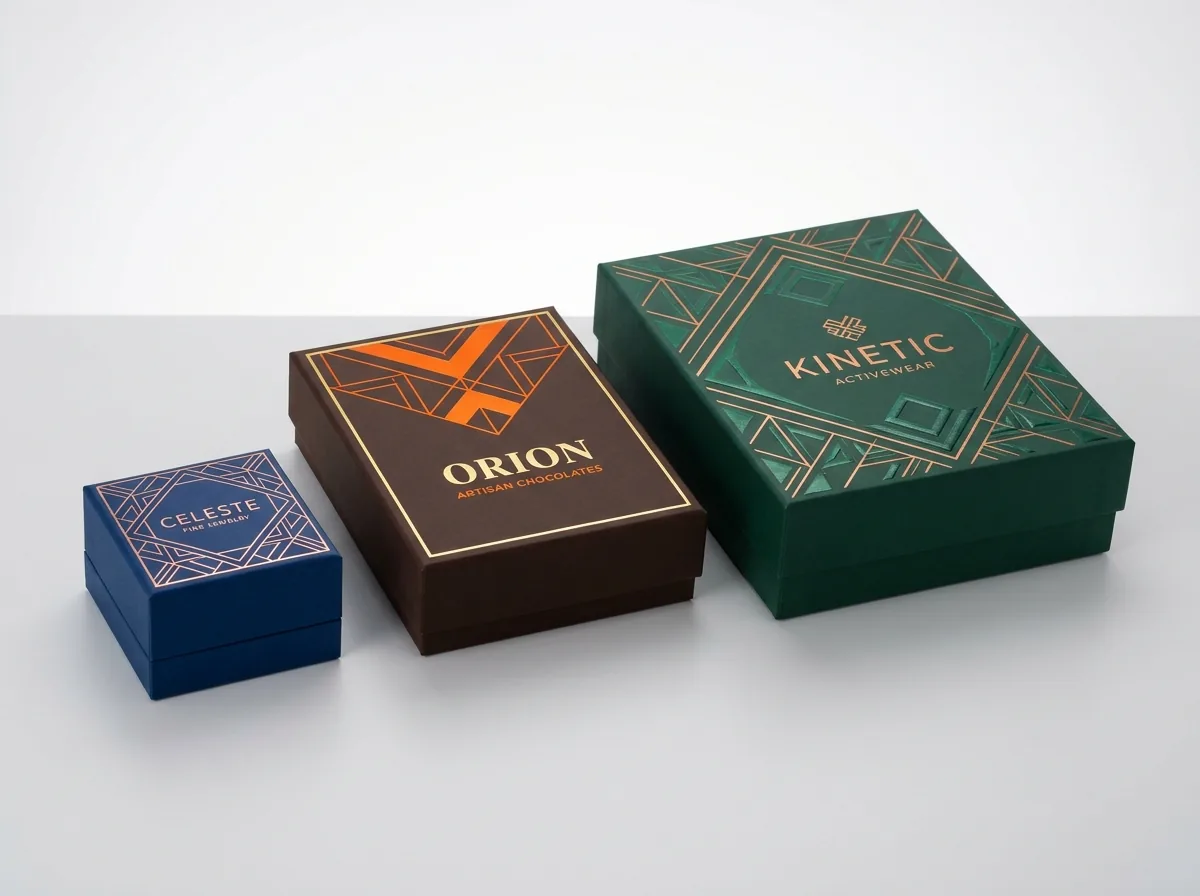
Every CubitPack order includes custom die-making with zero die or plate fees, so we build your base and lid to the exact millimeter your product requires. Use these eight proven retail benchmarks across our custom jewelry boxes, custom chocolate boxes, custom apparel boxes, custom candle boxes, and custom stationery boxes lines as starting points
| Product application | Base Usable Inside L × W × D (in) | Calculated Lid Inner L × W × Skirt (in) | Recommended board & lid profile |
|---|---|---|---|
| Pendant necklace & earring box | 3.50 × 3.50 × 1.50 in | 3.72 × 3.72 × 1.00 in | 2.0 mm Rigid or 24 pt · Shoulder-neck or partial lid |
| Chronograph watch presentation box | 4.50 × 4.50 × 3.25 in | 4.74 × 4.74 × 2.25 in | 2.0 mm Rigid board · Slow-descent partial lid |
| 12-piece artisan chocolate ballotin | 6.25 × 4.75 × 1.375 in | 6.43 × 4.93 × 1.375 in | 20 pt Food-Safe SBS · Full lid + thumb notches |
| A7 letterpress stationery & envelope set | 7.50 × 5.50 × 1.75 in | 7.68 × 5.68 × 1.75 in | 20–24 pt SBS or Kraft · Full lid + thumb notches |
| Luxury scented candle jar box (10 oz) | 4.25 × 4.25 × 4.75 in | 4.45 × 4.45 × 2.50 in | 24 pt Double-Wall or Rigid · Shoulder-neck lid |
| Eau de parfum bottle presentation box | 5.50 × 3.50 × 2.25 in | 5.72 × 3.72 × 2.25 in | 24 pt SBS or Rigid · Full lid + EVA foam insert |
| Folded dress shirt & knitwear box | 11.50 × 8.50 × 2.25 in | 11.72 × 8.72 × 1.50 in | 24 pt Folding Simplex · Partial 65% lid |
| Curated multi-item gift set / shoe box | 12.00 × 9.00 × 4.00 in | 12.40 × 9.40 × 2.50 in | E-Flute Corrugated 0320 · Double-wall rollover |
How do I verify my two-piece box lid-to-base clearance before full production?
After selecting your target base dimensions, read our companion guides on folding simplex vs rigid setup two-piece boxes and two-piece box dieline, full, partial, and shoulder-neck lids explained. When you order custom two-piece lid and base boxes from CubitPack starting at 1,000 units, our prepress team calculates both blanks (the inner base tray and the oversized outer lid) so you never have to guess wall thickness buildup. Because soft-touch lamination, heavy metallic foil coverage, and warehouse humidity can shift slide friction by 0.2 to 0.5 mm, testing a physical sample with your actual insert and product guarantees the exact lift-off feel your brand requires. Follow this 5-step verification checklist before full production
- Step 1: Measure your physical product together with any divider, thermoformed cavity tray, or cushion pad using digital calipers to confirm your usable Base Inside L × W × D.
- Step 2: Enter your Base Inside L × W × D, quantity (from 1,000 boxes), and preferred construction (flat-shipping folding simplex, corrugated, or rigid setup) into our quote form.
- Step 3: Tell your specialist whether you want a full-telescope lid (with thumb notches), a partial-telescope lid (40–65% coverage), or a stepped shoulder-neck collar.
- Step 4: Review your free matched two-blank 2D vector dieline proof and 3D mockup before payment to confirm lid skirt height, thumb notch clearance, and interior lid print orientation.
- Step 5: Perform a 3-cycle lift-and-drop test on a physical sample loaded with your actual product and insert to verify smooth corner clearance, zero side-wall scuffing, and your desired slow-descent or finger-lift release speed.
What are the most common measurement and clearance mistakes on two-piece boxes?
Avoid these five dimensional traps before approving your two-piece lid and base dielines
- Using the exact same dieline dimensions for both the lid and the base (0.0 mm clearance), which guarantees the lid will jam against the base's outer walls.
- Adding lid clearance to the Base Inside L × W while forgetting to add twice the double-wall rollover or rigid chipboard wall thickness first.
- Ordering a 100% full-depth lid on a tight rigid or folding box without side thumb notches, trapping air suction so shoppers cannot grip the base.
- Forgetting to add +3.0 to +5.0 mm to the base depth (D) for a top chocolate cushion pad, tissue paper fold, or insert flange.
- Running paperboard grain perpendicular to the long side wall on wide apparel boxes, causing the long rollover walls to bow inward.
Packaging for this

Ready to order two-piece boxes? Compare up to 3 quantities with a free 3D mockup.
Request a Quote →Questions about two-piece boxes
Should I enter the base dimensions or the lid dimensions in the quote form?
Always enter the usable inside dimensions of the bottom base tray: Inside Length (L) × Inside Width (W) × Total Assembled Height (D). Our prepress team automatically adds the double-wall rollover or rigid grayboard wall thickness plus the +1.5 to +3.0 mm telescope lid clearance.
How do you achieve the Apple-style slow-descent vacuum fit on a two-piece box?
A slow-descent pneumatic drop requires a rigid setup two-piece box built from 1.5–2.5 mm solid grayboard with razor-sharp 90-degree V-grooved corners and a tightly calibrated +1.5 to +2.0 mm total clearance between the outer base walls and inner lid walls. As the lid lowers, air escapes slowly through that narrow perimeter gap over 2.5 to 4 seconds.
Why does a double-wall folding simplex two-piece box need more lid expansion than a single-wall tray?
On a double-wall rollover simplex tray, each of the four side walls folds 180 degrees over an internal corner lock flap. That makes each wall two paperboard plies thick plus a corner fold knuckle (~1.4 mm per wall on 24 pt board), so the lid inner span must be +4.8 to +5.8 mm larger than the base inside span.
How deep should the top lid skirt be compared to the bottom base?
For chocolate ballotins, stationery sets, and footwear that need maximum vertical stacking strength, choose a full-telescope lid (95% to 100% of base height) with side thumb notches. For folded apparel or gift boxes where you want a two-tone side reveal and easy grip without notches, choose a partial-telescope lid covering 40% to 65% of the base height.
Does soft-touch lamination or foil stamping change the lid-to-base clearance?
Yes. Velvety soft-touch film has higher surface friction than gloss or matte lamination, and heavy wrap-around foil or embossing adds micro-relief on the side walls. When both the lid interior and base exterior use soft-touch film, we add +0.3 to +0.5 mm of extra clearance so the lid never sticks.
Still have a question? Ask a packaging specialist.
Request a Quote →Request your two-piece boxes quote
Tell us your size and quantities, and one dedicated account manager prepares pricing for each tier.
- Free design & AI-to-print studio + 3D mockup
- No die or plate charges · 4–5 day rush available
- Free shipping to all 50 states
- 10% off your first order
We verified FEFCO 0300 / 0320 and ECMA simplex lid-and-base dimensioning formulas, double-wall rollover wall buildup math, slow-descent rigid clearance tolerances (+1.5 to +2.0 mm), and 18–24 pt caliper span limits against FEFCO, European Carton Makers Association (ECMA), and Paperboard Packaging Council (PPC) technical references. A packaging specialist checked every formula and table row. Spot something wrong? Tell us and we fix it.
Sources
What changed
- October 27, 2026: First published with 3-step Base Inside to Lid Inner dimension formula, 6-construction clearance lookup table, height stack-up and grain chart, and 8-product size table.
More guides
New packaging guides by email
Sizes, materials and design tips. Unsubscribe anytime.