
How do I keep lip balm labels from peeling, flagging or smudging?
Short answer: Stop lip balm labels from flagging open by sizing your 0.15 oz tube wrap to 2.125 inches wide so the end overlaps 0.125 inches onto itself. Let hot-poured tubes cool completely, wipe off trace wax oils with rubbing alcohol, and order laminated custom lip balm labels.
On this page
- Why do lip balm tube labels lift at the edge ('flagging')
- How do you diagnose and fix each lip balm labeling problem
- What is the step-by-step protocol for labeling tubes from a 50-hole filling tray
- Which finishes protect lip balm labels from pocket wear and tinted oils
- How do you make 4.5 pt FDA ingredient text readable on a tiny lip balm wrap
- Common mistakes
- FAQs
Request a custom quoteFree dieline & 3D mockup
When a lip balm label lifts up along its vertical edge or smears inside a customer's pocket, the culprit is almost always a combination of tight cylinder physics and filling-tray oil residue. Standard 0.15 oz lip balm barrels are only 0.625 inches (5/8 in) wide and are injection-molded from polypropylene, a low-surface-energy plastic that resists ordinary stickers. To keep your labels locked down for the life of the tube, combine four steps: include a 0.125 to 0.15 inch self-overlap seam in a 2.125 × 1.75 inch wrap, wait until hot-poured wax cools to room temperature before labeling, wipe away trace coconut or castor oil after scraping your filling tray, and protect the print with matte or gloss lamination. At CubitPack, custom printed lip balm labels start at 500 pieces with free design help and free shipping across all 50 states.
Why do lip balm tube labels lift at the edge ('flagging')?
In packaging engineering, 'flagging' describes what happens when the vertical end of a label unrolls slightly from a small cylinder and sticks out like a tiny flag. A 0.15 oz lip balm tube has a radius of curvature of just 0.3125 inches. Any paper or thick film bent around that tight mandrel stores elastic energy and constantly pulls upward at the ends. At the same time, polypropylene (PP) plastic has low surface energy, making it harder for adhesive to wet out than glass or paperboard. When you size your lip balm tube labels to 2.125 inches wide instead of stopping at the 1.96 inch circumference, the trailing 0.15 inch strip of the label wraps right over the starting edge and bonds to the high-energy top coat of the label itself. That self-overlap seam turns the label into a closed ring that cannot pop open.
- Cause 1 (Zero self-overlap): A wrap narrower than 2.0625 inches leaves both ends resting on slick polypropylene where elastic memory lifts the edge.
- Cause 2 (Trace filling oil): Scraping the top of a 50-hole pouring tray with a putty knife spreads a microscopic film of castor or coconut oil onto the barrels.
- Cause 3 (Labeling warm tubes): Pouring wax at 155°F expands the plastic tube slightly; as the tube cools and shrinks, an early-applied label buckles.
- Cause 4 (Oily fingers): Handling label adhesive edges with balm-coated fingertips neutralizes tack right at the vertical seam.
How do you diagnose and fix each lip balm labeling problem?
If you have ever opened a batch carton a week after pouring only to find seams lifting or ink rubbing off, match the symptom in the table below to its mechanical or prepress fix. Every adjustment can be built into your dieline or filling checklist before your next run. Notice that three of the five most common problems happen at the pouring table before the sticker even touches the tube. Taking two minutes to cool and wipe your trays saves hours of re-labeling later.
| Symptom on the tube | Root cause | How to fix it permanently |
|---|---|---|
| Vertical edge lifts up ('flags') after 24–48 hours | Wrap is too short to overlap onto itself | Use a 2.125 in width so the end overlaps 0.15 in onto the label back |
| Horizontal wrinkles or loose tunnel down the barrel | Applied while hot-poured wax was still cooling | Let tubes cool to 70°F room temperature before capping and labeling |
| Entire label slides or spins freely around the tube | Coconut/beeswax film left on barrel from filling tray | Wipe capped tubes with 70%–90% isopropyl alcohol and let dry 60 sec |
| Ink smears or turns gray inside pockets and purses | Unlaminated ink rubbed by coins, keys, and lip oils | Add matte or gloss protective lamination over CMYK/Pantone print |
| Label spirals crookedly into the bottom twist wheel | Started the wrap at a slight angle by hand | Butting the tube cap against a straight ruler edge or tabletop jig |
What is the step-by-step protocol for labeling tubes from a 50-hole filling tray?
Most indie beauty brands fill 0.15 oz lip balm tubes in 50-cavity or 100-cavity plastic pouring trays: you insert empty uncapped tubes upside-down or right-side-up into the grid, flood the top trough with molten wax and oils, let the mound solidify, and scrape the excess flat with a metal spatula. During that scraping step, warm oils inevitably run down the outside of a few tubes or transfer onto your gloves. Follow a strict four-step sequence after pulling tubes from the tray: first, snap the caps on while the balm is cool and firm; second, let the capped tubes sit at room temperature for at least two hours so the polypropylene barrel finishes contracting; third, wipe each barrel with a lint-free cloth dampened with isopropyl alcohol; fourth, roll on your laminated label and let the adhesive cure for 24 hours before packing into display boxes. Wearing clean nitrile gloves while labeling also keeps natural skin oils off the final 0.15 inch adhesive seam.
Know your size? Compare pricing across up to 3 quantities.
Request a Quote →Which finishes protect lip balm labels from pocket wear and tinted oils?
Unlike a bathroom serum bottle that sits untouched on a glass shelf, a lip balm tube gets tossed into denim pockets, gym bags, backpacks, and hot car cupholders alongside keys and coins. Every time the user applies lip balm, trace castor oil, lanolin, or shea butter on their fingers touches the outside of the label. To prevent pocket abrasion and oil stains, always pair your artwork with matte lamination or gloss lamination, or select non-absorbent custom clear labels or custom foil labels. Matte lamination provides a velvety, non-slip grip when twisting open the cap, while gloss lamination creates a slick shield that wipes clean in seconds. Both laminations also add a thin structural layer that helps the 0.15 inch overlap seam bond tightly to itself and keeps your flavor colors looking bright until the last twist of the tube.
How do you make 4.5 pt FDA ingredient text readable on a tiny lip balm wrap?
A 2.125 × 1.75 inch label has less than 3.5 square inches of usable space once you subtract the 0.15 inch overlap strip. On that tiny canvas, cosmetic brands need to fit the brand logo, flavor name, statement of identity ('Lip Balm'), net weight in both ounces and grams ('Net Wt 0.15 oz / 4.25 g'), descending INCI ingredients, and business city/state/ZIP. To keep 4.5 pt or 5 pt typography sharp enough to read with the naked eye, set all back panel text in a clean sans-serif font printed in 100% single-color black ink on a white or light pastel panel. Avoid placing tiny white reverse text over a dark four-color CMYK background, where microscopic dot gain can close up the loops of letters like 'e' and 'a'. If your lip balm makes an SPF sun-protection claim, it is regulated as an over-the-counter (OTC) drug and requires a full Drug Facts panel, which almost always requires either a peel-back label or packing the tube inside custom lip balm boxes. When you upload your file to CubitPack, our prepress specialists inspect every line of small type on your free 2D digital proof and 3D mockup before you pay. If a font weight or barcode bar is too thin for a 0.625 inch curve, we adjust the stroke weight and layout for free so every tube scans and reads cleanly.
What are the most common lip balm label application and design mistakes?
Prevent peeling seams, crooked wraps, and unreadable ingredient lists by avoiding these five mistakes
- Pulling tubes straight out of a warm 50-cavity pouring tray and applying labels before wiping off trace beeswax and coconut oil with rubbing alcohol.
- Designing a 0.15 oz tube wrap at 1.95 inches wide with zero overlap, leaving the ends resting on slick polypropylene where they flag open.
- Skipping matte or gloss lamination on lip balm labels that will be carried loose inside pockets and purses next to keys and coins.
- Setting 4.5 pt INCI ingredient lists in thin metallic ink or reverse white type on a dark four-color background where small letters fill in.
- Trying to cram a full OTC SPF Drug Facts table onto a single-layer 2.125 × 1.75 inch wrap instead of pairing the tube with a custom lip balm box.
Find your label size
Suggested label size: 9⅛ × 2¾ in (width × height)
A typical starting point. Your account manager confirms the size on the proof.
Quote this size →Packaging for this
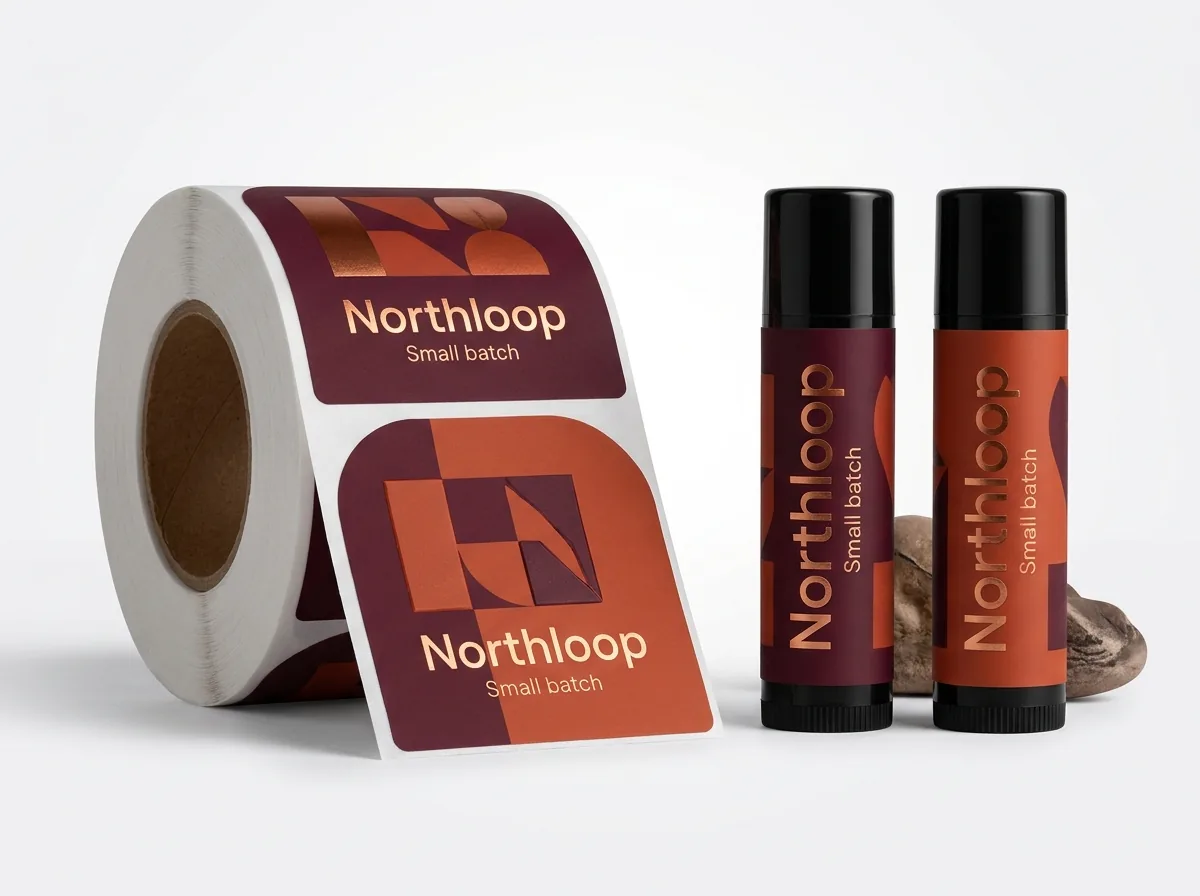
Ready to order lip balm labels? Compare up to 3 quantities with a free 3D mockup.
Request a Quote →Questions about lip balm labels
Why do my lip balm labels stay stuck for the first hour and then pop up the next morning?
Polypropylene lip balm tubes have low surface energy and a tight 5/8 inch curve. Initial finger pressure holds the end down briefly, but overnight the elastic memory of the label stock pulls the edge up unless the label is 2.125 inches wide and overlaps 0.125 to 0.15 inches onto itself.
What is the fastest way to clean 50 lip balm tubes after pouring a tray?
After snapping the caps onto your cooled tubes, lay them on a clean towel and wipe each barrel with a lint-free microfiber cloth misted with 70% or 91% isopropyl alcohol. The alcohol flashes off in 30 to 60 seconds and leaves a bone-dry, oil-free surface for the adhesive.
How do I apply 2.125 × 1.75 inch labels straight without a machine?
Butt the top cap of the lip balm tube flat against a straight ruler or the raised lip of a wooden tray on your desk. Align the top edge of the label parallel to that guide, press the leading edge down, and roll the tube forward under your palm.
Does matte or gloss lamination make a lip balm label too stiff to wrap?
No, provided your label includes the standard 0.125 to 0.15 inch self-overlap seam. Because the overlapping tail bonds directly to the high-energy laminated surface on the opposite end of the label, the seam holds tightly while protecting your print from pocket wear.
What information must appear on a cosmetic lip balm label in the US?
Cosmetic lip balms require the product identity ('Lip Balm'), net weight in US ounces and metric grams ('0.15 oz / 4.25 g'), an INCI ingredient list, and your business name and address. Under 21 CFR 701.3, small cosmetic packages displayed in trays can also use approved tear-away or counter-card ingredient displays.
Can I test your label finishes in my hands before placing my full order?
Yes. You can order our $50 sample kit (credited toward your first order) to inspect our stocks and matte, gloss, foil, and spot UV finishes, or request a paid printed sample of your exact lip balm label design credited to your order.
Still have a question? Ask a packaging specialist.
Request a Quote →Request your lip balm labels quote
Tell us your size and quantities, and one dedicated account manager prepares pricing for each tier.
- Free design & AI-to-print studio + 3D mockup
- No die or plate charges · 4–5 day rush available
- Free shipping to all 50 states
- 10% off your first order
This troubleshooting guide combines tight-mandrel cylinder adhesion mechanics (0.625 in polypropylene barrels with a 0.15 in self-overlap seam), hot-pour wax cooling practices, FDA 21 CFR Part 701 small-package cosmetic rules, and CubitPack's decided finishes from our published product specifications. Checked by a packaging specialist. Spot something wrong? Tell us and we will fix it.
Sources
What changed
- October 22, 2026: First published.
- October 22, 2026: Updated specifications, terminology, and verified source links.
More guides
New packaging guides by email
Sizes, materials and design tips. Unsubscribe anytime.